
Mistral has built a $14 billion company on a single, powerful promise: that a European enterprise can have frontier-class AI without handing its data to an American company that a US court can compel to give it up. French parent, EU jurisdiction, no CLOUD Act exposure. For a bank under DORA, a hospital under GDPR, or a ministry with secrets to keep, that promise is worth paying for.
There is just one detail the pitch tends to skip. Mistral distributes its models through Microsoft Azure, Google Cloud, and Amazon Web Services — the very American infrastructure it urges European customers to abandon.
That is not hypocrisy, exactly. It is the operating reality of a company trying to bootstrap a sovereign alternative while depending on the incumbents it wants to displace. But it exposes something the whole European sovereignty conversation keeps getting wrong: sovereignty is a property of the pipe your data flows through, not the flag on the company that built the model. A French passport on the lab does not travel down an American wire.
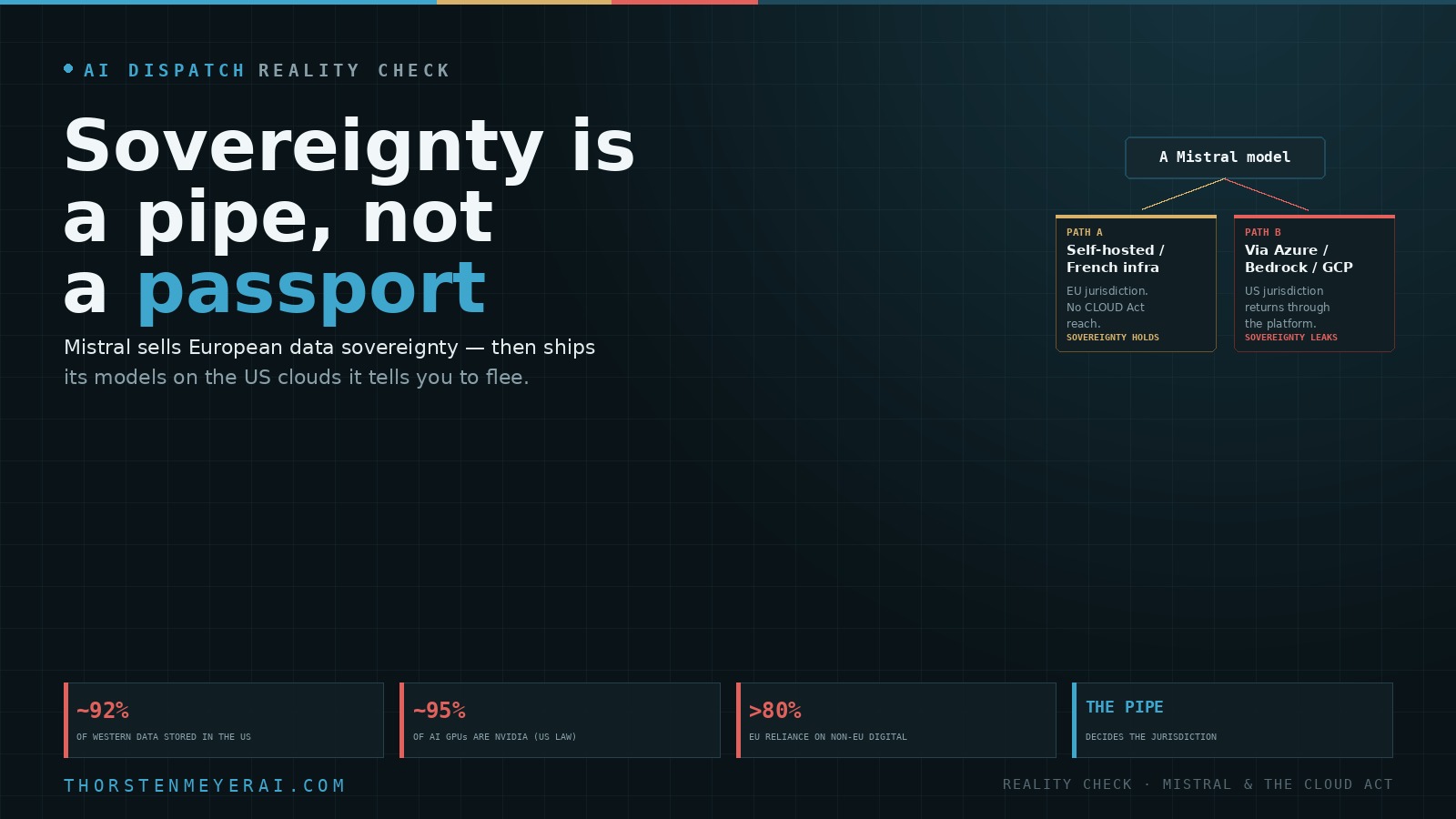
Sovereignty is a pipe, not a passport
Mistral sells European data sovereignty — then distributes its models through Azure, Bedrock & Google Cloud, the American infrastructure it tells customers to flee. A French passport on the lab doesn’t travel down an American wire.
Mistral-direct
hyperscaler
The CLOUD Act lets US authorities compel a US-headquartered provider to hand over data wherever it physically sits. Picking the “EU region” in AWS or Azure doesn’t resolve it — jurisdiction follows the company’s HQ, not the server’s location. Schrems II established the same from the EU side.
Mistral isn’t selling a lie — it’s selling a conditional truth, and the condition is the part the marketing skips. Sovereignty holds on Mistral’s own iron; it leaks the moment convenience routes the model through the American cloud. The deeper lesson cuts at Brussels: sovereignty is an end-to-end property of the whole stack — model, cloud, chips, supply chain — that Europe owns at no layer except the model itself. As Mensch put it: you “cannot regulate your way to computing supremacy.”
What the CLOUD Act actually reaches
Start with the law everyone invokes and few state precisely. The 2018 US CLOUD Act lets American authorities, with due process, compel a US-headquartered cloud provider to produce data in its possession — regardless of where that data physically sits. The binding fact is jurisdiction, not geography.
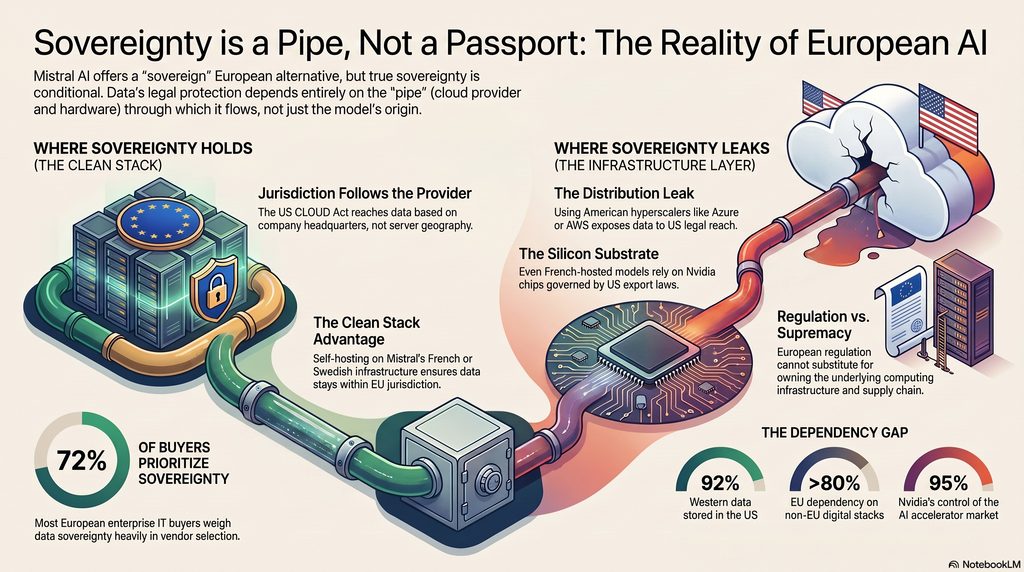
This is the part that quietly defeats most “sovereign cloud” marketing: selecting the “EU region” in AWS or Azure does not resolve the exposure, because the legal jurisdiction follows the provider’s headquarters, not the location of its servers. Your data can live in a Frankfurt data center and still be reachable, because the company that holds the keys answers to a court in Washington. The 2020 Schrems II ruling established the same principle from the European side, invalidating the EU-US Privacy Shield over exactly this conflict; the later Data Privacy Framework patched part of it, but French and German regulators have pointedly declined to treat the matter as settled. France’s own Health Data Hub became a national controversy for precisely this reason: French medical records, physically in Europe, hosted by an entity within CLOUD Act reach.
So the question for any AI vendor isn’t “where are the servers?” It’s “whose law governs the company holding the data?” And that question has to be asked of every layer of the stack — the model, the cloud it runs on, the chips underneath, the subcontractors around it.
European data sovereignty self-hosted AI model
As an affiliate, we earn on qualifying purchases.
As an affiliate, we earn on qualifying purchases.
Where Mistral’s claim genuinely holds
To be fair — and the article that isn’t fair to its target isn’t worth writing — Mistral’s sovereignty case is real where the stack is clean.
Run a Mistral model self-hosted, on-premise, in a single container that never phones home, and the data never leaves your infrastructure at all. Consume it through Mistral’s own French compute — the 44-megawatt site at Bruyères-le-Châtel south of Paris, or the €1.2 billion build in Sweden running on hydropower — and you are inside French and EU jurisdiction, beyond the CLOUD Act’s grasp. This is a genuine, structural advantage that no US-headquartered provider can fully match, and European procurement rules reward it: France’s SecNumCloud and Germany’s BSI C5 certifications create concrete checkboxes that favor EU-incorporated suppliers, and a 2024 industry survey found that roughly 72% of European enterprise IT buyers weigh data sovereignty in vendor selection.
The capital structure tells the same story. When Mistral raised $830 million in debt for its Paris data center, the lending syndicate was seven banks — six European plus one Japanese, and not a single US institution. That is European money deliberately ringfencing a European asset from American legal reach. The sovereignty thesis, at the infrastructure layer Mistral owns, is not theater.
privacy-focused cloud hosting for AI
As an affiliate, we earn on qualifying purchases.
As an affiliate, we earn on qualifying purchases.
Where it leaks
The leak is at the distribution layer — the one most enterprises actually buy through.
The moment that same Mistral model is consumed as a managed service on Azure, Bedrock, or Google Cloud, the US-jurisdiction exposure comes straight back, not through Mistral but through the platform carrying it. The model’s nationality is irrelevant; the pipe’s is decisive. A French model served through an American hyperscaler is, for CLOUD Act purposes, sitting in an American building with a French sign on the door.
And the differentiator is narrowing from the other direction. Microsoft’s EU Data Boundary, extended across its core cloud services, is built specifically to shrink the compliance gap Mistral’s pitch depends on. Anthropic and OpenAI now offer EU data-residency options of their own. None of these fully resolves the CLOUD Act question — European regulators have stopped short of blessing them — but they narrow it enough that, for many buyers, a major US provider with strong EU controls and a good legal opinion becomes “close enough.” Whether defensibly cleaner beats close enough is a procurement judgment, not a settled law of nature, and it is one variable competing against incumbent relationships, tooling depth, and switching cost. Mistral’s edge is real, but it is not permanent, and it is not automatic.
As an affiliate, we earn on qualifying purchases.
The dependency nobody escapes
Push the logic to the bottom of the stack and it gets uncomfortable for everyone, Mistral included.
Even a fully French-hosted model runs on Nvidia silicon — a company that controls roughly 95% of the AI accelerator market and answers to US export law, the same law that darkened Anthropic’s frontier models worldwide in June. Mistral’s own data centers are filled with 13,800 Nvidia GB300 chips. European incorporation does not extend down to the hardware, the GPU supply chain, or the subcontractors, and sophisticated buyers running a full SecNumCloud audit know it. A French legal domicile is a necessary condition for sovereignty, not a sufficient one.
The macro picture frames the whole problem: by the European Parliament’s own committee estimate, around 92% of Western data is stored in the United States, and the EU depends on non-EU providers for more than 80% of its digital stack. Mistral isn’t the exception to that dependency. It is the most credible attempt to carve out an exception — standing, like everyone else, on a substrate that is overwhelmingly American.

LOCAL LLM DEPLOYMENT: Training, Fine-Tuning, & Offline Inference: The Complete Developer’s Guide to Building, Training, and Running Private Open-Source AI Offline (with full source code)
As an affiliate, we earn on qualifying purchases.
As an affiliate, we earn on qualifying purchases.
What it changes about the view on Mistral
So how should this reshape the read on Europe’s AI champion? Not toward cynicism — toward precision.
Mistral is not selling a lie. It is selling a conditional truth, and the condition is the part that gets lost in the marketing. Sovereignty holds when you take the model on Mistral’s terms — self-hosted, or on Mistral’s own French and Swedish iron. It leaks the instant convenience wins and the model is consumed through the American cloud that most enterprises already live in. The company’s sovereignty is genuine; its customers’ sovereignty depends entirely on a deployment choice the customer, not Mistral, controls.
The deeper lesson is the one that should worry Brussels more than any single vendor’s contradiction. If even the continent’s flagship sovereign lab can only deliver clean jurisdiction by also running on the rails it tells everyone to avoid, then “European AI sovereignty” is not something you achieve by funding one company or incorporating in Paris. It is an end-to-end property of an entire stack — model, cloud, chips, supply chain — that Europe does not yet own at any layer except the model itself, and barely there.
Mistral’s own founder, Arthur Mensch, has put the macro version of this more honestly than any policymaker. Europe, he has said, is building excellent regulation — but “you cannot regulate your way to computing supremacy.” His company is the proof and the counter-proof at once: evidence that Europe can build a real model, and evidence that a real model is not enough when the pipe, the chips, and the cloud beneath it still belong to someone else.
A passport says where you were born. A pipe decides who can reach inside. Europe has been issuing itself passports. The pipes still run through California.
Sources: Raconteur (Mistral distribution via Azure/GCP/AWS; Microsoft EU Data Boundary; Schrems II); TechTimes and DataSolution (CLOUD Act mechanics; Health Data Hub); Introl and BuildMVPfast (Mistral French/Sweden infrastructure; Mensch quote; ITRE 92% figure); CB Insights (Mistral HQ and funding); CISPE 2024 survey; European Commission (>80% dependency). Model and policy specifics reflect reporting as of late June 2026. Analysis and opinions are the author’s; this piece credits Mistral’s genuine sovereignty advantages as well as their limits.