On June 16, days after a blockbuster IPO that pushed its value past $2 trillion, SpaceX exercised its option to buy Anysphere — the maker of the AI coding agent Cursor — for $60 billion in all-stock. Cursor CEO Michael Truell framed it as a joint effort to build “the world’s most useful AI models,” with a co-trained model shipping into Cursor and Grok Build soon.

Get business pricing on tech for your team
- Business-only prices and quantity discounts
- Tax-exempt purchasing
- Multiple users, one account, clear invoices
With that, the picture snaps into focus. SpaceX now controls every layer of the AI stack: the power and the silicon, the data centers, the research lab, a frontier model, and — as of this week — one of the only AI applications already making serious money.
That is a genuinely formidable position. It’s also worth saying plainly: owning every layer is not the same as winning at every layer. SpaceX just spent $60 billion to buy the one layer it couldn’t build on its own — and the reason it couldn’t is the most interesting part of this story.
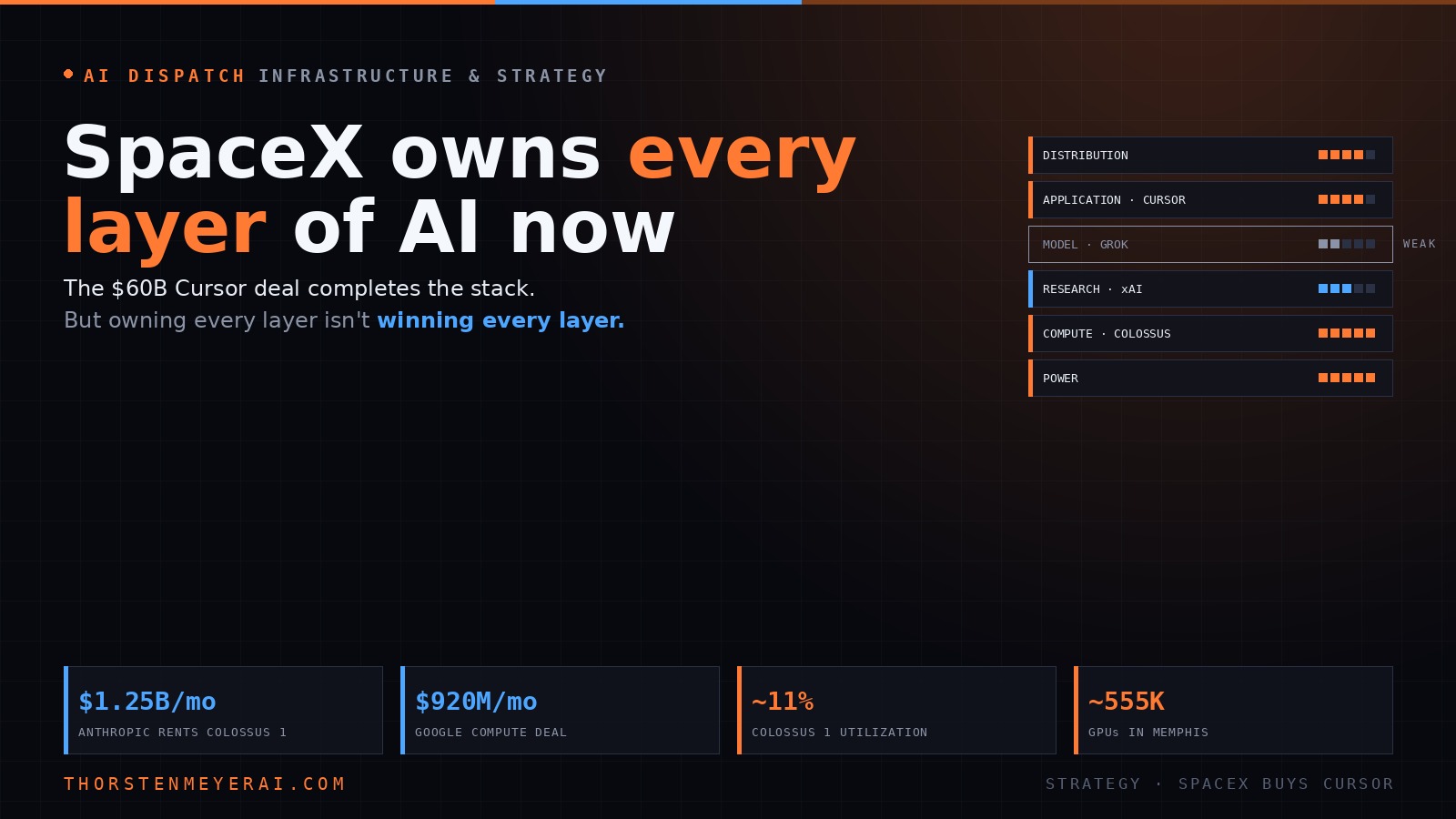
SpaceX owns every layer
of AI now
The $60B Cursor buy completes the stack: power, compute, research, model, app, distribution. But owning every layer isn’t winning every layer — and the model is the weak one.
(Anysphere)
You can buy a coding app and a model team. You can’t buy the research lead that makes your foundation model the one everyone else builds on — which is why Anthropic pays Musk $1.25B/month, not the other way around. Owning every layer bought SpaceX the right to attempt the hard thing. It hasn’t done it yet.
The capstone: $60 billion for Cursor
The deal is all-stock, with each Cursor share converting into SpaceX Class A shares, expected to close in Q3 2026, after which Cursor becomes a wholly owned subsidiary. SpaceX had earlier taken an option to buy Cursor for $60 billion or pay a $10 billion alternative fee; this week it pulled the trigger.
Cursor is not a charity case. Founded in 2022 by four MIT grads, it hit roughly $4 billion in annualized revenue by early June — up from $2 billion in February — in the one corner of AI where businesses are reliably paying real money: coding. It had rebuffed two approaches from OpenAI and a look from Microsoft, prioritizing independence. The tell that this was coming: Cursor trained its newest model on tens of thousands of xAI chips, and two senior Cursor engineers had already decamped to xAI.
So SpaceX didn’t just buy a product. It bought a profitable application, a developer distribution channel, and a model team — and wired them directly to its own compute.
As an affiliate, we earn on qualifying purchases.
Now count the layers
Stack it up and the vertical integration is unmatched in the industry:
Compute. The Colossus supercomputers in Memphis, plus a balance sheet near $2–3 trillion and stated ambitions to put compute in orbit — SpaceX has asked regulators for permission to deploy up to a million solar-powered AI satellites as orbital data centers.
Power. On-site gas generation built faster than utilities can interconnect — the thing that actually gatekeeps compute at this scale.
Research. xAI, folded into SpaceX in February 2026, with the Grok model line and the team behind it.
Model + application. Grok at the foundation layer, now Cursor at the application layer, and a jointly trained model meant to bridge them.
Distribution. X, Tesla, Optimus, and a developer base that arrives with Cursor.
No other company holds all of these at once. OpenAI rents its compute (Stargate, via Oracle and others). Anthropic rents its compute — increasingly, as we’ll see, from SpaceX itself. Google owns its silicon but not a rocket-scale power-and-capital flywheel. SpaceX is the closest thing the West has to a fully integrated AI conglomerate.
As an affiliate, we earn on qualifying purchases.
What Colossus cost to build
The compute layer is the strongest, and it was built at a speed that reset industry expectations. The first 100,000-GPU Colossus cluster went from bare factory floor to training in 122 days, then doubled to 200,000 GPUs in 92 more. The Memphis complex now runs on the order of 555,000 Nvidia GPUs (a mix of H100, H200, and GB200) toward roughly 2 gigawatts of capacity.
The price tags, by the public reporting: the initial phase ran as much as $4 billion; the silicon across the expanded ~555,000-GPU site has been pegged near $18 billion; and at least one analysis puts the all-in build cost of Colossus 1 alone in the tens of billions. Jensen Huang called the original buildout “superhuman” — operational in weeks against a typical multi-year timeline — a feat of vertical integration: xAI owned the chips, the racks, the cooling, and the power plant.
And then it rented much of that out to its rivals.
enterprise AI model training hardware
As an affiliate, we earn on qualifying purchases.
As an affiliate, we earn on qualifying purchases.
The landlord pivot
Here is where the “all layers” triumph gets complicated. According to SpaceX’s own filings:
- Anthropic agreed to pay roughly $1.25 billion per month — through May 2029, over $40 billion across the term — to reserve effectively the entire output of Colossus 1: more than 220,000 GPUs and 300 megawatts, available in under a month.
- Google signed a separate Cloud Service Agreement on June 5 at about $920 million per month through June 2029.
Combined, those two deals represent roughly $26 billion in annualized compute revenue — from two of the best-funded labs on earth, both competitors. (For anyone working from the rumor-mill version of these numbers: the figures are hundreds of millions to over a billion dollars per month, not per year.)
Why would a frontier lab lease its flagship supercomputer to its rivals? Because, by an internal xAI memo reported by Business Insider, Colossus 1 was running at about 11% Model FLOPs Utilization — “embarrassingly low” against the 35–45% that counts as production-grade. The cluster’s mixed H100/H200/GB200 architecture reportedly couldn’t parallelize Grok training efficiently, so xAI moved its own training to Colossus 2 and turned Colossus 1 into a rental property. Musk said he was comfortable leasing it precisely because training had already moved — while reserving, in his telling, the right to reclaim the compute if Anthropic’s AI ever “harms humanity.”
This is the model TechCrunch dubbed “neocloud”: labs renting excess compute to peer labs. It’s lucrative, and in a GPU market where idle silicon is economically irrational, defensible. But sit with the irony. Claude — the model at the center of last week’s U.S. export-control fight — now runs substantially on Elon Musk’s physical infrastructure, under a contract that one Musk tweet claims he can exit on short notice. The West’s compute is concentrating into very few hands, and one of those hands also ships a competing model.
As an affiliate, we earn on qualifying purchases.
Was Grok a failure?
That’s the provocative reading, and it isn’t baseless. An 11%-utilization flagship, a training pipeline relocated to a second data center, and a parent company that monetizes the first one by renting it to Anthropic and Google — none of that is the behavior of a model program firing on all cylinders. TechCrunch flatly called the Cursor deal a bid to help SpaceX’s “struggling AI division,” and buying a $60 billion coding app reads, in part, as an admission that xAI’s own application momentum wasn’t enough.
But “failure” overstates it. Grok remains a widely used frontier model with native distribution through X, and being unable to saturate the single largest GPU cluster ever assembled is a different problem than being uncompetitive. The honest framing is underdelivery relative to compute and ambition: xAI built the biggest hammer in the world and hasn’t yet found enough nails of its own. The Cursor acquisition is the response — buy the nails.
My take
The strategic logic is sound, and I’d resist both the triumphalist and the dismissive readings.
The triumphalist version — “SpaceX owns the whole stack, game over” — ignores that the layers are not equally strong. The compute layer is dominant; nobody builds power and silicon faster. The application layer was just acquired, smartly, because Cursor is real revenue in the one proven AI business. But the model layer is the weak link, and it’s the layer money can’t simply buy. You can purchase a coding app and a model team; you can’t purchase the research lead that makes your foundation model the one everyone else wants to build on. That gap is exactly why Anthropic is paying Musk $1.25 billion a month instead of the other way around.
The dismissive version — “it’s all financial engineering before the IPO” — underrates how much optionality full-stack ownership actually confers. Renting Colossus to rivals turns an underused asset into $26 billion a year and keeps SpaceX’s hand on a chokepoint its competitors now depend on. Owning Cursor gives it an instant, profitable foothold and a co-trained model that ships into a tool developers already love. Those are not nothing.
What gives me pause is the circularity. A $60 billion all-stock deal priced off a freshly frothy IPO; ~$26 billion in revenue from two competitors who are themselves racing to IPO; an acquired app whose value partly rests on model providers it now competes with. A great deal of capital is being recycled inside a small circle of AI giants, and each transaction flatters the next one’s numbers. That can be a flywheel. It can also be how bubbles keep their balance — right up until they don’t.
The thing to watch is narrow and decisive: does the joint Cursor/xAI model actually close the foundation-model gap, or does SpaceX settle comfortably into being the West’s largest AI landlord that also happens to ship an excellent coding tool? Both are lucrative. Only one of them is “building the world’s most useful AI models.” Owning every layer bought SpaceX the right to attempt the harder thing. It hasn’t done it yet.
Reporting drawn from SpaceX’s S-1 and SEC filings, the Wall Street Journal, Reuters, CBS News, TechCrunch, Forbes, and Business Insider, plus infrastructure reporting from Introl and Built In (Feb–June 2026). Compute-lease figures are from SpaceX filings: Anthropic ~$1.25B/month through May 2029; Google ~$920M/month through June 2029. Utilization figures reflect a reported internal xAI memo. Analysis and opinions are the author’s.
Fall Picks
fall essentials
As an affiliate, we earn on qualifying purchases.