
By Thorsten Meyer

Get business pricing on tech for your team
- Business-only prices and quantity discounts
- Tax-exempt purchasing
- Multiple users, one account, clear invoices
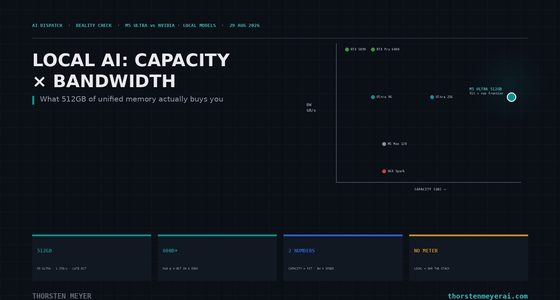
Apple just announced a desktop you can put under a monitor that will hold 512 gigabytes of memory the GPU can address directly, and the headline writing itself is “run frontier-scale AI models locally, no cloud required.” That headline is true. It’s also the kind of true that hides the question that actually matters, which is not can it run them but how fast, and for which job. As someone who runs a local-first inference operation, I’ve wanted a machine like this for years, and I’m genuinely enthusiastic — which is exactly why I want to be precise about where the enthusiasm should stop. Loading a big model and serving it fast are different achievements, and this machine is dramatically better at the first than the marketing lets on about the second.
Let me lay out what shipped, why the memory number is the real story, and the honest caveat that separates “runs frontier models” from “replaces your cloud.”
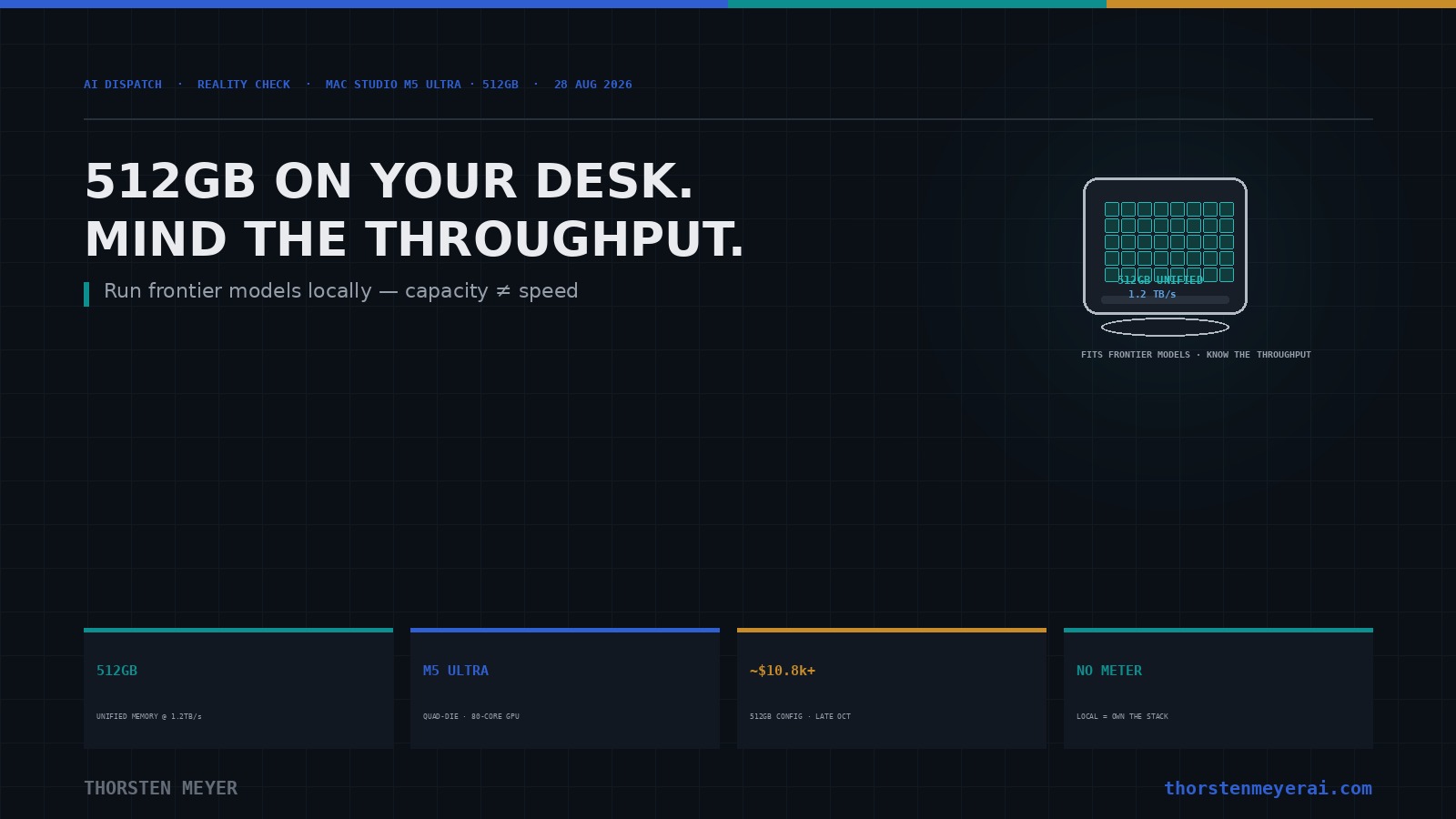
512GB of unified memory the GPU addresses directly lets you hold frontier-scale models on a desk. How fast they run is a different number — and the marketing steps around it.
What shipped
Apple announced the new Mac Studio on 25 August 2026, in two tiers. The M5 Max version — 18-core CPU, up to 40-core GPU, up to 128GB of unified memory — starts at $2,499 and is the sensible choice for most professionals. The one that matters for local AI is the M5 Ultra: up to a 36-core CPU, an 80-core GPU, and up to 512GB of unified memory at 1.2 terabytes per second of bandwidth. It starts at $5,499, but that's the floor — the 512GB configuration lands separately in late October and runs well above ten thousand dollars, around $10,800 before storage upgrades, because Apple charges roughly $25 for every added gigabyte of memory. Preorders are open; general availability is 22 September, with the big-memory model following in late October.
The engineering underneath is genuinely clever. The M5 Ultra is built by connecting two M5 Max chips — each already a dual-die design — through Apple's UltraFusion interconnect, so four dies operate as a single processor. Neural Accelerators are now baked into every GPU core, and Apple claims up to 4.3x faster AI performance than the M3 Ultra generation, and up to 9.8x over the older M1 Ultra in some tests. Hold those multiples loosely: they're Apple's own benchmarks, measured in July on selected workloads, and "depending on configuration and workload" is doing real work in the fine print.
Apple Mac Studio M5 Ultra 512GB desktop computer
As an affiliate, we earn on qualifying purchases.
As an affiliate, we earn on qualifying purchases.
Why the memory number is the whole story
Here's what makes this a genuinely important machine and not just a faster one. In most computers, the GPU has its own separate, smallish pool of fast memory, and a large AI model that doesn't fit in it either can't run or has to be painfully shuttled in pieces. Apple's unified memory means the GPU can address the entire pool directly — so 512GB of it means you can load models that would otherwise demand a rack of specialized datacenter GPUs to hold. That capacity is the unlock. It's why this is being called the first desktop under eleven thousand dollars that can run frontier-scale models locally without touching a cloud, and that claim is fair on the specific thing it says: fitting the model.
And fitting the model is not nothing. It's the difference between "I can experiment with this 400-billion-parameter open model on my desk" and "I can't." For a lot of research, development, and privacy-sensitive work, being able to load the whole thing locally is the entire ballgame.
AI inference workstation with 512GB memory
As an affiliate, we earn on qualifying purchases.
As an affiliate, we earn on qualifying purchases.
The caveat that separates the headline from the reality
Now the correction, because it's the one the marketing quietly steps around and the one a local-first practitioner has to say out loud: capacity is not throughput. Being able to hold a frontier-scale model is a different property from being able to run it fast. What governs how many tokens per second you actually get is memory bandwidth and compute, and while 1.2 terabytes per second is a lot for a desktop, it is a fraction of what a cluster of top-end datacenter accelerators delivers. So the honest translation of "runs frontier models locally" is: it will load and run them — often at speeds that are perfectly good for a single user experimenting, developing, or doing privacy-sensitive inference, and distinctly not at the speeds you'd need to serve many users at scale.
This is the exact same trap I flagged with cheap mixture-of-experts models, where "18 billion active parameters" got read as "runs like a small model" when you still had to host the whole thing. Here it runs the other direction: "512GB, runs frontier models" gets read as "datacenter in a box" when what you've actually bought is enormous capacity with desktop-class speed. Both are real capabilities. Neither is the other. Buy this machine knowing which job you need it for — a fantastic local research-and-development workstation and a genuine option for small-team or personal serving, not a drop-in replacement for a GPU cluster serving production traffic.
Two smaller honest notes. The performance multiples are Apple's, and independent benchmarks on real local-inference workloads are the ones I'd wait for. And the software reality matters: Apple silicon's local-ML tooling has come a long way, but it still isn't the mature, everything-runs-here ecosystem that the dominant GPU platform offers, so some workflows will need porting or will simply run better elsewhere.
high performance GPU desktop for AI models
As an affiliate, we earn on qualifying purchases.
As an affiliate, we earn on qualifying purchases.
The part that's mine to make
Set against everything else I've written this week, this machine is the counterweight, and I find it genuinely heartening. While the frontier labs vertically integrate down to their own closed silicon, and the dominant compute vendor reportedly buys the open commons where the models live, Apple just shipped a mass-market box that lets an individual or a small team run large open models on their own desk, under their own control, with no cloud in the loop. That's the own-it-yourself future getting a consumer-grade data point, and it's the sovereignty thesis I keep arguing made physical: your model, your hardware, your data never leaving the room.
There's a specific economic angle here that ties straight to the metering story. Run inference locally and there is no meter. No per-token bill, no usage dashboard, no third party counting what you spend — you paid for the box and the electricity, and that's the whole cost. In a year when a payments giant bought the layer that meters token spend, a machine that takes you out of the metered economy entirely is a quietly radical object. For privacy-sensitive work, for anyone who doesn't want their prompts and data flowing through someone else's infrastructure, and for teams whose cloud AI bill has started to look like a mortgage, the calculus is real: a five-figure box that pays for itself against cloud spend, and buys you sovereignty as a bonus.
The honest version of that enthusiasm keeps the throughput caveat firmly attached. This is the right machine for local development, research, privacy, and modest-scale serving — the DojoClaw kind of use, running your own models because you want to own the stack. It is not the machine that makes datacenter GPUs obsolete, and anyone selling it that way is selling the capacity number and hiding the bandwidth one.
Mac Studio for frontier-scale AI models
As an affiliate, we earn on qualifying purchases.
As an affiliate, we earn on qualifying purchases.
Where I land
The 512GB M5 Ultra Mac Studio is a genuinely significant machine for local AI, and the significance is exactly as narrow and exactly as real as the memory pool: it can hold frontier-scale models on a desk, cheaply enough and quietly enough to matter, which almost nothing else at this price and size can. Just keep the two halves of the truth together. Capacity, yes — enormous, unlock-level capacity. Throughput, desktop-class — good enough for a lot, not a cloud replacement for serving at scale. The performance multiples are Apple's until independent tests land, the 512GB config is a five-figure late-October purchase with likely constrained supply, and the software ecosystem is good-not-dominant. Inside those lines, this is the most compelling piece of own-it-yourself AI hardware to reach a normal desk, and the fact that it exists at all is a small, real win for the future where you run your own models instead of renting them.
Analysis and opinion from a builder, founder, and post-labor economist running a local-first inference operation. Specifications (M5 Max: 18-core CPU / up to 40-core GPU / up to 128GB, from $2,499; M5 Ultra: up to 36-core CPU / 80-core GPU / up to 512GB unified memory at 1.2TB/s, from $5,499, quad-die UltraFusion; announced 25 August 2026, general availability 22 September, 512GB config in late October at ~$10,800+; Thunderbolt 5, PCIe Gen 6) are verified at time of writing against Apple's newsroom and reporting from Macworld, TechRepublic, Tom's Guide, MacRumors, TechTimes, and AppleMagazine. AI-performance multiples (up to 4.3x vs M3 Ultra, up to 9.8x vs M1 Ultra) are Apple's own July 2026 benchmarks on selected workloads, pending independent verification. "Capacity is not throughput" is the author's analytical framing. This is analysis, not investment advice. Point-in-time as of 28 August 2026.
Columbus Day / Indigenous Peoples' Day Picks
long weekend sales
As an affiliate, we earn on qualifying purchases.