
By Thorsten Meyer

Get business pricing on tech for your team
- Business-only prices and quantity discounts
- Tax-exempt purchasing
- Multiple users, one account, clear invoices
This one sits off my usual beat — it’s intelligence and diplomacy, not models and compute — so let me say up front why it’s worth a Reality Check anyway. A story like this arrives as three incompatible versions at once: a leaked warning, an official shrug, and a flat denial. The useful skill isn’t picking which one confirms what you already believed. It’s separating what’s actually confirmed from what’s asserted, attributed, or denied — the exact muscle I use on vendor benchmarks, pointed at a very different subject. And there’s a real thread back to my usual territory at the end, so bear with the tradecraft first.
Here’s the discipline applied.
What’s actually confirmed
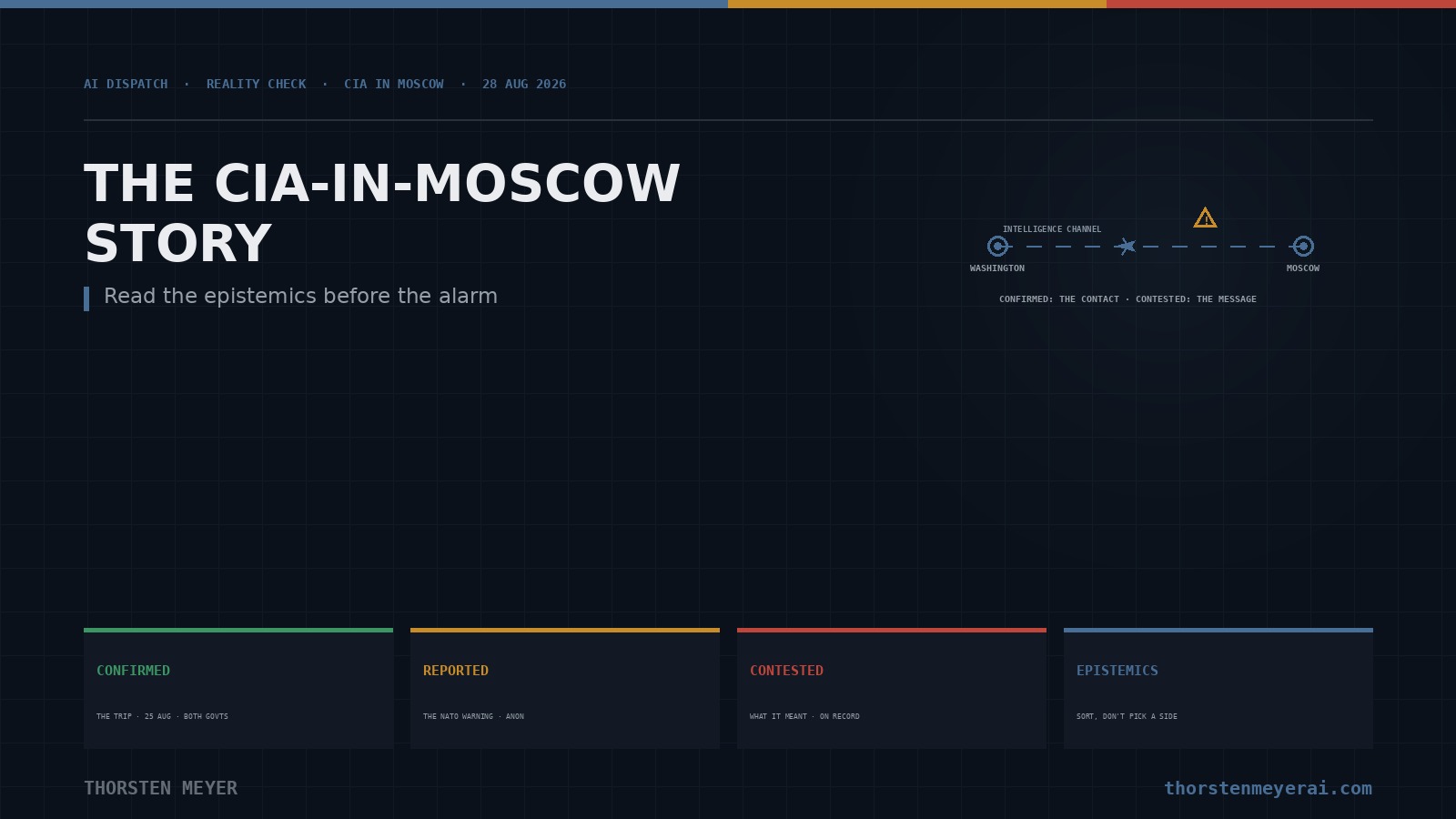
The hard core is solid and agreed by both governments. CIA Director John Ratcliffe made an unannounced trip to Moscow on 25 August 2026 — his first known visit to Russia as director, and the first known visit by a senior Trump-administration official to the Russian capital in months. It surfaced when a US Air Force transport aircraft was tracked landing at a Moscow airport and a diplomatic motorcade was filmed moving through the city. The Kremlin confirmed the contact: spokesman Dmitry Peskov said Ratcliffe met Russian intelligence counterparts and did not meet President Putin, describing the exchange as happening through the intelligence services. On the US side, President Trump confirmed the visit occurred. So: a rare, high-level, private intelligence-channel contact between Washington and Moscow happened this week. That much is not in dispute.
The story arrives as three incompatible versions at once — a leaked warning, an official shrug, a flat denial. The skill isn’t picking your favorite. It’s sorting confirmed from asserted from denied.
A few surrounding details are also well-sourced across outlets: the trip came a day after the US Treasury announced a new push to isolate Iran economically, and multiple reports say Ratcliffe also used the visit to press Russia on Iran, including a warning tied to the reopening of the Strait of Hormuz to shipping. And by one senior Ukrainian official's account, Kyiv was told a US delegation would travel to Moscow and was asked to hold off on strikes for the visit's duration. Those are attributed to named-government or single officials rather than fully public confirmation, so hold them a notch below the core fact of the trip itself.
discreet diplomatic communication devices
As an affiliate, we earn on qualifying purchases.
As an affiliate, we earn on qualifying purchases.
What's reported but not official
Here's where the confidence level has to drop, and where most of the headlines live. The content everyone is leading with — that Ratcliffe went to warn Russia not to attack NATO — was first reported by the Wall Street Journal and then matched by CBS and CNN, in every case citing people familiar with the matter. That is credible, multi-outlet, consistently-sourced reporting. It is also entirely anonymously sourced, and the CIA declined to comment on the reasons for the trip. So the warning is well-reported, not officially confirmed. Those are different epistemic states, and a Reality Check keeps them apart even when the reporting is from outlets I'd generally trust.
secure communication gadgets for intelligence professionals
As an affiliate, we earn on qualifying purchases.
As an affiliate, we earn on qualifying purchases.
What's actively contested
Now the part that should stop anyone from writing this up as settled. The two principals with first-hand knowledge are publicly pushing back on the framing. Trump downplayed the trip as "semi-routine," said it was not intended as a warning to Putin about NATO, and stated flatly that Russia is not going to attack NATO territory, citing his own conversations with Putin. The Kremlin's Peskov, for his part, dismissed the media accounts of the trip's purpose as "scare stories," while calling the contact itself positive but cautioning it was premature to read much into it.
I'm not going to adjudicate that. It's not my place, and more to the point, I don't have the information to. What I can do is lay out the honest state of it: reputable outlets, citing anonymous officials, say the trip carried a NATO warning; the US President and the Kremlin spokesman both, on the record, dispute that characterization. A responsible reader holds both of those at once rather than deleting whichever is less convenient.
As an affiliate, we earn on qualifying purchases.
The intelligence backdrop — and how to read it
The reporting ties the trip to recent US and European intelligence assessments that Putin could try to test NATO's resolve with a limited assault or incursion on an allied country within the next few years. This is the sentence doing the most work in every write-up, so it's worth being precise about what it is and isn't.
An intelligence assessment of this kind is a probability judgment over a multi-year horizon. It is not evidence of an imminent attack, a decision taken, or a plan in motion. "Could try to test, within the next few years" is an estimate of capability and possible intent, not a warning of next week. The tell that this is being read soberly on the ground is that officials in the Baltic states — the NATO members physically closest to the risk — are reportedly playing down any imminent threat. When the people with the most at stake are the calmest in the room, that's a signal about how to calibrate. Read assessments as probability, not prophecy; the failure mode in both directions is treating a "could, over years" as a "will, this month."
private conference recording devices
As an affiliate, we earn on qualifying purchases.
As an affiliate, we earn on qualifying purchases.
The 2021 echo, handled honestly
Every account reaches for the same historical parallel, and it's a fair one to raise: the last CIA director trip to Moscow was in late 2021, when Bill Burns went to warn Putin against the full-scale invasion of Ukraine — which Putin launched anyway in February 2022. That analogy is doing a lot of emotional work right now, so handle it carefully, because it cuts both ways. You can read it as this is what serious pre-conflict signaling looks like, take it gravely. You can equally read it as a direct, high-level warning did not deter a determined Kremlin last time, so a warning now is no guarantee of anything. Both readings are available from the same fact. The analogy is worth stating and not worth leaning on; it supplies gravity, not prediction. Don't let it do your thinking.
Why this is in AI Dispatch
Two honest reasons, and I'll keep them tight rather than force a connection that isn't there.
The first is the epistemics itself. The discipline I just walked through — confirmed versus attributed versus denied, probability versus prophecy, resisting the analogy that flatters your prior — is the same one this whole publication runs on when the subject is a benchmark table or a vendor's "industry-leading" claim. The muscle transfers. A warning leaked through anonymous officials and a chip's per-watt number measured by its own maker are, epistemically, closer cousins than they look: both are credible-but-interested claims you should neither swallow whole nor dismiss.
The second is where the subject genuinely touches mine. "Testing" an alliance short of open war increasingly means the gray zone — and the gray zone now runs heavily through the drone and cyber domains I do cover. The escalation everyone's watching isn't only tanks at a border; it's the incursions, the sabotage, the network intrusions that sit below the threshold of a declared attack, in exactly the AI-enabled-conflict space I wrote about with the OpenAI security incident and the dual-use capabilities of open cyber models. I want to be careful here: I have not verified that any specific assessment named a cyber vector, and I'm not going to imply it did. The point is structural — the frontier of state-level testing and the frontier of AI-enabled offense are converging, and that convergence is squarely on this desk even when the week's headline is a plane on a Moscow runway.
Where I land
Not on a prediction, and not on a verdict about anyone's diplomacy — both would be guessing dressed as analysis, and this is a live, contested, incompletely-known story. Where I land is on the reading discipline.
The confirmed core is genuinely notable on its own, independent of whose characterization of the message you believe: a rare, high-level, private intelligence-channel contact between Washington and Moscow took place this week, and both governments acknowledge it. That's a real data point about the state of the channel between the two capitals, and it doesn't require you to resolve the leak-versus-denial dispute to matter. Everything past that core — the specific warning, the intent, what it portends — is reported, disputed, or estimated, and should be held exactly that loosely. Resist the alarmist version and the nothing-to-see version equally; both are trying to collapse a genuinely uncertain picture into a clean one. The honest picture is the uncertain one, and the skill worth practicing — here as much as on any benchmark — is sitting with it without flinching toward the story you'd prefer.
Analysis from a builder, founder, and post-labor economist running a local-first inference operation. A fair, factual account of a developing and contested story, verified at time of writing against reporting from the Wall Street Journal, CBS, CNN, CNBC, The Hill, RFE/RL, and Kremlin statements via Russian state media. The fact of the 25 August 2026 visit and of intelligence-service contact is confirmed by both governments; the characterization of its purpose as a NATO warning is anonymously sourced and disputed on the record by both President Trump and the Kremlin. Characterizations are attributed to their sources, not endorsed; this is not a political endorsement or a prediction. Developing story, point-in-time as of 28 August 2026.
Halloween Picks
halloween
As an affiliate, we earn on qualifying purchases.