
A conventional drone camera sees the world through a soda straw — a narrow cone, one rooftop or one vehicle at a time. Wide-Area Motion Imagery throws that constraint away.

Get tech for your team delivered free — and shop member deals
- Fast, free delivery on millions of items
- Access to Prime Big Deal Days deals on October 6–7
- Prime Video, Amazon Music and more included
A single WAMI (Wide Area Motion Imagery) sensor watches an entire city at once, several square kilometers in a single frame, tracking every vehicle and pedestrian moving in the open — and, crucially, it records all of it, so an analyst can rewind time and follow any mover backward to where it came from.
That combination — see everything, remember everything — is what makes WAMI one of the most consequential surveillance technologies of the last two decades. It’s also why it can’t stand alone: it has hard physical limits, it’s useless without AI reading the firehose, and it raises a governance question that has already reached the courts. Here’s the honest picture.
The eye over the city: how Wide-Area Motion Imagery works — and where it goes blind
A normal drone sees through a soda straw. WAMI watches an entire city at once, tracks every mover, and records it all for forensic rewind. Immense reach — with hard limits that make radar and AI its necessary partners.
- City-scale motion, fine detail
- Forensic rewind
- Cloud / smoke / dark degrade it
- Needs a platform loitering overhead
sensing
+ AI
- Sees through cloud & total dark
- Tasked over denied airspace
- Persistent, wide-area from orbit
- Sovereign · on-prem · air-gap
The same archive that traces a bomber to a safe house can trace anyone home — retroactively, without prior suspicion. Baltimore’s secret 2016 deployment led to a 2021 federal ruling that persistent aerial tracking violated the Fourth Amendment. The security value is real; so is the mass-surveillance risk. Who owns the sensor, the archive, and the AI is the accountability question.
WAMI’s power is the archive and the AI reading it; its weakness is weather, airspace, and oversight. The mature posture isn’t optical-vs-radar or capability-vs-liberty — it’s layered sensing (optical WAMI + all-weather SAR), AI-enabled exploitation, and sovereign, auditable control of the whole chain. WAMI shows what a persistent eye can do with clear skies and owned airspace; for the cloud, the night, and the denied area, the radar layer is where the resilient coverage lives.
From soda straw to city-sized
The industry term is persistent surveillance, and the contrast with ordinary full-motion video (FMV) is the whole point. As BAE Systems describes it, WAMI is an airborne optical ISR system that fuses many sensors, cameras, and processors into one unit that detects and tracks everything moving across a city-sized area simultaneously, day or night, compiled into a single real-time image.
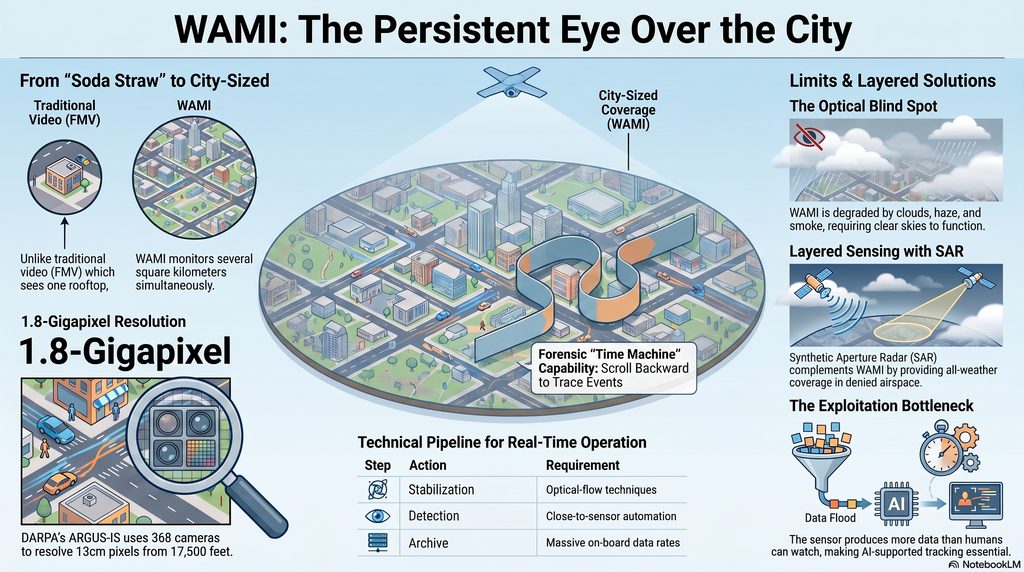
The analysts at RUSI put the distinction plainly: a WAMI system’s coverage area vastly exceeds that of full-motion video, and it delivers a real-time forensic capability other wide-area sensors lack. That forensic power is the part people underestimate. Because the imagery is archived, an operator who learns of an incident — a roadside bomb, a shooting, a border crossing — can scroll the recording backward from the event, watch the vehicle involved retrace its route, and identify where it originated and who it met along the way. It’s less a camera than a time machine pointed at a city.
wide area motion imagery surveillance camera
As an affiliate, we earn on qualifying purchases.
As an affiliate, we earn on qualifying purchases.
How it actually works
Physically, a WAMI payload is an array of cameras whose fields of view are stitched into one enormous composite image. The most cited example, DARPA’s ARGUS-IS, used 368 five-megapixel cameras to form a roughly 1.8-gigapixel image; from around 17,500 feet it resolved to about 13 centimeters per pixel at the center — enough, by one widely repeated description, to make out a six-inch object across a frame twice the width of Manhattan.
The processing pipeline is where the real engineering lives: capture the gigapixel frame, stabilize and register the background so the moving platform’s own motion is cancelled out (the academic literature leans on optical-flow techniques for this), detect the pixels that are genuinely moving against that stabilized background, track each mover frame to frame, and archive everything for later rewind. The catch is scale. The data rates are so enormous that you cannot downlink it all, and no human team can watch it live — which is why WAMI has always depended on close-to-sensor automation. That dependency is the thread that leads straight to modern AI, and we’ll return to it.
The sensors themselves have shrunk from bulky early rigs onto a widening range of platforms — manned aircraft like the MC-12W, tethered aerostats and blimps, helicopters, and increasingly tactical unmanned aircraft.
city-wide drone surveillance system
As an affiliate, we earn on qualifying purchases.
As an affiliate, we earn on qualifying purchases.
A short history
The lineage runs back to the early 2000s and the Sonoma Persistent Surveillance Program at Lawrence Livermore National Laboratory, led by John Marion. The capability transitioned to the US Department of Defense in 2005, and in 2006 the Army deployed a system dubbed Constant Hawk to Iraq aboard turboprop aircraft as a Quick Reaction Capability. From there it evolved into the DARPA ARGUS-IS sensor and the US Air Force’s Gorgon Stare pods, fielded on Reaper drones in Afghanistan around 2014. In two decades it went from an experimental rig to a shrinking, proliferating class of sensor.
AI-enabled security camera for large areas
As an affiliate, we earn on qualifying purchases.
As an affiliate, we earn on qualifying purchases.
What it’s for
The mission set is broad. In military ISR, WAMI’s signature use is network discovery — rewinding from an attack to expose the people and safe houses behind it, not just the triggerman. It’s used for border security, where its ability to hold a city or crossing full of movers outperforms narrow sensors, and for protecting fixed sites.
It has also moved well beyond the battlefield. The US Forest Service used WAMI to map wildfires in 2017; the Indiana National Guard flew wide-area surveillance after Hurricane Florence in 2018 to spot damaged infrastructure and blocked routes. As Marion has noted, WAMI doesn’t replace radar or full-motion video — it complements them. That word, complements, is the hinge of this whole piece.
As an affiliate, we earn on qualifying purchases.
Where it goes blind — and why radar rides shotgun
For all its reach, WAMI has three hard limits, and they’re worth stating bluntly because vendors rarely lead with them. First, it is optical — cloud, haze, smoke, and darkness degrade it (thermal infrared helps at night but doesn’t solve weather). Second, it needs a platform loitering overhead within physical reach of the target, which contested or denied airspace simply refuses to grant. Third, that loiter is expensive in aircraft hours and bandwidth.
This is precisely where a different modality earns its place: synthetic aperture radar (SAR). Radar sees through cloud, smoke, and total darkness — all-weather, day or night — and can be tasked from orbit over areas no aircraft can safely loiter above. It is the natural partner to WAMI’s optical eye, and it’s the modality that VigilSAR is built around: turning open and commercial SAR constellations into persistent, analyst-ready radar intelligence for defense operators. The academic literature has a name for using the two together — layered sensing, or sensor fusion: optical WAMI for continuous, fine-grained motion tracking where you can fly, and SAR for all-weather, deep-denied coverage where you can’t. Each covers the other’s blind spot. Neither is a substitute for the other.
The real bottleneck isn’t the sensor — it’s exploitation
Here’s the point that reframes the whole field. Both WAMI and SAR produce more data than any human can ever look at. The scarce resource was never the sensor; it’s the exploitation — turning gigapixels or radar returns into answers a decision-maker can act on. This is exactly the problem Fraunhofer IOSB works on: AI-supported detection and tracking of vehicles across large areas, because manual exploitation of a city-sized feed is a non-starter.
That is where the ISR conversation now sits, and it connects to a theme running through defense procurement everywhere: who controls the exploitation layer. An analyst-augmentation system that runs sovereign, on-premise, and air-gap-ready — the posture VigilSAR is designed around — keeps the intelligence chain under the operator’s own control, rather than routed through a foreign vendor’s cloud that can be throttled, gated, or switched off. In a year when model and infrastructure access has proven to be a geopolitical variable, that sovereignty isn’t a nicety; it’s the difference between a capability you own and one you merely rent.
The governance question that won’t go away
None of this can be discussed honestly without the other side of the ledger. WAMI’s archive is what makes it powerful — and what makes it dangerous. The same rewind that traces a bomber back to a safe house can trace anyone back to their home, their doctor, their place of worship, retroactively and without any prior suspicion. Persistent surveillance of a whole population is a categorically different thing from watching a target.
That tension is not hypothetical. The Baltimore Police Department secretly deployed a persistent aerial surveillance system over the city in 2016; when a later pilot was challenged, a federal appeals court ruled in 2021 (Leaders of a Beautiful Struggle v. Baltimore Police Department) that continuously tracking a city’s movements this way violated the Fourth Amendment. Meanwhile the technology has proliferated globally, with vendors reported across the US, China, Israel, and Hungary. The security value is real — crimes reconstructed, wildfires mapped, disaster response guided, lives saved. The civil-liberties risk is equally real. Both can be true at once, and pretending otherwise is how oversight gets skipped.
The sovereignty angle cuts here too: who owns the sensor, the archive, and the AI matters as much as what the system can do. Auditable, on-premise, sovereign ISR isn’t only a procurement preference — it’s a precondition for the kind of accountability that keeps a time-machine-over-a-city on the right side of the law.
The take
Wide-Area Motion Imagery is the unblinking optical eye: its power is the archive and the AI reading it, its weakness is weather, airspace, and oversight. The mature posture isn’t optical-versus-radar, or capability-versus-liberty — it’s layered sensing (optical WAMI plus all-weather SAR), AI-enabled exploitation to make either usable, and sovereign, auditable control of the entire chain from sensor to answer.
WAMI shows you what a persistent eye can do when the sky is clear and you own the airspace. For everything else — the cloud, the night, the denied area, the need to keep your intelligence under your own roof — the radar layer is where the resilient coverage lives. That’s the gap VigilSAR is built to fill.
Sources: BAE Systems — “What is Wide Area Motion Imagery?”; RUSI — “Wide-Area Motion Imagery Systems: Evolution, Capabilities and Mission Sets”; Fraunhofer IOSB — AI-supported detection and tracking of vehicles in large areas; Logos Technologies — WAMI overview; “Summary of methods in Wide-Area Motion Imagery (WAMI),” ResearchGate; Australian DST Group — Wide Area Motion Imagery project; ARGUS-IS/Gorgon Stare specifications and the Sonoma/Constant Hawk history via public reporting and Arthur Holland Michel’s “Eyes in the Sky”; Baltimore ruling via Leaders of a Beautiful Struggle v. Baltimore Police Department (4th Cir., 2021). Analysis and framing are the author’s. Related work: VigilSAR — persistent SAR ISR.
Fall Picks
fall essentials
As an affiliate, we earn on qualifying purchases.