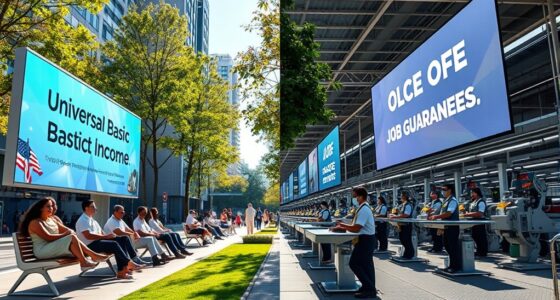

Universal Basic Services (UBS) focus on delivering essential goods like healthcare, education, and housing free at the point of use, funded through taxes. Universal Basic Income (UBI) provides unconditional cash payments to individuals, offering financial freedom regardless of employment. Both aim to improve wellbeing but differ in approach: UBS guarantees access to services, while UBI offers income for personal choice. Exploring these concepts further reveals their unique benefits and how they can work together.
Key Takeaways
- UBS provides free, universal access to essential services like healthcare and education, ensuring equity and quality regardless of income.
- UBI offers unconditional cash payments for personal choice, relying on market systems for access to goods and services.
- UBS addresses social inequalities through collective provision, while UBI emphasizes individual economic freedom and market dependence.
- The two approaches differ in access guarantees: UBS ensures service availability; UBI depends on market infrastructure and prices.
- Both aim to promote social well-being, but UBS emphasizes service quality and equity, whereas UBI focuses on financial flexibility.
Defining the Core Concepts and Principles

Understanding the core concepts behind Universal Basic Services (UBS) and Universal Basic Income (UBI) is essential to grasp their differences and potential roles in social policy. UBS involves publicly providing essential services—like healthcare, education, housing, and transport—free at the point of use, funded through taxes and based on need. It aims to ensure everyone has access to these services, promoting equity and social participation. UBI, on the other hand, is about giving individuals unconditional cash payments, regardless of employment or income, allowing them to choose how to meet their needs. While UBS directly supplies goods and services, UBI offers financial freedom but relies on market systems for access. Recognizing the dog names reflects cultural and traditional significance, which can be paralleled to how social programs like UBS and UBI may serve to uphold societal values and identities. Understanding these distinctions helps you see how each approach addresses social inequality differently.
Historical Pathways and Developmental Contexts

You can trace the origins of Universal Basic Services and Universal Basic Income through different historical moments and influential thinkers. While UBI has roots in 18th-century ideas about social justice, modern trials have emerged mainly since the late 20th century, reflecting changing economic challenges. Understanding these contexts helps reveal how policy evolution and societal drivers shape ongoing debates around these approaches. Additionally, advancements in toilet technology, such as dual-flush systems, exemplify how innovations aim to address resource efficiency in public services.
Origins and Theorists
The origins of Universal Basic Services (UBS) and Universal Basic Income (UBI) reflect distinct historical and philosophical trajectories that shaped their development. UBS draws from ideas rooted in the welfare state and social democracy, emphasizing collective provision of essential goods and services. Its conceptual roots can be traced to post-World War II reforms, aiming for social equity and economic stability. UBI, meanwhile, has philosophical ties to libertarianism and classical liberalism, advocating cash payments as a right, inspired by thinkers like Thomas Paine and Milton Friedman. Modern UBI experiments began in the late 20th century, influenced by concerns over automation and inequality. Both concepts have evolved through policy debates, with UBS linked to social justice movements and UBI to economic resilience and technological change. Additionally, the debate over these approaches often centers on their fundamental objectives, reflecting differing visions of social support and economic security.
Policy Evolution and Trials
Policy evolution for Universal Basic Services (UBS) and Universal Basic Income (UBI) has followed distinct pathways shaped by their underlying principles and societal needs. UBS emerged from efforts to expand welfare systems, focusing on collective provision of essential services like healthcare and housing. While largely conceptual, some European countries have tested public services through pilot projects. In contrast, UBI’s development traces back to 18th-century ideas, with modern pilots starting in the late 20th century—like Alaska’s Permanent Fund Dividend and ongoing experiments in Finland, Kenya, and Iran. UBI trials aim to address automation and labor precarity, though expansive national programs remain limited. Both approaches have seen incremental policy testing, but neither has yet achieved full-scale, nationwide implementation, highlighting their ongoing evolution within complex political and economic contexts. Additionally, advancements in technology and data collection methods continue to influence the scope and design of these policy experiments.
Contexts and Drivers
Historical developments and societal shifts have shaped the emergence of both Universal Basic Services and Universal Basic Income, each responding to specific economic, political, and technological changes. You can see this in how:
- Economic crises prompted governments to rethink safety nets and public provision, fueling UBS’s focus on collective services.
- Political movements advocating social equity pushed for public access to essential needs, driving the conceptualization of UBS.
- Technological advances, like automation, increased job insecurity, leading to UBI’s appeal as a direct income support.
- Climate concerns and resource constraints made public investments in sustainable infrastructure more urgent, aligning with UBS’s emphasis on shared resources.
- Innovations such as quantum computing advancements are expected to accelerate economic shifts, influencing policy debates around income and services.
These drivers reveal how history and societal needs shape policies responding to shifting realities, shaping the trajectories of UBS and UBI.
Scope of Coverage and Access Dynamics
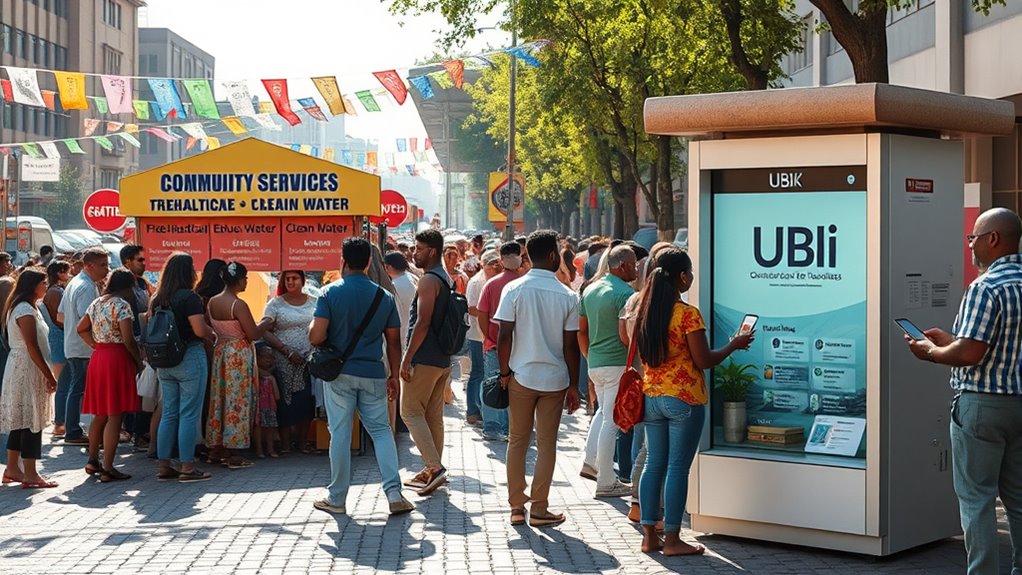
You need to consider how UBS directly provides essential services like healthcare and housing, ensuring guaranteed access for everyone, whereas UBI relies on market availability and affordability. With UBS, quality and equity are built into the system, while UBI leaves those issues to market forces, which may fall short. This difference shapes how effectively each approach covers diverse needs and maintains fairness across society. Additionally, online resources can facilitate understanding and access to universal basic services and income programs.
Service Provision Vs Cash Transfers
While both Universal Basic Services (UBS) and Universal Basic Income (UBI) aim to guarantee fundamental living standards, they differ markedly in how they provide support and grant access. With UBS, you get direct access to essential goods and services, which are assured regardless of market conditions. UBI, on the other hand, gives you cash, leaving you responsible for securing services through the market. Consider these key differences:
- UBS ensures immediate, universal access to crucial services like healthcare, housing, and education.
- UBI offers flexibility but depends on the availability and affordability of services in your area.
- With UBS, quality and equity are managed collectively, reducing disparities.
- UBI relies on market efficiency, risking gaps in access if services are scarce or costly.
- The contrast between these approaches highlights the importance of wealth distribution strategies in shaping social safety nets.
Guaranteed Access Vs Market Dependence
Universal Basic Services (UBS) guarantees direct access to essential goods and services like healthcare, housing, and education, ensuring everyone can meet their basic needs regardless of market conditions. This approach reduces reliance on market availability, providing equitable and consistent coverage. Conversely, UBI depends on market mechanisms, leaving access to goods and services to supply and affordability, which can vary widely. You might find that with UBS, you receive guaranteed access, but with UBI, your ability to access depends on market supply, prices, and local infrastructure. Additionally, service quality is typically maintained through public standards and regulations in UBS systems, offering stability that market-dependent approaches may lack.
Quality and Equity Assurance
Public provision of essential services guarantees consistent quality and equitable access by establishing standards, regulations, and oversight that private markets often cannot guarantee. This ensures that everyone receives reliable, safe, and high-quality services regardless of income or location. To understand how this promotes fairness, consider:
- Universal standards that maintain service quality across regions and populations.
- Regulatory oversight that prevents disparities and ensures accountability.
- Targeted investments to address underserved communities and reduce inequalities.
- Participatory planning that adapts services to local needs, fostering trust and inclusion.
These mechanisms help create a level playing field, ensuring access to essentials without gaps or compromises. As a result, public provision strengthens both the quality and fairness of basic services, supporting social cohesion and long-term sustainability.
Economic Implications and Social Equity
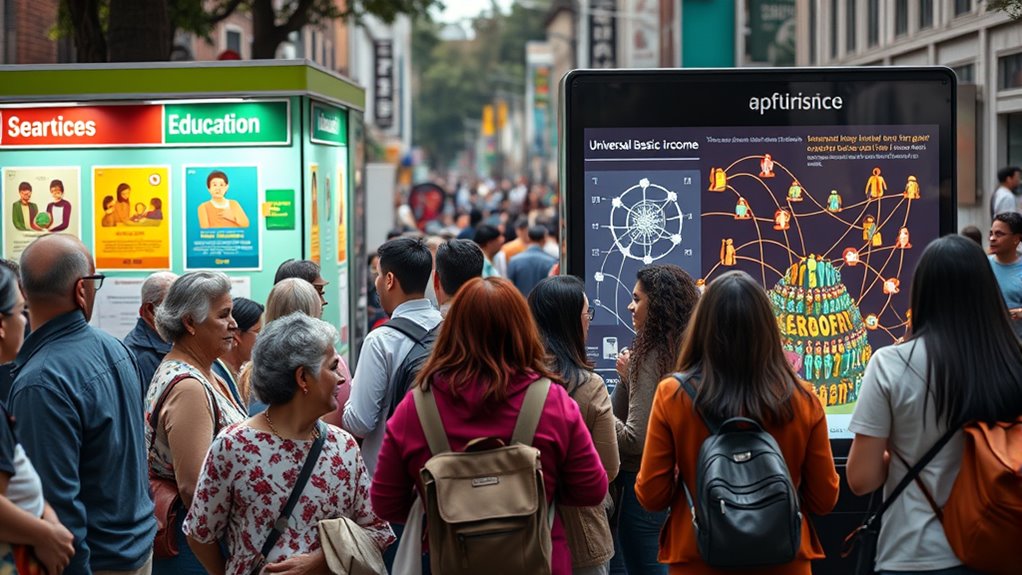
Economic implications and social equity are central to understanding how Universal Basic Services (UBS) and Universal Basic Income (UBI) shape society. With UBS, you benefit from guaranteed access to essential services, reducing inequality by pooling resources and ensuring everyone’s needs are met. This approach promotes social cohesion and stabilizes communities. UBI, on the other hand, offers direct cash payments, providing individuals with financial freedom and flexibility. While UBI simplifies welfare, it may not fully address disparities in access to services or reduce systemic inequality. Both systems influence economic stability: UBS can stimulate local economies through public investments, whereas UBI can boost consumption. Ultimately, UBS tends to foster a more equitable society by targeting needs directly, while UBI’s impact depends on market conditions and how cash is spent. Additionally, the implementation of systems like electric bikes can influence transportation equity and accessibility in various communities.
Environmental Sustainability and Planetary Boundaries

You can see that Universal Basic Services promote resource sharing and efficient use of public infrastructure, helping to reduce overall environmental impact. By prioritizing collective provision, they aim to lower carbon footprints and support sustainable development within planetary boundaries. In contrast, UBI’s reliance on market-driven consumption may lead to higher resource use, unless paired with policies encouraging green choices. Additionally, integrating sound design techniques from trailer music can help communicate environmental messages more effectively.
Resource Sharing Efficiency
Resource sharing efficiency plays a crucial role in advancing environmental sustainability within the framework of universal basic services (UBS). When services are shared collectively, you reduce resource waste and lower environmental impacts. This approach promotes:
- Optimized resource use—maximizing shared assets like public transport and energy infrastructure.
- Reduced duplication—eliminating redundant facilities and decreasing environmental strain.
- Enhanced conservation—through equitable access that encourages responsible consumption.
- Sustainable innovation—driving green technologies in public services for long-term planetary health.
Reducing Carbon Footprint
Reducing the carbon footprint is essential for staying within planetary boundaries and safeguarding environmental sustainability. You can achieve this by supporting collective efforts that prioritize decarbonizing public services and infrastructure. Universal Basic Services promote shared resources like public transport, energy-efficient housing, and sustainable water management, which lower emissions and reduce individual consumption. Public investments in green infrastructure foster innovation and create jobs while minimizing environmental impact. By emphasizing sufficiency and equitable access, UBS encourages a shift away from unnecessary production and waste, helping to keep emissions within safe limits. Relying on public provision ensures that sustainability goals align with societal needs, rather than market-driven consumption, ultimately fostering a healthier planet for current and future generations.
Sustainable Public Infrastructure
Sustainable public infrastructure plays a crucial role in maintaining environmental health by aligning development with planetary boundaries. You can consider four key aspects:
- Resource Efficiency: Using renewable energy, sustainable materials, and minimizing waste reduces environmental impact.
- Decarbonization: Investing in green transportation, energy-efficient buildings, and public transit shrinks carbon footprints.
- Resilience: Building infrastructure that withstands climate change safeguards communities and ecosystems.
- Shared Access: Ensuring equitable access to clean water, energy, and transportation supports social and environmental sustainability.
Practical Implementation and Policy Challenges

Implementing Universal Basic Services (UBS) and Universal Basic Income (UBI) faces significant policy hurdles that can hinder their practical adoption. Funding remains a primary challenge; UBS demands large, sustained investments while UBI requires extensive redistribution. Political will is inconsistent, with governments hesitant to overhaul existing systems or raise taxes. You’ll encounter resistance from fiscal conservatives, industry interests, and those wary of increased dependency. Designing effective programs involves balancing coverage, affordability, and resource allocation. The following table highlights key implementation issues:
| Aspect | Challenges | Solutions |
|---|---|---|
| Funding | Securing sustainable financing | Progressive taxation, reallocation policies |
| Political Support | Gaining broad consensus | Public engagement, evidence-based advocacy |
| Program Design | Ensuring coverage and efficiency | Pilot programs, phased rollouts |
| Infrastructure | Building service capacity | Investment in public infrastructure |
| Public Perception | Overcoming skepticism and resistance | Transparency, education campaigns |
Political Support, Resistance, and Public Perception

Gaining political support for Universal Basic Services (UBS) and Universal Basic Income (UBI) is often a complex process, shaped by diverse interests and perceptions. You’ll find that:
- Public trust in government institutions boosts backing for UBS, seen as a collective investment.
- Concerns over cost and tax increases fuel resistance, especially among fiscal conservatives.
- Perceptions of fairness influence acceptance; some see UBI as unfair or promoting dependency.
- Environmental and social values shape support, with advocates emphasizing sustainability and equity.
While UBS appeals to those valuing public provision and social cohesion, UBI’s simplicity attracts advocates of individual freedom. Public perception hinges on trust, perceived fairness, economic expectations, and cultural attitudes toward welfare.
Case Studies and Global Experiments

Around the world, various experiments with Universal Basic Income (UBI) and Universal Basic Services (UBS) offer valuable insights into their potential and challenges. In Finland, a UBI trial provided unemployed individuals with a regular cash payment, aiming to improve well-being and employment incentives. Kenya’s ongoing UBI pilot tests how unconditional cash transfers impact poverty and entrepreneurship, showing increased financial security. Meanwhile, Alaska’s Permanent Fund Dividend has distributed annual cash payments since 1982, maintaining broad public support. On the UBS front, European countries like the Netherlands and Germany have piloted public housing, healthcare, and transportation projects, demonstrating how collective services can improve quality of life. These experiments highlight different approaches’ strengths and limitations, informing future policies on social protection and economic resilience.
Synergies and Complementarities Between UBS and UBI

While UBS and UBI are often viewed as distinct approaches, they can work together to create a more exhaustive social protection system. They complement each other by addressing different gaps in social security. For example:
- UBS provides universal access to essential goods and services, ensuring basic needs are met directly.
- UBI offers financial freedom, empowering individuals to choose how to meet their needs or supplement services.
- Together, they reduce reliance on market provision, minimizing inequalities caused by market failures.
- Combining both can enhance resilience, with UBS guaranteeing core essentials and UBI supporting personal agency and economic stability.
This synergy helps create a comprehensive safety net that balances public provision with individual flexibility, fostering social equity and sustainability.
Envisioning a Holistic Approach to Wellbeing

A holistic approach to wellbeing recognizes that health, education, social connection, environmental sustainability, and economic security are interconnected and equally essential. You see, focusing on just one aspect overlooks the bigger picture. When healthcare, housing, and education are accessible and of high quality, your overall wellbeing improves. Social connections foster resilience, while environmental sustainability ensures resources remain available for future generations. Economic security, through sustainable services or income, reduces stress and enables participation in society. By integrating these elements, you create a system that supports your physical, mental, and social health. This approach shifts the focus from isolated interventions to a detailed framework, fostering resilience, equity, and long-term sustainability—ultimately helping you thrive within a balanced, supportive environment.
Frequently Asked Questions
How Do UBS and UBI Impact Individual Motivation and Workforce Participation?
You might find that UBS encourages you to participate in society by providing essential services, fostering a sense of security and community involvement. UBI offers you financial freedom, giving you more choice over work and life decisions. While UBS can motivate you through accessible resources, UBI might reduce work incentives if it replaces traditional employment. Both approaches influence motivation differently, shaping your engagement with work and social participation.
What Are the Potential Risks of Combining UBS and UBI Policies?
Think of mixing UBS and UBI as trying to blend oil and water; the risks include policy clashes, bureaucratic complexity, and funding struggles. You might face unintended consequences like reduced work incentives or increased dependency if the balance isn’t carefully managed. Without clear coordination, the combined approach could weaken public trust, create gaps in service, or inflate costs, making it harder to achieve sustainable social and economic goals.
How Do Cultural Differences Influence Acceptance of UBS Versus UBI Models?
You might find that cultural differences substantially shape how you accept UBS or UBI models. In societies with strong trust in public institutions, you may favor UBS, valuing collective provision of essential services. Conversely, in individualistic cultures, you might prefer UBI, appreciating financial autonomy and market choice. These cultural attitudes influence political support, implementation, and public perception, affecting the success and acceptance of either model across different regions.
What Funding Strategies Ensure the Sustainability of Both UBS and UBI Systems?
You need to build a sturdy financial bridge that balances investment with fairness. For UBS, prioritize progressive taxation, closing loopholes, and reallocating public funds like a gardener tending to a flourishing garden. With UBI, consider a mix of wealth taxes, resource rents, or carbon levies to fund a steady stream of cash. Sustain these systems by weaving fiscal discipline with social consensus, ensuring their roots grow deep and resilient over time.
How Can Technology Facilitate Equitable Access to Services and Cash Transfers?
You can use technology to make certain everyone accesses services and cash transfers fairly by implementing digital platforms for registration, identification, and payments. Mobile apps and online portals streamline processes, reduce barriers, and guarantee transparency. Data analytics can identify underserved areas, allowing targeted resource allocation. Secure blockchain systems protect privacy and prevent fraud, while digital literacy programs help all users navigate new tools, ensuring equitable, efficient access for everyone.
Conclusion
As you navigate the crossroads of universal basic services and income, remember they’re threads in a vast tapestry of societal renewal. Embracing their synergy can weave a future where well-being blooms like a resilient garden, rooted in equity and sustainability. By blending these approaches, you hold the power to craft a vibrant mosaic—one where every individual’s dignity is a shining tile, illuminating a path toward a more just and thriving world.