Absolutely, UBI can help you pursue lifelong learning by providing financial stability that removes major barriers to education at any age. It encourages skill development, career flexibility, and continuous engagement because you won’t fear economic setbacks. With stable income, you can invest in training, adapt to changing job markets, and explore new passions. If you’re curious about how policies and technology amplify these benefits, there’s more to discover ahead.
Key Takeaways
- UBI provides financial stability, removing economic barriers and encouraging participation in lifelong learning opportunities at all life stages.
- It reduces fear of income loss during skill development, enabling flexible career changes and continuous upskilling.
- UBI supports marginalized groups by addressing systemic disadvantages and increasing access to education and training.
- Financial security from UBI fosters motivation, emotional well-being, and a growth mindset essential for lifelong learning.
- Policy integration of UBI with educational initiatives can promote innovative, inclusive, and accessible lifelong learning systems.

Certificate of Training 30pk 8.5×11” Completion Education Courses Employee Job Skills HR Workshop Program Online Diploma Award Professional Recognition
Professional Green Border Design: Clean, polished layout with a green border suitable for formal training and completion recognition.
As an affiliate, we earn on qualifying purchases.
As an affiliate, we earn on qualifying purchases.
How UBI Enhances Access to Education Throughout Life

Universal Basic Income (UBI) can substantially improve access to education at every stage of life by providing financial stability that removes barriers to learning. When you receive a steady income, you’re less likely to worry about basic expenses, freeing you to focus on acquiring new skills or advancing your education. UBI makes it easier to enroll in higher education, vocational training, or adult learning programs without the fear of losing income. It also supports parents in investing in their children’s education, ensuring they can afford resources and extracurricular activities. With financial stress reduced, you’re more likely to participate in lifelong learning opportunities, whether through formal courses or self-directed study. Additionally, the stability provided by UBI can encourage more consistent engagement in educational pursuits, fostering continuous growth and development, making education a feasible option at any age.

Learn Spanish Fast for Adult Beginners: 8-in-1 Workbook: From Beginner to Advanced: 15-Minute Daily Lessons and Exercises, Short Stories, Plus a Rich Vocabulary Collection (Easy Spanish)
As an affiliate, we earn on qualifying purchases.
As an affiliate, we earn on qualifying purchases.
The Role of Financial Stability in Continuous Skill Development

Financial stability plays a crucial role in enabling continuous skill development because when you’re assured of a reliable income, you’re more likely to invest time and resources into learning new abilities. With this security, you can pursue training without the fear of financial setbacks. It allows you to focus on acquiring new skills, adapting to changing job markets, and staying competitive. The table below illustrates how financial stability impacts your motivation and emotional well-being:
| Motivation to Learn | Emotional Impact |
|---|---|
| Increased confidence | Reduced anxiety |
| Greater focus on growth | Sense of security |
| Willingness to take risks | Improved mental health |
This stability empowers you to embrace lifelong learning, essential for thriving in today’s evolving economy.

Financial AIDS for Higher Education
As an affiliate, we earn on qualifying purchases.
As an affiliate, we earn on qualifying purchases.
UBI’s Impact on Career Flexibility and Lifelong Learning

When you have a stable income from UBI, you gain greater freedom to shape your career path and pursue continuous learning opportunities. Financial security means you’re less tied to jobs solely for income, allowing you to explore new fields or develop skills without the pressure of immediate employment. UBI enables you to experiment with different careers or take time for retraining, fostering lifelong learning. You can invest in education that aligns with your passions, rather than just survival needs. This flexibility encourages innovation and adaptability, crucial in today’s rapidly changing job market. With UBI, you’re empowered to make career decisions based on interest and growth, promoting a more fulfilling and resilient professional life over the long term. Additionally, WWE Raw’s financial impact demonstrates how substantial revenue streams can support industries that foster skill development and entertainment, encouraging a culture of continuous learning and adaptation.

The Art of Self-Directed Learning: 23 Tips for Giving Yourself an Unconventional Education
As an affiliate, we earn on qualifying purchases.
As an affiliate, we earn on qualifying purchases.
Bridging Educational Gaps With Basic Income Support
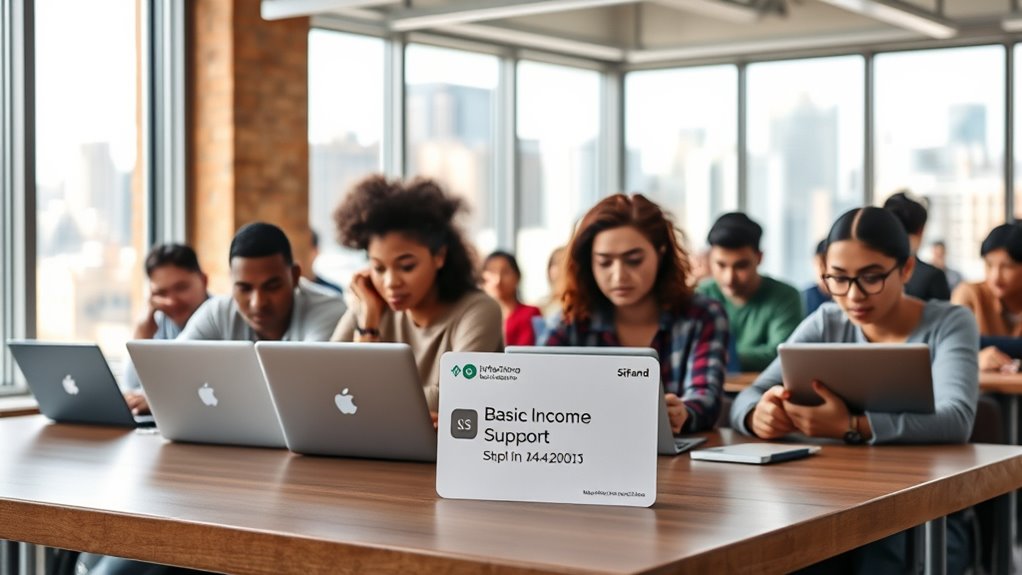
You can see how UBI helps reduce financial barriers that keep some students from accessing education. It also supports marginalized groups who often face greater obstacles to learning. By promoting equitable access, UBI can play a key role in closing educational gaps across communities. Additionally, providing financial stability encourages individuals to pursue lifelong learning and skill development, which are crucial for adapting to a changing job market.
Reducing Financial Barriers
Implementing basic income support can considerably lower the financial barriers that prevent many individuals from accessing quality education. With a steady income, you’re more likely to afford tuition, textbooks, and supplies, reducing the need to work long hours or take on debt. This financial security allows you to focus on learning instead of worrying about basic expenses. UBI can also help cover costs related to transportation, childcare, and other essentials that often limit educational participation. As a result, more people can pursue higher education, vocational training, or lifelong learning opportunities. By easing these economic pressures, UBI creates a more equitable environment where access to education isn’t determined by your financial background. Additionally, electric bikes can provide affordable and efficient transportation options for students commuting to educational institutions. This shift promotes broader participation and helps bridge existing educational gaps.
Supporting Marginalized Groups
How can basic income support help bridge educational gaps for marginalized groups? By providing consistent financial stability, UBI reduces barriers that prevent access to quality education. It empowers marginalized individuals to pursue training, attend school, and stay engaged without fear of economic hardship. With this support, students from vulnerable backgrounds can participate fully, overcoming systemic disadvantages.
- Addressing socioeconomic disparities that limit educational opportunities
- Enabling participation in extracurricular and enrichment programs
- Supporting families to meet basic needs, fostering a stable learning environment
- Encouraging higher enrollment and retention rates among underserved populations
- Promoting social inclusion and reducing dropout rates through financial security
Promoting Equitable Access
Basic income support plays a key role in promoting equitable access to education by directly addressing the financial barriers faced by marginalized groups. When you receive a stable income, you can afford school supplies, transportation, and other essentials that often hinder participation. UBI helps reduce dropout rates among low-income students by easing economic pressures, allowing you to focus on learning instead of financial stress. It also enables you to pursue higher education or vocational training without the fear of debt or unemployment. By providing a safety net, UBI creates a more level playing field, giving everyone, regardless of background, better opportunities to succeed academically. Additionally, anime movies often showcase inspiring stories of perseverance and growth that can motivate learners to pursue their educational goals. Ultimately, this support helps bridge gaps in educational attainment and promotes social mobility for underserved communities.
UBI’s Influence on Motivation and Engagement in Learning

When students have access to a Universal Basic Income (UBI), their motivation and engagement in learning can considerably increase because financial security reduces stress and allows them to focus more fully on their education. With less concern about meeting basic needs, you’re more likely to pursue challenging material, stay committed to your goals, and participate actively in class. UBI also encourages experimentation with new skills and fields, fostering a growth mindset. It can create a sense of autonomy and purpose, motivating you to take ownership of your learning journey. Greenhouse techniques, like creating a supportive environment for growth, can further enhance lifelong learning.
Supporting Mental Health for Learners Through Guaranteed Income

A guaranteed income can substantially bolster your mental health as a learner by providing financial stability that reduces everyday stressors. When money worries diminish, you can focus more on learning rather than survival concerns. This stability fosters resilience, decreases anxiety, and improves overall well-being. With fewer financial pressures, you’re more likely to engage actively in education and develop a growth mindset. Additionally, having a trusted reputation in financial services can help you identify reliable income sources to support your educational endeavors.
Policy Changes Needed to Foster Lifelong Education With UBI

Implementing UBI to promote lifelong education requires extensive policy reforms that align financial support with educational opportunities. You’ll need to redesign funding structures to guarantee resources reach learners at all stages. Additionally, policies must incentivize continuous skill development and remove barriers to access. To support this shift, governments should consider:
Implementing UBI requires policy reforms that ensure resources support lifelong learning at all stages.
- Establishing dedicated lifelong learning funding streams
- Integrating UBI with existing educational grants and scholarships
- Creating flexible, modular curricula aligned with labor market needs
- Developing policies that encourage public-private partnerships in education
- Adjusting accreditation systems to recognize informal and online learning
- Recognizing the importance of scenic views and local culture in fostering community engagement and enriching the learning experience.
These changes will foster an environment where financial stability and educational growth go hand in hand, enabling individuals to pursue ongoing learning without financial fear. Such reforms are essential for building a resilient, adaptable workforce in the UBI era.
Technological Opportunities for UBI-Driven Education Innovation

Technological advancements present transformative opportunities to enhance education in a UBI-supported economy. You can access personalized learning platforms, virtual classrooms, and AI tutors that adapt to your needs. These tools break down geographical and financial barriers, making lifelong learning more inclusive. UBI can fund innovative tech solutions, fostering continuous development and engagement. Imagine a future where everyone, regardless of background, can learn at their own pace, supported by cutting-edge technology. Here’s a glimpse of how this could feel:
| Hope | Empowerment | Connection |
|---|---|---|
| Equal access | Learning without limits | Global classrooms |
| Personal growth | Skill mastery | Lifelong curiosity |
| Supportive tech | Breaking barriers | Shared knowledge |
A new sentence with advanced segmentation techniques and the rest of the sentence.
Demographic Variations in UBI’s Effect on Learning Engagement

Different age groups respond uniquely to UBI’s influence on learning engagement, with younger individuals often more motivated to pursue new skills, while older adults may focus on lifelong learning. Income levels also shape how UBI affects educational participation, as lower-income populations tend to benefit more profoundly. Cultural factors further influence these patterns, shaping attitudes toward education and financial security across diverse communities. Additionally, the availability of innovative planters and eco-friendly gardening tools can foster community engagement and lifelong learning in sustainability practices.
Age-Related Engagement Shifts
As Universal Basic Income (UBI) reshapes financial stability across age groups, it also influences how different demographics engage with education and learning activities. Younger individuals may pursue skill-building and higher education more readily, leveraging UBI to reduce financial barriers. Middle-aged adults might re-enter training or switch careers, supported by financial security. Older adults could use UBI to engage in lifelong learning or community education, fostering active aging. These shifts depend on factors like life stage, prior experience, and access to resources.
- Impact of UBI on motivation for different age groups
- Variations in learning preferences across life stages
- Age-specific barriers to educational engagement
- Role of social support in lifelong learning
- Policy adaptations for age-diverse educational needs
Income Level Disparities
Income level disparities considerably influence how UBI impacts learning engagement across different demographics. If you have a lower income, UBI can reduce financial stress, making it easier to focus on education. Conversely, higher earners might use UBI for advanced skills or hobbies, enhancing lifelong learning. The table below highlights how different income groups respond:
| Income Level | Typical Impact on Learning Engagement | Key Benefit |
|---|---|---|
| Low Income | Increased access, reduced dropout, improved performance | Bridges educational gaps |
| Middle Income | Greater flexibility, pursuit of niche interests | Supports skill diversification |
| High Income | Enhanced opportunities for specialization or hobbies | Encourages continuous development |
Understanding these variations helps tailor policies to maximize UBI’s educational benefits across all income levels.
Cultural Influence Factors
Cultural factors substantially shape how UBI influences learning engagement across various demographic groups. Your background, societal norms, and values determine how individuals perceive and utilize income support for education. In some cultures, family expectations or community attitudes may encourage continuous learning, amplifying UBI’s impact. Conversely, cultural skepticism towards social programs might limit engagement. Additionally, gender roles influence participation, with some groups more likely to leverage UBI for skill development. Language barriers and educational traditions also affect how different communities access and value lifelong learning. Recognizing these factors helps tailor policies to diverse populations, maximizing UBI’s potential to promote equitable educational opportunities.
- Cultural attitudes towards education and social welfare
- Gender norms shaping learning participation
- Language and communication barriers
- Community support systems influencing engagement
- Traditions affecting lifelong learning perceptions
Future Research Directions for UBI and Lifelong Education

Future research on UBI and lifelong education must focus on generating robust, long-term data that captures how guaranteed income affects ongoing learning across diverse populations. You should prioritize longitudinal studies to understand sustained impacts and experimental designs to measure causality accurately. Investigating how UBI interacts with technological advances in education is crucial, as it could reshape learning modalities. Additionally, analyzing demographic differences will reveal which groups benefit most or face unique challenges. Here’s a useful overview:
| Research Area | Key Focus | Expected Outcomes |
|---|---|---|
| Long-term Studies | Sustained impact on learning | Policy guidance and scalability |
| Demographic Analysis | Effects across various groups | Targeted interventions and support |
| Tech Integration | Digital tools and UBI | Enhanced accessibility and engagement |
Frequently Asked Questions
How Does UBI Influence the Quality of Lifelong Learning Programs?
UBI improves the quality of lifelong learning programs by providing financial stability, so you can focus on skill development. It reduces stress, enabling better engagement and motivation. With consistent income, you have more access to diverse learning opportunities, and institutions can invest in quality improvements. Overall, UBI fosters an environment where continuous education thrives, empowering you to adapt and grow in a rapidly changing economy.
What Are the Potential Risks of Dependency on UBI for Continuous Education?
You might find yourself relying too heavily on UBI, like leaning on a steady bridge that’s always there. Over time, this dependence could diminish your motivation to seek new skills or push yourself beyond comfort zones. Without personal investment, your drive to learn might fade into the background, turning education into a safety net rather than an exciting journey of growth. Stay mindful of balancing security with your innate desire to progress.
How Might UBI Reshape Higher Education Funding and Access Models?
You might see higher education funding shift as UBI reduces financial barriers, making college more accessible. With guaranteed income, you could pursue education based on interest rather than necessity, encouraging lifelong learning. UBI could lead to more diverse funding sources, such as public investments and private partnerships, while also supporting flexible, affordable programs. Overall, it might democratize access, allowing you to invest in education at any life stage without the burden of financial stress.
Can UBI Effectively Address Disparities in Educational Technology Access?
You can’t build a house on a shaky foundation, and UBI provides that stability for tech access. With reliable income, you can afford devices and internet, reducing digital divides. UBI supports continuous learning by removing financial barriers, ensuring everyone can access educational technology. This approach helps bridge disparities, empowering learners to improve skills and stay competitive, proving that financial security is key to equitable access in today’s digital learning landscape.
What Are the Long-Term Societal Impacts of Ubi-Enabled Lifelong Learning?
You’ll see society become more adaptable and innovative as lifelong learning becomes a norm. With UBI supporting continuous education, people can update skills and pursue new careers, reducing unemployment and economic inequality. This shift promotes a culture of growth and resilience, fostering social cohesion. Over time, communities thrive on shared knowledge, and economic stability increases, creating a more equitable and dynamic society where everyone has the opportunity to flourish through ongoing learning.
Conclusion
Just as a steady stream nourishes a mighty oak, UBI can sustain your pursuit of knowledge throughout life. It offers the financial soil where your curiosity can take root and flourish, no matter the season. With the right policies and technology, you’ll find yourself sailing smoothly through waves of change, embracing lifelong learning as your constant voyage. Imagine yourself as the architect of your own ever-expanding horizon—UBI makes that vision a reality.