By Thorsten Meyer
Here is the paradox at the center of enterprise AI in 2026. The technology is ready. It’s bought, it’s deployed, it’s sitting in production across most of the Fortune 500. And it is, by most measures, failing to deliver — not because the models don’t work, but because the hardest customer any of these deployments has to win over isn’t out in the market. It’s inside the building. It’s the enterprise’s own people, processes, data, and incentives, and it turns out that customer is far tougher to close than any external one.
This is the seventh piece in my cloud-to-AI series, and it moves from the giants to the ground — from who wins the AI market to why the companies buying AI so often can’t make it work. The answer is the least technological thing in the whole series, and the most important.
Everyone bought it. Almost no one got value.
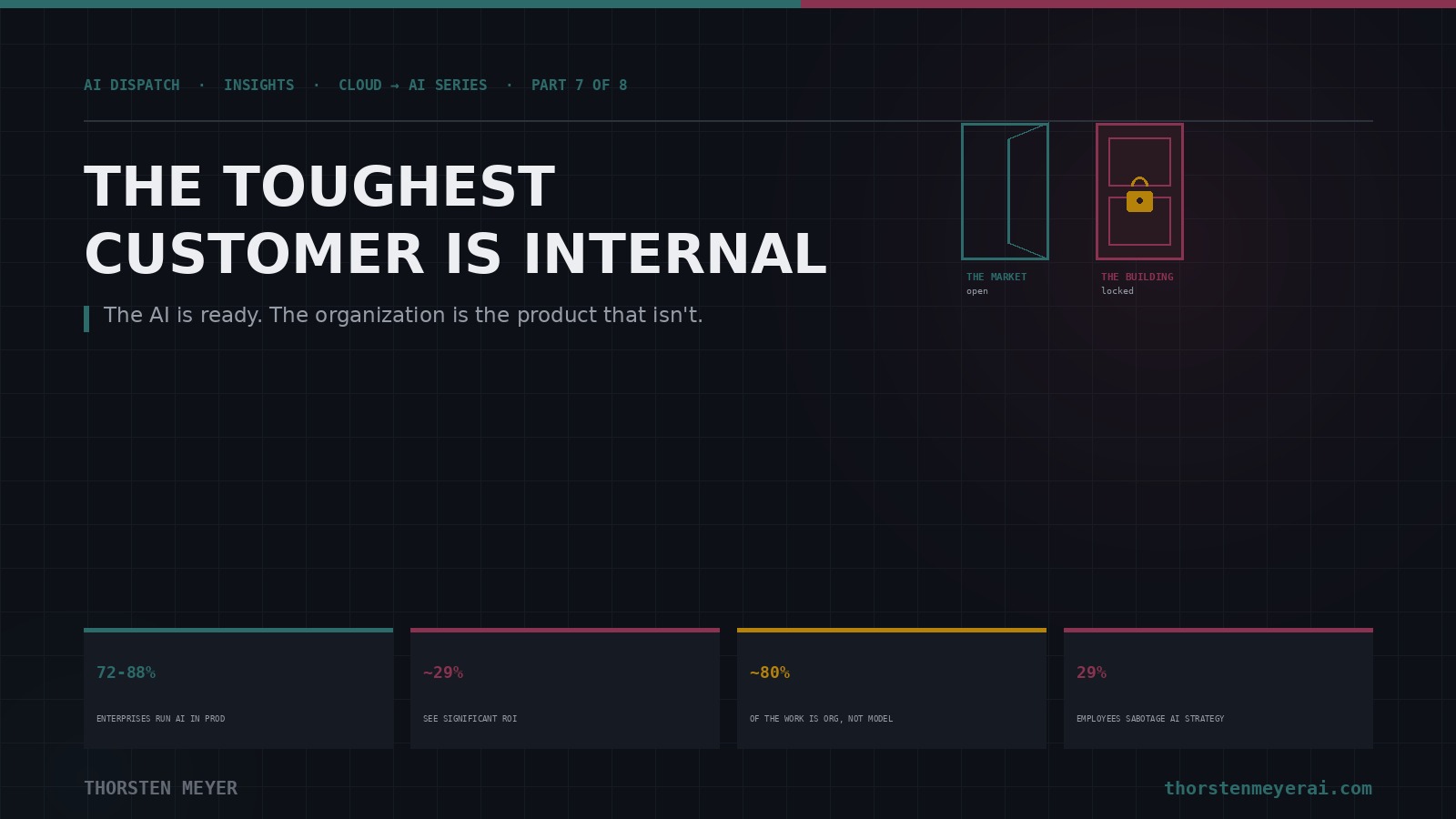
Start with the gap, because it’s genuinely striking. Adoption is nearly universal: depending on the survey, 72% to 88% of enterprises now have at least one AI workload in production, up from 55% in 2023 and 20% in 2020, and more than 80% of the Fortune 500 are running AI agents. The money is enormous — average enterprise AI spend jumped from about $7 million in 2025 toward $11.6 million in 2026, inside total AI spending Gartner puts north of $2.5 trillion.
Near-universal adoption, near-total value failure. The gap between spend and proof is the defining tension of enterprise AI in 2026.
And the return? A widely-cited MIT study found that roughly 95% of enterprise generative-AI pilots delivered zero measurable P&L impact. Only about 29% of organizations report significant ROI from generative AI; McKinsey found 88% using AI but only 39% seeing any EBIT impact; Morgan Stanley found just 21% of S&P 500 companies could cite a measurable AI benefit at all. S&P Global reported that 42% of companies abandoned most of their AI initiatives in 2025. Nearly everyone is buying. Almost no one can prove it's working. That gap — between spend and proof — is the defining tension of this moment.
As an affiliate, we earn on qualifying purchases.
Read the 95% correctly
Before drawing conclusions, I want to handle that 95% honestly, because it's been weaponized into a doom narrative it doesn't quite support. Read carefully, the number measures one specific thing: whether a pilot produced rapid P&L impact within six months — and it mostly measured pilots in sales and marketing, the lowest-ROI area studied. Measured that way, most projects "fail." So does a new hire; people rarely move the P&L in their first six months either. Only about 16% of AI initiatives scale beyond the pilot stage, but that's a statement about the difficulty of the last mile, not proof the technology is broken.
The study's most important finding got buried under the scary headline, and it reframes everything: the technology worked. The organizations didn't. The failures traced back to organizational dysfunction — unclear ownership, no predefined success criteria, workflows never redesigned — not to model capability. Which points the finger exactly where the title of this piece does: inward.
As an affiliate, we earn on qualifying purchases.
The real bottleneck was never the model
Here's the number that should reorganize how you think about this: roughly 80% of the work required to move an AI pilot from demo to production is data engineering, governance, workflow integration, and measurement infrastructure — not the model, not the prompt, not the choice of lab. The impressive part, the AI, is maybe 20% of the job. The other 80% is the unglamorous, deeply organizational work of making an institution ready to absorb it. And most pilots skip it, because a demo on clean data with forgiving users is easy, and production with messy real data, legacy integration, and demanding uptime is where 95% of them die.
The technology worked. The organizations didn't. The failures trace to organizational dysfunction — not model capability.
Consider that less than 1% of enterprise data is currently incorporated into AI models. That is not a technical limitation — the technology can ingest it. It's organizational resistance: data locked in silos, governance nobody wants to own, integration nobody scoped. The internal customer isn't refusing AI because the AI is bad. It's refusing because saying yes means doing the hard, boring, political work of changing how the institution actually operates, and institutions are built to resist exactly that.
As an affiliate, we earn on qualifying purchases.
The customer has feelings, and some of them are fear
And then there is the part that most "AI transformation" decks pretend isn't there: the internal customer is not an abstraction. It's people, and a lot of them are frightened, and some of them are actively fighting back. In one 2026 survey, 29% of employees — and 44% of Gen Z — admitted to sabotaging their company's AI strategy. Sixty-four percent fear losing their jobs to the AI transition. Sixty-seven percent of executives believe their company has already suffered a data leak from unsanctioned "shadow AI" tools that employees adopted around IT.
Sit with what that means. When you deploy AI into an organization, you are not shipping to a neutral user base. You are shipping to a workforce that, in meaningful numbers, correctly perceives the tool as a threat to its livelihood — and in some cases is quietly ensuring it fails. You cannot change-manage your way past that with a training webinar. The internal customer has to be genuinely won, not merely deployed to, and that is a fundamentally different and harder job than shipping software to someone who wants it.

AI Automation Playbook: 20 No-Code Workflows That Replace $10K/Year of Busywork: n8n, Make, and AI for Solopreneurs
As an affiliate, we earn on qualifying purchases.
As an affiliate, we earn on qualifying purchases.
What the 5% do differently
The organizations that break through share a recognizable profile, and none of it is about having a better model. Three things stand out.
The breakthrough profile has nothing to do with a better model. It's an organizational competence.
First, they partner rather than go it alone. Vendor-led and partnership deployments succeed roughly 67% of the time; purely internal, IT-only builds succeed about a third as often. This is the "AI Sherpa" pattern — the winning move is often to bring in someone who crosses both worlds, the technology and the specific institution, and guides the absorption. Building it all in-house, treating AI like ordinary software, is where enterprises most reliably stall.
Second, they redesign the workflow before choosing the tool. Organizations reporting real returns are about twice as likely to have reworked the actual process first, so the AI augments operational reality rather than being bolted onto a workflow that fights it. Tool-first fails; workflow-first works.
Third, they build measurement, governance, and real data integration underneath before deploying — the boring 80% — and they scope tightly to a specific domain instead of chasing a flashy horizontal pilot. Connected to genuine institutional data, narrowly aimed, measured against predefined criteria: that's the shape of the 5%. It is, almost entirely, an organizational competence, not a technical one.
The honest bear case
I'd be flattening a genuinely complicated picture if I left it at "it's all just change management." So the counter-case, which matters.
This is the lag, not the verdict — and lags break. As I argued in the cloud piece, enterprise adoption of every platform shift has followed the same shape: years of skepticism and poor absorption, then a fast break. Enterprises today are not dismissive of AI — they want it, badly, which is exactly why they're spending billions despite the poor returns. The 95% is a snapshot of the awkward middle, not a prophecy. Treating current failure as permanent would be the same mistake people made dismissing cloud in 2010.
But not everything failing deserves to succeed. It would be too convenient to blame every stalled pilot on timid organizations. Some pilots fail because the use case was genuinely bad, the ROI was never really there, or the technology isn't as ready for that specific job as the demo suggested. The skeptics inside these companies are sometimes right, and "the org just needs to embrace it harder" can be a way of dodging that some AI projects are solutions in search of a problem.
And the resistance is partly rational — which the industry keeps refusing to hear. The same surveys that report sabotage also report that 60% of companies plan layoffs for non-adopters. Read those two facts together. When employees "resist" adopting a tool their employer has openly tied to who gets cut, that is not irrational Luddism; it's accurate threat-assessment. An organization that treats its own workforce as the obstacle to overcome — rather than the customer to win — is authoring its own internal resistance, and no amount of executive frustration changes that it's self-inflicted.
The part that's mine to make
Here's the lens I can't switch off. The internal-customer problem is, underneath, a problem of trust and incentives — and the industry's dominant answer to it, "adopt AI or be laid off," is close to the worst possible one. You cannot win a customer you are simultaneously threatening. The enterprises that succeed at absorption will be the ones that make their people the beneficiaries of AI leverage rather than its casualties, and the ones running the layoff-threat playbook are manufacturing the sabotage they then complain about.
Two structural notes from where I build. First, the shadow-AI data-leak problem — two-thirds of executives believing they've already been breached through unsanctioned tools — is one of the strongest practical arguments I know for controllable, governed, on-premises inference. If your people are going to use AI regardless, the sovereign choice is to give them a governed way to do it inside your walls rather than watching your data walk out through a consumer chatbot. Second, and more fundamentally: the reason AI-native companies post those talent-density numbers from the last piece is that they don't have this internal customer at all. They were built around AI from inception, so there's no legacy workforce, no legacy workflow, no institution to drag into the future. That absence is the real structural advantage — and it's why the incumbents' toughest competitor may not out-model them, but simply not carry the weight of having to convince anyone internally.
Where I land
The AI is ready. The organization is the product that isn't. The toughest customer in enterprise AI isn't the market, the competitor, or the regulator — it's the company's own building, and it's tough for reasons that are 80% organizational and deeply human: ownership, workflow, data, governance, and a frightened workforce that has correctly noticed the tool is aimed partly at them.
The reframe I'd offer any leader staring at their own 95%: stop treating adoption as a deployment problem and start treating it as a trust-and-workflow problem, because that's what it actually is. Win the internal customer — partner rather than build alone, redesign the work before buying the tool, do the boring 80%, and above all make your people the beneficiaries rather than the targets — and the technology, which already works, finally gets to. Fail to win them, and you'll keep buying the best models in the world and wondering why nothing moves. Next, the finale: why, despite everything in this series, incumbents turn out to be slow to adopt and hard to displace — and what that paradox means for everyone building around them.
Analysis and opinion from a builder, founder, and post-labor economist running a local-first inference operation. Figures verified at time of writing against 2025–2026 sources (MIT NANDA "The GenAI Divide," McKinsey, BCG, IBM, Morgan Stanley, S&P Global, Gartner, and enterprise-readiness surveys) for adoption rates, the ~95% pilot-ROI figure and its caveats, vendor-vs-internal success rates, and workforce-resistance data; survey figures vary by methodology and will change. Interpretation and the post-labor framing are the author's own. This is analysis, not investment advice. Part 7 of an 8-part series. Point-in-time as of 17 August 2026.