
By Thorsten Meyer
Right now, the AI incumbents look invincible. Nvidia is one of the most valuable companies in history. The frontier labs are the most sought-after businesses on earth. The hyperscalers are pouring hundreds of billions into a build-out that assumes their dominance compounds. Every one of them looks unassailable — and that is precisely the moment worth being suspicious, because every tech giant that ever fell looked exactly this invincible right before it didn’t.
This is the sixth piece in my cloud-to-AI series, and it’s the one that reaches furthest back for its evidence. The history of technology giants is the best manual we have for what happens next, not because AI repeats the past but because the ways giants die are remarkably consistent across every platform era. So let me lay out the pattern, and what it says to the companies currently sitting on top.
Giants don’t die from competition. They die from platform shifts.
Here is the single most important thing the history teaches, and it’s counterintuitive: dominant tech companies almost never lose to a direct competitor playing the same game. They lose when the platform shifts underneath them and their greatest strength becomes the anchor that drowns them. Clayton Christensen named this the innovator’s dilemma decades ago, and it keeps being right.
They die when the platform shifts underneath them — and their greatest strength becomes the anchor that drowns them. Christensen named it decades ago.
The killer is never a better version of the existing product. It’s a redefinition of the product itself the incumbent can’t embrace — because embracing it means destroying what made them rich.
IBM owned the mainframe so completely that it couldn't see the PC and client-server wave coming until it had nearly ripped the company apart. Kodak invented the digital camera and sat on it, because every incentive pointed at protecting the film business that was its entire identity. Nokia and BlackBerry owned mobile phones right up until the touchscreen smartphone redefined what a phone was, and their dominance of the old definition was worthless in the new one. In each case the killer wasn't a better version of the existing product. It was a redefinition of the product itself, which the incumbent was structurally unable to embrace because embracing it meant destroying what made them rich.

AI Engineering: Building Applications with Foundation Models
As an affiliate, we earn on qualifying purchases.
As an affiliate, we earn on qualifying purchases.
The live cautionary tale: Intel
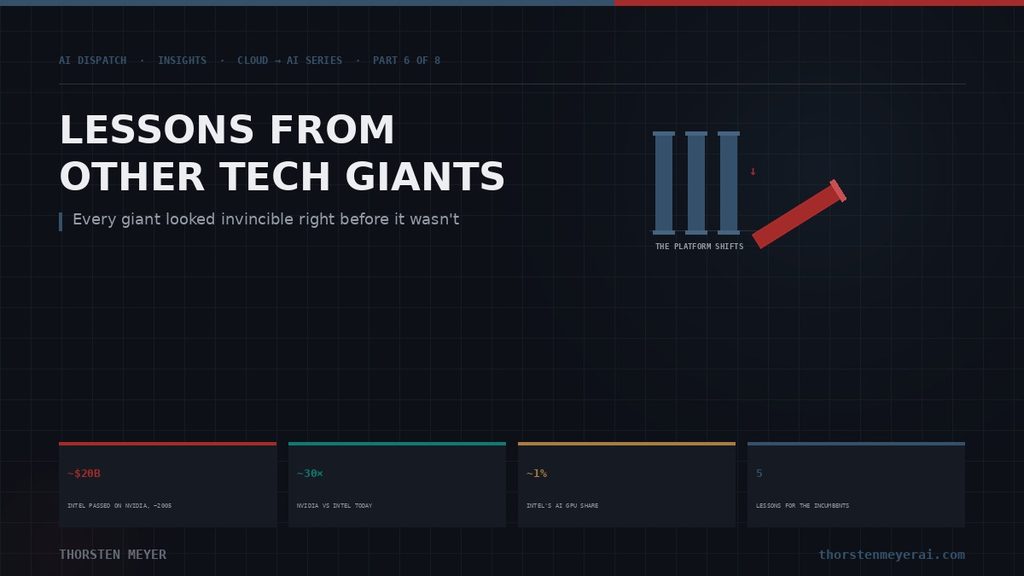
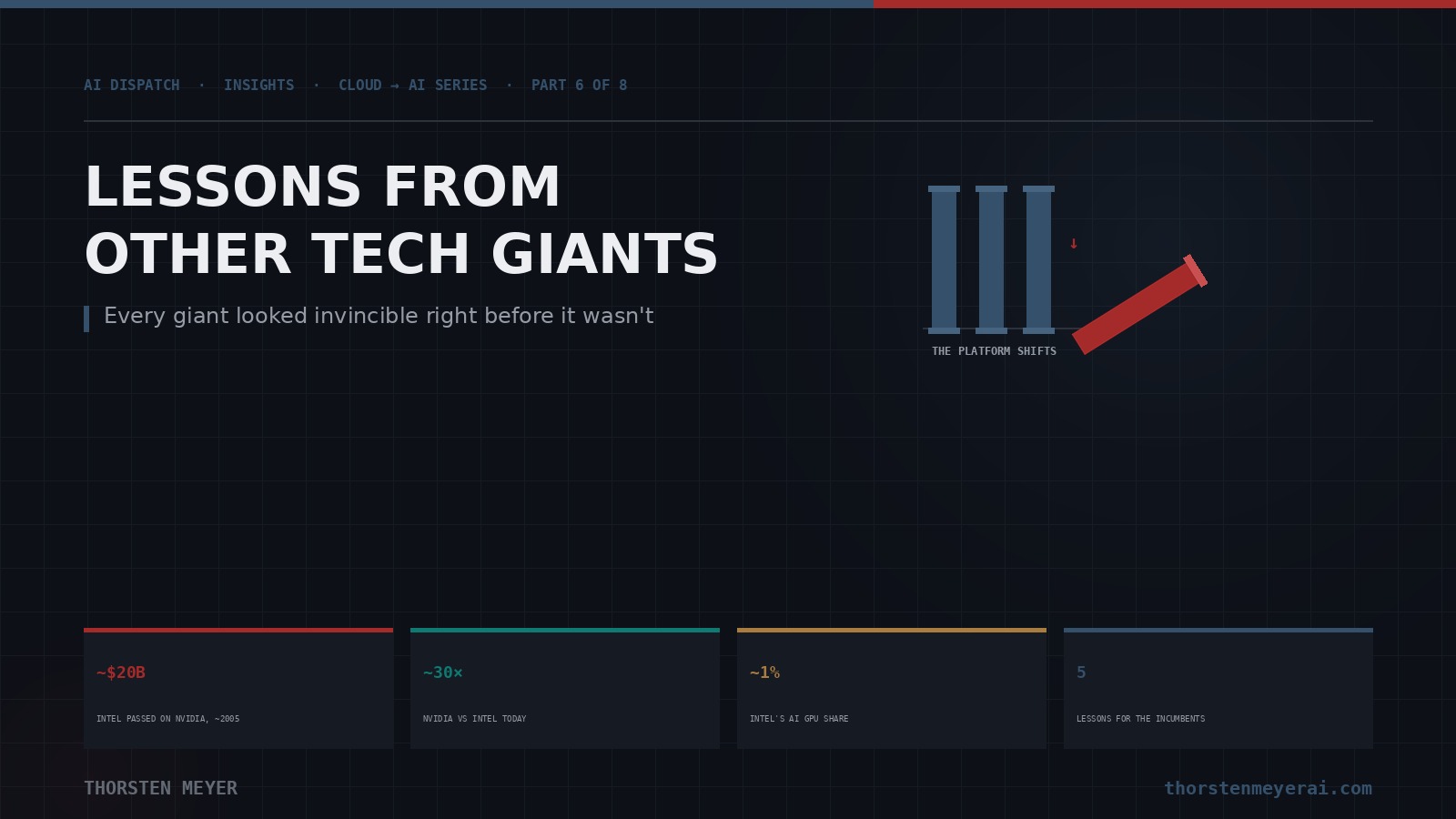
You don't have to reach into history for the clearest warning, because it's playing out in the AI era's own backyard. Intel spent decades as the most important company in computing — its chips were the substrate everything else ran on. Then it missed mobile (it reportedly passed on powering the first iPhone), and more fatally, it missed the GPU. Around 2005, Intel's leadership reportedly considered acquiring a young Nvidia for roughly $20 billion; the board balked. Nvidia went on to become the defining company of the AI era, worth more than 30 times what Intel is today.
The scorecard is brutal and public. Intel was removed from the Dow Jones in late 2024 and replaced, pointedly, by Nvidia. Its CEO was forced out. It holds around 1% of the AI GPU market that Nvidia built into a fortune, while Nvidia's CUDA software ecosystem became a moat every AI developer is now trapped inside. The most telling detail of all: Intel's stock actually soared in 2026 — but on excitement about its foundry turnaround, a fight happening entirely outside the AI-silicon race it lost. The market has effectively written Intel out of the AI story and is rewarding it for finding a different one. That is what missing a platform shift looks like from the inside: not a dramatic collapse, but a slow eviction from the future, while you're still large and still profitable and still, technically, fine.

IoT and Edge Computing for Architects: Implementing edge and IoT systems from sensors to clouds with communication systems, analytics, and security
As an affiliate, we earn on qualifying purchases.
As an affiliate, we earn on qualifying purchases.
What this says to today's giants
Now turn the lens forward, because the AI incumbents are not exempt — they're the next candidates. Five lessons transfer directly.
The incumbents aren't exempt — they're the next candidates, running the same play from the same position of overwhelming strength.
One: model supremacy is a platform, and platforms shift. The labs currently compete on having the best model. But "best model" may be the mainframe of this era — the thing you dominate right before the game changes to something else. The shift could be to agents, where orchestration and reliability matter more than raw model quality; to distribution, where whoever owns the user relationship wins regardless of whose model is marginally better; or to data and workflow integration, as I argued in the SaaS piece. The lab with the best model in 2026 could be Intel-with-the-best-CPU in 2010: still ahead, on the wrong axis.
Two: disruption comes from below, disguised as "worse." Christensen's core mechanism is that disruptors arrive cheaper and inferior, get dismissed by incumbents serving demanding high-end customers, and improve until they're good enough — at which point the bottom falls out. Open-weight models are exactly this shape. DeepSeek was dismissed, then it wasn't. Every time a frontier lab waves away open models as "not as capable," it is reading from the exact script Kodak and Nokia read from. Good-enough-and-radically-cheaper is how incumbents die, and it's the pattern I watch most closely, because it's the one that most favors the local-first, sovereign approach I build around.
Three: distribution beats invention. The pioneer rarely wins the mass market; the fast-follower with a distribution channel does. Google didn't invent search; Facebook didn't invent social; Apple didn't invent the smartphone. Each won by pairing a good-enough product with overwhelming distribution or timing. In AI, the labs invented the category — but Microsoft and Google can bundle "good enough" AI into billions of existing seats overnight. Being first to the model is not the same as being first to the customer, and history is merciless about which one matters more.
Four: the survivors cannibalized themselves. The giants that navigated platform shifts all did the same terrifying thing — they destroyed their own profitable business before someone else could. Microsoft under Nadella walked away from Windows-as-the-center and bet on cloud, cannibalizing its own crown jewel to build Azure. Apple let the iPhone eat the iPod. Amazon let AWS become a bigger story than retail. The common thread is reinvention while still dominant and cash-rich — the hardest possible time to change, and the only time it works. The caretaker executive who optimizes the existing franchise is the one who presides over the decline.
Five: regulation shapes the outcome as much as technology. It's easy to forget that Microsoft's antitrust battle arguably created the room for Google to rise; that IBM's consent decrees reshaped the industry. The AI incumbents now face exactly this — antitrust scrutiny of Nvidia's dominance, of the lab-hyperscaler entanglements, of data practices. The technology story and the regulatory story are not separate, and the giants who forget that get blindsided by the half of the game they weren't playing.
As an affiliate, we earn on qualifying purchases.
The honest bear case — against my own analogy
I'd be committing the exact error this series keeps flagging if I handed you "history repeats, the giants will fall" as confidently as the invincibility narrative I'm criticizing. So here's the case against my own framing.
You don't have to reach into history for the clearest warning — it's in the AI era's own backyard.
- Passed on a young Nvidia (~$20B)
- Removed from the Dow (2024), CEO out
- ~1% of the AI GPU market
- 2026 rally is on foundry — not AI
- ~$300B (2022) → multi-trillion — ~30× Intel
- ~70–90% of AI GPU revenue
- CUDA: a full-stack software moat
- The substrate every AI dev depends on
History rhymes; it doesn't repeat. AI may be genuinely different in a way that breaks the analogy. The data-and-compute flywheel could produce winner-take-most dynamics that prior platform shifts didn't have — where scale advantages compound rather than erode, and the leader's lead widens instead of inviting disruption. If that's true, the innovator's dilemma is the wrong map, and the giants really are more durable than history suggests.
The lessons are riddled with survivorship bias. We remember Nadella's Microsoft and forget the dozens of companies that tried the same bold reinvention and died anyway. "Cannibalize yourself" is great advice that also describes many firms that cannibalized themselves straight into oblivion. The pattern is real, but it's not a formula, and treating it as one is how you talk yourself into a confident wrong prediction.
And Intel itself is a caution against the caution. Nobody predicted Intel's 2026 stock surge on foundry momentum. The company written out of the AI story found a different story. Which is the deeper lesson: the future is genuinely hard to call, incumbents can reinvent on axes nobody was watching, and anyone — including me — narrating a clean "giants will fall" arc is overreaching. The honest version is that platform shifts create the opening for giants to fall, not the certainty.

Enterprise AI Solutions Architecture: The Practitioner’s Handbook for Designing, Delivering, and Scaling Production AI Systems
As an affiliate, we earn on qualifying purchases.
As an affiliate, we earn on qualifying purchases.
Where I land
The value of studying the old giants isn't a prediction that the new ones will fall. It's a corrective to the invincibility narrative that surrounds them right now — a reminder that dominance on the current axis has, historically, been the single most reliable setup for being blindsided by a shift to a new one. The AI incumbents are not fated to become Intel. But they are running the same play Intel ran, from the same position of overwhelming strength, with the same structural incentives to protect what made them rich.
The meta-lesson, and the one that ties this whole series together, is that incumbency is temporary and platform shifts are where value relocates. That's the thread through cloud, SaaS, fintech, and energy: the pie moved, and the winners were rarely the ones defending the old center. For a small builder, that's not a threat — it's the entire opportunity. Giants are more vulnerable than their market caps suggest, the disruption tends to come from below and cheaper, and the axis that matters next is rarely the one everyone is measuring today. Watch the shift, not the scoreboard. Next in the series: the hardest customer any of these companies has to win — the one inside their own building.
Analysis and opinion from a builder, founder, and post-labor economist running a local-first inference operation. Historical cases (IBM, Kodak, Nokia, BlackBerry, Microsoft, Apple, Amazon) reflect well-documented technology history; present-day figures on Intel (Dow removal 2024, leadership change, ~1% AI-GPU share, 2026 foundry-driven rally) and Nvidia (market cap and GPU-share dominance, CUDA moat) were verified at time of writing against 2025–2026 reporting and will change. The innovator's-dilemma framing follows Clayton Christensen. Interpretation is the author's own. This is analysis, not investment advice. Part 6 of an 8-part series. Point-in-time as of 16 August 2026.