
TL;DR
A report attributed to Huawei Pangu says AI forecasting is changing weather prediction as communities face rising extreme-weather risks. The available report headline provides no model version, benchmark results or new research, leaving the scope and strength of the claim unverified.
A report attributed to Huawei Pangu says AI-based weather forecasting is reshaping predictions as societies confront rising extreme-weather risks, highlighting the potential for faster and more useful forecasts while leaving the claimed advance without published supporting details.
The report frames artificial intelligence as a major change in weather prediction, where rapid processing could help meteorological agencies identify developing conditions sooner. Its available headline connects that capability to more frequent or severe extremes, but does not identify a specific forecast event, model release or operational deployment.
No technical information accompanies the claim. The report does not provide a Pangu model version, forecast horizon, geographic coverage, training dataset or comparison with numerical weather prediction. It also offers no accuracy scores for temperature, precipitation, wind or extreme-event forecasting, making it impossible to measure the reported improvement.
The distinction matters because AI forecast speed and forecast accuracy are separate measures. A system may generate results quickly without improving every prediction, while strong average performance may still conceal weaknesses involving rare local events. The available information does not establish performance on either measure.
AI Forecasting Meets a World of Rising Extremes
A Huawei Pangu-linked report presents artificial intelligence as a major shift in weather prediction. The promise is compelling: faster guidance and earlier warnings. The missing benchmarks, model details and deployment evidence make the strength of that claim impossible to verify.
Why faster forecasts could reduce harm
Weather guidance shapes decisions across emergency response, transport, agriculture, energy and daily life. Faster computation could give professional forecasters more time to inspect dangerous patterns and issue warnings—provided the guidance remains reliable.
Earlier threat review
Rapid AI output may give meteorologists additional time to assess developing heat, flood, cyclone or severe-storm risks before conditions worsen.
01Warnings carry consequences
False alarms impose costs; missed events leave communities exposed. Processing speed only becomes valuable when paired with tested accuracy and calibrated uncertainty.
02AI joins the toolkit
AI guidance can sit beside physics-based models, satellite observations, radar data and human analysis. It need not replace the established forecasting stack.
03The headline leaves critical blanks
No technical documentation accompanies the available claim. Without a model identity, test design or comparison baseline, readers cannot determine whether this concerns new research, an existing Pangu system, a commercial service or a broad industry review.
| Evidence item | Needed to evaluate | Available report |
|---|---|---|
| Model identity | Version, architecture, release date | ✗ Not supplied |
| Forecast scope | Horizon, region, resolution | ✗ Not supplied |
| Training basis | Datasets and observation period | ✗ Not supplied |
| Performance | Temperature, rain, wind and extremes | ✗ No metrics |
| Baseline | Operational numerical forecasts | ✗ No comparison |
| Core premise | AI may accelerate forecast production | ~ Plausible claim |
Forecast value is built end to end
A fast prediction is only one link. Useful public warnings depend on observations, model output, expert interpretation, uncertainty communication and timely action.
Atmospheric observations
AI and physics models
Forecaster analysis
Calibrated warning
Community action
Forecast speed
AI systems may reduce computing demands and generate guidance rapidly.
Published proof
The available Huawei Pangu-linked report provides no measurable support.
What readers can conclude now
The report supports interest in AI-assisted forecasting, but it does not establish superior operational performance. The central claim remains an attributed characterization rather than a confirmed finding.
A broad claim, not an identifiable release
No new model, customer deployment, research paper or specific forecast event is named in the available information.
No measurable evidence is provided
There are no accuracy metrics, test methods or direct comparisons with operational weather models.
It can create decision time
Earlier guidance may help forecasters and emergency planners review threats, but only when reliability and uncertainty are understood.
Named systems and independent tests
Readers need a version, date, datasets, geographic scope and benchmarks focused on both routine conditions and extremes.
AI may change how quickly weather guidance is produced. This report does not yet show how much better the forecasts are.
Faster Warnings Could Reduce Harm
Weather forecasts support decisions by emergency services, transport operators, energy companies, farmers and the public. If an AI system can produce reliable guidance faster or more often, forecasters may gain additional time to examine dangerous weather patterns and issue warnings before conditions worsen.
The public benefit, however, depends on more than processing speed. Forecasts used for flood preparation, evacuation planning or power-grid management need tested accuracy, stable performance and clear communication of uncertainty. False alarms can carry costs, while missed events can leave communities exposed. The Huawei Pangu-linked report does not document those operational trade-offs.

Pocket Guides – Weather Forecasting – Weather Reports – Guide to Weather Forecasting – Ron Codres
- Compact Survival Guide: Rugged, write-on weather guide
- Illustrated Forecasting: Covers cloud signals and formations
- Emergency Weather Tips: Forecasting by clouds, wind, terrain
As an affiliate, we earn on qualifying purchases.
As an affiliate, we earn on qualifying purchases.
AI Joins Established Forecast Systems
AI weather systems generally learn patterns from historical atmospheric data and past model outputs, allowing them to calculate predictions with fewer computing demands than some physics-based systems. Conventional forecasting instead uses equations describing the atmosphere and oceans, supported by large observation networks and high-performance computers.
The two approaches are not necessarily direct replacements. Meteorological agencies can use AI-generated guidance alongside established models, satellite measurements, radar data and human analysis. For operational adoption, agencies typically need testing across different regions and seasons, including unusual events that appear infrequently in training records.
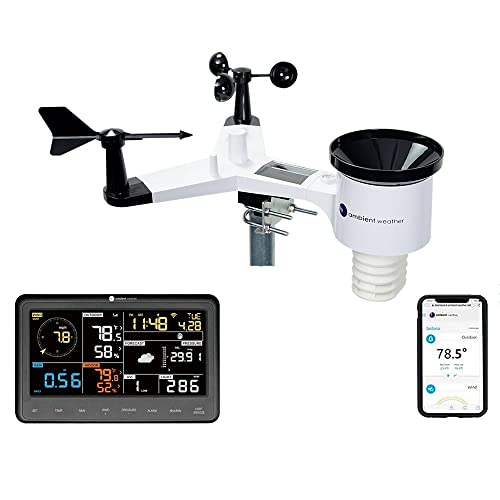
Ambient Weather WS-2902 Wi-Fi Smart Weather Station
- Complete Weather Station: Includes Sensor Array and LCD Display
- Hyper-Local Weather Data: Wireless sensors measure wind, rain, UV, and more
- Smart Home Compatibility: Supports alerts and remote access via IFTTT, Alexa, Google
As an affiliate, we earn on qualifying purchases.
As an affiliate, we earn on qualifying purchases.
Evidence Behind the Claim Is Missing
It is not clear whether the report refers to new research, an existing Huawei Pangu system, a new commercial service or a broader review of AI forecasting. There is also no stated publication date, deployment partner or independent evaluation tied to the reported development.
The phrase linking AI forecasting with rising extremes also lacks a defined dataset, region and observation period. No evidence is presented showing that the unnamed system predicts heat waves, floods, cyclones or severe storms more accurately than current alternatives. Any claim of a forecasting revolution remains an attributed characterization rather than a confirmed performance finding.

DreamSky Weather Radio NOAA Alert with Battery Backup & FM Radio for Home
- S.A.M.E. NOAA Weather Radio: Localized emergency alerts for your area
- 80+ Emergency Alerts: Multiple alerts with 3 notification modes
- Digital FM Radio: Enjoy music, news, and talk shows
As an affiliate, we earn on qualifying purchases.
As an affiliate, we earn on qualifying purchases.
Benchmarks Must Supply the Proof
The next meaningful step would be publication of model documentation, dated benchmark results and comparisons against recognized operational forecasts. Independent testing should examine both routine conditions and high-impact extremes, while any deployment would need to show how professional forecasters use the output and communicate its uncertainty.

Sainlogic WiFi Smart Weather Station 14-in-1 with 24/7 Accurate Weather Forecast by Weatherseed AI, 8.5" Large Display, Wind Gauge, 2-Year Data Storage & Export (Only 2.4G)
- WiFi Connectivity: Supports 2.4G WiFi for app access
- AI Weather Forecast: 24/7 accurate predictions with instant alerts
- Real-Time Monitoring: Tracks temperature, humidity, pressure continuously
As an affiliate, we earn on qualifying purchases.
As an affiliate, we earn on qualifying purchases.
Key Questions
What was announced?
A report attributed to Huawei Pangu presented AI as a major force in weather forecasting. The available information does not identify a new model release, customer deployment or research paper.
Does the report prove that AI forecasts are more accurate?
No. It provides no accuracy metrics, test methodology or direct comparison with operational weather models. Better performance cannot be confirmed from the headline alone.
Why could faster forecasting matter?
Faster forecasts could give meteorologists and emergency planners more time to review developing threats. That value depends on reliable predictions and well-calibrated uncertainty, not speed alone.
What information is needed next?
Readers need a named model version, publication date, datasets, regional coverage and independent benchmarks covering extreme-weather events. Those details would show whether the report describes a tested advance or a broad industry claim.
Source: Huawei Pangu
Source: Huawei Pangu