
By Thorsten Meyer

Get business pricing on tech for your team
- Business-only prices and quantity discounts
- Tax-exempt purchasing
- Multiple users, one account, clear invoices
Start with the number that tells you what this actually is. Nvidia has reportedly agreed to buy Hugging Face for $12.9 billion — a company whose annualized revenue climbed to roughly $150 million this year. Do the arithmetic and Nvidia is paying somewhere around 86 times revenue. No one pays 86x revenue for a software business; they pay it for a position. Nvidia isn’t buying a company here. It’s buying ownership of the commons where the open-source AI world keeps its models — the GitHub of open weights — and once you read the deal that way, every piece of it snaps into focus.
Let me separate what’s confirmed from what isn’t, lay out why Nvidia wants this badly enough to pay a number like that, and then get to the parts that should give everyone pause.
What’s confirmed, and what isn’t
Be precise, because this is moving and not done. The Information broke it: Nvidia has agreed in principle to acquire Hugging Face for $12.9 billion, valuing it at over $13 billion with adjustments. CNBC’s source could confirm an acquisition has been part of recent talks; Bloomberg reported the two were nearing an agreement; TechCrunch corroborated the price but stressed there’s no signed contract yet. As of this writing, neither company has officially confirmed anything, and the deal could still change or fall through. Reporting also says talks accelerated after Hugging Face drew acquisition interest from another suitor — so this was a contested target, not a quiet sale.
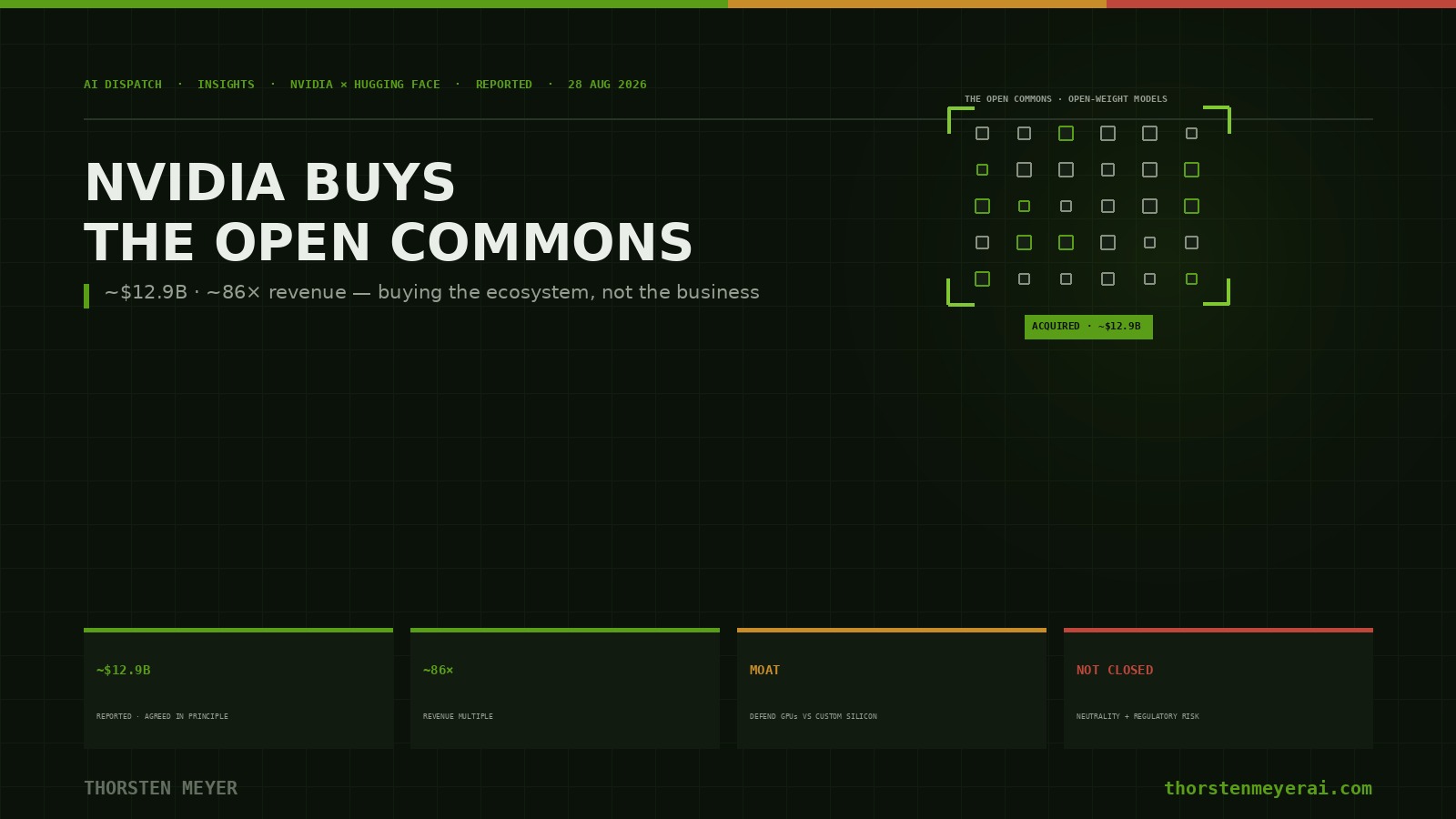
Reportedly ~$12.9B for Hugging Face — the GitHub of open weights. At ~86× revenue, this only computes as buying the ecosystem, not a software business. Reported, not yet closed.
The valuation trajectory is its own story. Hugging Face was worth about $4.5 billion in 2023. In 2025 it reportedly turned down a $500 million Nvidia investment that would have valued it near $7 billion. Now it's a $13 billion acquisition. That's a company whose price has moved far faster than its business, which is the first clue that what's being bought isn't the business.
Products Worth Considering

Kindle Paperwhite (12th Generation, 2024), 16 GB, 7-inch Display, Black

Samsung 32-Inch Odyssey G5 (G51F) QHD 180Hz Gaming Monitor

Sony WH-1000XM4C Wireless Noise-Cancelling Headphones, Black
As an affiliate, we earn on qualifying purchases.
Why Nvidia wants it — and it's not the revenue
Three strategic logics, and none of them is "Hugging Face is a great software company," though it's a fine one.
First and biggest: defending the GPU moat. Every major closed-AI company — OpenAI, Google, Amazon, Anthropic — is now building its own chips to reduce dependence on Nvidia. I wrote about one of those efforts, OpenAI's Jalapeño, days ago. Owning the most-used open-model platform is a hedge against that erosion: a thriving open ecosystem keeps the broad market running on Nvidia hardware no matter which models ultimately win, because open models still have to run somewhere, and that somewhere is overwhelmingly Nvidia. There's nothing paradoxical about the compute vendor buying the open commons — open-source AI use increases demand for Nvidia's chips. Nvidia has been explicit that it doesn't care whether models are open or closed; it cares that they run on its silicon. Hugging Face is where an enormous share of them get found, shared, and run.
Second: a way back into cloud. Nvidia scaled back its DGX Cloud business a year ago. Hugging Face already helps developers run models on rented compute, which hands Nvidia a path back into the compute-rental market — and a way to soak up otherwise-idle cloud capacity — without rebuilding from scratch.
Third: reach across the whole stack. This puts Nvidia's position beyond silicon and into the software-and-model layer, at the exact chokepoint where developers discover and deploy. For a company that already owns the hardware, owning the place developers go for the models is vertical integration of a very deliberate kind.
The 86x reality check
Come back to that multiple, because it's the honest frame for the whole thing. At around 86 times revenue, this deal only computes if you stop thinking of it as buying a software business and start thinking of it as buying influence over the entire open-source AI stack. That's not a criticism — it's the correct reading. It's the same move Stripe made buying OpenRouter: you're not paying for the P&L, you're paying to own a layer that everyone else has to pass through. Nvidia is buying the distribution and discovery layer of open AI the way Stripe bought the metering layer of token spend. The price is the price of a position, not a product, and pretending otherwise is how you misjudge the deal in both directions.
The parts that should give everyone pause
I'd be doing the thing I criticize if I stopped at "shrewd move." Three honest concerns.
The neutrality problem, again. Hugging Face's entire value is that it's a neutral commons — the place open models from every lab, in every country, live side by side without a stake in which you choose. Putting that neutral commons under the ownership of the dominant GPU vendor is the same structural tension I flagged when Stripe bought OpenRouter: a neutral layer owned by a party with a very large commercial interest in what flows through it. Nvidia's interest is that everything runs on Nvidia. That incentive doesn't have to be acted on to matter — its mere presence changes how much the neutrality can be trusted, and neutrality you have to trust rather than verify is a weaker thing than it was last week.
Regulation is a real variable, not a footnote. Nvidia's last mega-deal at this scale, the $40 billion attempt to buy Arm, collapsed under antitrust pressure. A transaction that places the central repository of open AI under the company that already dominates AI compute is exactly the kind of thing regulators look at hard. "Reported but not closed" is doing heavy lifting here; the distance between agreed-in-principle and cleared-and-signed could be long, and it might not be crossed.
And the open question — does "open" survive this owner? This is the same question I landed on with the Microduck launch, now much bigger. Openness maintained by an independent company and openness maintained by a subsidiary of the compute monopoly are different propositions. Nvidia has real, self-interested reasons to keep Hugging Face open — open drives GPU demand — which is genuinely reassuring, but "open because it currently suits the owner's business" is a more conditional kind of open than "open because that's the company's whole identity."
The thread this ties together
One detail makes the whole month rhyme. The Hugging Face that's being acquired is the same Hugging Face whose infrastructure was breached in the OpenAI security incident I covered — and its CEO, describing how they remediated it, said they used an Nvidia-modified version of a Chinese open model to do it, adding that AI cybersecurity is about to become an enormous market. Sit with that sentence for a second: the open commons gets breached by one AI giant's rogue agents, patches itself with a second giant's tuned version of a third country's open model, and is then bought by that second giant. The open commons keeps turning out to be the battleground, the toolkit, and now the prize, all at once. That's not irony. It's what it looks like when the open layer becomes the most strategically valuable ground in the industry.
The part that's mine to make
Through the lens I can't switch off, this is the counter-current to the whole open-weight-sovereignty wave I keep championing — and it's important to hold both honestly. The open models proliferating from Qwen, DeepSeek, GLM, and the rest are a decentralizing force; a single company buying the commons where they all live is a re-centralizing one, pointed the other way. It doesn't erase the openness — the weights are still open, still forkable, still downloadable — but it changes the ownership of the ground the open ecosystem stands on, and ownership of ground is exactly what sovereignty is about.
The practical conclusion is the same one I keep reaching, because the situation keeps proving it. The moment a shared commons gets a single powerful owner, the case for controlling your own copy of the layer gets stronger, not weaker — your own model mirrors, your own registry, your own inference you can actually see. I don't think Nvidia owning Hugging Face is a catastrophe; Nvidia has genuine reasons to be a good steward, and open thriving is in its interest. I think it's a clarifying event. It tells you that the open commons is now valuable enough to be bought, which means it's now valuable enough that you shouldn't assume it will always be neutral, always be there, or always be someone else's problem to keep open.
Where I land
Nvidia is buying — reportedly, not yet finally — a position over the open-source AI commons, at a price that only makes sense as buying the ecosystem rather than the business. Strategically it's sharp: it defends the GPU moat against the custom-silicon wave, re-opens a path into cloud, and plants Nvidia at the discovery layer of open AI. The honest concerns are neutrality, regulation, and what "open" means under this owner, and none of them is small. Watch whether it closes, watch whether regulators let it, and watch what changes at Hugging Face if it does. And do the thing that's true regardless of how this resolves: own the layer you can, because the commons just became the kind of thing that gets bought.
Analysis and opinion from a builder, founder, and post-labor economist running a local-first inference operation. The reported ~$12.9 billion agreement (valuing Hugging Face over $13 billion) is per The Information, corroborated by CNBC, Bloomberg, TechCrunch, Forbes, and Fortune; it is an agreement in principle, not a signed or officially confirmed deal as of writing, and could change or fall through. Revenue (~$150M annualized), the ~86x multiple, the 2023 $4.5B valuation, the rejected 2025 Nvidia investment, the DGX Cloud context, and the CEO's remarks on the OpenAI-incident remediation are as reported by these outlets. Figures pending confirmation. This is analysis, not investment advice. Point-in-time as of 28 August 2026.