By Thorsten Meyer | November 29, 2026 | ThorstenMeyerAI.com

Get business pricing on tech for your team
- Business-only prices and quantity discounts
- Tax-exempt purchasing
- Multiple users, one account, clear invoices
A Florida man pretended to be a popular streamer to sell a fake endorsement. The final proof he sent was a voice message made with AI. The buyers paid about $260,000. Now he has been sentenced to 47 months in prison.
The case shows how a voice clone works in practice. It was not one fake message. It was a chain of fake accounts, fake paperwork and a fake voice, each making the next one more believable.
This article explains how the scheme worked, according to prosecutors as reported, and what creators, brands and viewers can check. Reports as checked on Sunday, November 29, 2026.
Key takeaways
- The sentence: David Anthony Sanchez, 36, of Port St. Lucie, Florida, got 47 months after pleading guilty to money laundering and aggravated identity theft, the Times of India reported, citing the US Department of Justice.
- Who was impersonated: the Kick streamer N3on. He did not take part in the scheme.
- How it worked: fake accounts, agreements signed in the streamer’s name, and an AI-generated voice recording that “confirmed” the deal.
- The money: organisers of a memecoin project sent about $260,000 in cryptocurrency for an endorsement that never existed.
- What happens now: the court ordered restitution to the victims. The amount was not given.
Sentenced · guilty plea
How a cloned voice sealed a fake endorsement
Prosecutors described a chain of fakes, as reported. The voice was the last link, and the one that made the deal feel real.
- Step 1Fake accountsOnline accounts made to look like they belonged to the streamer N3on.
- Step 2A fake representativeHe wrote to the organisers as the streamer and as his representative.
- Step 3The AI voiceA cloned voice recording falsely confirmed the streamer was in.
- Step 4About $260,000 sentThe organisers of a memecoin project paid in cryptocurrency.
- Sentence47 monthsAfter a guilty plea to money laundering and aggravated identity theft.
- Blue: fake accounts and fake paperwork.
- Orange: the AI-generated voice recording.
Sources: The Times of India, November 28, 2026, reporting the US Department of Justice; Gizmodo, November 27, 2026. Schematic.
Graphic: Powered by Thorsten Meyer AI
Products Worth Considering

Apple MacBook Air 13-inch Laptop with M5 Chip, 32GB Memory, 1TB SSD, Silver

DJI Osmo Mobile 8 Phone Gimbal with Mic Mini Transmitter, Infinity Black

Jackery Explorer 300 Portable Power Station, 292Wh
As an affiliate, we earn on qualifying purchases.
What this means for you
- If you are a brand or a project paying a creator: never let a voice note, a chat or a signed PDF be the final proof. Confirm the deal through a contact you found yourself, such as the creator’s known management or a verified channel.
- If you are a creator: tell partners in public how you do deals and who speaks for you. Then a fake “representative” stands out.
- If you are a viewer: a familiar voice is no longer proof of who is speaking. Be wary when a clip pushes you to send money or buy a coin fast.
- If you work in finance or sales: the same pattern can hit any payment approval. A call-back on a number you already know is cheap and works against cloned voices.
The tips above are our reading of the case, not advice from the court or prosecutors.
In plain words
- Voice clone: an AI copy of a person’s voice that can say new sentences the person never spoke.
- Impersonation: pretending to be someone else, here online and on the phone.
- Memecoin: a cryptocurrency built around a joke, a meme or a famous name, often promoted by influencers.
- Money laundering: moving money through transactions to hide where it came from.
- Aggravated identity theft: a US federal crime of using another person’s identity while committing certain other crimes.
- Restitution: money a court orders a criminal to pay back to the victims.
How did the scheme work?
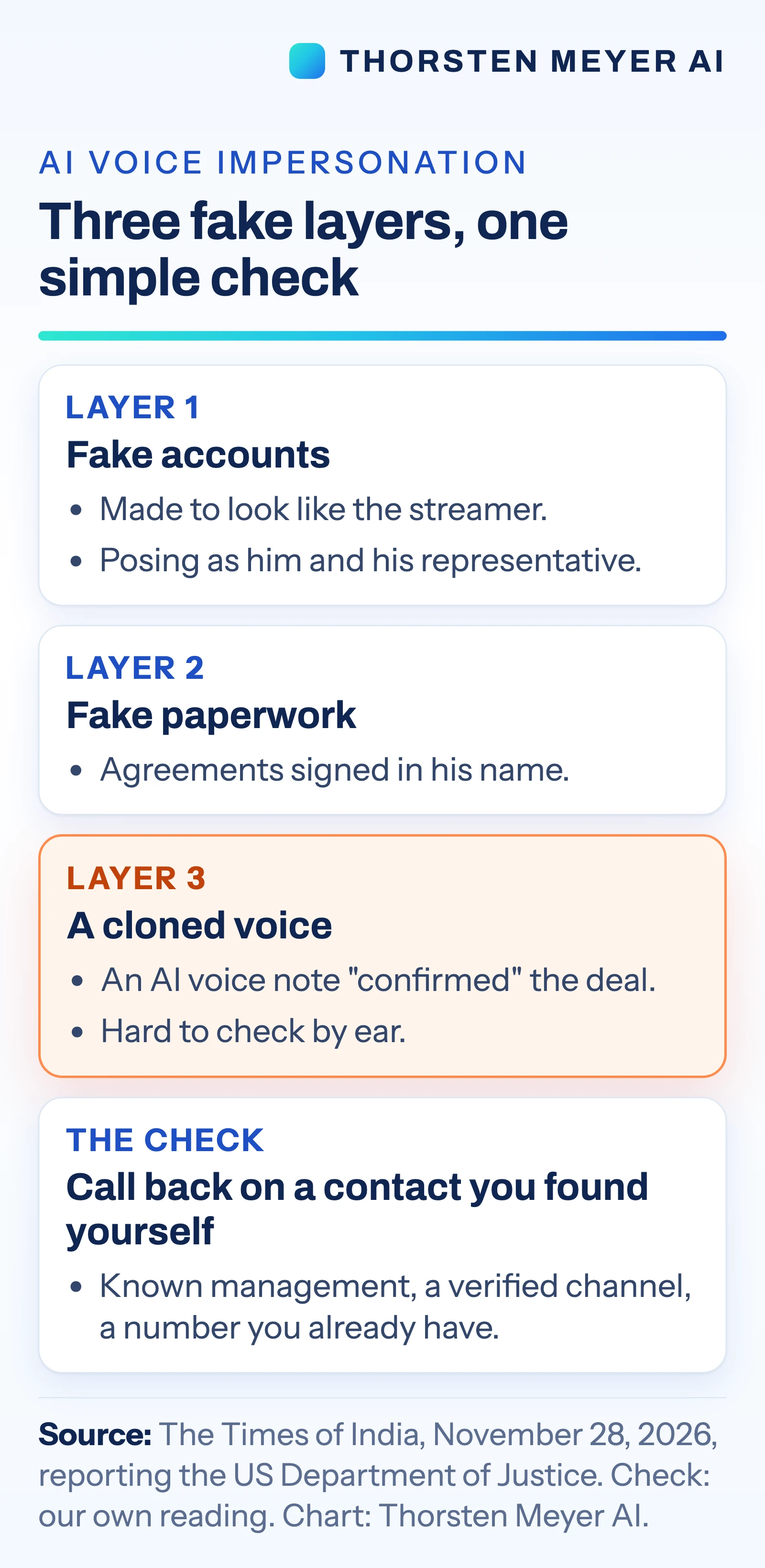
Prosecutors described three layers, as reported by the Times of India. Each one made the next one easier to believe.
First, the accounts. Sanchez “created online accounts designed to look as though they belonged to N3ON”, the report said. He contacted the organisers while posing both as the streamer and as his representative.
Second, the paperwork. He “executed agreements using N3ON’s identity”. The documents made the deal look formal.
Third, the voice. Sanchez sent the organisers audio “that mimicked N3ON’s voice and falsely confirmed his participation”, prosecutors said. Believing it, the victims transferred about $260,000 in cryptocurrency to accounts he controlled.
Think of it like a forged letter that arrives with a forged signature and then a phone call from the “sender”. Each piece alone might raise doubts. Together, they feel like proof. The picture has a limit: a letter can be checked by an expert, but a short voice note is hard for anyone to check by ear.
What happened to the money?
Sanchez “converted a substantial portion of the cryptocurrency into US dollars” through transactions designed to hide its source, the report said. He used the money for his personal benefit, according to the Justice Department.
That is what money laundering means here: not just taking the money, but trying to hide where it went.
The court also ordered him to pay restitution to the victims. The Justice Department did not specify the amount, the Times of India reported. It also did not name the memecoin project.
Who decided the case, and when?
The Justice Department announced the sentence on November 24, the Times of India reported. US District Judge Melissa Damian handed it down in the Southern District of Florida. The FBI’s Miami field office investigated.
Sanchez pleaded guilty, so there was no trial on the facts. He also used other names, including “Dave the Jeweler”, the report said.
Acting US Attorney Yara Lorenzo Klukas spoke about the role of AI. “In this case, the defendant exploited artificial intelligence to manipulate the trust of unsuspecting victims and deprive them of their money,” she said.
Why does a voice make a scam work?
A voice feels personal. We trust it more than a typed message, because for most of history only the real person could produce it.
That shortcut no longer holds. The Times of India noted that the FBI has warned before that AI-generated audio can make fraudulent requests for money sound more credible.
There is an odd twist in this case. N3on has himself experimented with AI versions of himself, including a digital likeness used to keep broadcasts running, according to technology and gaming publications cited by the Times of India. When a creator’s own content may be partly AI-made, a cloned voice is even harder to spot.
You don’t need to know how voice cloning works in detail. Just remember: the voice is not the check. The channel you used to reach the person is.
What we know, and what we don’t know
What we know:
- Sanchez was sentenced to 47 months after pleading guilty to money laundering and aggravated identity theft.
- He used fake accounts, agreements in the streamer’s name and an AI-generated voice recording.
- The victims sent about $260,000 in cryptocurrency, and the court ordered restitution.
What we don’t know yet:
- Which memecoin project it was. The Justice Department did not name it.
- How much will be paid back. The restitution amount was not given.
- Which tool made the voice. The reports do not say.
The bottom line
This was not a high-tech heist. It was an old trick, the fake middleman, with one new tool on top. For you, the defence is just as simple: confirm big deals and payments through a contact you found yourself, not through the voice that is asking.
Further reading: Block’s Dessa Laughs, Hesitates and Interrupts Like a Person. Why a Human-Sounding Voice Is a Scam Risk
I’m Thorsten Meyer. The full sources are below, and more reality checks are at thorstenmeyerai.com.
Sources
- The Times of India: “A Florida man created fake accounts and used AI to mimic a popular streamer’s voice …”, November 28, 2026, reporting the US Department of Justice announcement of November 24
- Gizmodo: “Florida Man Jailed for Using AI to Impersonate Streamer in Memecoin Scam”, November 27, 2026
- The Justice Department’s own release (justice.gov) answered our request with a bot check; we did not work around it and quote the release only as reported.
—
Researched and drafted with AI assistance, including Anthropic’s Claude. No government, company or person named here reviewed or sponsored this article. Our own text and graphics contain no affiliate links; offer and product boxes added by the site may contain Amazon affiliate links. This article is for information only. It is not legal, financial or investment advice. Reports as checked on November 29, 2026. Images: AI-generated illustration (Runware) and graphics by Thorsten Meyer AI; our own images show no real people or logos. Boxes added by the site may show product photos or people.