By Thorsten Meyer | October 16, 2026 | ThorstenMeyerAI.com

Get business pricing on tech for your team
- Business-only prices and quantity discounts
- Tax-exempt purchasing
- Multiple users, one account, clear invoices
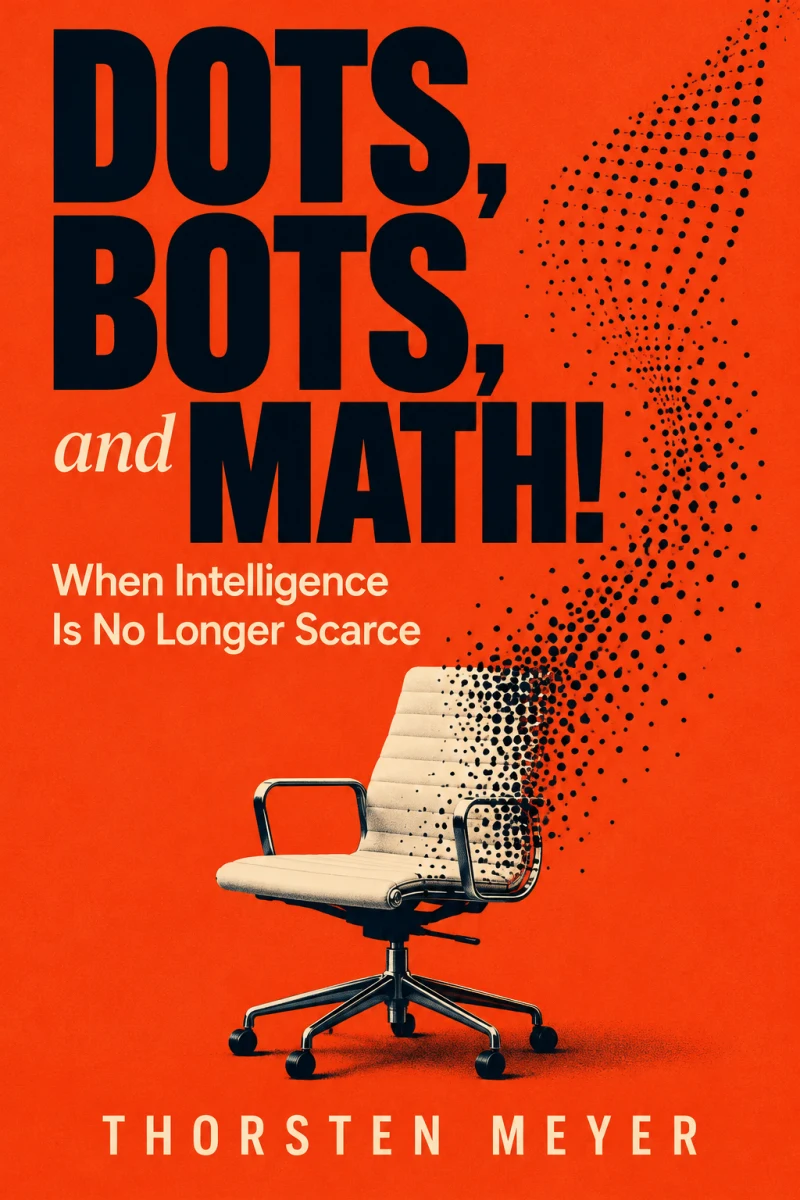
What happens to work, wealth, and human purpose when intelligence is no longer scarce? That’s the question behind my new book. The ebook is out now at Apple Books, Barnes & Noble, Kobo, Bookshop.org and other stores.
My new book, Dots, Bots, and Math! When Intelligence Is No Longer Scarce, went into distribution on October 16, 2026, and the ebook is now available. Library platforms such as OverDrive, hoopla and cloudLibrary, and a few more stores, follow over the coming days.
Get the ebook: Apple Books · Barnes & Noble · Kobo · Bookshop.org · Smashwords · Fable · Vivlio
If you read my essay Dots, Bots, and Math earlier this week, this is the long version: about 75,000 words, twelve chapters, 613 source notes, and a glossary of 55 terms. Here’s what it’s about, and why I wrote it.
The assumption we stopped noticing
We rarely notice the assumptions we live inside, because they are everywhere. One of the deepest is that useful thinking is scarce.
It’s built into almost everything. Schools produce a limited supply of trained minds, and credentials certify who has one. Companies are organized around the limited attention of the people in them: meetings to decide what deserves attention, reports to compress information for the busy, managers to route it, approvals to make sure someone accountable has looked. Wages price that scarcity, and taxes, pensions and health insurance are financed from those wages.
Calculation was the first part of this assumption to break. Before electronic machines, “computer” was a job title for people who calculated, often in large rooms. That job disappeared, and no modern institution is organized around a shortage of arithmetic anymore. But the rest held. Understanding, coordinating, following up and deciding stayed human work.
The book argues that the systems arriving now are the first to plausibly reach into that remaining scarcity. Not all of it, and not reliably yet. But far enough that the arrangements built on top of it start to look less permanent than they did.
As an affiliate, we earn on qualifying purchases.
Dots, bots, and math
The title names three developments.
Dots are persistent AI agents: software that holds a person’s goals over days and keeps working after the conversation ends. I use “dot” in lowercase as a general term for any such agent, whoever makes it. Several companies launched products like this in 2026, and people also run open-source agents on their own hardware. The book treats none of them as its subject and has no affiliation with any company that uses the name for a product.
Bots are systems that carry out and check real work. Here the book draws a line that many demonstrations blur: a plausible output is not the same as a completed, verified task.
Math stands for machines producing new results faster than people can verify them. The book separates four things that are easily confused: a candidate result, a publication, a formal proof, and acceptance by the people who have to build on it.
The title, decoded
Three developments, one question.
What happens to work, wealth and purpose when thinking is no longer scarce? The book follows three developments that reach into the work that stayed human.
Dots
Agents that don’t go away
Persistent AI agents that hold a person’s goals over days and keep working after the conversation ends.
The book’s term“dot”, lowercase, means any persistent agent, whoever makes it.
Bots
Software that does the work
Systems that carry out and check real work, not just suggest it.
The distinctionA plausible output is not a completed, verified task.
Math
Discovery becomes a system
Machines producing new results faster than people can verify them.
- 1Candidate result
- 2Publication
- 3Formal proof
- 4Accepted by the people who build on it
The book discusses agent products from several companies plus self-hosted open-source agents. It has no affiliation with any company that uses the name “Dots” for a product.
Source: Thorsten Meyer, Dots, Bots, and Math! When Intelligence Is No Longer Scarce (ebook, October 2026).
Powered by Thorsten Meyer AI
As an affiliate, we earn on qualifying purchases.
Walkers and rocket builders
The central image of the book is the difference between walkers and rocket builders.
A walker gets better at a known route: faster, safer, more skilled. That is real expertise, and it’s easy to measure and reward. A rocket builder asks which parts of the climb the destination actually requires. Much of the early use of AI makes walkers faster. The bigger changes come when someone redesigns the route itself, for example when a weekly report is replaced by a system that alerts the right person when a decision is needed.
I don’t present redesign as a happy ending. The same chapters describe how redesigns fail, how they can concentrate power, and how they can remove work people valued. Rocket builders need the walkers’ knowledge more than ever. Someone has to know where the ground is loose.
The book's central image
Walkers and rocket builders.
Two kinds of intelligence: getting better at a task, and asking whether the task should exist at all.
The walker
Gets better at the route
Learns the terrain, gains speed and skill, earns every step. Real expertise, easy to measure and reward. Much early use of AI makes walkers faster.
“How do I walk faster?”
The rocket builder
Questions the route
Asks which parts of the climb the destination actually requires. Needs the walker’s knowledge to build something that doesn’t crash.
“Why are we walking at all?”
An example from the book
A composite scene from the Prologue.
Redesign is not a happy ending by default. It can fail, concentrate power, and remove work people valued.
Source: Thorsten Meyer, Dots, Bots, and Math! When Intelligence Is No Longer Scarce (ebook, October 2026).
Powered by Thorsten Meyer AI
machine learning mathematical proof tools
As an affiliate, we earn on qualifying purchases.
As an affiliate, we earn on qualifying purchases.
What doesn’t get cheaper
A deliberate counterweight runs through the middle of the book. Energy, materials, physical work, trust and legitimacy don’t become cheap because thinking does. When one form of intelligence becomes abundant, the constraint moves to whatever hasn’t.
That makes the economic questions in the last part of the book sharper, not softer.
As an affiliate, we earn on qualifying purchases.
Who owns the rockets?
If a growing share of value is produced by models, chips, data centers and agents, it matters enormously who owns them. The book offers a four-question test for any proposal about the AI economy:
- Who controls it? Who holds the productive asset: the models, the chips, the cloud, the data, the agent platforms?
- Who can inspect it? Can users and the public see how it behaves and what it does on their behalf?
- Who carries the risk? When it fails or changes its terms, who pays, and can they leave?
- Who receives the gain? Owners, workers, customers, the public: where does the value end up?
The book applies those questions to every layer of the technology, and to older ways societies have shared the gains of a common resource.
A test for any proposal about the AI economy
Four questions about who owns the rockets.
If more value comes from systems of models, chips, data centers and agents, ownership decides who benefits. The book asks the same four questions every time.
Who controls it?
Models, chips, cloud, data and agent platforms: who holds the productive asset?
Who can inspect it?
Can users and the public see how it behaves and what it does on their behalf?
Who carries the risk?
When it fails or changes its terms, who pays, and can they leave?
Who receives the gain?
Owners, workers, customers, the public: where does the value end up?
Applied to every layer
And to older ways societies have shared the gains of a common resource.
Source: Thorsten Meyer, Dots, Bots, and Math! When Intelligence Is No Longer Scarce (ebook, October 2026).
Powered by Thorsten Meyer AI
More than a paycheck
One chapter goes back to the 1930s and the study of Marienthal, an Austrian village whose factory closed. The researchers documented what a job provides besides money: a structure for the day, contact with other people, shared purpose, status and regular activity.
A society could become much richer and still leave many people adrift, unless it deliberately builds other ways to provide what work used to provide. The closing chapter doesn’t prescribe a single policy. It describes several paths a society might take, with signposts readers can watch for themselves, and weighs a toolbox of options on evidence, feasibility and trade-offs.
What this book is, and what it isn’t
It’s written for general readers. You don’t need a technical background, and there’s no code in it.
It isn’t a how-to guide for AI tools. The tools change too quickly for that kind of advice to stay useful. And it isn’t a forecast. Yesterday I published ten predictions for 2027, each with a confidence level. This book deliberately makes none. Where it discusses scenarios, it says so.
Each chapter follows the same discipline. It opens with a scene, develops one central idea, gives the strongest objection a fair hearing, and ends with a question that the next chapter takes up. Claims are labeled by evidence type: demonstrated, reported, independently validated, or scenario. Some scenes are composite illustrations built from common situations, and they are labeled as composites.
Inside the book
Three parts, twelve chapters.
Written for general readers: no technical background needed, no code. Not a how-to guide and not a forecast.
Part I
When Intelligence Becomes Abundant
- The Scarcity We Built the World Around
- The Agent That Doesn't Go Away
- Bots: When Software Starts Doing the Work
- Math: When Discovery Becomes a System
Part II
Walkers, Rockets, and the Reinvention of Institutions
- Walkers vs. Rockets
- The Interface Disappears
- The Company That Rebuilt Its Org Chart
- What Doesn't Become Cheap
Part III
The Labor Zero Horizon
- When Thinking Becomes Cheap
- Who Owns the Rockets?
- Beyond the Paycheck
- The Social Contract We Haven't Written
How every chapter works
It opens with a scene, develops one central idea, gives the strongest objection a fair hearing, and ends with a question that leads into the next chapter. Composite scenes are labeled as composites. Every claim carries its evidence type:
Source: Thorsten Meyer, Dots, Bots, and Math! When Intelligence Is No Longer Scarce (ebook, October 2026). Plus an Introduction, a Prologue and an Epilogue.
Powered by Thorsten Meyer AI
Where I stand
I build and run software systems in which AI agents do work that people used to do: writing and changing software, and running a publishing operation. That makes me more confident than many observers that these changes are real. It also makes me more skeptical than many enthusiasts about how smoothly they will arrive. The most important parts of such systems are rarely the intelligent ones. They are the checks, the records, the limits on what an agent may do, and the moments at which it must stop and ask a person.
I also used AI systems in writing this book, for research, checking, drafting and review. The book says so openly. The argument and the judgments are mine. A book about what happens when intelligence stops being scarce shouldn’t pretend to have been produced as though it still were.
Where to find it
The ebook is available now at these stores:
It’s also on its way to tolino, Everand and Gardners.
It’s also going out to library platforms: OverDrive, hoopla, cloudLibrary, BorrowBox and Vivlio Libraries. If your library uses one of them, you can ask it to add the book.
If your store or library doesn’t list it yet, look again in a few days.
An invitation
For most of history, we didn’t have to decide what to do with abundant intelligence, because it didn’t exist. Our institutions made that decision for us by rationing it. If that rationing ends, even partly, the decisions come back to us: as workers and employers, as citizens and voters, as parents deciding what to tell our children about the future.
This book doesn’t tell you what to decide. It tries to show clearly what is changing, what isn’t, and which choices are still open. The machines may change the route to the summit. What the summit is for is still up to us.
Fall Picks
fall essentials
As an affiliate, we earn on qualifying purchases.