
By Thorsten Meyer | October 15, 2026 | ThorstenMeyerAI.com

Get business pricing on tech for your team
- Business-only prices and quantity discounts
- Tax-exempt purchasing
- Multiple users, one account, clear invoices
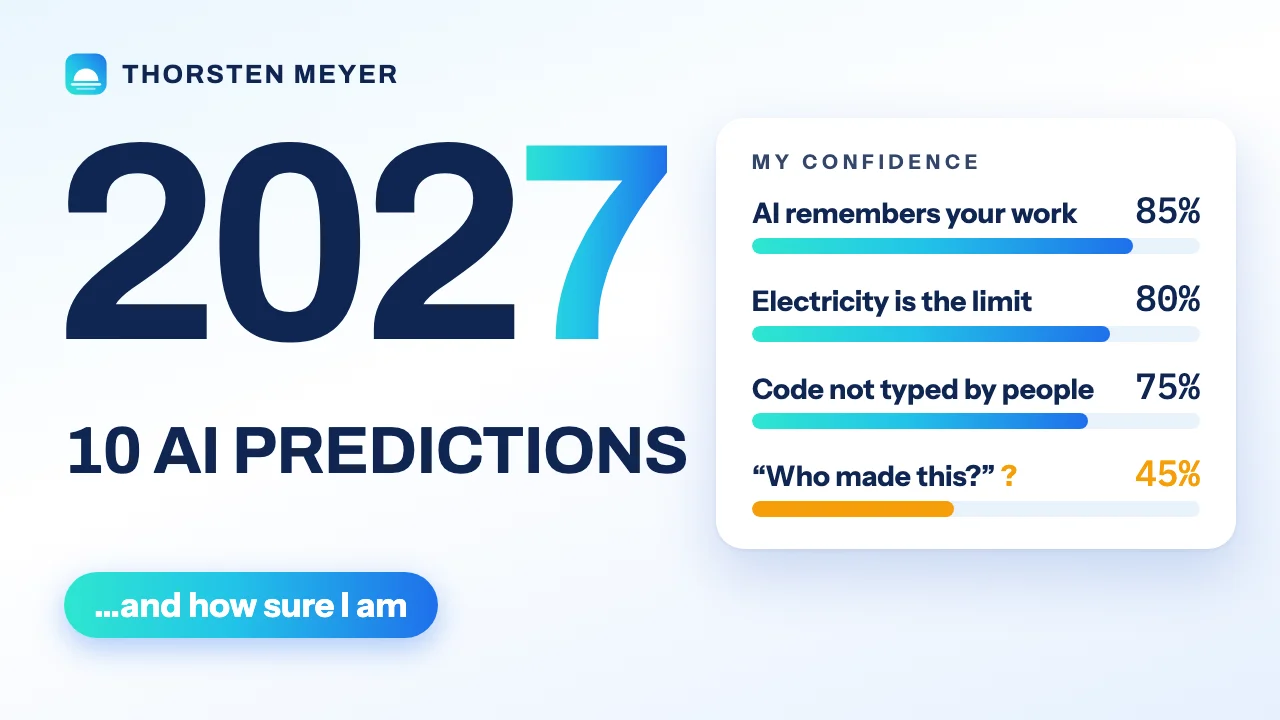
Most people are still learning how to talk to AI. Next year, AI starts doing the work. Here are my ten predictions for 2027, each with a confidence level and the evidence I will use to score it. A forecast, not a prophecy.
A prediction without a number can’t be wrong, and a prediction that can’t be wrong is useless. So I put a confidence level on each of these ten calls. Seventy percent means I would bet on it, but I expect to lose that kind of bet roughly three times in ten. Forty-five percent means I lean slightly against my own headline.
The numbers also make me accountable as a whole. My ten confidence levels average 72.5%. If I’m well calibrated, about seven of these predictions come true by October 2027. If all ten come true, I was too timid. If only three do, I was overconfident. Either way, we’ll know, because under each prediction you’ll find an infographic with the signals I’ll use to score it.
I also made a short video of all ten. If you prefer watching to reading, start here:
The scorecard
Ten predictions for 2027, and how sure I am.
Each call carries a confidence level, so the forecast can be scored. If I’m well calibrated, about seven of ten come true.
My confidence, prediction by prediction
Subjective probability that each call is clearly true by October 2027.
- 01You'll delegate a week, not a prompt.Work70%
- 02Most new code won't be typed by people.Software75%
- 03“Should work” stops counting. Evidence does.Quality80%
- 04Your AI will remember your work.Memory85%
- 05The bottleneck isn't ideas. It's electricity.Compute80%
- 06AI becomes a lab partner.Science65%
- 07One person, a fleet.Teams70%
- 08“Who made this?” becomes a reflex.Trust45%
- 09AI rules move from paper to practice.Policy75%
- 10A job is more than income.Labor80%
Forecast by Thorsten Meyer, October 15, 2026. Confidence is my own subjective probability, not a measurement or survey result. Watch all ten predictions in the video.
Powered by Thorsten Meyer AI
1. You’ll delegate a week, not a prompt (70%)
Today, most people use AI one question at a time. You type, it answers, you type again. You are the loop.
In 2027, agents will run multi-day work on their own: research on Monday, build on Tuesday and Wednesday, check the result on Thursday, and hand you something to decide on Friday. Your job moves to the two ends of the week. You set the goal, and you judge the result.
I’m at 70% rather than higher for one reason: long-running agents still drift. Over a few hours they hold a goal well. Over several days they can quietly solve a slightly different problem. The tools that win in 2027 will be the ones that make the middle of the week visible, with a work log, checkpoints and a clear “here is what I did and why.”
What would prove me wrong: agents that are still mostly a chat window by next October, with long tasks staying a demo instead of a default.
2027 forecast · Work
You'll delegate a week, not a prompt.
Agents run multi-day work on their own: research, build, verify. Your job: set the goal and judge the result.
My confidence
I'd bet on it, and expect to lose that bet about 3 times in 10.
How I’ll score this in October 2027
The prediction counts as right if most of these are clearly true.
- Major AI assistants ship tasks that run for days, not minutes, as a standard feature.
- Long agent runs come back with a work log and checkpoints you can review, not just an answer.
- Handing a weekly goal to agents is normal team practice, not a demo.
Forecast by Thorsten Meyer, October 15, 2026. Confidence is my own subjective probability, not a measurement or survey result. The diagram is an illustration, not data. Watch all ten predictions in the video.
Powered by Thorsten Meyer AI
As an affiliate, we earn on qualifying purchases.
2. Most new code won’t be typed by people (75%)
This one is already half true in the teams that work closest to the tools. People write the spec and the acceptance test. Agents write the code. And the tests decide what ships.
That changes what a good engineer does all day. The scarce work isn’t typing a function. It’s describing exactly what “done” means, in a form a machine can check. A vague ticket used to cost an afternoon of back-and-forth. Handed to an agent, it costs a confident, wrong implementation that compiles.
I wrote about what this feels like in practice in Five Days, Sixteen Versions, Nineteen Games. The short version: the code was never the hard part. Knowing what I wanted, and proving I got it, was.
What would prove me wrong: most new production code in 2027 still typed line by line by people, with AI limited to autocomplete.
2027 forecast · Software
Most new code won't be typed by people.
People write the spec and the acceptance test. Agents write the code, and the tests decide what ships.
My confidence
Likely. I'd expect to be wrong about 1 time in 4.
How I’ll score this in October 2027
The prediction counts as right if most of these are clearly true.
- Large software companies say most of their new code is written by AI agents.
- Specs and acceptance tests become the main thing people review.
- Agent changes that pass the tests get merged without a person rewriting the code.
Forecast by Thorsten Meyer, October 15, 2026. Confidence is my own subjective probability, not a measurement or survey result. The diagram is an illustration, not data. Watch all ten predictions in the video.
Powered by Thorsten Meyer AI
As an affiliate, we earn on qualifying purchases.
3. “Should work” stops counting. Evidence does. (80%)
When answers get cheap, proof gets valuable. An AI can produce a plausible report, a plausible fix or a plausible design in seconds. Plausible is now free. What isn’t free is knowing whether it’s right.
So verification becomes the bottleneck, and the skill everyone needs. “Should work” won’t be accepted as a status anymore. People will ask for the test run, the screenshot at phone size, the second opinion from an independent reviewer, the measured number. Teams that build this habit will move faster, not slower, because they stop shipping rework.
I’m at 80% because the economics push hard in this direction. Every company that lets unverified AI output reach a customer learns the lesson once, publicly.
What would prove me wrong: AI products that still deliver answers without sources, tests or traces, and customers who don’t mind.
2027 forecast · Quality
“Should work” stops counting. Evidence does.
When answers get cheap, proof gets valuable. Verification becomes the bottleneck, and the skill everyone needs.
My confidence
Likely. I'd expect to be wrong about 1 time in 5.
How I’ll score this in October 2027
The prediction counts as right if most of these are clearly true.
- AI tools attach evidence by default: sources, test runs, screenshots, traces.
- Verification and evaluation tools grow faster than tools that only generate.
- Teams routinely reject agent output that arrives without proof.
Forecast by Thorsten Meyer, October 15, 2026. Confidence is my own subjective probability, not a measurement or survey result. The diagram is an illustration, not data. Watch all ten predictions in the video.
Powered by Thorsten Meyer AI
As an affiliate, we earn on qualifying purchases.
4. Your AI will remember your work (85%)
This is my most confident call. Projects, people, decisions, open questions: your AI will carry them from one conversation to the next. No more starting from zero, no more pasting the same background into every new chat.
The technical direction is clear. The open question isn’t whether AI gets memory. It’s where that memory lives, and who controls it. A memory of your work is the most valuable data you will ever give a vendor. It knows your clients, your mistakes, your half-finished ideas. I want that memory to be inspectable, editable, exportable, and stored where I choose, on my own hardware if I want it there.
Expect 2027 to be the year this becomes a buying decision, not a feature checkbox.
What would prove me wrong: mainstream assistants that still forget everything between sessions, or memory that stays a gimmick nobody relies on.
2027 forecast · Memory
Your AI will remember your work.
Projects, people, decisions, open questions. No more starting from zero. The big question: where that memory lives, and who controls it.
My confidence
My most confident call. I'd be surprised to be wrong.
How I’ll score this in October 2027
The prediction counts as right if most of these are clearly true.
- All major assistants keep persistent memory across projects and sessions.
- You can inspect, edit, export and delete what your AI remembers.
- Ordinary users can keep that memory local or self-hosted if they choose.
Forecast by Thorsten Meyer, October 15, 2026. Confidence is my own subjective probability, not a measurement or survey result. The diagram is an illustration, not data. Watch all ten predictions in the video.
Powered by Thorsten Meyer AI
As an affiliate, we earn on qualifying purchases.
5. The bottleneck isn’t ideas. It’s electricity. (80%)
There’s no shortage of ideas for what AI should do. There is a shortage of power, chips and cooling to run it. In 2027, those physical limits decide what ships, when, and at what price.
I’ve written about this from two angles: the demand side in AI Demand and the Energy Bottleneck, and the unit we should be measuring in Agents Per Gigawatt. The second half of this prediction follows from the first: when central compute is scarce and expensive, everyday AI moves onto your own devices. Laptops and phones will handle routine assistant work locally, and the big data centers will be reserved for the hard problems.
What would prove me wrong: AI capacity that grows freely without grid and power constraints making the news, and everyday AI that stays entirely in the cloud.
2027 forecast · Compute
The bottleneck isn't ideas. It's electricity.
Power, chips and cooling decide what ships. And everyday AI moves onto your own devices.
My confidence
Likely. I'd expect to be wrong about 1 time in 5.
How I’ll score this in October 2027
The prediction counts as right if most of these are clearly true.
- Power and grid access are named as the main limit on new AI capacity.
- New laptops and phones run everyday assistant tasks on the device.
- AI prices and rate limits follow compute supply, not just model quality.
Forecast by Thorsten Meyer, October 15, 2026. Confidence is my own subjective probability, not a measurement or survey result. The diagram is an illustration, not data. Watch all ten predictions in the video.
Powered by Thorsten Meyer AI
6. AI becomes a lab partner (65%)
Picture thousands of agents working on one research problem: proposing approaches, running experiments in simulation, and handing their best candidates to machines that check the proofs. Discovery speeds up.
But faster discovery moves the bottleneck rather than removing it. Testing and judgment become the scarce part. A lab can now produce more hypotheses in a week than it can test in a year. The people who decide what’s worth testing, and who can tell a real result from an artifact, become the most valuable people in the building.
I’m at 65% because science moves on its own clock. Peer review, replication and real-world experiments don’t compress as easily as code does. I expect the change to be visible in 2027, especially in mathematics and computational fields, but uneven.
What would prove me wrong: AI contributions to research staying at the level of literature summaries and writing help.
2027 forecast · Science
AI becomes a lab partner.
Thousands of agents on one research problem, machines checking the proofs. Discovery speeds up. Testing and judgment become the scarce part.
My confidence
More likely than not, but science moves on its own clock.
How I’ll score this in October 2027
The prediction counts as right if most of these are clearly true.
- Published results credit AI agents with a substantial part of the research work.
- Machine-checked proofs become common for AI-generated mathematics.
- Labs name testing and replication, not ideas, as their bottleneck.
Forecast by Thorsten Meyer, October 15, 2026. Confidence is my own subjective probability, not a measurement or survey result. The diagram is an illustration, not data. Watch all ten predictions in the video.
Powered by Thorsten Meyer AI
7. One person, a fleet (70%)
Small teams will run work that once took whole departments. One person with a fleet of agents can research, draft, build, test and publish at a pace that used to need a floor of an office building.
That makes the org chart the battleground. Most companies are organized as relay races: work passes from team to team, and each handoff adds delay. Agents make the handoffs the most expensive part. I made a related argument in AI Is the Alibi. The Reorg Is the Signal. Watch the reorganizations, not the press releases.
The scarce skill in this world isn’t doing the work. It’s deciding what’s worth doing, and saying no to everything else your fleet could easily produce.
What would prove me wrong: headcount and team structures that look the same in late 2027 as they did in 2025, with AI bolted onto existing roles.
2027 forecast · Teams
One person, a fleet.
Small teams run work that once took whole departments. The org chart becomes the battleground. The scarce skill: deciding what's worth doing.
My confidence
I'd bet on it, and expect to lose that bet about 3 times in 10.
How I’ll score this in October 2027
The prediction counts as right if most of these are clearly true.
- Very small companies reach output and revenue that once took departments.
- Reorganizations around agents make headlines, not just tool rollouts.
- Job ads ask for directing and checking agents as a core skill.
Forecast by Thorsten Meyer, October 15, 2026. Confidence is my own subjective probability, not a measurement or survey result. The diagram is an illustration, not data. Watch all ten predictions in the video.
Powered by Thorsten Meyer AI
8. “Who made this?” becomes a reflex (45%)
Synthetic media is everywhere already. Images, voices, video and text can be generated faster than anyone can check them. The obvious response is signed provenance: content credentials attached at capture, carried through every edit, and shown when something is published.
The technology exists. Adoption is the problem. It only works if cameras sign, editing tools keep the signature, platforms display it, and people actually look. Every link in that chain has to move, and most of them are slow.
Honestly, this is my shakiest call. Forty-five percent. I believe asking “who made this?” will become a reflex eventually. I’m not convinced it happens by 2027. If you want my working rule in the meantime: no signature, treat it as unverified.
What would prove me wrong (in the good direction): major platforms showing content credentials by default, and people checking them without being told to.
2027 forecast · Trust
“Who made this?” becomes a reflex.
Synthetic media is everywhere. Signed provenance helps, but adoption is slow. Honestly, my shakiest call.
My confidence
My shakiest call. I lean slightly against it happening by 2027.
How I’ll score this in October 2027
The prediction counts as right if most of these are clearly true.
- Major platforms show content credentials on images and video by default.
- Mainstream phones and cameras sign photos and video at capture.
- Checking where something came from becomes everyday behavior, not an expert move.
Forecast by Thorsten Meyer, October 15, 2026. Confidence is my own subjective probability, not a measurement or survey result. The diagram is an illustration, not data. Watch all ten predictions in the video.
Powered by Thorsten Meyer AI
9. AI rules move from paper to practice (75%)
For the last few years, AI governance mostly lived in documents: principles, policies, frameworks. In 2027 it moves into the systems themselves. Permissions, audit trails, human oversight and disclosure stop being slides and become engineering work, built in from day one.
The driver is simple. Once agents act instead of answer, someone has to be able to show what an agent was allowed to do, what it actually did, and who approved it. You can’t produce that after the fact. It has to be in the architecture.
I’ve been skeptical of how we regulate AI. I said so in We Are Regulating an Intelligence We Do Not Have. But whatever you think of the rules, the practical outcome is the same: compliance becomes a feature of the product, not a binder on a shelf.
What would prove me wrong: agent platforms that still ship without permissions, logs and approval steps as standard, and buyers who don’t ask for them.
2027 forecast · Policy
AI rules move from paper to practice.
Permissions, audit trails, oversight, disclosure. Compliance becomes engineering work, built in from day one.
My confidence
Likely. I'd expect to be wrong about 1 time in 4.
How I’ll score this in October 2027
The prediction counts as right if most of these are clearly true.
- Agent platforms ship permissions, audit logs and human approval steps as standard.
- Companies hire engineers specifically to build AI compliance into products.
- Buyers and regulators ask for logs and evidence, not just policy documents.
Forecast by Thorsten Meyer, October 15, 2026. Confidence is my own subjective probability, not a measurement or survey result. The diagram is an illustration, not data. Watch all ten predictions in the video.
Powered by Thorsten Meyer AI
10. A job is more than income (80%)
The debate about AI and work is still mostly about money: who gets paid, and how much. That matters. I wrote a whole book about it, After the Paycheck.
But a job is more than income. It’s structure: a reason to get up at a certain time. It’s identity: an answer to “what do you do?” It’s belonging: colleagues, a team, a place. And it’s purpose: the feeling that your effort matters to someone.
If AI does more of the work, we need new answers for all of it, not just the paycheck. In 2027 I expect that question to move from philosophy seminars into boardrooms, town halls and kitchen tables. I explored the bigger arc in Dots, Bots, and Math.
What would prove me wrong: a public conversation about AI and work that stays about income only, with structure, identity, belonging and purpose left out.
2027 forecast · Labor
A job is more than income.
It's structure, identity, belonging and purpose. If AI does more of the work, we need new answers for all of it.
My confidence
Likely. I'd expect to be wrong about 1 time in 5.
How I’ll score this in October 2027
The prediction counts as right if most of these are clearly true.
- The public debate on AI and work moves beyond income to purpose and structure.
- Serious pilots test community, time and meaning, not only cash payments.
- Companies talk about what people do with freed-up time, not only headcount.
Forecast by Thorsten Meyer, October 15, 2026. Confidence is my own subjective probability, not a measurement or survey result. The diagram is an illustration, not data. Watch all ten predictions in the video.
Powered by Thorsten Meyer AI
What stays human
Read the ten predictions together and a pattern shows up. In almost every case, AI takes over the doing, and something human becomes more valuable, not less.
- Judgment: deciding what’s worth doing, and whether the result is good enough.
- Responsibility: someone has to sign off, and own the outcome when it goes wrong.
- Purpose: knowing why the work matters at all.
- Each other: the structure, identity and belonging that work used to provide.
That’s my forecast for 2027. Ten predictions, each with a number, each with the signals I’ll check. Hold me to them. Let’s compare notes in a year.
This forecast is dated October 15, 2026. The confidence levels are my own subjective probabilities, not measurements or survey results. The scoring signals in each infographic are the criteria I will use when I revisit these predictions in October 2027.
Halloween Picks
halloween
As an affiliate, we earn on qualifying purchases.