
By Thorsten Meyer | November 19, 2026 | ThorstenMeyerAI.com

Get business pricing on tech for your team
- Business-only prices and quantity discounts
- Tax-exempt purchasing
- Multiple users, one account, clear invoices
Reality check · Security. This article explains a public security warning for defenders and ordinary users. It deliberately leaves out how the flaw is triggered or exploited and lists no indicators of compromise; those are in the advisories.
Base64 is one of the most boring pieces of the internet. It turns binary data into plain letters so it can travel inside login tokens, cookies, file uploads and network messages. Almost every Java server decodes it all day long.
On November 17, 2026, that boring piece became the reason for an urgent US government alert. The Cybersecurity and Infrastructure Security Agency (CISA) “strongly urges organizations to immediately patch” CVE-2026-114938, a memory-corruption flaw in the Base64 decoder of the Java virtual machine. Its finders call it “Java4Shell”, a name that deliberately echoes Log4Shell, the notorious flaw in a Java logging library.
The warning is real and the fix is out. But the details matter more than the name: the flaw needs a specific kind of processor, it does not touch the oldest Java versions at all, and the scores given to it range from “high” to “critical” depending on who is counting. Here is what is documented, who has to act, and what is not known yet.
Key takeaways
- What it is. A memory-corruption bug in an optimized Base64 decoding routine inside the Java virtual machine. According to CISA, “Specially crafted Base64 input could crash the JVM and allow for unauthenticated remote code execution.”
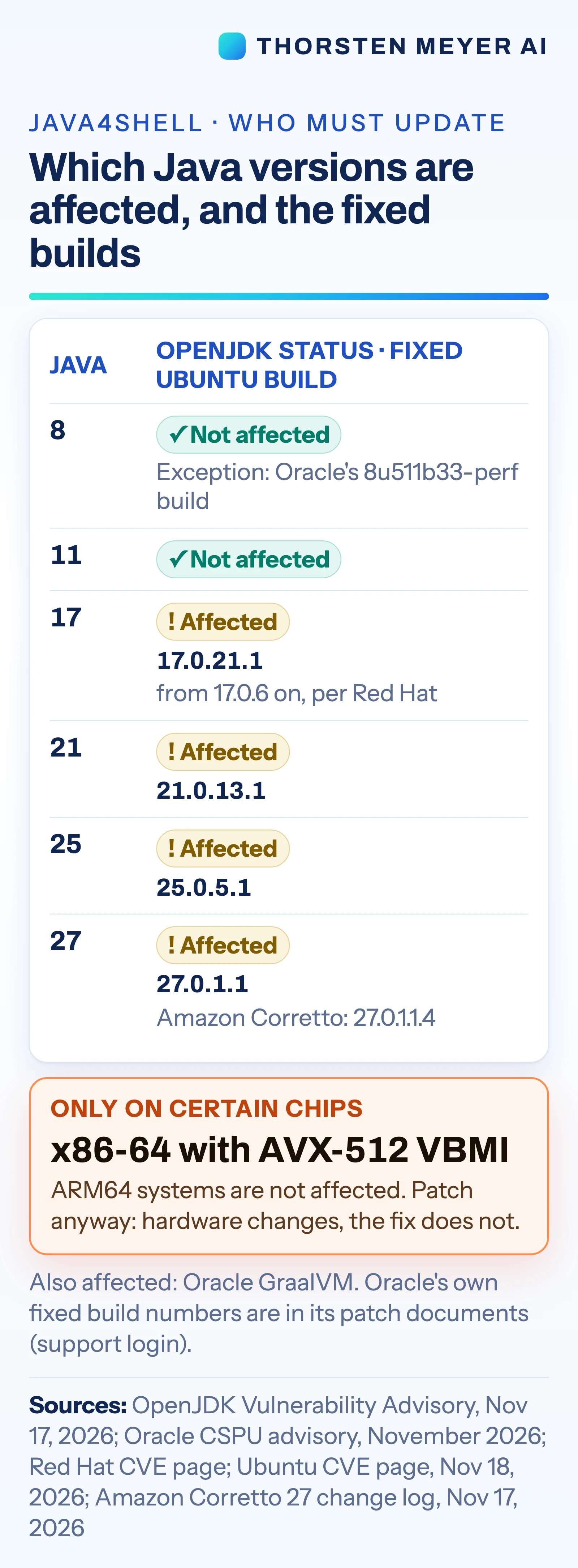
- Who is affected. Java 17, 21, 25 and 27 runtimes built from OpenJDK, plus Oracle’s GraalVM and one special Oracle Java 8 build. Red Hat says the vulnerable code arrived in OpenJDK 17.0.6, and that OpenJDK 8 and 11 “do not contain it and are not affected.”
- Only on certain chips. Exploitation needs an x86-64 processor with the AVX-512 VBMI instruction set. Red Hat: systems on ARM64 or on x86-64 processors without that feature “are not affected.”
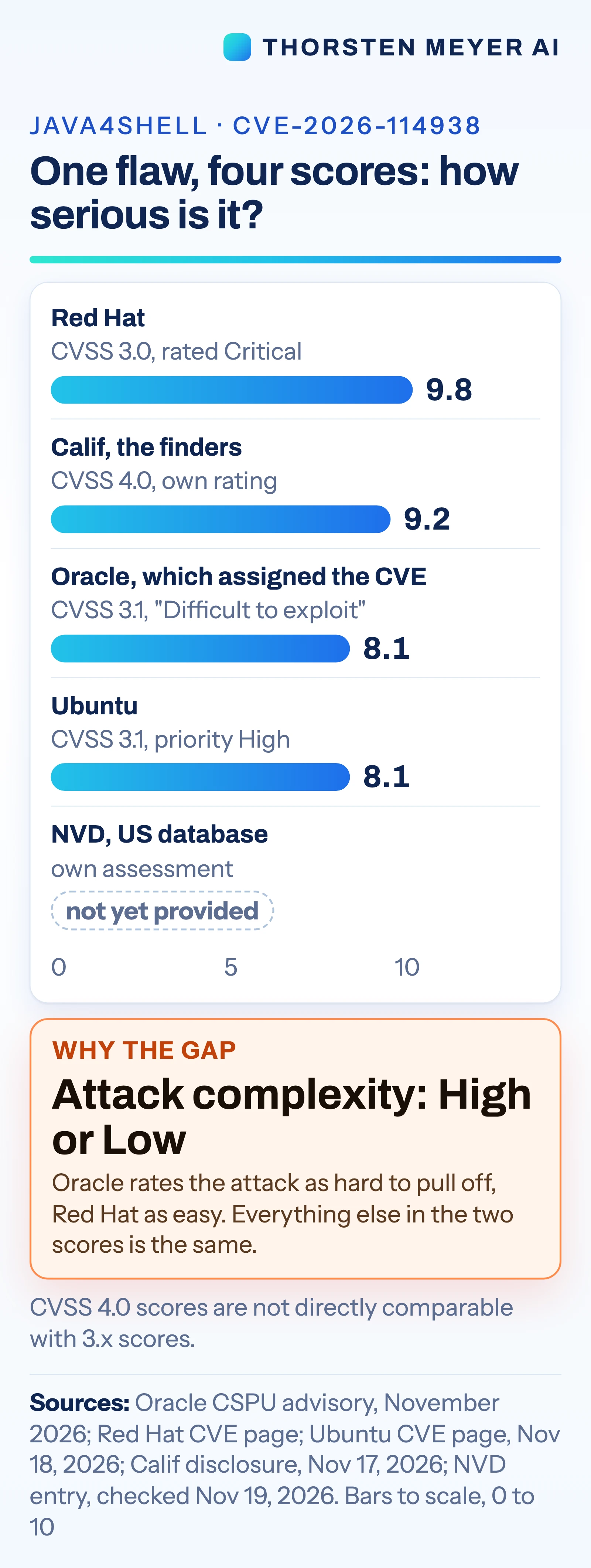
- How serious. Oracle scores it 8.1 out of 10 and calls it “Difficult to exploit”. Red Hat rates it Critical at 9.8. The finders give 9.2 under the newer CVSS 4.0. The national database NVD has not scored it yet.
- Not exploited, as far as anyone has said. CISA’s own record for the CVE lists “Exploitation: none”, and the flaw is not in CISA’s catalogue of known exploited vulnerabilities. The researchers say they are holding back product-specific attack chains “until everyone has had a chance to upgrade.”
- What to do. Update every Java runtime to your vendor’s November build, starting with internet-facing systems, and look for Java that ships hidden inside other products and container images.
Java4Shell · CVE-2026-114938
Three conditions, one fix
A Java server is exposed only when all three come together. Each one rules out a large group of systems.
Is my system exposed?
- A Java runtime in the affected rangeJava 17, 21, 25 or 27 (OpenJDK 17.0.6 and later), Oracle GraalVM, Oracle’s 8u511b33-perf build✓ Not affected: Java 8 and 11 from OpenJDK
- An x86-64 chip with AVX-512 VBMIA speed feature of several recent Intel Xeon and AMD chip generations✓ Not affected: ARM64, including Macs with Apple chips
- Outside data reaches the Base64 decoderLogin cookies, tokens, uploads: everyday input to a web service✓ Not the route: old browser applets
All three: exposed until patchedTwo of three: not exposed to this flaw
Exploited yet? CISA’s record listed “Exploitation: none” on Nov 17, and the flaw was not in its catalogue of known exploited flaws on Nov 18.
Sources: CISA alert, Nov 17, 2026; Oracle Critical Security Patch Update Advisory, November 2026; OpenJDK Vulnerability Advisory, Nov 17, 2026; Red Hat CVE page; Siemens SSA-272816, Nov 18, 2026; CVE record (CISA decision data); CISA KEV catalogue version 2026.11.18.
Graphic: Powered by Thorsten Meyer AI
Products Worth Considering

Samsung Galaxy Tab A11+ Kids Edition, 128GB, Royal Blue

Sony WH-1000XM6 Wireless Noise-Canceling Headphones, Black

Amazon Kindle Scribe (16GB) with Premium Pen, Tungsten
As an affiliate, we earn on qualifying purchases.
What CISA and Oracle actually published
CISA’s alert is short. It names the flaw, links Oracle’s advisory and lists five actions. The core sentence: “This critical memory-corruption vulnerability, known as “Java4Shell,” affects the Base64 decoder of the x86-64 HotSpot Java Virtual Machine (JVM), which is part of the Java Development Kit (JDK).” HotSpot is the standard engine that runs Java programs in OpenJDK. The Canadian Centre for Cyber Security contributed to the alert.
Oracle shipped the fix in its “Critical Security Patch Update” for November 2026, a monthly format that, in Oracle’s words, complements its “existing quarterly cumulative Critical Patch Updates.” The November package contains 655 new security patches across Oracle’s products, 11 of them for Java SE. CVE-2026-114938 is the highest-scored of the 11.
The OpenJDK project, which maintains the open-source code most Java distributions are built from, published its own advisory the same day. Its risk matrix marks the flaw for Java 17, 21, 25 and 27, and leaves Java 8 and 11 blank.
Oracle’s entry adds one important limit. The flaw “can only be exploited by supplying data to APIs in the specified Component without using Untrusted Java Web Start applications or Untrusted Java applets, such as through a web service.” In plain words: the danger is a program that accepts data from outside, typically a server, not the old browser plug-in model.
Who is affected
Three things have to come together, and all three are in the vendor and distributor statements.
1. A Java runtime in the affected range. Oracle lists these supported versions as affected:
- Oracle Java SE: 8u511b33-perf, 17.0.21.0.3, 21.0.13.0.3, 25.0.5.0.3 and 27.0.1.0.3
- Oracle GraalVM for JDK: 17.0.21.0.3 and 21.0.13.0.3
- Oracle GraalVM Enterprise Edition: 21.3.20.0.3
Older, unsupported versions are likely affected too. Oracle’s general rule is that releases outside support “are not tested” but “it is likely that earlier versions of affected releases are also affected.” Red Hat dates the start precisely: “The vulnerable code path was introduced in OpenJDK 17.0.6; OpenJDK 8 and OpenJDK 11 do not contain it and are not affected.” The one Java 8 exception in Oracle’s list is a special Oracle build marked “-perf”.
Because so many Java distributions are built from OpenJDK, the finders at the security firm Calif list Amazon Corretto, Eclipse Temurin, Microsoft Build of OpenJDK, Azul Zulu, BellSoft Liberica, SAP SapMachine and Red Hat OpenJDK as affected as well. Check your own vendor’s advisory for the exact build.
2. A processor with AVX-512 VBMI. The bug sits in a speed-optimized routine that only runs on x86-64 chips with this instruction set. Red Hat: “Exploitation requires an x86-64 processor providing the avx512f, avx512bw, avx512vbmi, and bmi2 features.” Calif names the mainstream families: Intel Xeon Ice Lake, Sapphire Rapids, Emerald Rapids and Granite Rapids, and AMD EPYC and Ryzen from Zen 4 onward. That covers several recent server chip generations and, on the AMD side, some recent desktop processors. ARM-based machines, which includes Macs with Apple chips and ARM cloud servers, are not affected according to Red Hat.
3. Outside data that reaches the decoder. Siemens, which has affected industrial products, spells out the last conditions: “Untrusted Base64” reaching Java’s standard decoder, and “A JIT-compiled decoder”, meaning the routine has been used often enough for Java to optimize it. On a busy server, both are normal. Apache Shiro, a widely used Java security library, explains why: its remember-me login cookie is Base64-encoded, so “a request handled through this path may be vulnerable” on an affected runtime. The Shiro team adds that “changing Shiro versions alone does not fix a vulnerable JDK.”
How serious is it?
It depends on who is counting, and the reason is instructive.
- Oracle, which assigned the CVE, gives a CVSS 3.1 base score of 8.1, “High”, and calls it a “Difficult to exploit vulnerability” that can still “result in takeover” of Java.
- Red Hat rates it “Critical” with 9.8 under CVSS 3.0. Its reason: “public research has demonstrated working exploits against multiple widely deployed Java applications in their default configurations.”
- Calif, the finders, write that “Under CVSS 4.0, this vulnerability scores 9.2 out of 10 (CRITICAL).”
- Ubuntu uses the 8.1 score and gives the issue “High” priority because “This is an RCE”, remote code execution.
- NVD, the US National Vulnerability Database, shows “NVD assessment not yet provided.”
The gap between 8.1 and 9.8 comes down to one setting: Oracle rates the attack complexity “High”, Red Hat rates it “Low”. Calif’s own write-up supports both readings. It says there is “no universal exploit”, that each target “needs a bespoke profile”, and that its attack is “sensitive to network conditions”. It also says the team demonstrated remote code execution, before any login, against Keycloak, Atlassian Jira and Confluence, JFrog Artifactory, Jenkins and PingFederate in their default setups. We have not seen statements from those vendors in the sources we checked, so treat that list as the researchers’ claim, and watch each vendor’s own advisory.
CISA’s alert calls the flaw “critical”. Its own machine-readable decision record for the CVE, added on November 17 at 21:53 UTC, reads: “Exploitation: none”, “Automatable: no”, “Technical Impact: total”. In other words: no known attacks at that point, not easy to automate across the internet, but complete control if it works.
Is anyone exploiting it?
Not according to any source we could check on November 19.
- CISA’s catalogue of Known Exploited Vulnerabilities (KEV), version 2026.11.18, released November 18 at 19:17 UTC, does not list CVE-2026-114938. So there is no KEV due date for US federal agencies yet.
- CISA’s decision record says “Exploitation: none”.
- Calif says it is “holding back the application-specific exploits for now” and that “The weaponized chains for individual products stay private until everyone has had a chance to upgrade. We will publish them later.”
That last sentence is the clock. The general technique is already public, and Calif has said it will publish the product-specific chains. The time to patch is before that happens, not after the flaw shows up in the KEV catalogue.
How AI found it
This is the part that makes Java4Shell a story about AI, not only about Java. Calif writes that it “used AI to find and weaponize Java4Shell.” Its researcher Quang Luong describes pointing OpenAI’s Codex at the parts of the Java engine where complex code crosses boundaries, discarding many useless results, and then getting a real hit: “Codex brought me a finding for a memory corruption in the Base64 decoder itself.”
The company’s numbers: “It took our own Quang Luong an hour to discover the vulnerability, and two more hours to develop the first working exploit. The total token cost was less than $200.” Those are the finders’ own figures and cannot be checked from outside. But they fit a pattern we have covered before with PHP2Shell, the same team’s earlier find: AI tools shorten the time between the moment a bug exists and the moment someone can use it, and that pushes the burden onto patch speed. Oracle credits Albert Yang and Quang Luong of Calif.io with the report.
What businesses should do now
These steps come from CISA’s alert, Oracle’s advisory and the distributor statements. None of them needs a new product.
- Find every Java runtime. CISA asks organizations to review their inventory “for JDKs and Java runtimes, including those bundled with third-party applications or included in container images and appliances,” and warns that they “may not appear as separate entries in software inventories.”
- Update to your vendor’s fixed build, internet-facing systems first. On Ubuntu, for example, fixed OpenJDK packages carry the numbers 17.0.21.1, 21.0.13.1, 25.0.5.1 and 27.0.1.1. Amazon’s fix for Corretto 27 is version 27.0.1.1.4. Oracle’s own patch documents sit behind a support login that we could not open; Oracle customers should follow the patch document linked from the advisory.
- Rebuild containers. A patched server does not fix a container image that carries its own Java. Rebuild images on a fixed base and redeploy.
- Chase the products that bundle Java. Siemens is one example: on November 18 it listed Industrial Edge Management Pro V1, Pro V2 and Virtual as affected, with “Currently no fix is available” and mitigations instead. Expect more vendor notices like this; ask your suppliers directly.
- Use temporary controls only as a bridge. If you cannot patch at once, CISA suggests “restricting and validating Base64 input at the application boundary, enforcing input-size limits, and limiting unauthenticated access.” Some vendors and the finders also describe a Java start-up option that switches off the accelerated decoder; see your vendor’s advisory, test it, and still install the update.
- Watch for warning signs. CISA names “rogue runtimes, unexpected JVM crashes, and suspicious Java processes.”
- Do not stop at the CPU check. Knowing that some hosts run on ARM or older chips helps you set priorities, but hardware changes when servers are replaced or cloud instances are resized. Patching the runtime removes the question.
What it means for developers
If you build or ship Java software, the vulnerable code is not in your application but in the runtime underneath it. Updating a library such as Shiro does not help. What helps: pin your builds and container base images to fixed runtime versions, tell your customers which runtime your product bundles, and if you embed a Java runtime in an installer, ship an update. Calif also writes that a Java program that connects to a malicious server “can be compromised, even if it exposes no service of its own”, so client tools that talk to untrusted servers belong on the list too.
What it means for ordinary users
For most people, the main exposure is indirect: the companies that hold your data run Java servers. You cannot patch those, but you can expect your providers to.
On your own computer, the risk is lower but not zero:
- Macs with Apple chips and other ARM devices are not affected, according to Red Hat’s statement on ARM64.
- Windows or Linux PCs with recent Intel or AMD chips may have the right processor. If you have Java installed, update it through its own updater, or remove it if you no longer use it.
- Apps that bring their own Java (some games, developer tools, office and business programs) update through their own update function. Install those updates when they arrive.
- Old browser applets are not the attack route: Oracle’s note says the flaw is reached by supplying data to the affected component, “such as through a web service,” not through untrusted applets.
What is not known
- Whether attackers are already using it. No source we checked reports exploitation. CISA’s record said “Exploitation: none” on November 17, and the KEV catalogue did not list the CVE as of November 18. That can change quickly.
- Which products bundle an affected runtime. Vendors are still assessing; Siemens’ first advisory, for example, says it “is currently assessing the impact.”
- How hard real-world attacks are. Oracle says “Difficult to exploit”, Red Hat scores it as easy. Calif’s claims about specific products have not, in our sources, been confirmed by those vendors.
- The official NVD score. The NVD had not provided its own assessment when we checked.
- Oracle’s exact fixed build numbers. They are in Oracle’s patch documents, which require a support login.
Sources
- CISA: Critical Java Vulnerability Requires Immediate Patching, alert, November 17, 2026
- Oracle: Oracle Critical Security Patch Update Advisory – November 2026, Java SE risk matrix
- OpenJDK Vulnerability Group: OpenJDK Vulnerability Advisory: 2026/11/17
- CVE Program: CVE-2026-114938, CVE record with CISA’s decision data (SSVC)
- NIST: NVD entry for CVE-2026-114938, “Undergoing Enrichment”
- CISA: Known Exploited Vulnerabilities Catalog, JSON feed, catalogue version 2026.11.18, checked November 19, 2026
- Red Hat: CVE-2026-114938, Red Hat Customer Portal
- Ubuntu: CVE-2026-114938, published November 18, 2026
- Amazon Corretto 27: change log for version 27.0.1.1.4, November 17, 2026
- Siemens ProductCERT: SSA-272816: Java4Shell Vulnerability in Industrial Edge, November 18, 2026
- Apache Shiro: Java4Shell (CVE-2026-114938): what Shiro users should know, November 18, 2026
- Calif: “Java4Shell” disclosure and technical write-up, November 17, 2026. We quote it for the finders’ own claims and deliberately do not link it, because it contains exploit code.
Further reading on ThorstenMeyerAI.com
- From PHP2Shell to Wiper: How Attackers Hit Check Point Gateways, and What to Patch Now
- Two Days From Patch to Root: How a PHP2Shell Chain Took Over 25 Palo Alto Servers
- FBI Warns About the ARTEX AI Hacking Tool: What ‘Under Three Hours’ Really Means
- Critical Apache HTTP/2 Flaw CVE-2026-119618: Who Is Affected and What to Do Now
I’m Thorsten Meyer. More reality checks are at thorstenmeyerai.com.
This article is for information only. It is not security-consulting or legal advice, and it deliberately leaves out technical attack details. Researched and drafted with AI assistance, including Anthropic’s Claude. For transparency: the finders say they used OpenAI’s Codex, and another Java fix in the same Oracle update (CVE-2026-114940) credits a researcher at Anthropic, the company whose AI we used; neither changes the facts reported here. No company or organization named here reviewed or sponsored this article. Our own text and graphics contain no affiliate links; offer and product boxes added by the site may contain Amazon affiliate links. Sources checked on November 19, 2026. Images: AI-generated illustration (Runware), animation and charts by Thorsten Meyer AI from the published numbers; our own images show no real people or logos. Boxes added by the site may show product photos or people.