By Thorsten Meyer | November 18, 2026 | ThorstenMeyerAI.com

Get business pricing on tech for your team
- Business-only prices and quantity discounts
- Tax-exempt purchasing
- Multiple users, one account, clear invoices
Reality check · Security. This article explains a public FBI warning for defenders. It deliberately leaves out how the tool is obtained, set up or run, and it lists no indicators of compromise; those are in the advisory itself.
On November 1, 2026, at 04:33 UTC, someone used a forgotten cloud key at Barracuda, a company that sells email and network security. Within minutes the key was being used to map what it could reach. About 44 hours later the intruder was done. Barracuda’s own engineers noticed on November 4, after the activity had already stopped.
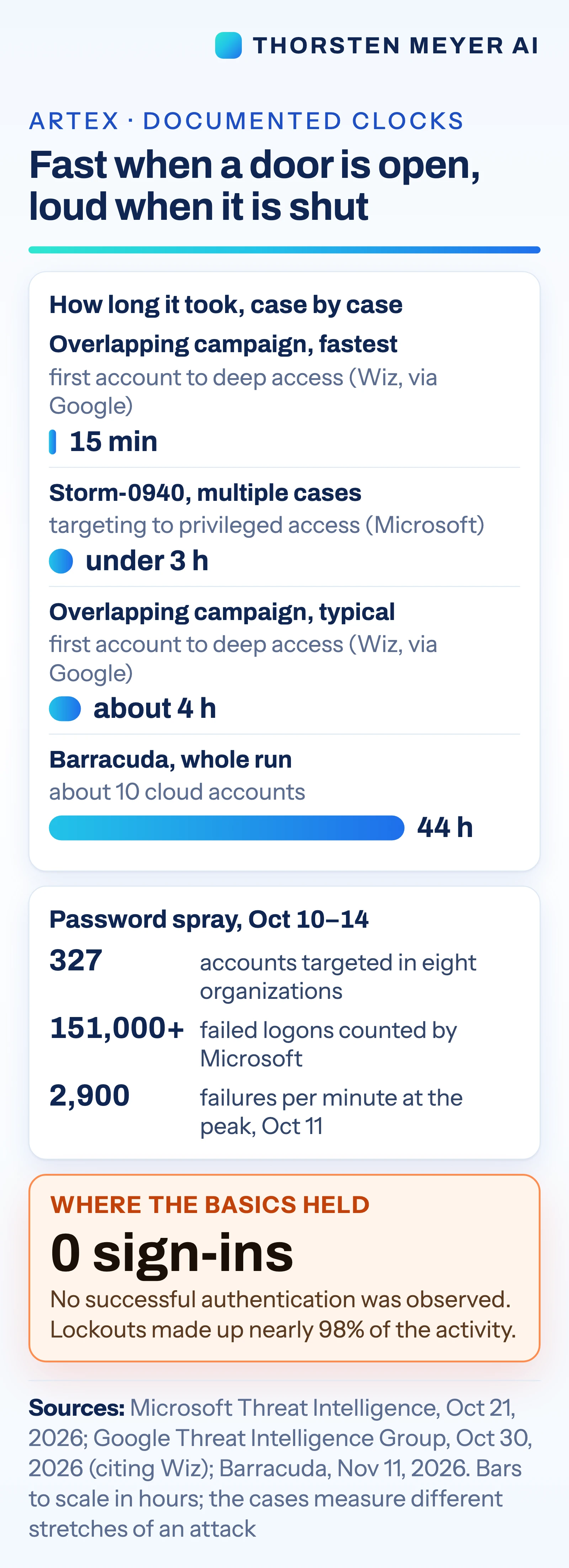
Barracuda says the pattern matches ARTEX, an open-source “AI penetration testing” framework. Twelve days after that first call, on November 13, the FBI published a FLASH warning about the same tool: multiple threat actors have weaponized it since at least August 2026, and “some intrusions” went “from initial targeting to privileged access in under three hours.”
That phrase is now in every headline. This piece looks at where it comes from, what it covers and what it does not, and what the documented cases say defenders should do this week.
Key takeaways
- The warning is official and specific. FBI FLASH-20261113-001 calls ARTEX an open-source, AI-driven “agentic platform” that threat actors use “to automate multiple phases of cyber intrusions at machine speed, from reconnaissance through data exfiltration.”
- “Under three hours” is real, but it is not the typical case. The figure traces back to Microsoft, which saw “multiple instances” where one China-state-aligned group, Storm-0940, went from targeting to privileged cloud access in less than 3 hours. Microsoft also writes that “the majority of the targeting wasn’t successful.”
- The Barracuda case shows the real problem: the clock. The intruder touched about 10 cloud accounts in roughly 44 hours. By the time the activity was reported, “it had already stopped.”
- No zero-day required. Barracuda’s intruder came in with a valid key that should have been retired. Amazon, which watched two ARTEX campaigns through decoy sensors, says “None of the techniques in these campaigns were new.”
- The fixes are known. Inventory what faces the internet, retire long-lived keys, limit what one credential can open, rate-limit sensitive APIs and keep enough logs to tell what happened.
Barracuda incident · Nov 1–4, 2026
Machine speed: a 44-hour run, found on day four
How the intrusion Barracuda links to ARTEX unfolded, in the company’s own timeline (all times UTC).
Intruder vs. defender, hour by hour
- Nov 1, 04:33First call with a valid cloud key that was never retired
- Next 24 hoursEach secret it finds opens the next system: cloud, analytics, source-code token, Kubernetes
- About 10 cloud accountsIt hunts for credentials and crypto wallets, leaves a container behind
- Nov 2, 23:31Last recorded activity, roughly 44 hours after the start
- Nov 4An engineer notices unusual activity; the vendor calls the same day
The fastest documented clock: Microsoft saw multiple cases of under 3 hours from targeting to privileged access (one group, Storm-0940).
Sources: Barracuda, “Forty-four hours: Anatomy of a machine-speed intrusion”, Nov 11, 2026, and Trust Center advisory, Nov 10 and 13, 2026; Microsoft Threat Intelligence, Oct 21, 2026. Timeline to scale in hours; the time of day on Nov 4 is not stated, so the whole day is marked.
Graphic: Powered by Thorsten Meyer AI
Products Worth Considering

DJI Mini 5 Pro Fly More Combo with DJI RC 2, 1-Inch CMOS

Amazon Kindle Scribe (16GB) with Premium Pen, Tungsten

Jackery HomePower 3000 Portable Power Station, 3072Wh, 3600W
As an affiliate, we earn on qualifying purchases.
What the FBI actually published
The document is a FLASH, the FBI’s format for urgent technical warnings to companies, dated November 13, 2026 and marked TLP:CLEAR, which means it may be shared without restriction. It runs to 13 pages. We found no joint advisory from CISA; this one carries the FBI’s name alone.
What it says about the tool:
- What ARTEX is. An “autonomous, multi-agent penetration testing platform written in Go.” The operator describes a goal in plain language and AI agents turn it into actions, “requiring minimal human interaction beyond initial objective setting.”
- Which AI it uses. ARTEX has no model of its own. It plugs into external ones; the FBI lists Anthropic Claude, OpenAI GPT, DeepSeek, GLM, Grok and Kimi. In attacker-controlled installations “Chinese models are most prevalent,” with DeepSeek’s Flash models dominating “due to their balance of capabilities, relatively low cost, and lack of observable guardrails when framed for penetration testing.”
- Where it came from. A developer using the name “Autumn-27” published it on GitHub in July 2026. It gathered an estimated 1,500–2,000 stars within 10 weeks. The developer said it was meant for authorized testing and took the repository down on October 8, 2026, after reports of abuse.
- Why that did not end it. The FBI says it “continues to proliferate through community forks, localized variations, archived copies, and a commercial version (ARTEX PRO).”
- Who has been targeted. Organizations in financial services, government, technology, defense, semiconductors, energy, healthcare, manufacturing, telecommunications and law.
The FBI names two notable campaigns: financially motivated attacks on South Korean financial institutions that exposed personal information of “approximately 67,000 individuals”, and the supply chain compromise of ConnectWise Cloud Backup customers, which led to “attempted sign-ins to more than 2,250 downstream tenants.”
The bureau’s list of risks is the most useful part for a non-specialist. ARTEX “excels at identifying and exploiting peripheral systems receiving less security attention than flagship applications”: partner and supplier portals, mobile backends, employee apps, legacy services, third-party integrations. It lowers the skill needed for complex intrusions. And it creates a “Compressed Detection Window”: the traffic is “forensically noisy” and may trigger alerts, but its speed leaves little time for a coordinated response before the attacker reaches its goal.
What “under three hours” means
The FBI’s sentence carries a footnote. It points to Microsoft’s October 21 report on Storm-0940, which Microsoft describes as a China-state-aligned actor. There, the wording is more careful: Storm-0940’s ARTEX-driven attacks included “multiple instances where the time from initial targeting to privileged access was less than 3 hours.”
Three things follow from that.
- It is a best case for the attacker, not an average. “Multiple instances” of one group’s campaign is not a statement about every ARTEX intrusion. Barracuda’s intruder needed about 44 hours for its whole run. Google’s threat intelligence team cites Wiz research on a campaign that overlaps with Storm-0940: “typically” around four hours from the first compromised account to deep system access, and “in one case as rapidly as 15 minutes.”
- It measures the attacker’s clock, not the defender’s. “Privileged access” is the moment an intruder holds the keys to an administrator account or cloud role. What matters for a company is whether anyone notices before that, and whether one stolen credential opens the next door.
- Most attempts still fail. Microsoft writes that “the majority of the targeting wasn’t successful.” Between October 10 and 14, one Storm-0940 address sprayed passwords at 327 accounts across eight organizations. Microsoft counted 151,000+ failed logons, with a peak of 2,900 failures per minute on October 11. Lockouts made up nearly 98% of the activity, and “no successful authentication, token issuance, Graph call, or directory change was observed.”
So the honest summary is this: automation makes attacks fast and loud, and against basic controls such as lockouts and strong sign-in rules it still fails loudly. Where a valid key or an over-privileged app is lying around, it wins fast.
The Barracuda case, hour by hour
Barracuda published a customer advisory on November 10, updated it on November 13, and its chief information security officer, Arve Kjoelen, wrote up the full story on November 11 under the title “Forty-four hours: Anatomy of a machine-speed intrusion.” It is unusually frank.
- The way in. “The attacker did not break down our door. It gained access using a valid cloud access key.” Barracuda had given that key to a third-party vendor for an earlier project. “We did not retire the key when the vendor — a company working in AI — finished that work. That is on us.” In October the vendor’s own development environment was compromised. The November 13 update says the key sat in a configuration file in the vendor’s GitHub repository.
- The run. From the first call on November 1, the intruder used each secret it found to reach the next system: from cloud accounts to a data analytics system, to a source-code access token, to Kubernetes clusters. The last activity Barracuda recorded was November 2 at 23:31 UTC. “In all, the attacker touched about 10 cloud accounts in roughly 44 hours.”
- What it wanted. Credentials, “Everywhere,” and cryptocurrency. Commands searched for wallet files and seed phrases. “No wallet material exists on those systems.” Barracuda adds that AI-service credentials were also within reach and a third motive “cannot be ruled out.”
- The way back in. The intruder deployed a container that could read the underlying server’s file system, and tried to create a new administrative cloud identity. That attempt “was blocked.”
- How it was found. On November 4 an engineer noticed unusual activity on their own account. The same day the vendor called about its own incident, even though it did not believe Barracuda was affected. “By the time the activity was reported, it had already stopped.”
- What it means for customers. One system the attacker reached holds credentials that Barracuda XDR uses to collect data from customers’ connected services. Barracuda found “no direct evidence” that they were viewed, but logging “was not detailed enough to rule it out.” It told potentially affected customers of Managed XDR Cloud and Monitored Endpoint to revoke and recreate their integration credentials. “If you have not heard from us, no action is needed.”
Why does Barracuda say ARTEX? The probe names, other indicators and the order of work “all match ARTEX.” It is explicit about the limit: “Because many groups use ARTEX, the match tells us how the attacker operated, not who it was.”
What Amazon saw from the inside
Amazon’s threat intelligence team adds a rare view. From October 3 to November 5, 2026, its MadPot decoy sensors posed as AI model services. ARTEX agents sent requests to them, and those requests carried the agents’ own records of their campaigns. Amazon assesses “with moderate confidence” that ARTEX was used, and that the operators were separate China-linked groups.
- Campaign 1 stole credentials for AI services at scale, in a loop where stolen keys paid for the AI that hunted for more keys.
- Campaign 2 tried to defeat identity checks at two cryptocurrency exchanges with deepfakes. The verification vendor’s server rejected the fake “in every attempt the agents recorded.”
Amazon is careful about what it can prove: it “cannot verify the outcomes the agents reported.” Its conclusion is the most practical sentence in the whole story: “The agents succeeded where basic security hygiene was missing, including default or hardcoded credentials, keys left in code and public artifacts, unauthenticated interfaces and inference endpoints, and unpatched software. Getting those fundamentals right remains the most effective defense.”
How widespread is it?
Counting ARTEX installations is harder than it sounds, and the numbers show it.
- The FBI says that as of early November “over 1,600” ARTEX consoles were publicly exposed, and that the total is “likely significantly higher” with systems behind firewalls.
- Censys, an internet scanning company the FBI also cites, counted 1,465 hosts running an exposed console in early November. About 650 of them sit in two blocks of identically configured hosting, “which leaves roughly 815 distinct-looking deployments.”
- Censys also notes that “Not every ARTEX instance is operated with malicious intent”; some exposed hosts are “likely operated by authorized testers.”

What changes for defenders
None of the sources claim the attackers invented anything. Google’s threat intelligence team puts it in two sentences: “LLM-enabled offensive tooling does not fundamentally change the techniques attackers use. It reduces the time required to combine them.”
That shifts the weight from catching to preventing. Barracuda’s CISO goes furthest: “Detect-and-respond, as the primary strategy, is dead. The focus must move to prevent and recover.” You do not have to sign up to the word “dead” to see the point. If an intruder finishes in two days and you find out on day four, the alarm was too late. What would have stopped Barracuda’s case, in its own words: “Short-lived, narrowly scoped credentials would have stopped this intrusion at its first step.”
There is a second shift. ARTEX goes after the systems nobody owns: the old partner portal, the integration a business unit set up years ago, the vendor key from a finished project. A human attacker has to choose where to spend time. An agent can try everything at once.
What businesses should do now
These steps come from the FBI’s recommendations, Barracuda’s lessons and Amazon’s conclusions. None needs a new product.
- Inventory everything that faces the internet, including “partner and supplier portals, mobile backends, employee applications, sales-support systems, legacy services, third-party integrations” (FBI). If nobody owns it, it is the likeliest way in.
- Retire keys when projects end, especially keys held by vendors. Replace long-lived keys with short-lived, narrowly scoped ones, and scan code, build pipelines and container images for secrets that should not be there.
- Keep admin interfaces off the open internet. The FBI asks to restrict cloud administration, device management, publishing interfaces, hypervisors and backup platforms to trusted networks.
- Limit what one credential opens. “No single credential should open the next door, and the one after that” (Barracuda). Apply least privilege to third-party apps and their consent grants.
- Rate-limit sensitive APIs and portals, and alert on bursts of automated requests and sequential lookups.
- Watch for the quiet signals: new credentials added to apps, unexpected privilege changes, unusual calls to AI services and unexpected AI bills (FBI, Amazon).
- Log enough to answer whether a system was touched. Barracuda could not rule out access to customer credentials because logging was not detailed enough.
- Patch, and use phishing-resistant multi-factor sign-in. The South Korean bank attacks were blamed largely on weak defenses such as missing multi-factor authentication, according to TechCrunch. Microsoft’s spray campaign failed where lockouts held.
- Use the advisory’s indicators with care. The FBI asks organizations to “investigate or vet IOCs prior to taking action,” because addresses may have been reassigned. See the advisory for the list.
- Report it. The FBI asks victims to report to a local field office or to IC3 at ic3.gov.
What it means for users
Most people will never meet ARTEX directly. They meet it through the companies that hold their data, as the South Korean bank customers did. Three habits help: use a password manager and unique passwords, turn on multi-factor sign-in everywhere it is offered, and treat a vendor’s request to rotate your credentials as urgent, after checking that it really comes from that vendor. If you run small AI projects, never commit API keys to a repository, and set spending limits on AI accounts so a stolen key shows up as an alert, not a bill.
What is not known
- How many organizations were breached. The FBI lists campaigns, not a total. Microsoft says Storm-0940 reached privileged cloud persistence “at many organizations” but gives no number.
- Who attacked Barracuda. Barracuda has not attributed the intrusion, and says the ARTEX match does not reveal the attacker.
- Whether customer data left Barracuda. The company found no direct evidence that XDR credentials were accessed, but cannot rule it out.
- How often the three-hour pace happens. No source gives a share of intrusions that reached privileged access that fast.
- Exact victim counts in South Korea. The FBI says “approximately 67,000 individuals.” TechCrunch, citing The Record, wrote “at least 68,000 people.” We use the FBI’s figure.
- What Amazon’s agent records leave out. Amazon could not verify the outcomes the agents described.
Sources
- FBI: FLASH-20261113-001, Threat Overview of ARTEX Autonomous Penetration Testing Framework, November 13, 2026, pages 1–13
- Microsoft Security Research and Microsoft Threat Intelligence: AI-driven, large-scale nation-state campaign using ARTEX enables supply chain compromise, October 21, 2026
- Barracuda: Barracuda XDR Integration Credentials, Trust Center advisory, published November 10, 2026, updated November 13, 2026
- Barracuda, Arve Kjoelen: Forty-four hours: Anatomy of a machine-speed intrusion, November 11, 2026
- Amazon Threat Intelligence: Amazon Threat Intelligence observes threat actors running cybercrime campaigns with ARTEX AI agents, AWS Security Blog, November 13, 2026
- Censys: ARTEX: Agentic Asbestos, November 5, 2026
- Google Threat Intelligence Group and Mandiant: ARTEX and Friends: Enter Agentic Offensive Frameworks, October 30, 2026
- Media, for attribution only: BleepingComputer and BleepingComputer on Barracuda, November 15 and 16, 2026; TechCrunch, November 16, 2026; SecurityWeek, November 16, 2026
Further reading on ThorstenMeyerAI.com
- Google Finds AI Attacks With No Human in the Loop. What Is Proven, What Is Only Forecast
- It’s Worse Than We Thought: AI Has Taken the Clock Off Cyberattacks
- Attackers Now Go After Your AI Tools: Stolen Sessions, Leaked Agent Logs and Hidden Reasoning
- One Hacker, a Swarm of AI Agents, 100+ Company Websites
I’m Thorsten Meyer. More reality checks are at thorstenmeyerai.com.
This article is for information only. It is not security-consulting or legal advice, and it deliberately leaves out technical attack details. Researched and drafted with AI assistance, including Anthropic’s Claude. Conflict of interest: the FBI lists Anthropic’s Claude among the AI models ARTEX can use, and Anthropic makes the AI we used; we report this as the sources state it. No company or organization named here reviewed or sponsored this article. Our own text and graphics contain no affiliate links; offer and product boxes added by the site may contain Amazon affiliate links. Sources checked on November 18, 2026. Images: AI-generated illustration (Runware), animation and charts by Thorsten Meyer AI from the published numbers; our own images show no real people or logos. Boxes added by the site may show product photos or people.