
By Thorsten Meyer | November 19, 2026 | ThorstenMeyerAI.com

Get business pricing on tech for your team
- Business-only prices and quantity discounts
- Tax-exempt purchasing
- Multiple users, one account, clear invoices
On Monday morning, November 16, the employers were supposed to put a number on the table. The minimum wage board for Bangladesh’s garment industry had scheduled its third meeting, and factory owners were expected to answer the workers’ proposal of 32,000 taka a month. The meeting was called off that morning: a workers’ representative on the board had fallen ill and was admitted to hospital, according to a joint statement by the two main factory owners’ associations.
By Tuesday, workers were back on the highways around Dhaka. Police fired tear gas and stun grenades; protesters threw bricks, set vehicles on fire and blocked the main road between the capital and Mymensingh, AFP reported. On Wednesday, according to AP, around 20,000 workers from one factory blocked the Dhaka-Aricha Highway in Savar, and police charged them with batons.
Earlier this month, I wrote about the day the wage board was formed. This is the follow-up: what is actually on the table now, why this industry matters far beyond Dhaka, and how wages, buyers’ prices and machines squeeze the same four million jobs from three sides.
Facts as of 07:00 UTC on Thursday, November 19, 2026 (13:00 in Dhaka). Currency conversions use Bangladesh Bank’s US dollar rate of 124.75 taka, on its rate sheet effective November 19, 2026; they are our arithmetic, rounded.
Key takeaways
- The gap is wide. The current minimum is 12,500 taka a month (about $100), in force since December 1, 2023. Protesters demand 30,000 taka (about $240), a 140 percent rise. The workers’ side on the wage board formally proposed 32,000 taka (about $257). Factory owners have not presented a figure; before Monday’s meeting they discussed around 15,000 taka (about $120), The Financial Express reported.
- The calendar is fixed, the number is not. The wage board meets again on November 23. Its chairman says the new wage takes effect on December 1, whatever the amount, and workers will receive it with their January 2027 pay.
- The protests are large and the response is hard. On Tuesday, a BGMEA vice-president said production was halted at nearly 450 factories, The Daily Star reported. The paramilitary Border Guard Bangladesh deployed 42 platoons, and police in Savar said 117 people had been arrested since October 31. No deaths have been reported in the coverage we reviewed.
- The squeeze runs through the buyers. Owners say a steep rise would erode their cost advantage over India and Vietnam, and point to low prices from buyers and rising energy costs. In the reports we reviewed, no international buyer has commented on this round.
- The machines are already here. In a 2024 study of factories around Dhaka, automated lines needed 30.58 percent fewer workers, most of them helpers. Women’s share of apparel jobs fell from 46.2 percent in 2016-17 to 35.2 percent in 2024, an ILO working paper calculates from labour force survey data.
Bangladesh garment wages · Oct 31, 2026 to January 2027
A fixed calendar, a missing number
Monthly minimum wage in taka: what workers get today, what they demand, and the steps that decide the new figure.
- Unrest beginsOct 31Protests over pay spread around Dhaka
- Wage board formedNov 1Six members: government, owners, workers
- Workers proposeNov 932,000 taka a month to the board
- Meeting postponedNov 16A workers’ representative fell ill; owners’ figure not presented
- ClashesNov 17–18Tear gas, highway blockades, hundreds of factories halted
- Next meetingNov 23Owners due to present their proposal
- New wage appliesDec 1Whatever the amount, says the board’s chairman
- First paymentJanuary 2027With the January pay
Sources: The Business Standard (Nov 16, 2026); The Daily Star (Nov 17 and 18); Prothom Alo (Nov 17); The Financial Express (Nov 17); AFP via Al Jazeera (Nov 1 and Nov 17); AP via Arab News (Nov 18).
Graphic: Powered by Thorsten Meyer AI
Products Worth Considering

Sonos Era 300 Wireless Smart Speaker with Dolby Atmos, Black

Anker SOLIX S2000 Portable Power Station, 2,010Wh, 1,500W

Apple MacBook Air 13-inch with M5 Chip, 16GB Memory, 512GB SSD, Midnight
As an affiliate, we earn on qualifying purchases.
What happened, November 16 to 18
Monday, November 16. The board’s third meeting was postponed that morning. In their joint statement, the Bangladesh Garment Manufacturers and Exporters Association (BGMEA) and the Bangladesh Knitwear Manufacturers and Exporters Association (BKMEA) said they learnt from the media that Anwar Hossain, the workers’ permanent representative on the board, had fallen ill. The employers’ side was fully prepared to submit its proposal, they said, and they asked for a new date without delay. The same day, 98 factories were closed under the “no work, no pay” provision of section 13(1) of the Bangladesh Labour Act, and another 24 suspended operations, according to BGMEA sources quoted by The Financial Express. Five labour alliances representing 55 worker organisations warned that the delay might give workers the wrong message.
Tuesday, November 17. Protests spread across Gazipur, Savar, Ashulia and Mirpur in Dhaka. “We want to return to our machines,” a 28-year-old garment worker told AFP. “We are not sure if the wage board members are aware of our demands.” Another worker told AFP: “The owners seem unwilling to meet our salary demands. They are already dragging their feet.” In Gazipur, workers blocked the Dhaka-Mymensingh highway at several points, The Daily Star reported. A newspaper reporter covering the protests near the Bhogra bypass was injured when a sound grenade exploded near his foot, the paper reported. In Mirpur, police said several people were detained.
The numbers depend on who is counting. A BGMEA vice-president, speaking anonymously to The Daily Star, said production was halted at nearly 450 factories. The paper’s correspondents, quoting industrial police and protesters, counted at least 250 closed factories in Savar, Ashulia and Hemayetpur and another 60 in Gazipur. AFP, citing sources, put the number at about 500 of the country’s 4,500 garment factories.
The state answered with force and surveillance. Border Guard Bangladesh deployed 42 platoons across industrial zones in Dhaka, Gazipur and Narayanganj, its spokesperson told The Daily Star. “BGB headquarters has been closely observing the situation from a monitoring cell,” the force said, according to AFP; it is also using drones and body-worn cameras. In Savar, the officer in charge of the police station said 11 cases had been filed and 117 people arrested since the protests began on October 31. He alleged that members of various organisations, including banned groups, had infiltrated the movement; the report does not cite evidence for that claim. He also said no casualties were reported during Tuesday’s demonstrations.
Wednesday, November 18. According to AP, citing local media, around 20,000 workers from one factory blocked the Dhaka-Aricha Highway in Savar. Police used tear gas, stun grenades and batons. “It wasn’t immediately clear how many people were injured,” AP reported. About 25 factories in Ashulia were closed because of the unrest, police said, and in Gazipur protesters torched a police vehicle.
One worker representative on the board, Babul Akhter, blamed the renewed anger on the postponement, and appealed to both sides: “I will say again that while the wage board is working to fix the wages, both workers and owners should return to their workplaces and behave responsibly,” he told The Daily Star.
The numbers on the table
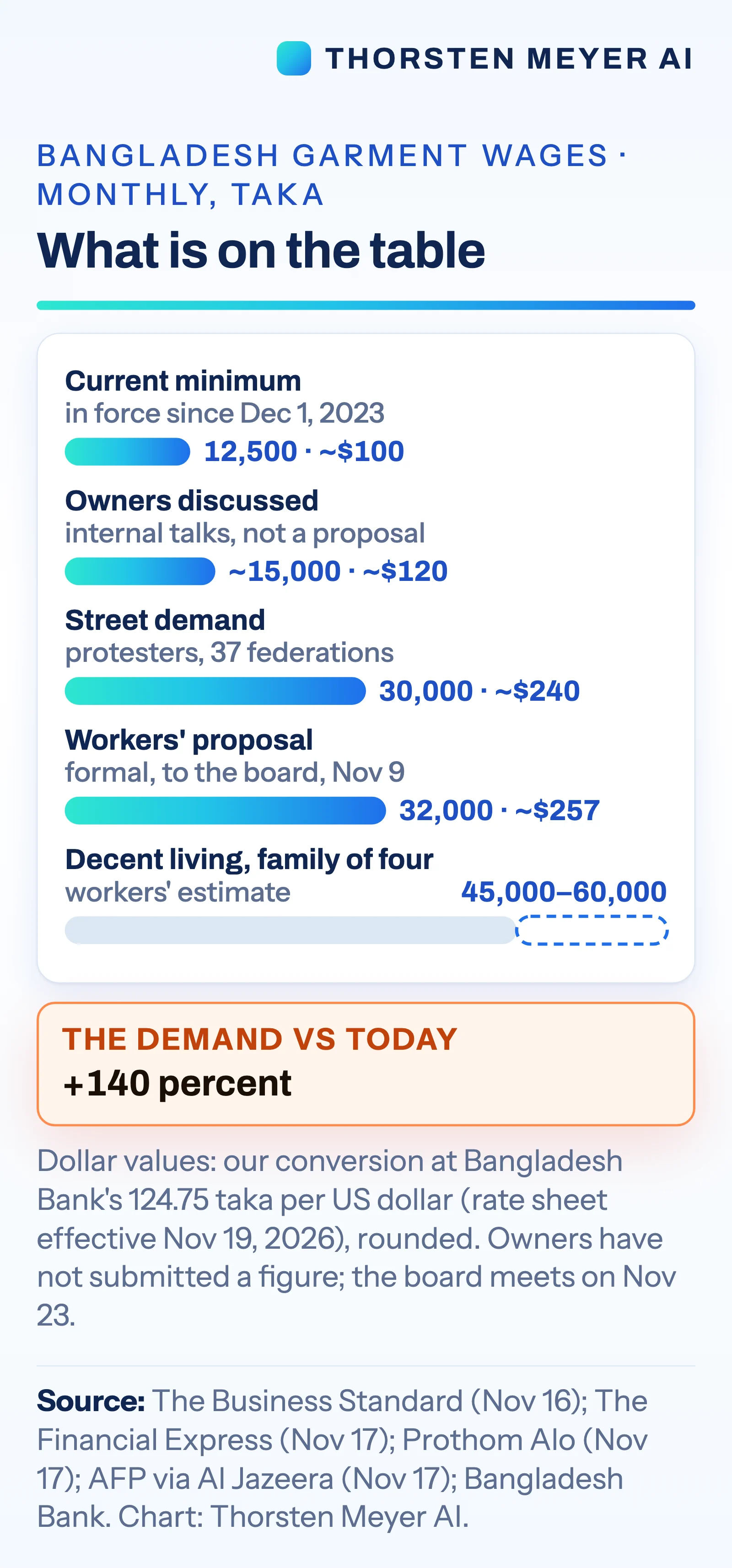
- Current minimum: 12,500 taka a month, in force since December 1, 2023, according to The Business Standard. That is about $100 at Bangladesh Bank’s rate of November 19.
- The street’s demand: 30,000 taka, about $240. That is a 140 percent increase. An alliance of 37 federations handed the board a memorandum with this figure and asked for the talks to end within November, The Financial Express reported.
- The workers’ formal proposal: 32,000 taka (about $257) for the entry level, with higher amounts for higher grades, submitted on November 9, according to The Business Standard. The workers’ representatives said a family of four needs between 45,000 and 60,000 taka a month (about $361 to $481) for a decent standard of living, but proposed 32,000 taka “taking into account the industry’s capacity”, Prothom Alo reported.
- The owners’ side: no figure yet. At meetings before Monday, owners discussed around 14,000 taka, then a range of 14,500 to 15,500 taka, and leaned towards about 15,000 taka, according to The Financial Express. Those are internal discussions, not a proposal.
History suggests the first offer will not be the last. In the previous five wage boards, owners proposed half or less of what workers’ representatives demanded, and raised their offer only after protests and long negotiations, Prothom Alo notes.
What makes 12,500 taka so contested is what it buys. Bangladesh has had inflation of around 9 percent on average since 2022, according to Reuters. One sewing worker in Gazipur told Reuters that after five years in the industry she earns 13,500 taka, about 16,000 with overtime, and that the money rarely lasts until the next payday. Manufacturers reply that workers also receive a 9 percent annual increment and two festival bonuses, Reuters reported.
The wage board meets again at 11:30 a.m. on November 23, at its office in Dhaka, for the rescheduled third meeting. “Workers will receive their revised salaries in January 2027,” the board’s chairman told a press briefing, according to The Daily Star. Once an amount is final, the board must allow 14 days for objections or appeals, he said, and the new scale takes effect from December 1 regardless of the amount. AFP reported that the new wage would take effect in January; the chairman’s account is that it applies from December 1 and is first paid in January.
Why this industry matters beyond Dhaka
- It is most of the country’s exports. Ready-made garment exports were $38.70 billion in the fiscal year 2025-26, according to Export Promotion Bureau data reported by The Financial Express. The Daily Star, which rounds the figure to $38.7 billion, puts that at about 80.6 percent of merchandise exports.
- Its buyers are in Europe and North America. The European Union took 49.25 percent of those exports, the United States 20.01 percent and the United Kingdom 11.34 percent.
- Its rank is contested. News agencies call Bangladesh the world’s second-largest garment exporter after China. An ILO working paper published in March notes that import data suggest Vietnam likely surpassed Bangladesh in 2020.
- Its workforce is large, and the count depends on the definition. AFP says the industry “employs more than four million people”. The ILO paper’s figures from Bangladesh’s labour force survey give 3,704,917 people working in the manufacture of wearing apparel in 2024.
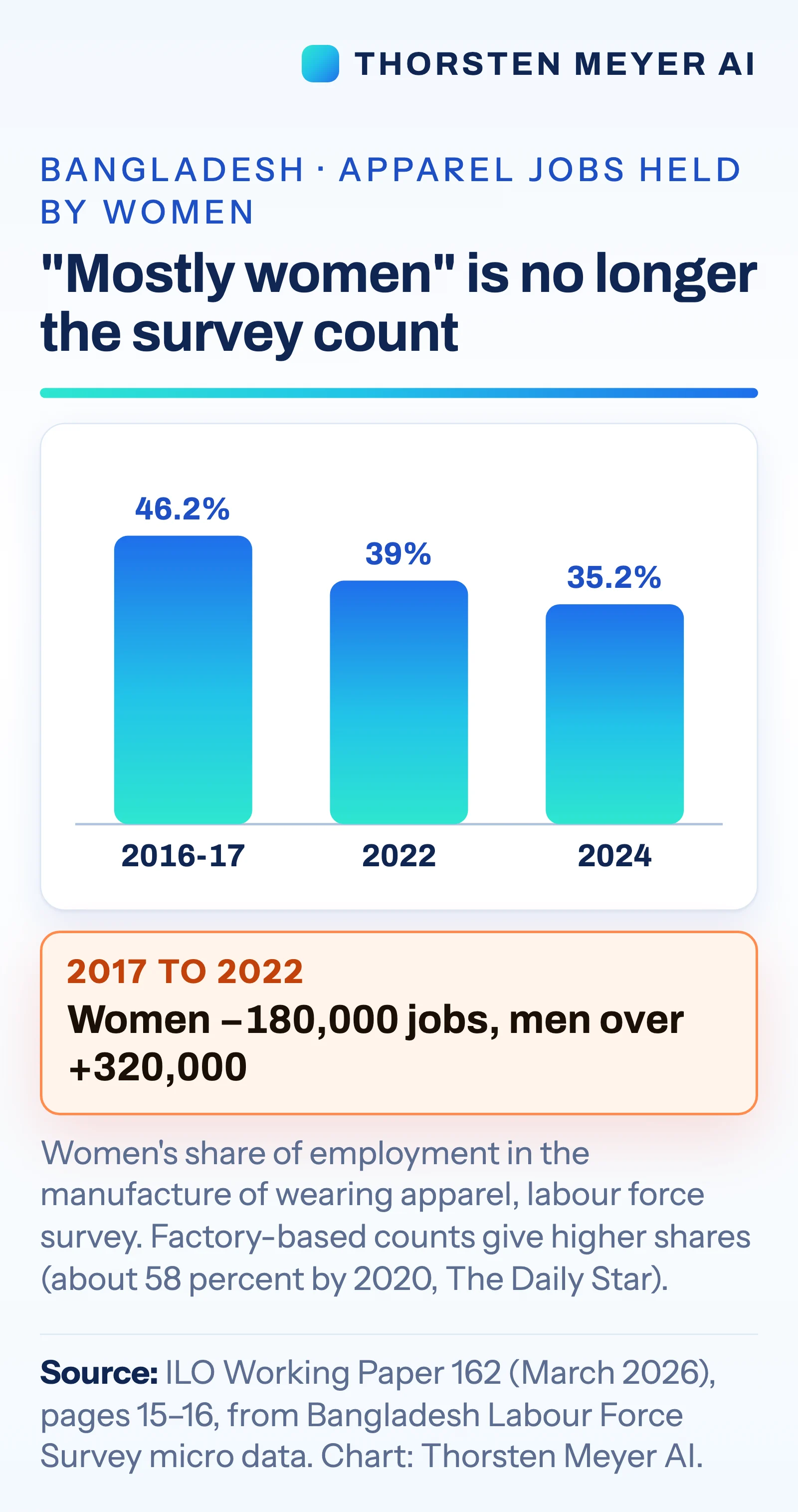
Mostly women? Not any more, by the survey count. AP describes the workforce as “mostly women from rural Bangladesh”. That was the industry’s famous profile. The ILO paper’s labour force survey data tell a different story: the female share of apparel employment fell from 46.2 percent in 2016-17 to 39 percent in 2022 and 35.2 percent in 2024. Between 2017 and 2022, employment for women fell by 180,000 while employment for men rose by over 320,000. Factory-based counts give higher shares: The Daily Star, citing research, puts women at about 58 percent of the garment workforce by 2020. The two numbers measure different things, but they point the same way. The paper names a “possible explanation”: “the adoption of labour-saving technology and automation in Bangladesh’s RMG sector”.
The squeeze, from three sides
From the buyers. Manufacturers say a steep wage increase would erode Bangladesh’s cost advantage over rivals such as India and Vietnam, and squeeze margins already hit by higher energy costs, Reuters reported. Shovon Islam, a former BGMEA director, told The Financial Express that demand in major export markets was weak and buyers were paying low prices while fuel and raw material costs rose. Owners set the wage, but buyers set the price that has to cover it. In the reports we reviewed, no international brand or retailer has said whether it will pay more for orders once the new wage applies.
From the calendar. BGMEA president Mahmud Hasan Khan said on November 14 that the protests were “setting the stage for an irrational wage announcement under pressure”, Prothom Alo reported. The Centre for Policy Dialogue, a Dhaka think tank, adds a structural pressure. As Bangladesh approaches graduation from the UN’s least developed country category, its policy brief says, the “withdrawal of preferential trade access will sharpen competitive pressures in export sectors, particularly readymade garments”, hastening the shift towards automation.
From the machines. This is where the story becomes a post-labour story.
What automation is already doing
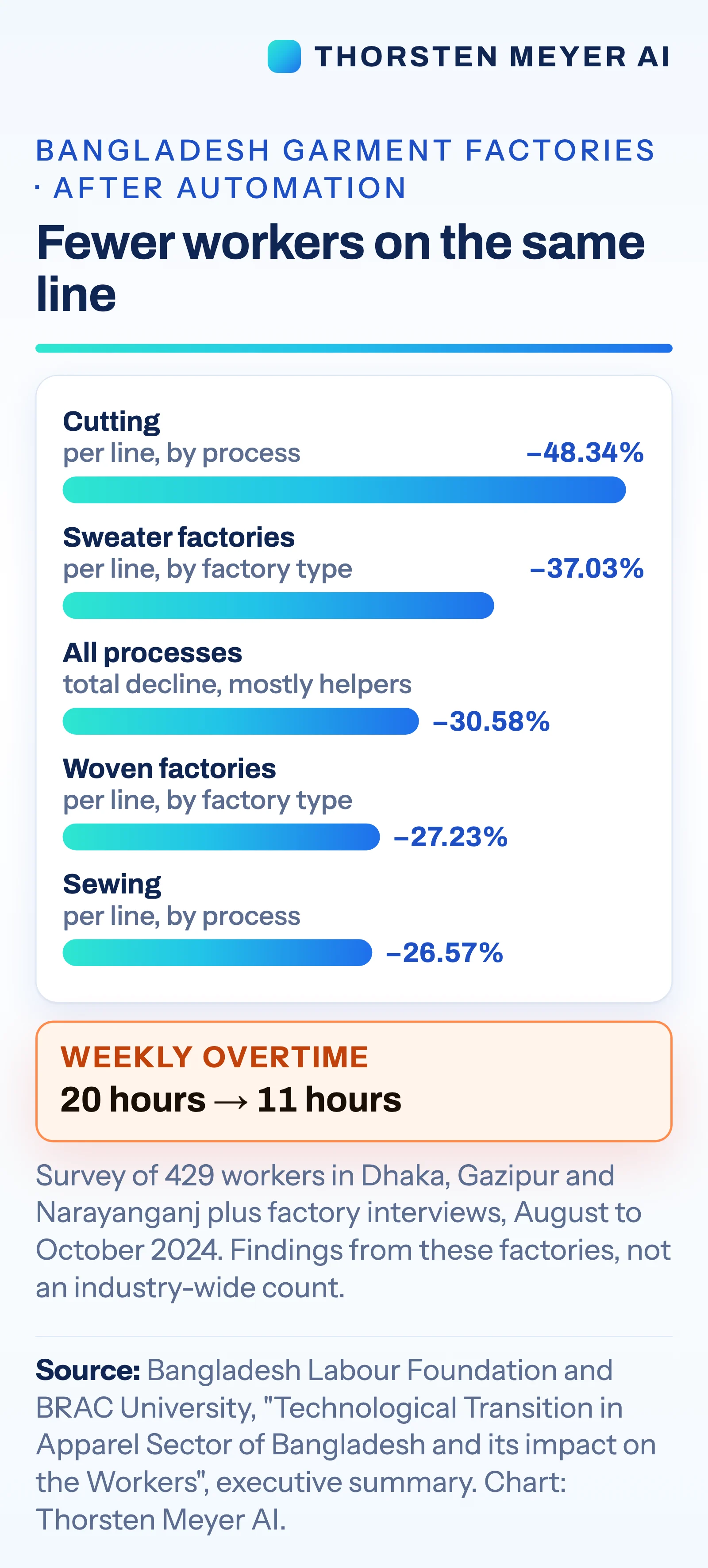
The best evidence is not a forecast but a study of factories that have already automated. Researchers at BRAC University, commissioned by the Bangladesh Labour Foundation with support from Solidaridad Network Asia, surveyed 429 workers in Dhaka, Gazipur and Narayanganj between August and October 2024. Their findings:
- Fewer workers per line. Across production processes, the number of workers fell by 30.58 percent, “and the majority of them were helpers”. Cutting saw the biggest drop, 48.34 percent per line; sewing the smallest, 26.57 percent. By factory type, sweater factories saw a decline of 37.03 percent and woven factories 27.23 percent.
- More output, less overtime. Weekly overtime fell from an average of 20 hours to 11. Overtime is a large part of take-home pay, so a machine can lower a worker’s income without touching the minimum wage. The study also reports higher production targets and stricter monitoring.
- Women hit first. 62 percent of surveyed workers said women were replaced, by being moved to other roles or, in some cases, losing their jobs.
- Not a robot takeover yet. The researchers rate automation at 2.5 to 3 on a scale of 5. Only 3 of 10 stages, from spinning to shipment, are fully automated. The sewing section, “where the majority of workers are employed, is still semi-automated”.
Some workers gain: 85 percent reported less physical strain, and about 79 percent believe their new skills would earn them more elsewhere. But the study also found that a worker who moves to one more machine earns only 278 taka more. “While the factories have benefited significantly after the use of advanced technology and machines, there has been no significant rise in the income of the workers after this technological transition,” the authors write.
The forward-looking numbers are projections, not counts. The Centre for Policy Dialogue’s brief says up to 1.22 million RMG jobs “could be threatened by automation”, citing a 2024 study, and “as much as 60 per cent of female RMG employment could be displaced by 2041”, citing a 2019 study. The ILO working paper notes that tasks once performed by four or five operators can now be handled by a single worker overseeing multiple machines.
Put the three pressures together and the wage round looks different. Every taka added to the minimum makes a machine that replaces a helper pay off sooner. Every year without a raise makes the job less worth keeping. Workers are bargaining over the price of jobs that are slowly being redesigned without them.
What it means for brands and buyers
- The wage round is a pricing question. A new minimum takes effect on December 1. Buyers who do not adjust prices push the cost onto suppliers, who will look for savings in automation, overtime or headcount.
- Disruption is a sourcing risk now, not later. Hundreds of factories have stood still on single days in November. Lead times and shipments for spring orders depend on how fast the board settles.
- Silence is a position. The owners’ associations, the workers’ federations and the government have all spoken publicly. A brand that sources here and says nothing about its prices is part of the negotiation, whether it says so or not.
What it means for workers and consumers
- For workers, the minimum is only part of the pay. Overtime, increments and bonuses decide what reaches the household, and automation is already cutting overtime. A higher minimum with fewer hours can leave take-home pay flat.
- Lost days are lost pay. Under “no work, no pay”, factories closed during unrest can withhold wages, AFP notes. The protest itself costs the people who join it.
- For consumers, the shirt is not the problem, the contract is. We found no current source that measures how much of a shirt’s shop price goes to the wages of the people who sew it in Bangladesh, so we will not put a number on it. What shoppers can do is ask the brands they buy from whether they will pay suppliers enough to cover the new minimum.
What is not known
- The number. Owners had not submitted a proposal as of November 19. The wage board meets again on November 23; the final figure, and whether workers accept it, are open.
- The full toll of the clashes. No overall count of injuries has been published in the coverage we reviewed. AP said it was not immediately clear how many people were injured on Wednesday.
- How many factories were shut on November 17. Estimates for that day ranged from at least 310 in two regions to about 500 nationally, depending on who counted.
- What buyers will do. No major brand has said publicly, in the reports we reviewed, whether it will raise prices to cover a new wage.
- How fast automation spreads. The BRAC University study covers factories that automated; the 1.22 million figure is a projection. Nobody has a current national count of jobs lost to machines.
- The infiltration claim. A police officer’s allegation that outside groups are inciting violence is not supported by evidence in the reports we reviewed.
The bottom line
The protests are about 12,500 taka not lasting a month. But the wage board is also setting the price at which a factory decides between a person and a machine, under pressure from buyers who have so far said nothing. If the new minimum rises without prices following, the cost will be paid in overtime cut and helpers replaced. If it barely rises, it will be paid on the highways. The number announced after November 23 decides which.
Further reading: the day Bangladesh formed its garment wage board, how wages are set, and who wins and who loses from trade.
I’m Thorsten Meyer. The full sources are below, and more reality checks are at thorstenmeyerai.com.
Sources
- Bangladesh Bank: “Exchange Rate”, FX rate sheet effective November 19, 2026, USD/BDT 124.7500, bb.org.bd (retrieved 05:29 UTC, November 19, 2026)
- ILO, Radhicka Kapoor: “Reviving and Reconnecting Economic Growth and Employment in Bangladesh”, ILO Working Paper 162, March 2026, pages 15-16 and 41 (PDF pages 18-19 and 44), including Table 6 from Bangladesh Labour Force Survey micro data
- Bangladesh Labour Foundation and BRAC University: “Technological Transition in Apparel Sector of Bangladesh and its impact on the Workers”, supported by Solidaridad Network Asia, executive summary, pages 10-13 (PDF pages 12-15)
- Centre for Policy Dialogue, Debapriya Bhattacharya, Towfiqul Islam Khan, Mamtajul Jannat and Maliha Rahman: “Is Bangladesh Ready for the Future of Work? Preparing the Labour Market for Automation, AI, and Structural Transition”, policy brief, 2026, pages 1 and 3
- Al Jazeera (AFP): “Bangladesh police clash with garment workers amid protests over wages”, November 17, 2026
- Arab News (AP): “Police in Bangladesh clash with garment workers demanding higher minimum wages”, November 18, 2026
- The Daily Star: “RMG unrest flares”, November 18, 2026, and “New pay scale for garment workers to be announced soon, to take effect from Dec 1: Wage board chief”, November 17, 2026
- The Daily Star: “Can AI Save Bangladesh’s Garment Industry?”, October 12, 2026 (export share, women’s share by 2020)
- The Business Standard: “Garment owners seek announcement of next wage board meeting soon”, November 16, 2026 (BGMEA and BKMEA joint statement)
- The Financial Express: “Minimum Wage Board meeting deferral fuels more tensions”, November 17, 2026
- The Financial Express (UNB): “EU share erodes as Bangladesh RMG exports slip 1.64pc to $38.70b in FY26”, July 7, 2026 (Export Promotion Bureau data)
- Prothom Alo: “Garment sector: Postponed 3rd meeting of minimum wage board rescheduled for Monday”, November 17, 2026, and “Pretext being created for unreasonable wage announcement: BGMEA president”, November 14, 2026
- CNA (Reuters): “Behind Bangladesh’s garment boom, workers cut food, healthcare as wages fall short”, November 11, 2026
Researched and drafted with AI assistance, including Anthropic’s Claude. No organization, company or person named here reviewed or sponsored this article. Our own text and graphics contain no affiliate links; offer and product boxes added by the site may contain Amazon affiliate links. This article is for information only; it is not financial, legal or investment advice. Statements as published by the organizations named and as reported by the outlets above, as of 07:00 UTC on November 19, 2026. Images: AI-generated illustration (Runware) and graphics by Thorsten Meyer AI; our own images show no real people, logos or flags. Boxes added by the site may show product photos or people.