By Thorsten Meyer | November 18, 2026 | ThorstenMeyerAI.com

Get business pricing on tech for your team
- Business-only prices and quantity discounts
- Tax-exempt purchasing
- Multiple users, one account, clear invoices
Every team lead has seen both videos. In one, an AI agent builds a working app from a single prompt while the audience applauds. In the other, the same kind of tool spends an afternoon on a two-line bug in your own code base and still gets it wrong. Both are real. That is why Can AI do X? is the wrong question for anyone who plans work.
A better question comes from METR, an independent research nonprofit that tests AI models on real tasks. How long would X take a skilled person? And how reliably does AI finish tasks of that length? The answer is one number, the time horizon, and it is the most useful yardstick we have for deciding which work to hand to AI today and how to plan for next year.
This guide explains how the number is measured, what it says today, how to translate it to a backlog of tickets, and where it misleads. For the forecast debate about 2027, see our separate analysis Scenario 2027.
Key takeaways
- The yardstick is human time, not AI time. METR’s time horizon is the length of task, measured in the working time of skilled humans, that an AI agent completes with a given success rate. The strict version is 80%: four out of five attempts.
- The number to remember: about three hours. The best measured model, an early Claude Mythos Preview released in April 2026, has an 80% time horizon of 185.9 minutes, about 3 hours and 6 minutes. GPT-4 in March 2023 managed 0.89 minutes.
- Read it with two discounts. At 50% success the same model reaches 17.4 hours, so reliability costs length. And METR’s tasks are clean and well specified; in one METR comparison, messier tasks cut the horizon by a factor of almost three.
- The line has doubled every 3 to 7 months, if the trend holds. In our own fits, a full eight-hour workday at 80% falls between September 2026 and November 2027, depending on which years you trust. Nothing after April 2026 has been measured publicly.
- 80% is not 100%. Someone has to catch the fifth task. In METR’s 2025 trial, experienced developers were 19% slower with AI while believing they were 20% faster, and reviewers in another study caught only 31% of errors that needed the task’s rules to spot.
- What teams should do: cut work into pieces of hours with a clear acceptance check, give AI the testable parts first, budget the checking, pick models per task, and re-measure on your own work every quarter.
AI time horizon · how it is measured
How long a task can AI finish 4 times out of 5?
The time horizon turns “can AI do it?” into one number. It counts the task’s length in human working time, not how long the AI runs.
- 1 · People time the tasksSkilled professionals with about 5 years of experience solve each task. Every task gets a length in human working time. The suite has 228 tasks.
- 2 · The AI tries, again and againMETR runs the AI 6 times on each task. Short tasks usually succeed, long ones often fail. Cheating counts as failure.
- 3 · Read off the 80% pointA curve is fitted to success rate by task length. Where it crosses 80% is the time horizon: about 3 hours (185.9 minutes) for the best measured model, April 2026.
Sources: METR, Task-Completion Time Horizons (methodology and FAQ) and Time Horizon 1.1 results file, retrieved November 18, 2026; METR, Time Horizon 1.1 (January 29, 2026). Task dots are illustrative; the curve follows the shape of METR’s fit for the early Claude Mythos Preview.
Graphic: Powered by Thorsten Meyer AI
Products Worth Considering

Jackery Solar Generator 1000 V2 with 100W Solar Panel

Bose SoundTouch 30 Wireless Speaker, Black

Amazon Kindle Scribe Colorsoft 64GB with Premium Pen
As an affiliate, we earn on qualifying purchases.
The time horizon in one sentence
METR defines it as “the task duration (measured by human expert completion time) at which an AI agent is predicted to succeed with a given level of reliability.” Three steps produce it.
- Time the tasks with people. METR contracts skilled professionals in software engineering, machine learning and cybersecurity, with “an average of about 5 years of relevant experience”, and records how long they take. Each task now has a length in human working time, from seconds to more than eight hours. The current suite, Time Horizon 1.1, has 228 tasks.
- Let the AI try each task several times. METR launches 6 independent runs per task and checks the transcripts for cheating, which it scores as failure.
- Find the crossing point. Plotting success against task length gives a falling curve: short tasks almost always succeed, long ones rarely. Where the fitted curve crosses 80% is the 80% time horizon; where it crosses 50% is the better-known 50% horizon.
The most common misunderstanding is that a three-hour horizon means the AI works for three hours. It does not. METR calls it “a measure of the difficulty of a task, rather than the time an AI spends to complete the task.” On tasks they complete, AI agents are “typically several times faster than humans.”
We use the 80% version in this guide because it is the planning number. A tool that fails half the time on a task class is a coin toss; one that succeeds four times in five is something you can build a process around.
The number to remember: about three hours
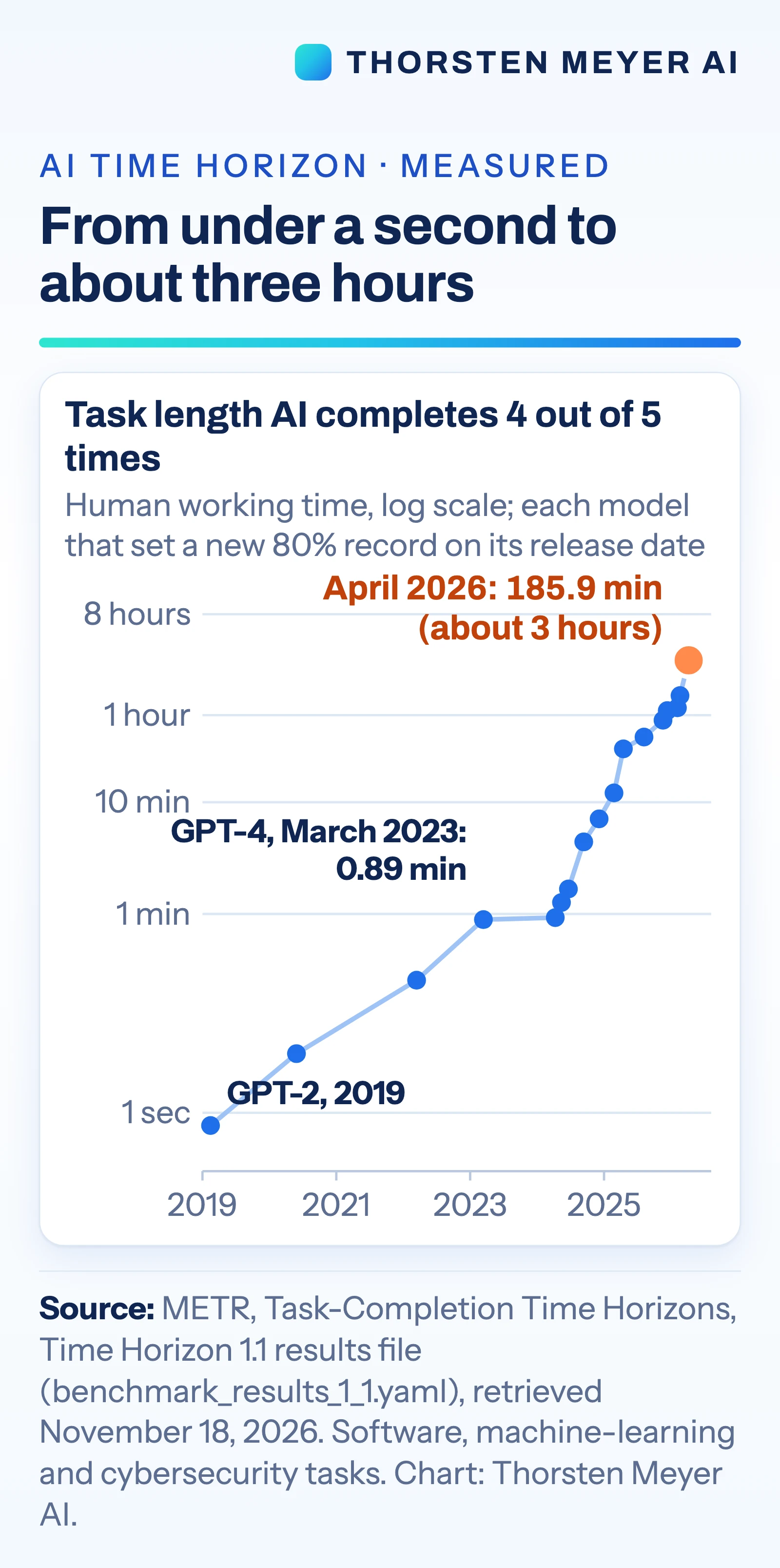
In METR’s results file, the 80% record rose from under a second for GPT-2 in 2019 to 0.89 minutes for GPT-4 in March 2023, 29.98 minutes for o3 in April 2025 and 66.00 minutes for GPT-5.2 in December 2025. The current record is an early version of Anthropic’s Claude Mythos Preview, dated April 7, 2026 in METR’s file: 185.9 minutes. That is a factor of about 209 in three years.
Two caveats belong next to that number. The confidence interval is wide, from 97.3 to 398.5 minutes, or roughly 1.6 to 6.6 hours. And METR has stopped updating the public record: its page says it “is no longer actively updated”, last updated September 8, 2026. In its Frontier Risk Report for February to March 2026, METR estimated the labs’ internal frontier at “≥3h but <4h” at 80%, so the public three hours was not far behind.
If you remember one thing, remember this: tasks a skilled person needs about three hours for, the best measured model finishes four times out of five, on METR’s kind of task.
Two discounts before you use the number
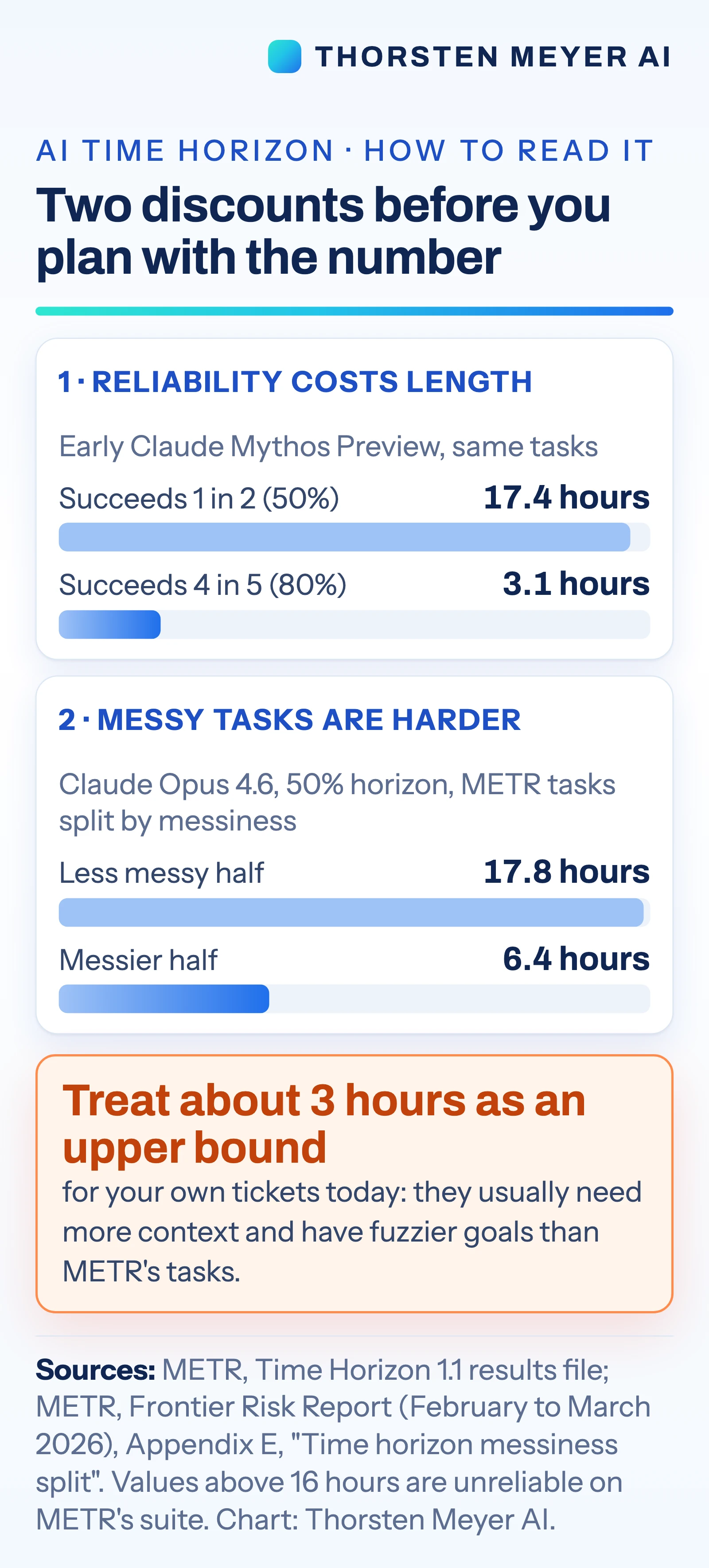
Discount 1: reliability costs length. The same early Mythos Preview has a 50% time horizon of 1,044.8 minutes, about 17.4 hours, against 3.1 hours at 80%. Asking for four successes in five instead of one in two shrinks the task length by a factor of about 5.6. METR also warns that “Measurements above 16 hrs are unreliable with our current task suite”, so the 17.4 hours itself is soft.
The horizon is also an average, not a promise per task. METR explains it with GPT-5 and its horizon of about 2 hours and 17 minutes: on tasks of 90 minutes to 3 hours, it “succeeds 100% of the time for around one-third of the tasks, fails 100% of the time for around one-third of the tasks, and sometimes succeeds and sometimes fails on the remaining third of tasks.” In practice: some task types simply work, some never do, and you only learn which by trying.
Discount 2: your tickets are messier. METR’s tasks “are designed to be self-contained and well-specified, with clear success criteria that can be automatically evaluated.” It suggests reading a 2-hour task as what someone with low or no prior context, “like a new hire or freelance contractor”, could complete in 2 hours. Most real work draws on earlier conversations, unwritten rules and knowledge of an existing code base.
METR has measured this. It scored its tasks on 16 “messiness” factors. Its software and research tasks average 2.36 out of 16, with a maximum of 6; a task like “write a good research paper” would score between 9 and 15. On the less messy half of its tasks, Claude Opus 4.6 reached a 50% horizon of 17.8 hours; on the messier half, 6.4 hours. Messiness cut the horizon by a factor of almost three, and even the messiest METR task scores far below a real-world project like a research paper.
So treat about three hours as an upper bound for your own work today, not a floor.
Translated to your backlog: a rule of thumb
What does a three-hour horizon mean for tickets? The table below is a rule of thumb derived from the METR yardstick. It is not a measurement of any code base, and your results will differ by domain, code base and tooling.
| Task length (skilled human) | Typical example | AI today, 80% yardstick |
|---|---|---|
| Minutes | Write a unit test, explain an error message, small refactor | Mostly reliable; still check |
| Up to about 1 hour | Fix a bug with a clear reproduction, add an endpoint with tests | Usually |
| 1 to 3 hours | Implement a scoped feature across a few files | Often, with review |
| A workday or more | Design and ship a feature end to end, data migrations | Not reliably yet |
One pattern matters more than the rows: the same ticket moves up a row when it has a clear test or acceptance criterion. That is the practical lesson of METR’s clean tasks. A ticket that says make checkout faster is messy; one that names the endpoint, the target response time and the tests that must stay green is close to a METR task. The second one is the one to give to an agent.
How fast the line moves, if it holds
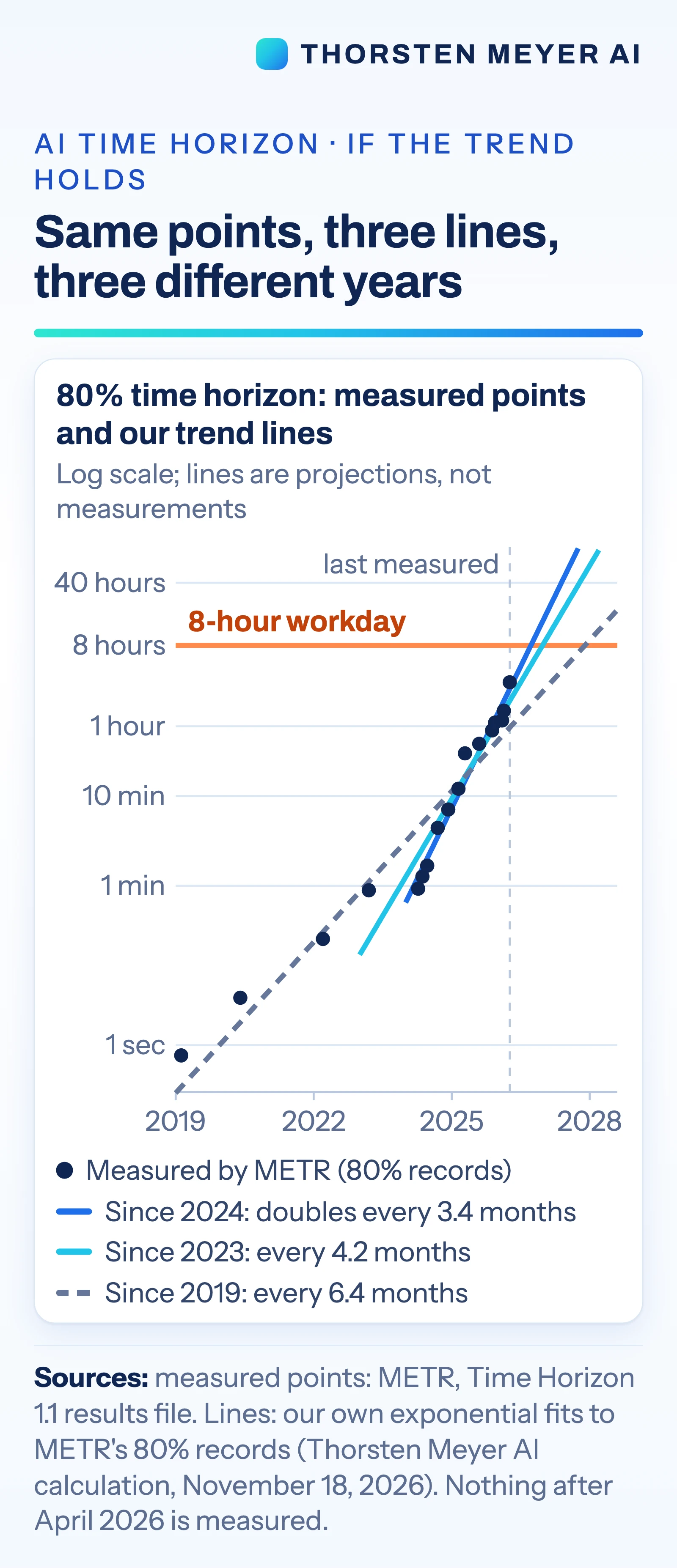
METR’s original 2025 paper found that the time horizon had been “doubling approximately every seven months since 2019, though the trend may have accelerated in 2024.” Fitted only to recent models, the doubling is faster. Our own fits to METR’s 80% records give three answers from the same points:
| Trend line (our calculation) | Doubles every | 8-hour workday at 80% | 40-hour week at 80% |
|---|---|---|---|
| Models since 2024 | 3.4 months | September 2026 | May 2027 |
| Models since 2023 | 4.2 months | December 2026 | October 2027 |
| All models since 2019 | 6.4 months | November 2027 | February 2029 |
These are projections, not measurements. On the fastest line, AI would already have crossed a full workday at 80% in September 2026; no public measurement can confirm it, because nothing after April 2026 has been published. In our backtests, the fast line ran ahead of the later models by a factor of up to about 3.1, and the long-run line fell short by a factor of up to 6.5. Reality has so far landed between the two. METR’s suite also cannot measure reliably beyond 16 hours, and of its 31 tasks that take people 8 hours or more, it timed only 5 with real people.
For planning, use a range, not a date: a full workday at 80% somewhere between late 2026 and late 2027 on METR-style tasks, later on your messier ones. Our Scenario 2027 analysis has the five curve types, the backtests and the takeoff debate in full.
80% is not 100%: someone has to catch the fifth task
At an 80% horizon, one task in five fails. The failure is rarely loud. It is plausible code that passes a quick look and breaks a rule nobody wrote down.
The best-known test of this is METR’s randomized trial from early 2025. Sixteen experienced open-source developers worked on 246 tasks in projects they knew well. Before the study, they expected AI to cut their time by 24%. Afterwards, they estimated it had cut it by 20%. Measured, “allowing AI actually increases completion time by 19%.” In February 2026, METR said it believes “developers are more sped up from AI tools now”, but that its newer data are “only very weak evidence” for the size of the change, partly because many developers no longer wanted to work without AI.
Checking is where the cost moves. In an experiment with 2,784 participants by researchers at LMU Munich and the University of Maryland, people reviewed AI-style suggestions in data tables. “Spelling errors, such as confusing two digits, are corrected most frequently, 82% of the time.” Errors that needed “a conceptual understanding of the annotation rules” were caught only 31% of the time. In software terms: reviewers catch the typo, and miss the wrong business rule. More on this in Checking AI’s work has a hidden cost.
The planning rule that follows: every hour AI saves in writing can cost time in review. Budget the checking, not just the generation.
Pace and cost: the other half of the picture
Two signals suggest the line will not slow down soon, and one suggests choosing models carefully.
- AI is helping build AI. METR reviewed internal evidence from Anthropic in October 2026 and found the company “likely improving the capabilities of their models on well-specified tasks at around twice the rate they did between March 2024 and October 2025.” It “would not be surprised if the true acceleration was closer to 1.3x or 3x the historical rate.”
- A first official threshold. On November 17, 2026, OpenAI wrote in its GPT-6.2 system card that “GPT-6.2 Astra is our first externally released model to meet the High threshold for AI Self-Improvement.”
- Cost per task varies widely. Artificial Analysis measures what one task of its Intelligence Index costs at each model’s highest tested setting. On November 17, 2026, across five leading models at their highest setting, it ran from $1.01 for GPT-6.2 Sol (Max, index score 57) to $26.54 for Claude Fable 5.2 (Max, score 65), a spread of about 26 times. The most capable model is not automatically the right one for a sub-hour ticket.
And the public yardstick itself is paused. Teams that want to know where they stand will have to measure on their own tasks.
Five consequences for product and engineering teams
- Cut work into task-sized pieces of hours. Each piece gets a clear acceptance check: a test, a metric, an example output. Pieces under about three hours with a check are where AI helps most today.
- Give AI the well-specified, testable parts first. Keep the parts with unclear goals, many stakeholders or unwritten rules with people, or turn them into well-specified pieces before you hand them over.
- Budget review and testing time explicitly. Put it in the estimate. If the plan only counts generation time, the fifth task lands on someone’s evening.
- Choose models per task. Cost per task differs by a factor of about 26 between leading models. Route routine, sub-hour work to cheaper models and test whether the expensive one actually changes the result.
- Re-check the yardstick every quarter, on your own tasks. Keep a small set of real tickets with known human times and acceptance tests, run them on new models and record the success rate by task length. That is a time horizon for your own work, and it is the number your planning should use.
For product managers, the horizon tells you which parts of a feature can be accelerated now. For engineering, acceptance checks are what turn AI output into something you can trust.
What it means for workers
The work that moves to AI first is the well-specified, low-context work: the tasks a capable newcomer could do from the ticket alone. The work that stays longest is the work around it: deciding what to build, writing the acceptance check, judging the result and answering for it. That shifts value toward people who can specify and verify. If you want to understand why the models behave this way, our plain-English guide How deep learning works is a good start.
What is not known
- The current number. METR’s public page is no longer updated, and the last published 80% record is from April 2026. Lab-internal models are likely ahead.
- How the horizon transfers to your work. METR’s tasks are mostly software, machine learning and cybersecurity. METR expects horizons on all economically valuable tasks to “range over several orders of magnitude.”
- Whether the trend holds. Our fits disagree by more than a year on when a workday is reached, and the backtests show both fast and slow lines can miss.
- The real productivity effect today. METR’s controlled trial is from early 2025; its own later data cannot say how much faster developers are now.
Three questions for your next planning meeting
- Which backlog items are 1- to 3-hour tasks with a clear test?
- Where would a wrong AI answer be expensive for us?
- What would we change if the horizon reaches a full workday in 2027?
I’m Thorsten Meyer. The sources are below, and more reality checks are at thorstenmeyerai.com.
Sources
- METR: Task-Completion Time Horizons of Frontier AI Models, last updated September 8, 2026 (definition, methodology, FAQ), and the results file benchmark_results_1_1.yaml (Time Horizon 1.1), both retrieved November 18, 2026
- METR: Time Horizon 1.1, January 29, 2026 (228 tasks; 5 of 31 long tasks timed by humans)
- Kwa, T. et al. (METR): Measuring AI Ability to Complete Long Software Tasks, arXiv:2503.14499, abstract
- METR: Frontier Risk Report (February to March 2026), May 19, 2026, Table 1 and Appendix E (“Time horizon messiness split”)
- Becker, J. et al. (METR): Measuring the Impact of Early-2025 AI on Experienced Open-Source Developer Productivity, arXiv:2507.09089, abstract
- METR: We are Changing our Developer Productivity Experiment Design, February 24, 2026
- Beck, J., Eckman, S., Kern, C. and Kreuter, F.: Bias in the Loop: How Humans Evaluate AI-Generated Suggestions, arXiv:2509.08514, section 5.1.6
- METR: Independent Assessment of AI R&D Acceleration at Anthropic in October 2026, November 5, 2026
- OpenAI: GPT-6.2 System Card, Deployment Safety Hub, November 17, 2026
- Artificial Analysis: OpenAI has the #2 model in the Intelligence Index with the release of GPT-6.2 Astra and GPT-6.2 Sol and model pages for GPT-6.2 Astra and GPT-6.2 Sol, November 17, 2026 (cost per index task)
- Our calculations: exponential fits and backtests on METR’s measured 80% records, reproducible from the results file above
Further reading on ThorstenMeyerAI.com
- Scenario 2027: a year of AI progress in two months, until compute runs out?
- Checking AI’s work has a hidden cost
- How deep learning works: a plain-English guide
- From minutes to months: AI’s rising ability to finish long tasks (our first look at the yardstick, August 2025)
This guide explains published research; it is not legal, career or investment advice. Researched and drafted with AI assistance, including Anthropic’s Claude. Conflict of interest: the best measured model in METR’s record is an early Claude Mythos Preview made by Anthropic, and Anthropic figures appear in this article, including METR’s assessment of Anthropic’s own research speed; Anthropic also makes the AI we used. We quote the sources’ caveats and the independent checks as they state them. No company or organisation named here reviewed or sponsored this article. Our own text and graphics contain no affiliate links; offer and product boxes added by the site may contain Amazon affiliate links. Sources checked on November 18, 2026. Images: AI-generated illustration (Runware), animation and charts by Thorsten Meyer AI from the published numbers; our own images show no real people or logos. Boxes added by the site may show product photos or people.