

By Thorsten Meyer | November 21, 2026 | ThorstenMeyerAI.com

Get business pricing on tech for your team
- Business-only prices and quantity discounts
- Tax-exempt purchasing
- Multiple users, one account, clear invoices
Every new session with an AI agent starts the same way. The agent is smart, fast and eager, and it knows nothing about you. It does not know which decision you made last week, which approach already failed, or what you call your own projects. So you explain it all again. And again tomorrow.
I run many AI agents every day, and I got tired of being their memory. So I built them one. I call it my Second Brain: a long-term memory that I share with all of my agents. Any agent can look something up in it, and any agent can add to it. This article explains how it works, what it looks like, and what you can take from it for your own work or your company. The short video version is right below the key takeaways.
Key takeaways
- What it is: a personal knowledge base and long-term memory that I and my AI agents share. When an agent needs to know something about my work, it asks the Second Brain first.
- How it is built: plain markdown files kept in git, one cluster of facts per page. One index file,
INDEX.md, lists every memory as one line. No vector database, no cloud. - How an agent remembers something: index first, files second. A small script,
recall.py, scores the index without opening any file, opens only the best page and returns just the answering section, with its source. - How new facts get in: in one step.
remember.pywrites the page, its index line and a log line together, so the catalogue never drifts. - How big it is, as of November 21, 2026: 1,278 pages, 1,761 links and 1,363 recalls. On recall top-1, the brain’s own measure for how often the first page it picks is the right one, it scores 97.4%.
- What it means for you: plain files and one index make agent memory something you can read, check and move. The price is discipline, and a setup that is built for one owner, not a team.
Second brain · how one memory works
Index first, files second
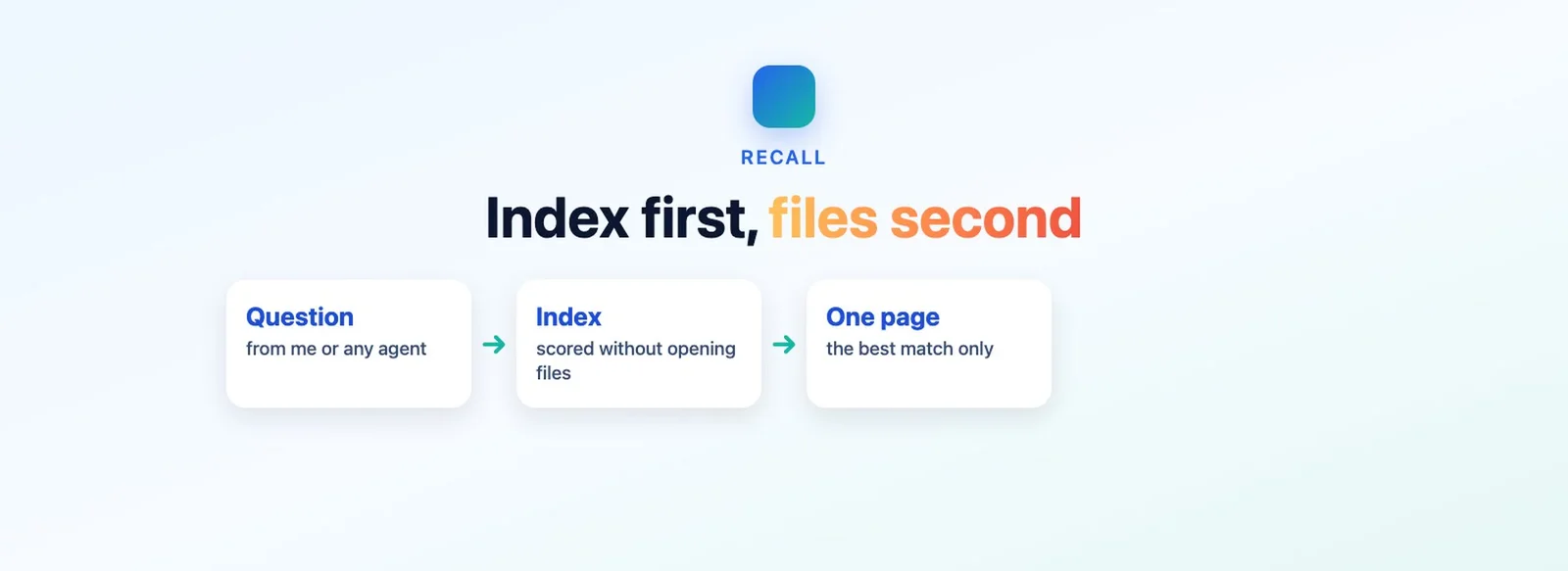
Every memory is a plain markdown page. One index lists them all, one line each. An agent never searches the whole pile: it reads the index, opens one page and answers with the source.
- 1 · Plain files, one indexEvery fact lives in a markdown page, kept in git. One index lists every memory, one line each. No vector database, no cloud.
- 2 · Index firstA question comes in. A small script scores the index lines without opening a single file.
- 3 · One file secondOnly the best page is opened. The answer comes back with just the answering section and its source.
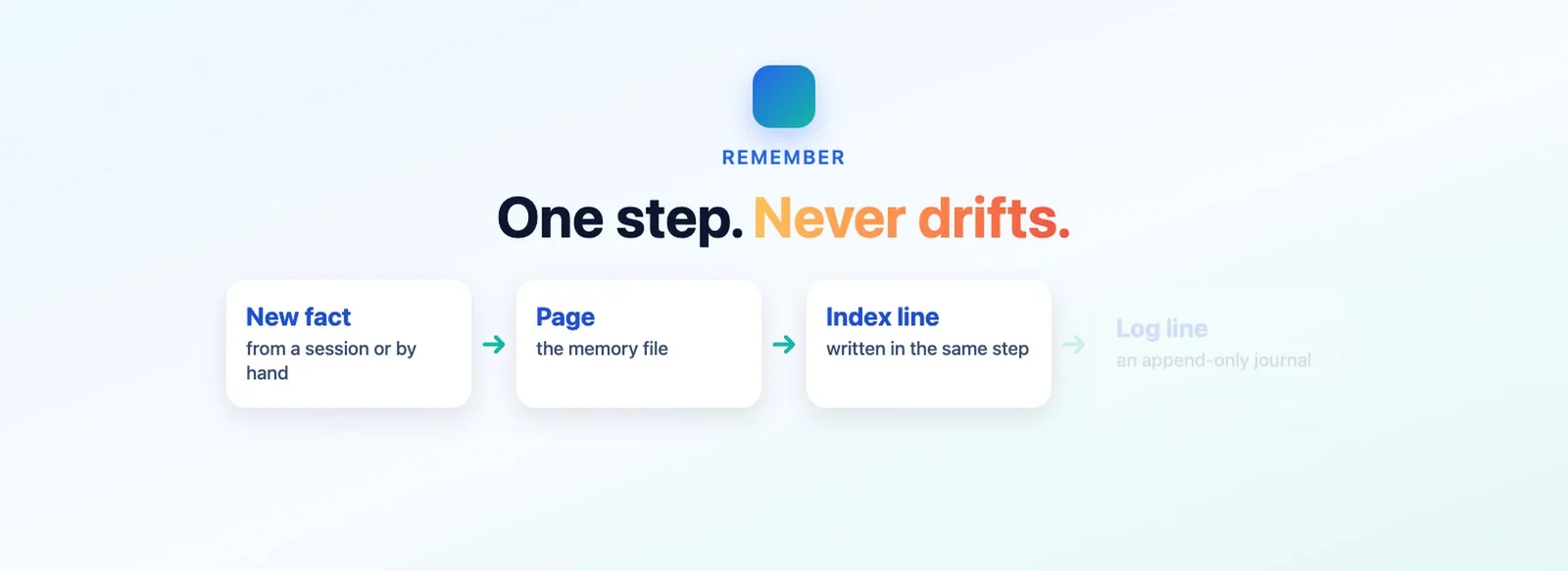
- 4 · Remember in one stepA new fact writes its page, its index line and a log line together, so the index never drifts.
Source: the author’s own second brain and its explainer film, November 21, 2026. Drawing: a generic diagram, not a screenshot.
Graphic: Powered by Thorsten Meyer AI
Products Worth Considering

Samsung Odyssey OLED G8 34-Inch Curved Ultra WQHD Gaming Monitor

Jackery Explorer 300 Portable Power Station, 292Wh

Bose SoundLink Plus Portable Bluetooth Speaker, Black
As an affiliate, we earn on qualifying purchases.
The problem: agents that start from zero
An AI agent works inside its context window: what it can see right now. Once a session ends, that is gone. Some tools add a memory feature, but it often sits in a place you cannot easily read, edit or audit, and every tool has its own.
I wanted the opposite. One memory, shared by every agent I run, that I can open and read myself. If an agent gives me an answer based on it, I want to see where that answer came from. And if a fact is wrong, I want to fix it in one place.
How it works: plain files and one index
The idea is simple. Every fact lives in a plain markdown file, kept in git. A page holds one cluster of facts, for example everything about one project or one decision. Git keeps the full history: who changed what, and when.
Next to the pages sits one index file. It lists every memory, one line per memory. That index is the heart of the system. Recall reads only these lines, so each line has to say what its page is about.
There is no vector database and no cloud service. The whole memory is a folder of text files that any editor can open.
Recall: index first, files second
When an agent needs to know something, it does not search through every page. It checks the index first and opens files second. A small, deterministic script scores the index lines without opening a single file. It then opens the one page that scores best and returns only the section that answers the question, with its source.
That last part matters most to me. An answer from the Second Brain always says which page it comes from. I can open that page and check it.
Remember: one step, never drifts
Storing a new fact is one step. The page, its index line and a log entry are written together. That rule sounds small, but it solves a real problem: in many note systems, the index and the notes slowly drift apart until nobody trusts the index any more. Here, a page without an index line cannot happen through the normal path, and the log records every change in order.
What it looks like: nine views
Files and an index are enough to make it work. To see what is going on, the Second Brain has nine views. The video walks through all of them:
- Map: how everything connects: projects, skills, routines, and the apps that read and write the brain.
- Brief: every morning, a summary of yesterday: sessions, new memories, knowledge gaps and open captures.
- Triage: sessions leave captures behind. Triage decides what becomes a lasting memory, what gets merged with an existing page, and what is dropped.
- Almanac: grades the health of the brain and ranks the pages that are used most.
- Chronicle: the paper trail. Every change to the brain, in order.
- Explorer: draws all pages and their links. A link only exists where one page really changes how you read another.
- Live: the brain at work, as agents recall and remember in real time, with the recall pipeline, the agents writing into one memory, the path from capture to page, the nightly pass and the tools.
- Desk: the control room for the day. Six stations, from session to page, fire into one index. Below them: the balance of pages, the tape of events, the project rotation, every step in the trace, and a forecast for the next thirty days.
- Fleet: a console that watches every service and machine the brain runs on.
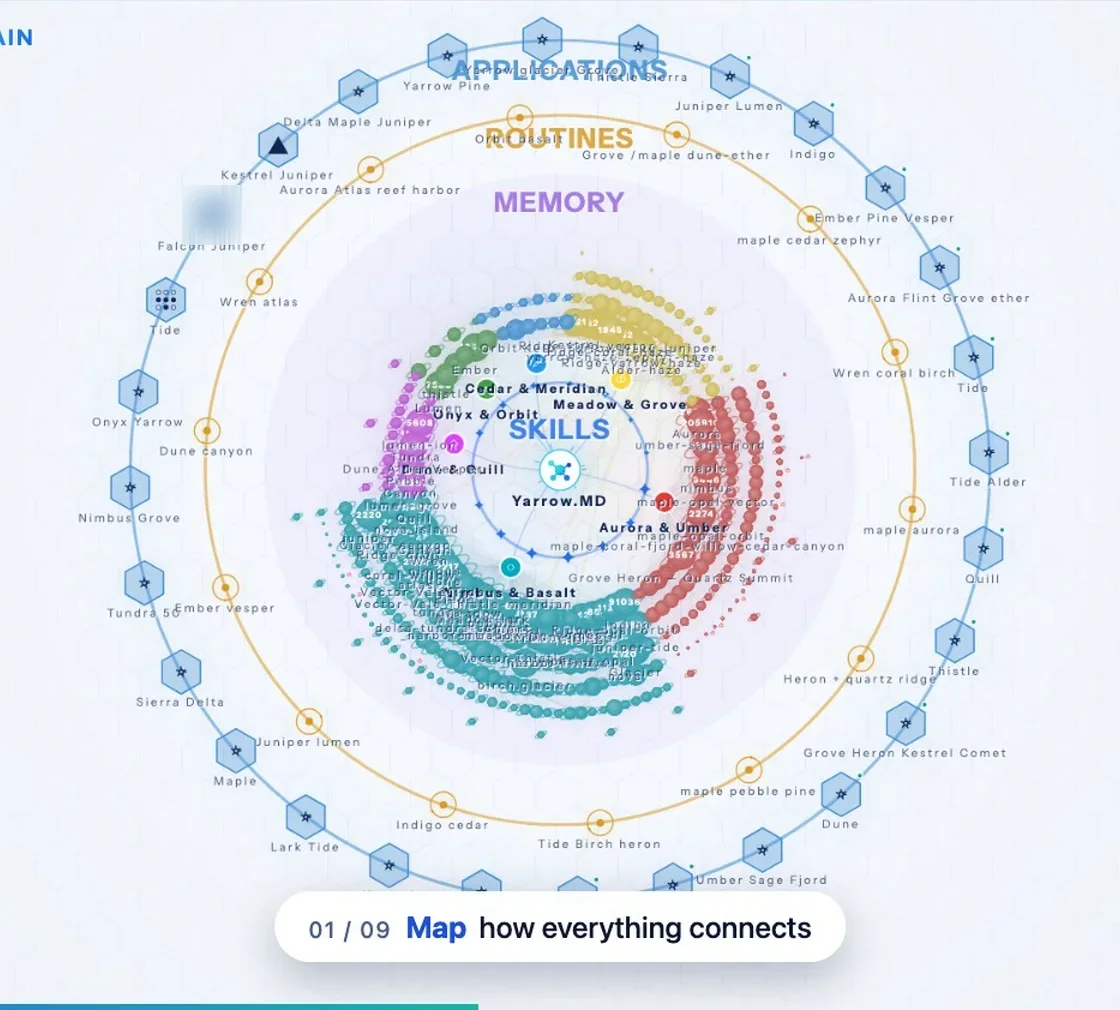
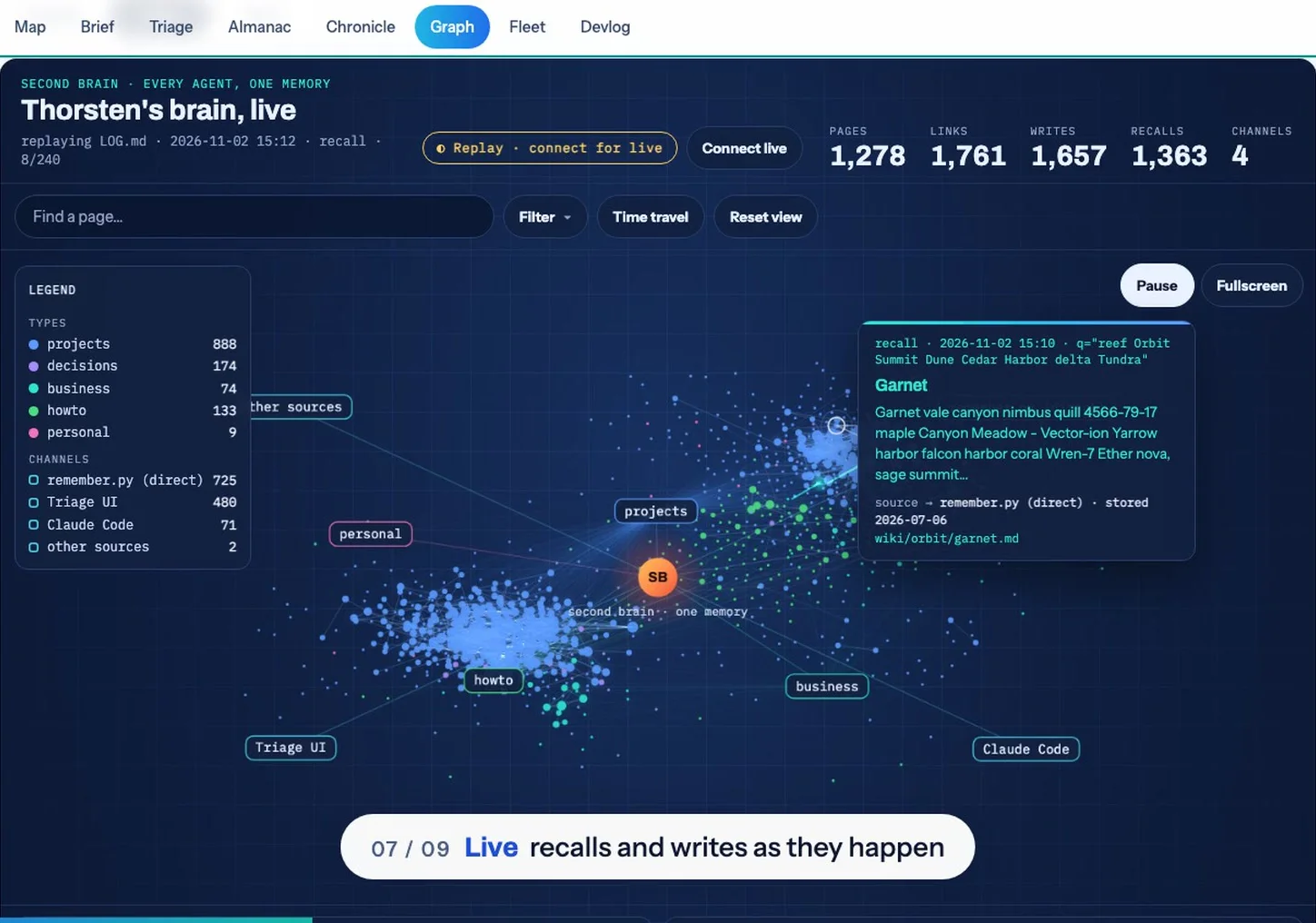

All personal data in the video and in these frames is protected.
The numbers
As of November 21, 2026, the Second Brain holds 1,278 pages connected by 1,761 links, and it has answered 1,363 recalls. Its recall top-1 is 97.4%: in the brain’s own measurement, the first page that recall picks is the right one in almost every case.
Two cautions belong next to that number. It is measured on my own recalls, against my own pages, not on an independent benchmark. And it is a snapshot taken on a single day; the counts change every time an agent writes.
What this means for you and your business
You do not need my setup to use the idea. What carries over is the design.
- Memory you can read is memory you can trust. If your agents’ memory is a folder of text files, anyone on the team can open it, read it and correct it. A memory hidden inside a tool, or spread across a vector store, is much harder to check.
- Every answer should name its source. Index first, files second means the agent’s answer always points to one page. That turns the AI said so into page X says so, which you can verify.
- One memory for all agents. If you use more than one AI tool, each tool’s own memory feature keeps its own picture of your work. A shared memory in plain files works with any agent that can read a file.
- Version history comes for free. With git, every change has a date and a reason. When something goes wrong, you can see when a wrong fact came in and roll it back.
- Cheap and portable. No vector database to run and no cloud service to pay for. The memory moves with you, to a new tool or a new machine, as a folder.
If you want to try it, start small: one folder of markdown pages, one index file with one line per page, and two rules. Agents read the index before they open a page. And nobody, human or agent, writes a page without writing its index line in the same step.
Trade-offs and limits
Plain files and one index are not magic. Know the limits before you copy the idea:
- It is built for one owner. My Second Brain is a single person’s memory. A team version would need answers to questions mine does not have to ask: who may read which page, who may change it, and what happens when two people disagree.
- It needs discipline. Captures pile up if nobody triages them. Links only help if they are meaningful. The nine views exist because a memory without care slowly fills with noise.
- The index has to be good. Recall reads index lines, not whole pages. If an index line is vague, the right page can be missed. Writing good index lines is part of the work.
- The quality figure is my own. The 97.4% top-1 comes from my own recalls on my own pages. It says the system works for me; it does not predict how a copy would do with your data.
- It is not a replacement for search in huge archives. Mine has 1,278 pages. I have not tested how the same approach behaves at a much larger scale.
The bottom line
A second brain for AI agents does not have to be a black box. Plain files, one index, and evidence behind every answer were enough to give my agents a shared, long-term memory. My agents no longer start from zero, and when they tell me something, I can see where they got it.
I’m Thorsten Meyer. More hands-on AI experience reports and explainers are at thorstenmeyerai.com.
Sources
- The author’s own Second Brain: its design notes, its views and the counts shown in its dashboards, read on November 21, 2026.
- Our explainer video What Is a Second Brain?, recorded from the same system on November 21, 2026, with all personal data protected.
- How we checked: every figure in this article is taken from the system’s own dashboards as shown in the video. We did not run a separate test for this piece, and no outside party has reviewed the recall figure.
Further reading on ThorstenMeyerAI.com
- How AI Agents Remember: What Anthropic’s Memory Research Shows, and What We Learned Running Agents With Memory
- Why I Switched to T3 Code: Claude, Codex and Several Macs in One Workspace
- Stop Babysitting Your AI Agents: The 4 Rules I Use to Get Decisions, Not Updates
This is a personal experience report about the author’s own tool, not a product review. Researched and drafted with AI assistance, including Anthropic’s Claude. Our own text and graphics contain no affiliate links; offer and product boxes added by the site may contain Amazon affiliate links. Figures checked on November 21, 2026. Images: AI-generated illustration (Runware), frames from our own explainer video and an animation by Thorsten Meyer AI; all personal data shown is protected, and our own images show no real people. Boxes added by the site may show product photos or people.