
Meta has reshaped its artificial intelligence arm once again—its fourth reorganization in six months. The stakes are monumental: CEO Mark Zuckerberg and Chief AI Officer Alexandr Wang want Meta Superintelligence Labs (MSL) to deliver breakthroughs that can rival, or surpass, peers like OpenAI and Google DeepMind.
But will this new structure be the one that finally provides clarity, stability, and results?
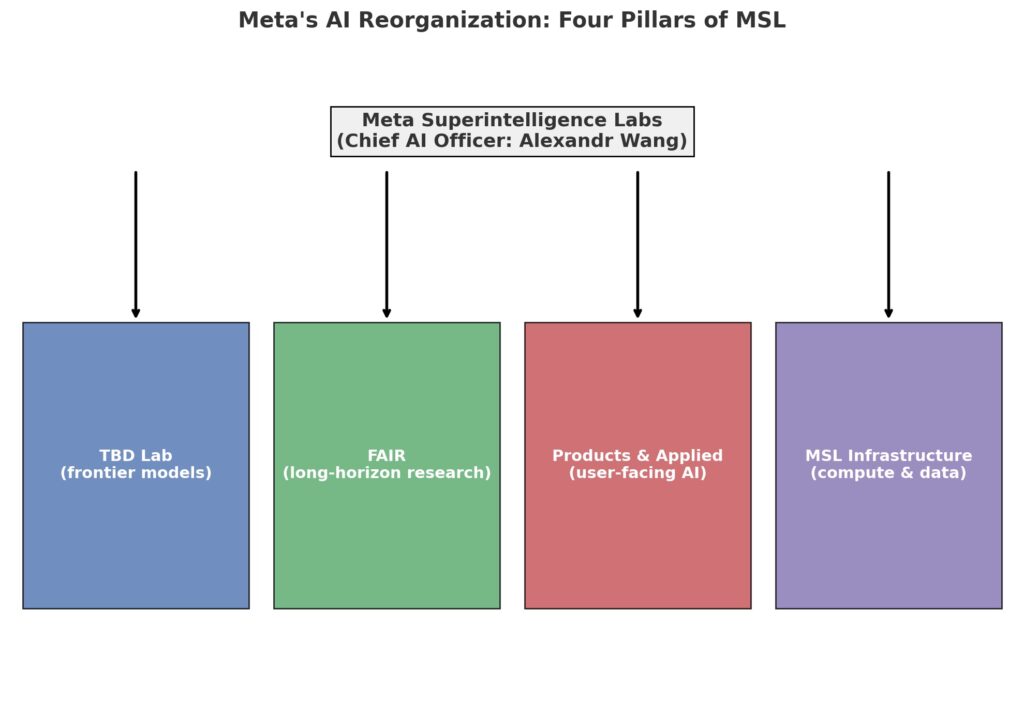
The New Org Chart: Four Pillars of Meta AI
Wang’s memo outlines a reorganization into four distinct divisions:
- TBD Lab
The spearhead for training frontier foundation models (Llama successors, reasoning-focused systems, and exploratory multimodal “omni” models). This is where Meta hopes to keep pace with GPT-5 and Gemini. - FAIR (Fundamental AI Research)
Led by Rob Fergus and still home to Chief Scientist Yann LeCun, FAIR is the long-horizon research hub. Its mission: invent the methods and architectures that tomorrow’s large-scale models will run on. - Products & Applied Research
Directed by Nat Friedman, this division focuses on turning research into usable experiences across Meta AI Assistant, Facebook, Instagram, WhatsApp, and glasses. Think deployment, user engagement, and monetization. - MSL Infrastructure
Under Aparna Ramani, this is the compute and data backbone—GPU clusters, training pipelines, inference at scale, and cloud integrations.
The once-separate AGI Foundations team has been dissolved, its staff reabsorbed into these four groups.
SLURM FOR AI AND DEEP LEARNING: GPU CLUSTER MANAGEMENT AND DISTRIBUTED TRAINING: SCHEDULE PYTORCH, TENSORFLOW, AND MULTI-NODE LLM WORKLOADS WITH JOB QUEUING AND RESOURCE OPTIMIZATION
As an affiliate, we earn on qualifying purchases.
As an affiliate, we earn on qualifying purchases.
Why This Matters: Spending, Stability, and Scale
- Capital outlay: Meta forecasts $66–72 billion in 2025 capex, largely for AI infrastructure. Longer-term, it has hinted at hundreds of billions in total investment.
- Cloud partnership: To accelerate, Meta signed a $10 billion+ deal with Google Cloud, adding external GPU capacity while it builds its own data centers.
- Hiring freeze: Amid the reorg, Meta paused hiring and internal transfers—an attempt to restore focus, but also a risk for talent morale.
This restructuring is meant to unify research, scaling, productization, and infrastructure under one playbook, with Wang as the single point of accountability.

LAFVIN ESP32-S3 1.69" LCD Development Board with Camera, AI Vision Voice Development Kit, Programmable IoT Board with Mic Speaker for STEM Education
- Powerful Microcontroller: ESP32-S3 with 16MB Flash and 8MB PSRAM
- AI Vision & Voice Capabilities: Camera and audio for AI interactions
- Supports OpenCV & YOLO: Face tracking and human pose estimation
As an affiliate, we earn on qualifying purchases.
As an affiliate, we earn on qualifying purchases.
How Meta Stacks Up Against Its AI Rivals
| Dimension | Meta (MSL) | OpenAI | Google DeepMind |
|---|---|---|---|
| Org shape | Four pillars: TBD, FAIR, Applied, Infra | Research + Applied + API (ChatGPT) | DeepMind + Google Brain merged into Gemini |
| Compute strategy | Hybrid: owned DC build + $10B Google Cloud | Azure (primary), reports of Google Cloud | Google TPUs + Google Cloud |
| Model focus | Llama lineage + “omni” | GPT-x (ChatGPT, API, enterprise) | Gemini multimodal |
| Openness | “Open-ish” via Llama releases | Closed weights, API access | Closed weights |
| Key risk | Execution amid reorg + spend discipline | Platform dependency & regulation | Balancing research speed vs. safety |
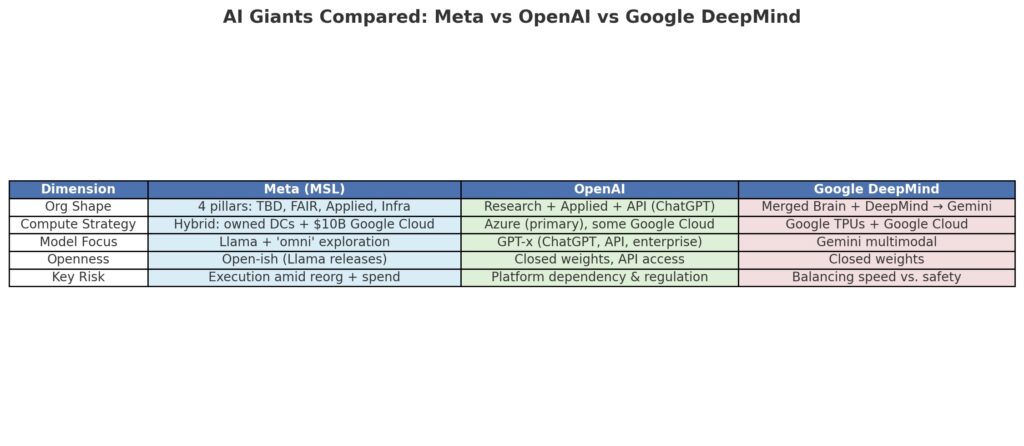
Meta is leaning into its consumer moat: billions of daily users. If it can deliver high-quality assistants and tools inside those apps, adoption could dwarf ChatGPT’s reach. The challenge is execution—can four freshly reshaped teams, after repeated reorgs, deliver at the speed the market demands?

Developing Apps with GPT-4 and ChatGPT: Build Intelligent Chatbots, Content Generators, and More
As an affiliate, we earn on qualifying purchases.
As an affiliate, we earn on qualifying purchases.
What to Watch Next
- Next Llama release: Does it rival GPT-5 or Gemini Ultra in reasoning and multimodality?
- Product adoption: Do users embrace Meta AI inside Instagram, WhatsApp, and glasses, or does it feel bolted on?
- Stability: Another restructuring would signal cultural friction remains unsolved.
- ROI: Can Meta show tangible returns on tens of billions in annual AI spend?
Cloud 3.0 and AI Infrastructure: Design, Build, and Scale
As an affiliate, we earn on qualifying purchases.
As an affiliate, we earn on qualifying purchases.
Final Take
Meta’s AI ambitions are nothing short of superintelligence at consumer scale. The new four-pillar structure clarifies the pipeline from research → training → product → infrastructure. But clarity on paper is not the same as execution in reality.
With OpenAI’s GPT-5 live and Google DeepMind’s Gemini deeply embedded into Search and Android, Meta has no time to lose. If Wang’s structure holds, Meta could leverage its unmatched user base to deliver the world’s most widely used AI. If not, it risks repeating the pattern of the Metaverse: big vision, big spend, and uncertain payoff.
👉 At Thorsten Meyer AI, we track these inflection points where corporate strategy, technical capability, and market adoption collide. Meta’s reorg is one of those moments. The next 12 months will tell us whether this is the foundation of a breakthrough—or the latest rebrand in an unstable AI race.




![SenseTime’s AI Strategy: Dominating AI As Frontier AI Lab [In-Depth Analysis, 2026] - Klover.ai](https://thorstenmeyerai.com/wp-content/uploads/2026/09/sensetime-s-ai-strategy-dominating-ai-as-frontier-ai-lab-in-depth-analysis-2026-featured-260x140.jpg)