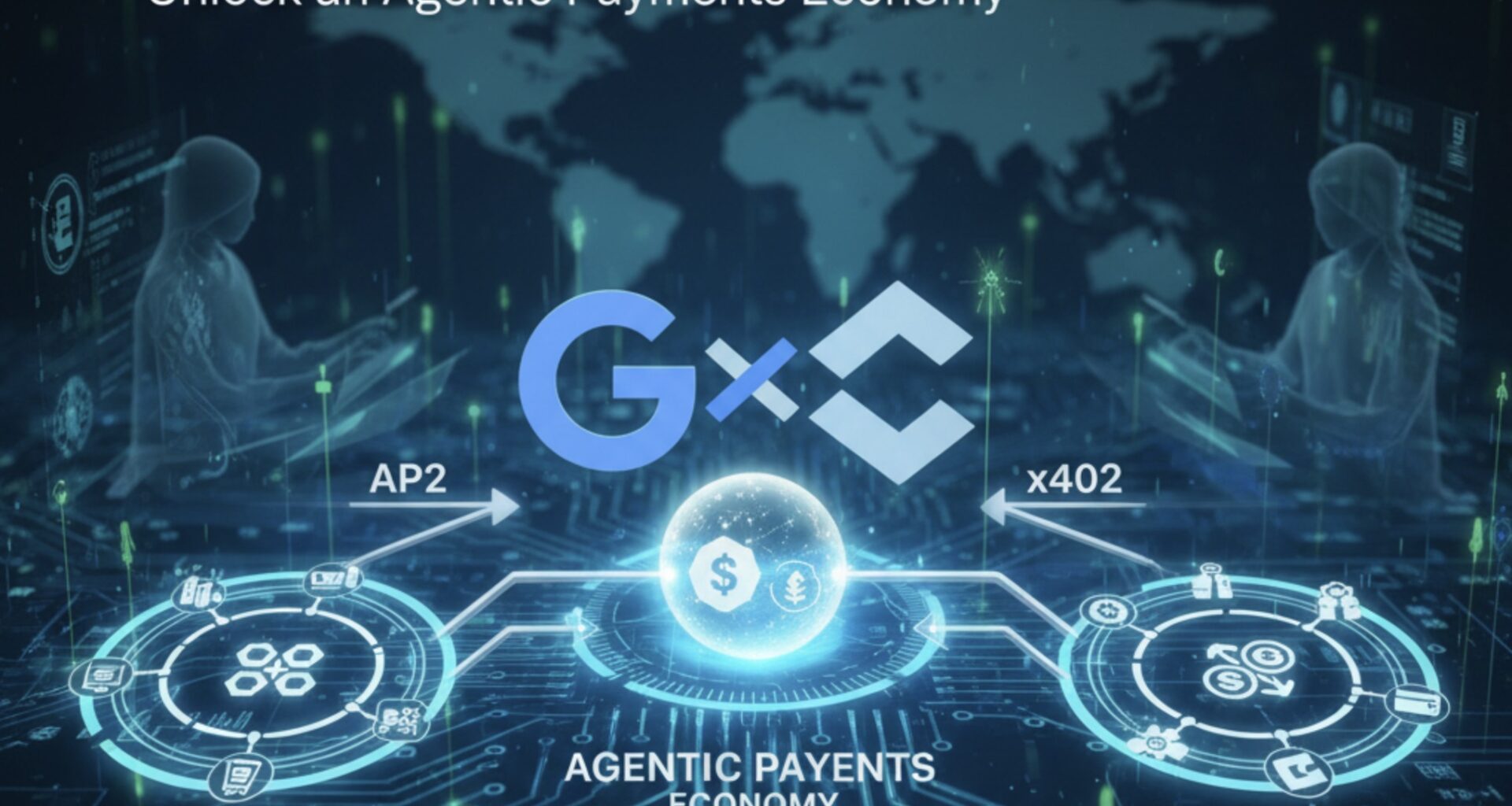
Published context: Google announced the Agent Payments Protocol (AP2) on September 16, 2025; Coinbase simultaneously positioned x402 as a payment rail inside the AP2 ecosystem. Google Cloud+1
Thesis
AP2 solves the trust problem for machine‑initiated payments (Who authorized this? What exactly was approved? Who is accountable?), while x402 solves the settlement problem (How does money actually move between agents, quickly and with low friction?). Together, they outline a credible path from agent conversation to agent commerce—but their success will hinge on governance, risk controls, latency in the real world, and adoption across both traditional and on‑chain rails. Google Cloud+1
1) Why agents need a payments protocol at all
Modern payment systems assume a human clicks “buy” on a trusted surface. Autonomous agents break that assumption. The moment an agent proposes to pay—perhaps for an API call, a data crawl, or a real‑world purchase—the merchant needs verifiable answers to three questions: authorization, authenticity, and accountability. AP2 is explicitly framed to address these gaps and to avoid a splintered world of bespoke, incompatible solutions. Google Cloud
cryptographically signed digital payment credentials
As an affiliate, we earn on qualifying purchases.
As an affiliate, we earn on qualifying purchases.
2) What AP2 contributes: a chain of evidence, not just a checkout button
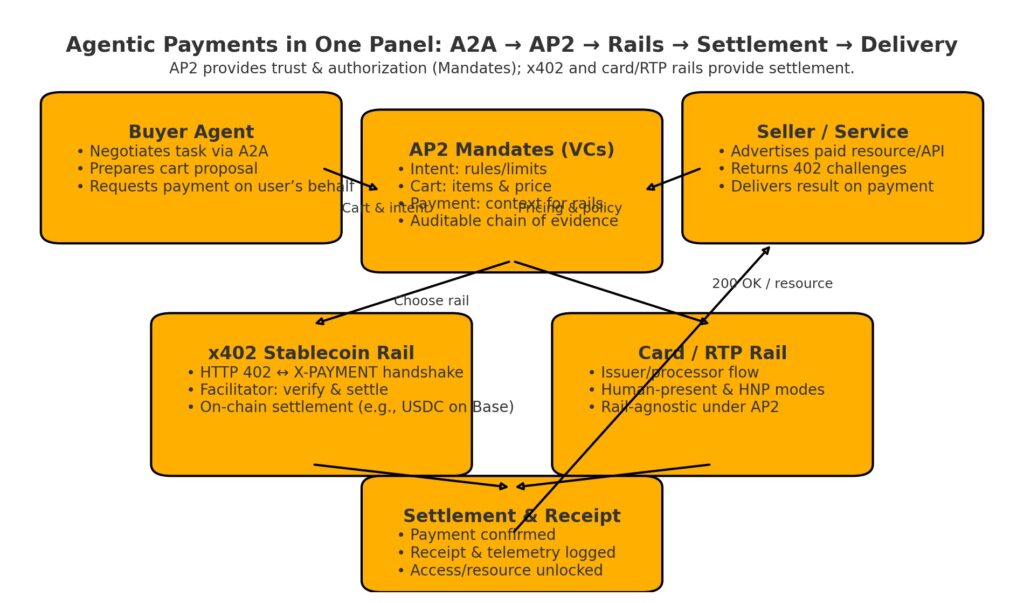
AP2 is an open protocol (Apache‑2.0) designed to plug into existing agent stacks (A2A, MCP) and to remain payment‑method agnostic (cards today; real‑time transfers and digital currencies on the roadmap). Its core mechanism is a set of cryptographically signed Mandates encoded as Verifiable Credentials (VCs)—a structured, non‑repudiable record of user intent that travels with the transaction:
- Intent Mandate: what the user authorizes the agent to do (and under what limits).
- Cart Mandate: what the user finally approved (exact items and price).
- Payment Mandate: the signal sent to payment networks/issuers about the agent context.
This design doesn’t merely “allow” an agent to pay; it binds the payment to explicit user intent in a format that counterparties can audit and trust. AP2 Protocol
AP2 ships with public docs, samples (e.g., “Human‑Present Cards,” “Human‑Present x402”), and a GitHub repository confirming its open licensing and initial release artifacts—all signs the team intends a community‑driven standard rather than a proprietary API. goo.gle+1
microtransaction API payment solutions
As an affiliate, we earn on qualifying purchases.
As an affiliate, we earn on qualifying purchases.
3) What x402 contributes: a web‑native rail for micro‑transactions
x402 “revives” HTTP 402 Payment Required to make per‑request payments a first‑class part of a normal HTTP flow. A server can respond to a request with 402 and structured payment requirements; the client (agent) answers with a signed payment payload; a facilitator verifies and settles; the server then returns the resource on success. The Coinbase‑hosted facilitator abstracts chain details and exposes /verify and /settle endpoints so merchants don’t need to run on‑chain infrastructure. GitHub+2Coinbase Developer Docs+2
Under the hood, Coinbase’s implementation uses EIP‑3009 (“transferWithAuthorization”), enabling signature‑based transfers and gasless flows where the facilitator sponsors gas—meaning buyers don’t need to hold the native token just to pay a few cents for an API call. Today’s managed path is USDC on Base, with discovery via the x402 Bazaar (a machine‑readable catalog of payable endpoints). Coinbase Developer Docs+2Coinbase Developer Docs+2
As an affiliate, we earn on qualifying purchases.
4) How the pieces fit: A2A → AP2 → x402
- A2A (Agent‑to‑Agent) provides the lingua franca for agents to negotiate and coordinate tasks across vendors and stacks. It is now hosted as an open project at the Linux Foundation, evidence of maturing governance. Linux Foundation
- AP2 slots into that conversation to attach verifiable intent and authorization to the shopping and payment flow, for both human‑present and delegated, human‑not‑present scenarios. Google Cloud
- x402 handles the payment execution step when the chosen rail is on‑chain stablecoins, using the A2A x402 extension that Google and Coinbase published as a production‑ready bridge. Google Cloud+1
The result is an end‑to‑end path where agents can discover services, agree on terms, present a cart for approval, and settle programmatically—without custom billing integrations or pre‑funded accounts. AP2 Protocol+1
verifiable credentials for digital payments
As an affiliate, we earn on qualifying purchases.
As an affiliate, we earn on qualifying purchases.
5) Strategic significance
a) Expanding the design space of automation.
Per‑request pricing becomes viable for things that were “too small to bill”: API calls, crawling pages, model inferences, one‑off transforms, or even agent‑to‑agent micro‑tasks. This is where legacy card rails struggle; on‑chain stablecoins + HTTP‑native handshake shine. Coinbase
b) A credible trust story.
VC‑based Mandates convert messy, inferred intent into deterministic evidence. Merchants can accept agent‑originated orders with clearer accountability, while issuers and networks get structured context to reason about risk. This is the missing piece that agent commerce has lacked. AP2 Protocol
c) Ecosystem momentum.
Google’s launch cites 60+ collaborators spanning networks (e.g., AmEx, Mastercard, UnionPay), processors, and web3 firms—early signs that AP2 aims to be a big tent for both traditional and crypto rails. Google Cloud
6) What could go wrong? A sober assessment
Latency & finality.
Coinbase marketing and third‑party coverage talk about ~200 ms payments for agentic APIs. That is an aggressive figure when measured against typical on‑chain finality on Base (where many services wait minutes for conservative confirmation), so treat “200 ms” as acknowledgment/fast‑path UX, not necessarily economic finality under all conditions. Expect variability with network load, merchant confirmation policies, and facilitator queues. The prudent approach is tiered confirmation (e.g., soft‑unlock vs. hard‑deliverable), especially for high‑value items. x402+1
Consumer protections and disputes.
On‑chain rails emphasize final settlement (no chargebacks). That reduces fraud exposure for sellers but shifts dispute handling upstream into Mandate capture and downstream into refund workflows. AP2’s audit trail helps adjudicate, yet merchants must design clear reversal and remediation paths for inevitable edge cases (e.g., agent hallucinations that slipped through). AP2 Protocol
Security posture.
Agents create and sign Mandates; merchants rely on them. That puts a premium on agent security, prompt injection defenses, and UI integrity during cart presentation. AP2 narrows “who authorized what,” but it does not eliminate agent misbehavior or phishing‑by‑interface risks. Builders should pair AP2 with least‑privilege scopes, spend ceilings, expirations, and robust telemetry. AP2 Protocol
Regulatory throughput.
Coinbase’s facilitator advertises KYT/OFAC screening; that’s helpful, but global compliance spans KYC, data privacy, e‑money rules, and the emerging category of agentic commerce itself. Enterprises will still need policy controls mapping Mandate types to monetary limits, regions, and identities. Coinbase
7) Adoption vector: why AP2’s openness matters
Two signals stand out. First, AP2’s Apache‑2.0 licensing, public repos, and samples lower the barrier to experimentation across stacks. Second, A2A’s move to the Linux Foundation suggests that core interoperability won’t live and die with one vendor roadmap. Open governance is essential if merchants and issuers are to treat agent‑originated transactions as first‑class citizens. goo.gle+1
8) Implementation reality: what builders can do today
- Prototype the trust loop. Use AP2 samples to capture Intent → render Cart → attach Payment. Even if you start on card rails, the Mandate model de‑risks a later switch to stablecoins or RTP. AP2 Protocol
- Wrap one resource in x402. Pick a micro‑API (e.g., “extract table from URL”) and turn it into a 402‑protected endpoint. Start on USDC/Base via Coinbase’s facilitator to avoid running chain infra, and list it in the x402 Bazaar for discovery. Coinbase Developer Docs+1
- Connect A2A ↔ AP2 ↔ x402. For agent orchestration across services, use A2A; stamp every payable hop with AP2 Mandates; settle with x402 where appropriate. Google’s A2A x402 extension gives you reference code and types. GitHub
9) Economics to watch (and how to measure them)
- Authorization‑to‑settlement latency: distribution of time from Cart Mandate to “paid” acknowledgment (p50/p95). Align SLAs to content value and risk. Coinbase Developer Docs
- Micropayment viability: blended fee + infra costs per request under realistic loads; error/retry rates around
402handshakes. Coinbase Developer Docs - Dispute ratio by Mandate class: human‑present vs human‑not‑present; expected to be lower with precise Mandates if UXs are robust. AP2 Protocol
- Discovery flywheel: number of endpoints discoverable via Bazaar and conversion from discovery → first paid call. Coinbase Developer Docs
10) Bottom line
AP2 gives agents a legible contract to spend; x402 gives them a rail to settle. That combination finally makes “agents that pay each other” more than a demo. For now, expect adoption first in API‑native niches where per‑request value is clear and delivery is digital. As protocols harden and governance broadens, the same primitives could extend into B2B procurement and machine‑to‑machine transactions. The opportunity is real, but so are the responsibilities: design Mandates carefully, price fairly, sandbox aggressively, and instrument everything. Google Cloud+1
Sources (key, primary)
- Google Cloud Blog announcement of AP2 (mandates, openness, multi‑rail design; partners; A2A x402 extension). Sept 16, 2025. Google Cloud
- AP2 docs & GitHub (VC types; human‑present/not‑present flows; Apache‑2.0 repo). AP2 Protocol+1
- Coinbase x402 launch note (AP2 + x402 positioning; Lowe’s demo disclaimer). Sept 16, 2025. Coinbase
- x402 docs (protocol flow, facilitator APIs, EIP‑3009/gasless rationale; Bazaar). Coinbase Developer Docs+3Coinbase Developer Docs+3Coinbase Developer Docs+3
- Linux Foundation press release on A2A project governance. June 23, 2025. Linux Foundation