
Government: Cybersecurity Standards & Digital Commerce Policy
North America – Strengthening Trust Frameworks: U.S. policymakers and standards bodies are closely watching Visa’s “Trusted Agent Protocol” (TAP) as a model for securing AI-driven commerce. The protocol’s use of cryptographic agent verification aligns with broader cybersecurity trends like Zero Trust, prompting discussions at agencies such as NIST about machine identity standards in e-commerce. While no federal mandates specifically target AI shopping agents yet, public-private collaborations are emerging. Visa and Cloudflare’s work on open standards (e.g. HTTP Message Signatures) with the IETF and OpenID Foundation is one exampleusa.visa.com. This industry-wide approach dovetails with government interests in interoperable security frameworks rather than siloed solutions. U.S. officials have informally applauded the effort as a proactive step to combat automated fraud, noting Visa’s $40 billion in fraud prevention over the past year (much from AI-powered card attacks)venturebeat.com. At the same time, regulators are scrutinizing how much gatekeeping power networks like Visa gain. The Department of Justice’s ongoing investigations into Visa’s market practicesventurebeat.comventurebeat.com suggest any move that could entrench its dominance will be watched. Indeed, experts predict U.S. regulators and the FTC will insist that any agent verification system remain open to all qualified players and doesn’t unfairly favor Big Tech bots over startupsventurebeat.comventurebeat.com. Visa’s collaborative stance – engaging with Google, OpenAI, and Stripe for compatibilityventurebeat.comventurebeat.com – is likely in response to these concerns, aiming to preempt fragmentation or antitrust pushback.
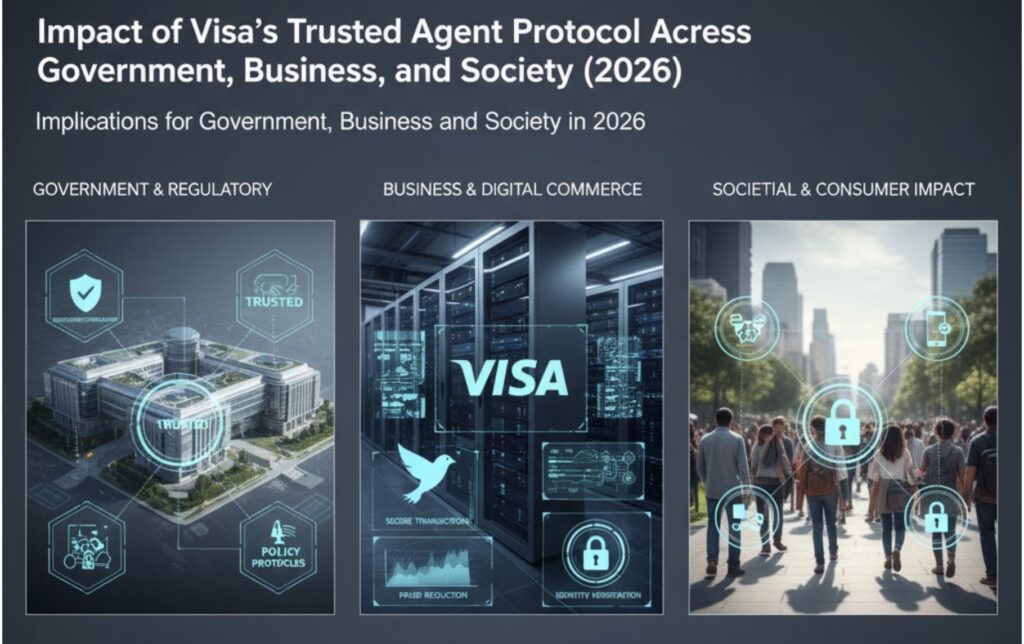
Europe – Regulatory Frameworks & Standards Alignment: In Europe, TAP lands in a rapidly evolving policy environment. The EU’s AI Act (set to take effect by 2026) emphasizes transparency and trust in AI interactions, which bolsters the case for protocols that clearly identify AI agents. European regulators have long pressed for “secure-by-design” digital commerce, and TAP’s ability to distinguish trusted AI agents from rogue bots has drawn interest as a potential best practiceusa.visa.comusa.visa.com. European banking and cybersecurity authorities (e.g. the ECB and ENISA) are likely to incorporate agent authentication into updated payment security guidelines. Already, EMVCo – the global consortium for payment standards – and European payment networks are collaborating with Visa to ensure TAP complements existing standardsusa.visa.com. This suggests any EU policy response may come in the form of supporting industry standards (potentially writing them into updates of the PSD2/PSD3 regulations for online payments). Data privacy regulators will also weigh in: TAP’s design lets an agent share “consumer recognition” data (indicating if the customer has an account or past interaction)usa.visa.com. EU GDPR authorities will demand that such data sharing remains minimal and user-consented. Visa has signaled that privacy safeguards are built-in – only approved agents can transact, backed by best practices to protect user datacorporate.visa.comcorporate.visa.com. European policymakers are expected to encourage adoption of trusted agent frameworks alongside strict privacy and liability rules. For instance, if an AI agent misinterprets a user and buys the wrong product, existing EU consumer protection law (right of return, liability for faulty AI decisions, etc.) may be updated to clarify dispute resolution. In 2026 we may see public-private task forces in Europe bringing together regulators and companies (Visa, Cloudflare, Mastercard, etc.) to refine these guardrails. Both North America and Europe appear poised to support the core goal of TAP – boosting security and trust in AI commerce – while insisting it remains an open, multi-stakeholder standard rather than a proprietary toolventurebeat.comventurebeat.com. This balance is crucial to regulatory acceptance: governments want safer digital markets without simply handing more control to one network.
Top picks for "impact visa trust"
Open Amazon search results for this keyword.
As an affiliate, we earn on qualifying purchases.
Business: Implications for Retail, Fintech, and AI Services
Retail & E-Commerce – Adapting or Getting Left Behind: The rise of “agentic commerce” is reshaping retail competition. AI shopping agents have become the new gatekeepers of commerce, filtering what consumers see. As PYMNTS warns, merchants that fail to adapt to agent-driven shopping “risk vanishing from the shopping journey altogether”pymnts.com. The numbers are striking – AI-driven visits to retail sites jumped over 4,700% in the past yearusa.visa.comusa.visa.com – but many of those agents today only browse or compare. By 2026, experts anticipate a shift from AI merely recommending products to AI completing purchases autonomously. Visa’s Jack Forestell predicts the 2026 holiday season will be the first where AI agents make a measurable dent in consumer spendingaxios.comaxios.com. Retailers are already running pilots to prepare: for example, Walmart teamed up with OpenAI to let customers plan meals, restock, and shop via ChatGPTreadthejoe.com. Such early adopters are positioning themselves to capture the tech-savvy consumers who delegate shopping tasks to AI. Operationally, TAP and similar protocols mean merchants can welcome this new traffic without overhauling checkout systemsaxios.comaxios.com. The protocol’s “no-code” integration lets a site seamlessly accept a purchase from an agent as if it were a familiar customerusa.visa.comventurebeat.com. This is a boon for retailers: they can avoid false positives from bot-blockers (losing sales to legitimate AI shoppers) and reduce friction for consumers. Early deployments suggest higher conversion rates and fewer abandoned carts when AI agents handle repetitive tasks like coupon codes or autofill loyalty infocorporate.visa.comcorporate.visa.com. Competitive impact: Retailers who embrace trusted AI agents could gain an edge in personalization and convenience, while those who resist may see their visibility drop when consumers rely on AI to curate optionspymnts.com. However, there’s also a note of caution – merchants are wary of ceding too much control to AI intermediaries (e.g. an AI might present only a few product options). This is driving some to engage directly with AI platforms (providing product data feeds, sponsoring AI “recommendation slots,” etc.) to ensure they aren’t left out. Overall, by late 2026 the retail sector is expected to see a wave of integrations: from big-box chains to boutique online stores (via platforms like Shopify), accepting “trusted agent” checkouts will move from novelty to necessity.
Fintech & Payments – Security Enhancements and Competition: Visa’s protocol has catalyzed a broader fintech response. Payment processors and banks quickly realized that enabling AI-driven transactions securely can be a competitive differentiator. Many have jumped on board: Visa gathered feedback from major acquirers and payment platforms (Adyen, Worldpay, Stripe, Fiserv, CyberSource, etc.) during TAP’s developmentusa.visa.comusa.visa.com. For these companies, supporting TAP is a way to offer merchants protection and tap into new transaction volumes. For example, Nuvei (a global acquirer) announced it is a strategic partner in Visa’s pilot, aiming to help its 150+ million merchant locations globally recognize trusted agentsprnewswire.comprnewswire.com. “Support from Nuvei demonstrates the important role acquirers will play in enabling merchants to trust and transact with AI agents,” noted Visa’s Rubail Birwadkerprnewswire.comprnewswire.com. In practice, payment gateways are updating their fraud tools to incorporate agent signatures: a transaction flagged as coming from a verified AI agent might be routed through faster with tailored risk checks, whereas unknown bots get blocked at the “front door”cloudflare.comcloudflare.com. This could reduce chargebacks and fraud for merchants, since malicious bot traffic (like card-testing attacks) is more easily filtered outventurebeat.comventurebeat.com.
At the same time, competition among fintech giants is heating up. Visa is not alone – Mastercard, American Express, Stripe, PayPal, and Google are all pushing their own agent-commerce solutions. Mastercard, for instance, is building “Mastercard Agent Pay” using Cloudflare’s Web Bot Auth technology to let merchants verify trusted agents just as Visa’s doescloudflare.comcloudflare.com. Stripe has been working with OpenAI on an Agentic Commerce Protocol of their ownfinextra.comfinextra.com, leveraging Stripe’s payment API expertise to let AI-driven purchases flow through its platform. And Google rolled out an Agent Payments Protocol (AP2) with over 60 partners – including Adyen, Mastercard and PayPal – using cryptographic “mandates” as tamper-proof contracts for AI transactionsreadthejoe.comreadthejoe.com. These mandates essentially act like digital purchase orders specifying what an AI is authorized to buy, addressing concerns around limits and user consent. The flurry of activity has led to a race for standards: “Multiple technology giants [are] racing to establish competing standards for AI commerce,” notes VentureBeatventurebeat.com. Visa’s strategy has been to collaborate and not let this become a winner-takes-all battle. Visa executives say they are engaging with Google, OpenAI, and Stripe to ensure compatibility across the ecosystemventurebeat.com. Indeed, Visa’s TAP is built to complement others – it will “complement…Google’s and Stripe’s protocols” and eventually interoperate, rather than forcing merchants to pick one systemfinextra.comfinextra.com. By 2026, the fintech industry may converge on a unified framework or at least a few interoperable ones, possibly under the guidance of standards bodies like EMVCo. But if coordination falters, merchants and payment processors might have to accommodate multiple verification schemes in parallel – an unwelcome complexity that the industry is trying to avoidventurebeat.comventurebeat.com.
AI Services & Platforms – New Capabilities and Integrations: For AI and tech companies, TAP opens the door to monetizing their services through commerce. AI assistants that could previously only recommend now can act – searching, comparing, and actually buying products on behalf of usersusa.visa.comusa.visa.com. This has huge implications for AI platform providers (OpenAI, Google, Microsoft) and a growing ecosystem of startups building shopping bots. Many are already integrating these protocols. Cloudflare’s “Agents SDK”, for example, is making it easier for developers to build AI agents with built-in support for TAP/Web Bot Auth, so that any agent they create can “shop autonomously at millions of merchants globally”cloudflare.comcloudflare.com. Microsoft – named as an early Visa partnerusa.visa.com – is expected to weave TAP into its shopping tools (imagine Bing AI or Microsoft’s Copilot being able to securely purchase items it recommends). Similarly, Shopify’s involvementusa.visa.com signals that AI plugins or shopping assistants (like Shopify’s own AI concierge) will use the protocol to drive sales to Shopify merchants. We are also seeing AI services partner directly with retailers: beyond Walmart’s ChatGPT integration, others like Instacart’s AI assistant or Amazon’s Alexa could adopt trusted-agent credentials so they can place orders across the web, not just on their own platforms. For AI services, trust and reputation are now key competitive factors – being on Visa’s “approved agents” list or a similar registry assures merchants of reliabilityventurebeat.comventurebeat.com. Smaller AI startups recognize this as a way to gain legitimacy. However, there’s an emerging competitive wrinkle: approval gatekeepers. As of now, Visa’s Intelligent Commerce program vets and approves which AI agents get credentialsventurebeat.comventurebeat.com. If companies perceive this as too slow or exclusionary, they might seek alternatives or push for a more decentralized trust model. Despite that, the momentum is towards broad adoption – experts note that as AI agents start driving a significant share of transactions, no AI service will want to be left out. By late 2026, we expect to see dozens of popular consumer AI apps (from virtual shopping assistants to voice assistants) proudly announcing “Visa Trusted Agent Certified” or similar badges as they vie for user and merchant confidence.

The operational impact for businesses adopting TAP is generally positive. Integrations are designed to be lightweight – for example, Cloudflare is enabling verification at the network level, so any site using Cloudflare’s CDN can easily toggle on agent authenticationventurebeat.com. Payment gateways like Stripe or Adyen can build the verification into their APIs, meaning merchants on those platforms get the protection with a simple update. Training staff and updating policies will be another aspect: customer service may need protocols for handling AI-agent orders (e.g. recognizing an AI-placed order in the system, assisting with agent-initiated returns). Businesses also must ensure liability clarity – many are awaiting guidelines (or insurance products) on who is responsible if an AI agent mis-orders or a fraudulent “agent” slips through. Despite these questions, the early business sentiment is optimistic. As Worldpay’s Chief Product Officer put it, “agentic commerce will quickly become the channel of choice for many consumers… but its future adoption and scale depends on trust. This is about more than technology – it’s about collaboration between tech innovators and payments leaders to deliver reliability and adoption at scale.”pymnts.com Worldpay and other processors see a market opportunity in solving this trust issue, positioning themselves as essential facilitators of the AI commerce era.
Society: Consumer Trust, Privacy, and AI Adoption Behavior
Consumer Trust and Confidence: Visa’s Trusted Agent Protocol is fundamentally aimed at bolstering consumer trust in AI-driven transactions. Early indications show consumers are receptive: 85% of shoppers who have used AI to assist with purchases say it improved their experienceusa.visa.comventurebeat.com. By providing a secure, transparent layer for AI commerce, TAP addresses some anxieties that consumers have about letting an algorithm spend their money. Knowing that an AI assistant is “Visa-certified” or authenticated may reassure users that the agent is legitimate and acting in their interest (much like seeing a trusted logo on a website). In practice, as 2026 unfolds, we expect consumer-facing branding of this trust layer – e.g. an app might display “Transacting via Visa Trusted Agent” at checkout – which could become a selling point. Public education will play a role as well. People will need to understand what it means for an AI to be “trusted” and how the system protects them. The industry message is that TAP provides “guardrails” so that “sellers can trust AI agents as much as their best customers” and vice versausa.visa.com. If executed well, this could increase overall trust in AI, moving it from a novelty to a normal part of shopping. Jack Forestell of Visa has expressed a hopeful view that making commerce “secure, simple, seamless, trustworthy and fast” will spur more commerce – essentially, as consumers trust AI agents more, they will use them more frequentlyaxios.com. Indeed, some consumers may find an AI agent’s diligence (scouring reviews, finding deals) more trustworthy than their own hurried Google searches. However, trust is hard-won and easily lost. Any high-profile mishap – say an AI agent gone rogue making an unauthorized big purchase – could cause public backlash. As of 2025, there have been no major incidents, but questions about liability loom large: if an AI misinterprets your request and orders the wrong item or too many items, are you on the hook? Visa has noted that existing fraud protections and chargebacks should apply, but details on agent-initiated dispute processes are still being worked outventurebeat.comventurebeat.com. Consumer advocates in 2026 are likely to push for clear “AI purchase rights” – for example, the right to easily cancel or return an order an AI placed by mistake, without penalty. Overall, if TAP and similar protocols function as intended (no major security breaches, smooth user experience), consumer confidence in AI assistants will rise steadily. We could see by late 2026 a significant segment of the public trusting AI for routine purchases – a shift from just a year prior when most people still double-checked everything their AI recommended.
Data Privacy Considerations: The advent of AI shopping agents raises new questions about personal data handling. On one hand, these agents can streamline purchases without exposing as much data repeatedly – e.g. an agent might hold your payment credentials and share them via a secure token, rather than you typing your card details into every site. Visa’s protocol even allows agents to carry payment info in a secure field to support the merchant’s preferred methodusa.visa.com, potentially reducing the need for consumers to transmit sensitive data each time. Additionally, consumer recognition data (like whether you have an account with the merchant) is shared in a limited fashion, mainly to personalize the experience or apply loyalty benefitsusa.visa.com. Visa and its partners assert that privacy is safeguarded by design – only necessary information is sent, and it’s cryptographically signed (not human-readable to eavesdroppers)usa.visa.comfintechnews.sg. Nonetheless, privacy experts are keeping a watchful eye. In effect, your AI agent might accumulate a very detailed profile of your shopping history across many merchants. Ensuring that this trove of data is protected and not misused is crucial. Who holds the data? Likely the AI service (e.g. your digital assistant app) will store your preferences, past orders, etc., similar to how web browsers store cookies. But now, that AI could transmit certain data to merchants (“this user has bought here before”) under agreed protocols. Regulators in Europe will demand that any such processing complies with GDPR – meaning users should be informed and give consent to their data being used in this way. We might see new privacy settings in AI shopping apps: perhaps an option like “Allow this agent to share my loyalty ID with merchants” or “Keep my identity anonymous for new site visits.”
Public surveys show that AI transparency and data privacy are top concerns people have regarding brands using AIemarketer.comemarketer.com. Companies deploying TAP will likely emphasize that using a trusted agent is actually safer than manual shopping – for example, the agent won’t accidentally leak your credit card number on an unsafe site because it uses tokenized payment datacorporate.visa.comcorporate.visa.com. Post-purchase protections are also being highlighted: if something goes wrong, the same dispute resolution processes that protect cardholders will “reinforce trust” for AI-driven purchasescorporate.visa.comcorporate.visa.com. Still, some consumers may hesitate, worrying about scenarios like: Could an AI trick me into buying something by exploiting my data (for instance, knowing I’m low on a product and nudging an unnecessary purchase)? Such ethical concerns about manipulative AI behavior will be part of the public discourse. The onus will be on AI service providers to maintain user trust by being transparent about how recommendations are generated (e.g. disclosing sponsored suggestions) and by letting users set limits.
AI Adoption and Behavioral Shifts: By 2026, shopping via AI agent may start to feel as normal as shopping via a web browser – a profound change in consumer behavior. We’re already seeing the convenience factor drive adoption: busy consumers let an AI handle tedious tasks (finding the best price, applying coupons, etc.), essentially outsourcing decision fatigue. As one industry observer noted, “AI is transforming holiday shopping into a race for speed and simplicity…we’re in the early innings of this shift.”axios.comaxios.com Consumers generally love convenience, so long as they feel protected. With trust frameworks like TAP in place, even skeptical users may give AI shopping a try for low-stakes purchases, and gradually increase usage as comfort grows. Analysts forecast explosive growth in the value of transactions AI agents handle – potentially reaching $1.7 trillion by 2030 if current trends continuereadthejoe.com. In 2026 specifically, we anticipate a few key behavioral trends:
- Routine Purchases Go Autonomous: Replenishment of household goods, groceries, and other routine buys will increasingly be delegated. Services like restocking subscriptions will evolve into AI agents that check your usage and order when needed, with minimal user intervention. Walmart’s meal-planning chatbot is an early example in 2025; by 2026 more retailers will offer similar AI-driven auto-order optionsreadthejoe.com.
- Conversational Commerce Normalization: Instead of scrolling through dozens of product pages, consumers will get comfortable with conversational queries (“I need a durable black cocktail dress under $100”) and trusting the AI to present a curated few optionspymnts.compymnts.com. This changes how we discover products – it’s less about visual window-shopping and more about Q&A with an algorithm. The breadth of choice might feel narrower (since the AI filters out a lot), but many will appreciate the time saved. Brands, in turn, will adapt their marketing to be “AI-visible” (much like SEO for search engines).
- User Control and Limits: A segment of consumers will embrace AI agents but with tight reins – for instance, setting spending caps (“don’t spend over $500 without asking”) or requiring a quick confirmation ping for orders above a threshold. The notion of giving an AI a “mandate” (as Google’s AP2 does with cryptographic contracts) could become a standard practice to make users comfortablereadthejoe.comreadthejoe.com. Through 2026, expect user interfaces to include more of these controls, educating users that they remain in charge.
On the societal front, there will also be public discourse around the implications of AI-driven consumption. Some consumer advocates might question whether AI shopping truly benefits the public: Does it encourage overspending (because it’s so easy)? Does it disadvantage those who don’t use AI (if certain deals or speedy checkouts become AI-only)? And importantly, who is deciding what the AI buys? As one analyst provocatively asked, “In an economy increasingly mediated by AI, who decides which algorithms get to spend our money?”venturebeat.comventurebeat.com. There’s a concern that if a handful of companies control the predominant AI agents, they could influence purchasing behavior at scale. By 2026, regulators and possibly legislators may start contemplating consumer-protection rules in this vein – for example, ensuring AI agents act in the best interest of the consumer (fiduciary-like duty) rather than, say, prioritizing partner merchants or higher commission items. Endorsements of TAP from major players (Cloudflare: “The future of commerce is agentic…security [must be] built in by design”cloudflare.com, Mastercard: it enables a “unified approach…that is scalable, secure, and widely adopted”cloudflare.comcloudflare.com) indicate that industry leaders are publicly in favor of this evolution. We’ve yet to see open endorsements from consumer organizations, but generally, the concept of safer e-commerce draws support.
Public Concerns and Endorsements: Initial public reaction to TAP has been relatively muted – partly because it operates behind the scenes. As consumers become more aware, we expect a mix of excitement and caution. Tech-savvy users often welcome anything that reduces fraud and hassle (for instance, no longer dealing with endless CAPTCHA because your AI agent is pre-verified as legitimate). These early adopters may become unofficial ambassadors for agentic commerce, sharing positive experiences (“my AI assistant snagged the best Black Friday deal for me while I was sleeping, securely!”). On the other hand, skeptics will voice concerns like loss of personal touch and over-reliance on AI. Some may fear a scenario where AI agents, not humans, make the bulk of purchasing decisions – potentially impacting jobs in sales and marketing, or leading to algorithms reinforcing certain buying patterns. By late 2026, if agentic commerce grows as anticipated, don’t be surprised if it enters political discourse: for example, consumer rights debates or even campaign talking points about the role of AI in everyday life. Governments might launch public consultations or roundtables on “AI in commerce and its societal impact,” inviting citizen input.
In summary, Visa’s Trusted Agent Protocol is acting as a catalyst for change well beyond the technical realm. For governments, it presents both an opportunity and a challenge: an opportunity to uplift cybersecurity standards and public-private cooperation, and a challenge to ensure no single entity disproportionately controls the new ecosystem. For businesses, it’s a clarion call to innovate or risk irrelevance – bringing new security tools, operational adjustments, and competitive dynamics as companies race to serve AI-mediated customers. And for society, it marks the dawn of a new consumer era – one where trust is brokered through cryptography and AI assistants might be as commonplace (and as trusted) as web browsers, fundamentally altering how we shop, who we trust, and how we balance convenience with control in the digital age. The year 2026 will be pivotal in testing and shaping these impacts, as the early frameworks solidify into mainstream practice.
Sources:
- Visa Press Release – “Visa Introduces Trusted Agent Protocol…” (Oct 14, 2025)usa.visa.comusa.visa.comusa.visa.comusa.visa.com
- Cloudflare Press Release – “Cloudflare Collaborates… to Secure Agentic Commerce” (Oct 14, 2025)cloudflare.comcloudflare.comcloudflare.comcloudflare.com
- PYMNTS – “Visa Introduces ‘Trusted Agent Protocol’ for AI Shopping” (Oct 14, 2025)pymnts.compymnts.com
- VentureBeat – “Visa just launched a protocol to secure the AI shopping boom…” (Oct 14, 2025)venturebeat.comventurebeat.comventurebeat.comventurebeat.com
- Axios – “Visa preps for AI holiday shoppers, agentic commerce” (Oct 14, 2025)axios.comaxios.com
- The Average Joe (Tech Newsletter) – “AI Shopping Agents Surge 4,700% as Tech Giants Race…” (Oct 14, 2025)readthejoe.comreadthejoe.com
- Finextra – “Visa launches Trusted Agent Protocol for AI commerce” (Oct 15, 2025)finextra.comfinextra.com
- Nuvei Press Release – “Nuvei Supports Visa Trusted Agent Protocol to Advance Agentic Commerce” (Oct 14, 2025)prnewswire.comprnewswire.com
- Visa/Corporate – “Enabling AI agents to buy securely and seamlessly” (Visa Intelligent Commerce overview, 2025)corporate.visa.comcorporate.visa.com
- Fintechnews Singapore – “Visa, Cloudflare Develop Framework to Verify AI Agents…” (Oct 15, 2025)fintechnews.sgfintechnews.sg
- Cloudflare Blog – “Forget IPs: using cryptography to verify bot and agent traffic” (May 15, 2025)blog.cloudflare.comblog.cloudflare.com