

Experts warn that by 2026, AI bots could automate many routine jobs like administrative tasks, data entry, and customer support, putting millions at risk. White-collar roles, especially entry-level positions, may see up to half their roles eliminated as AI becomes more advanced. Manufacturing and sectors with less digitization could experience slower change, but the overall impact will be significant. To understand how to stay prepared, explore what’s coming next.
Key Takeaways
- Up to 50% of routine, entry-level white-collar jobs may be automated by 2026.
- Administrative, data entry, and customer support roles are most vulnerable to AI automation.
- Manufacturing jobs have already declined significantly, with AI accelerating displacement trends.
- New roles in AI oversight, data ethics, and human-AI collaboration will emerge, requiring reskilling.
- Workers lacking AI skills face increased layoffs, highlighting the need for workforce transition programs.
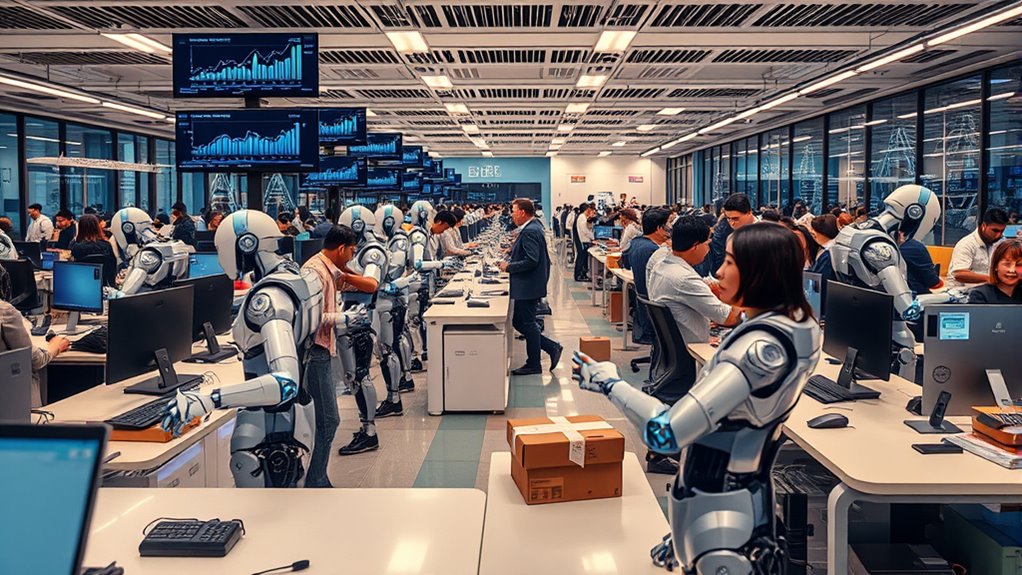
By 2026, AI bots are expected to markedly reshape the job market, with nearly 40% of companies already using AI tools like ChatGPT and automation software to replace workers. This rapid adoption means you’ll likely see AI automating many routine tasks, especially in administrative, data entry, and customer support roles. If your job involves repetitive, process-driven tasks, it’s at high risk of displacement within the next few years. Entry-level white-collar positions could see up to half of their roles eliminated in five years, especially if you’re new or lack specialized skills. Workers with little experience or those earning higher salaries without AI-related expertise face significant layoffs. Manufacturing jobs have already declined since 2000, with 1.7 million lost to automation, and this trend is expected to accelerate as AI technologies become more integrated. AI adoption is projected to reshape the job market more dramatically in 18-24 months than in decades. While some jobs disappear, new roles are emerging. Opportunities in AI oversight, data ethics, prompt engineering, and human-AI collaboration are growing rapidly. Sectors like healthcare, education, and AI maintenance are creating new positions that require a blend of technical AI skills and domain knowledge. Workers who develop expertise in AI-related fields tend to earn higher wages, especially those skilled in prompt engineering or data quality assurance. However, this shift demands significant reskilling, as many displaced workers lack the technical competencies needed for these emerging roles. Industry boundaries are blurring, and the speed of change creates both challenges and opportunities for the workforce. Economically, AI adoption boosts productivity and profits but also results in layoffs and hiring freezes, especially in data-rich industries experiencing rapid “creative destruction.” Some sectors digitize faster than others, leading to uneven job impacts. Wages are rising in industries most exposed to AI, such as retail and energy, driven by demand for AI-augmented skills. Policymakers and companies must prioritize workforce transition programs to help workers adapt. An estimated 12-14% of workers may need to switch careers by 2030 due to automation, highlighting the urgent need for reskilling initiatives. If you’re in a vulnerable role, staying adaptable and acquiring new skills become your best strategies for steering the AI-driven job landscape ahead. Additionally, understanding the impact of automation on various industries can help workers better prepare for upcoming changes.

Funny AI Geek Men Women Prompt Engineer AI Whisperer T-Shirt
- Design for Men and Women: Funny AI Whisperer prompt engineer design
- Theme: AI Geek and Machine Learning
- Material: Lightweight, durable fabric
As an affiliate, we earn on qualifying purchases.
As an affiliate, we earn on qualifying purchases.
Frequently Asked Questions
What Skills Will Remain Valuable Despite AI Automation?
You’ll find that technical, analytical, and human-centered skills stay valuable despite AI automation. Your creativity, strategic thinking, and emotional intelligence set you apart. By understanding complex systems, translating business problems, and working empathetically with others, you’ll remain essential. Keep learning new technologies, adapt quickly, and leverage AI as a tool to enhance your work. Your ability to problem-solve, communicate, and connect on a human level makes your skills irreplaceable.
How Can Workers Prepare for Ai-Driven Job Changes?
You can prepare for AI-driven job changes by embracing lifelong learning, even if you’re convinced you’re already the smartest person in the room. Develop skills in AI oversight, data ethics, and human-AI collaboration—think of it as upgrading your toolkit for the future. Stay industry-savvy, seek out new roles like prompt engineering, and remain flexible. After all, the only thing worse than job loss is being unprepared when your job suddenly becomes obsolete.
Which Industries Are Most Vulnerable to AI Job Replacement?
You should watch the clerical, legal, finance, data processing, manufacturing, warehousing, transportation, customer service, and marketing industries, as they’re most vulnerable to AI job replacement. Routine, rule-based tasks are easily automated, putting roles like clerks, paralegals, bank tellers, factory workers, and drivers at high risk. Prepare by developing tech skills, focusing on complex problem-solving, emotional intelligence, and roles that require human judgment to stay ahead in these sectors.
Will AI Create New Job Opportunities in the Future?
You’ll be pleased to know that AI is expected to create new job opportunities, with about 12-14% of workers shifting into new roles by 2030. AI’s growth fosters jobs in areas like healthcare, education, and AI maintenance, boosting productivity and economic growth. Your skills in AI oversight, prompt engineering, or data ethics will become more valuable. Embracing reskilling now will help you stay ahead in this evolving job market.
How Can Governments Support Workers Affected by AI?
You can support workers affected by AI by advocating for policy reforms that encourage human capital investment, such as tax benefits for retraining and lifelong learning programs. Push for targeted, evidence-based initiatives that help vulnerable groups, and promote rapid retraining and upskilling. Support social safety nets like Universal Basic Income and guarantee educational systems include AI literacy, so workers can adapt to changing job markets and stay competitive in an AI-driven economy.

Fivefold Ministry Basic Training: Understanding the distinct roles and functions of apostles, prophets, evangelists, pastors, and teachers
As an affiliate, we earn on qualifying purchases.
As an affiliate, we earn on qualifying purchases.
Conclusion
By 2026, AI bots could impact millions of jobs, with reports suggesting up to 30% of roles might be automated. This means you should start preparing now—whether that’s upgrading your skills or exploring new career paths. Staying adaptable and learning about AI technology can help you stay ahead in this rapidly changing landscape. Don’t wait until it’s too late—embrace the change and position yourself for future success.

Human–AI Collaboration in Research
As an affiliate, we earn on qualifying purchases.
As an affiliate, we earn on qualifying purchases.

Intelligent Oversight: How the Whole Makers are Reshaping Agentic AI Decision-Making Systems
As an affiliate, we earn on qualifying purchases.
As an affiliate, we earn on qualifying purchases.