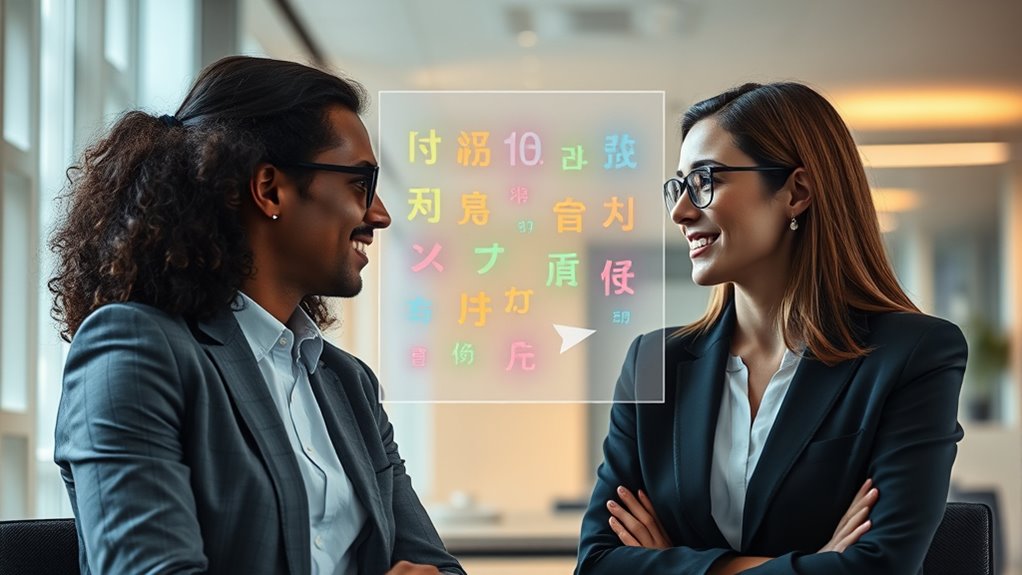

AI-powered real-time translation tools are transforming workplaces by instantly bridging language gaps and enabling seamless collaboration across diverse teams. These advanced systems understand context, idioms, and cultural nuances, making communication more natural and accurate. They support sectors like healthcare, education, and business, boosting efficiency and inclusion. As technology evolves, future innovations will further enhance quality and privacy. Exploring these advancements can help you harness AI’s potential for breaking language barriers even further.
Open a free Amazon Business account
Business pricing, bulk buying and tax-exempt orders.
As an affiliate, we earn on qualifying purchases.
Key Takeaways
- AI-powered real-time translation enables seamless communication across multilingual teams, boosting collaboration and productivity.
- Advanced AI models capture cultural nuances, idioms, and context for more accurate and natural translations.
- Deployment on edge devices like smartphones and AR glasses allows instant, private translations in various work environments.
- Sector-specific AI translation improvements enhance healthcare, education, and business operations by reducing language barriers.
- Combining AI with human expertise ensures higher accuracy, cultural relevance, and trust in workplace multilingual communication.
As an affiliate, we earn on qualifying purchases.
The Evolution of AI Translation Technologies

The evolution of AI translation technologies has transformed how you communicate across languages. Initially, machine translation relied on literal word substitution, often producing awkward or inaccurate results. Over time, advances in natural language processing allowed AI to understand context, idiomatic expressions, and cultural nuances. By 2025, AI models now deliver real-time, contextually aware translations that are highly nuanced and sensitive to cultural differences. Edge computing and multimodal AI enable seamless translations on devices like smartphones and AR glasses, making communication more natural. These innovations have drastically improved sectors such as healthcare, education, and business, breaking down language barriers quickly and efficiently. Additionally, automation’s role in business intelligence has accelerated data analysis and decision-making processes, further enhancing global communication and collaboration. Despite ongoing challenges, AI translation has evolved into a sophisticated tool that enhances global interaction in daily life and work.
As an affiliate, we earn on qualifying purchases.
How Real-Time AI Transforms Global Communication

Advancements in AI translation technology have revolutionized how people communicate across language barriers, making real-time understanding more accessible than ever. You now experience instant, context-aware translations that bridge gaps seamlessly. This progress transforms global interactions in three key ways:
AI translation breakthroughs enable seamless, real-time global communication and collaboration.
- Enhanced Collaboration: Multilingual teams communicate effortlessly, boosting productivity and innovation.
- Increased Inclusivity: People with diverse backgrounds participate fully in discussions, fostering diverse perspectives.
- Streamlined Operations: Businesses expand globally with quick, accurate translations, reducing delays and costs.
- Additionally, ongoing research into AI security emphasizes the importance of developing safe and trustworthy translation systems to prevent vulnerabilities.
These innovations break down traditional barriers, enabling you to connect, share, and collaborate across cultures instantly. As AI continues to evolve, your ability to engage in fluent, meaningful conversations worldwide becomes more natural and efficient, reshaping how we work and interact globally.
As an affiliate, we earn on qualifying purchases.
Key Sectors Benefiting From Instant Language Solutions

Instant language solutions are transforming critical sectors by enabling real-time, accurate communication across language barriers. In healthcare, AI translators allow doctors to understand patients’ needs quickly, improving diagnosis and treatment. Education benefits as multilingual platforms support diverse learners, fostering inclusive classrooms. International business teams use instant translation to coordinate projects seamlessly, boosting productivity and collaboration. E-commerce companies leverage AI for rapid, multilingual product descriptions, expanding global reach without extra costs. Customer service departments deploy AI-powered chatbots to handle inquiries 24/7 across multiple languages, enhancing customer experience. In travel and hospitality, real-time translation ensures smooth interactions between staff and guests from different backgrounds. These solutions make it easier to connect, collaborate, and serve across borders, creating new opportunities in every sector. Additionally, multilingual communication is now more accessible than ever, reducing misunderstandings and fostering trust among diverse audiences.
multilingual workplace translation tool
As an affiliate, we earn on qualifying purchases.
As an affiliate, we earn on qualifying purchases.
The Economic Impact and Market Growth of AI-Powered Translation

As AI-powered translation continues, its economic impact becomes increasingly significant, driving substantial market growth and transforming global language services. You’ll see this through:
- The market is projected to hit nearly $2.94 billion by 2025, reflecting rapid adoption across industries.
- The global language services industry is expected to reach $75.7 billion in 2025, with AI-driven solutions capturing a growing share.
- Cost savings are notable—machine translation post-editing reduces expenses by 30–50%, boosting efficiency and profitability.
- Relationships – Personality Test insights can help tailor communication strategies, making AI translation more effective in nuanced human interactions.
This growth isn’t just about numbers; it reshapes how businesses communicate globally. As AI becomes more integrated, expect more streamlined workflows, broader access to multilingual content, and a shift in the demand for skilled human translators to focus on high-value, nuanced work.
Combining Human Expertise With Machine Efficiency

Combining human expertise with machine efficiency creates a powerful synergy that enhances translation quality and productivity. You start by using AI to generate quick drafts, saving time and reducing manual effort. Then, you, as a skilled translator, refine these outputs, ensuring accuracy, cultural relevance, and nuance. This collaboration reduces errors and maintains brand consistency across languages. Human insight is essential for complex texts—legal, medical, or creative—that demand context and sensitivity AI can’t fully grasp. Over time, AI learns from your corrections, improving terminology and style. Many translation agencies now rely on this hybrid approach, balancing speed with quality. Additionally, high-quality projectors can be used to review visuals and ensure visual consistency across translated materials. By integrating AI tools with your expertise, you can deliver precise, culturally appropriate translations faster and more efficiently than ever before.
Practical Use Cases of AI in Workplace Multilingual Interactions

AI-powered translation tools are transforming how workplaces handle multilingual interactions, making communication more seamless and efficient. You can now:
- Improve patient care in healthcare by enabling doctors and patients to understand each other instantly, reducing misdiagnoses.
- Boost international team productivity, as real-time translation allows seamless collaboration regardless of language barriers.
- Enhance customer experience by providing instant multilingual support through chatbots and service platforms, reducing wait times and increasing satisfaction.
- As automation technologies advance, they also help ensure data privacy and compliance in multilingual data handling, safeguarding sensitive information during translations.
These use cases demonstrate AI’s ability to break down language barriers, fostering inclusivity and faster decision-making. By integrating AI translation in daily workflows, you guarantee clearer communication, stronger relationships, and more efficient operations across diverse linguistic environments.
Overcoming Challenges and Ensuring Quality in AI Translation

While AI translation technology has advanced rapidly, ensuring consistent quality remains a significant challenge. You need to monitor AI outputs carefully, as mistranslations, hallucinations, or missed nuances can occur, especially with idiomatic expressions or cultural subtleties. To address this, combining AI with human oversight is essential. Human translators can review, edit, and refine AI-generated content to maintain accuracy, relevance, and cultural appropriateness. Regularly updating AI models with feedback from human experts helps improve performance over time. Prioritizing data security and privacy is also vital, especially with sensitive information. By integrating robust review processes and leveraging human expertise, you can overcome these challenges, ensuring that AI translation delivers reliable, high-quality results aligned with your communication standards. Incorporating insights from language nuances found in diverse content can further enhance translation accuracy and cultural relevance.
Future Trends and Innovations in Real-Time Language AI

As real-time language AI continues to evolve, we can expect groundbreaking innovations that make cross-language communication more seamless and intuitive. These advancements will focus on three key areas:
- Enhanced Contextual Understanding: AI models will grasp cultural nuances, idioms, and humor, reducing misinterpretations.
- Multimodal Integration: Combining voice, text, and visual cues will enable more natural, adaptive conversations across languages.
- Edge Computing Deployment: Translators will operate directly on devices like smartphones and AR glasses, ensuring faster, private, and offline translation capabilities.
- Additionally, language preservation efforts will benefit from these technologies by helping endangered languages stay alive through accurate digital representation.
These trends will make communication more fluid, inclusive, and efficient, helping you connect across languages with minimal barriers. As technology advances, your ability to collaborate globally will become more natural and reliable.
Navigating Privacy and Ethical Considerations in AI Translation

Guiding privacy and ethical considerations in AI translation is essential because the technology often processes sensitive information that must remain secure. You need to guarantee data privacy by using encrypted channels and adhering to regulations like GDPR and HIPAA. Be transparent with users about how their data is collected, stored, and used, and obtain consent when necessary. Avoid relying solely on cloud-based AI systems without proper safeguards, as sensitive data can be vulnerable to breaches. Ethical use also requires avoiding biases that could skew translations or reinforce stereotypes. Regularly audit AI outputs for fairness and accuracy. By prioritizing privacy and ethics, you protect user trust and uphold responsible AI practices, ensuring translation tools serve everyone fairly and securely. Incorporating mindfulness practices can also help developers remain aware of ethical considerations and stay attentive to potential biases in AI outputs.
Frequently Asked Questions
How Accurate Are Current Real-Time AI Translation Tools in Complex Conversations?
Current real-time AI translation tools are quite advanced but not flawless in complex conversations. You might notice occasional mistranslations, especially with idiomatic expressions, humor, or cultural nuances. While they handle straightforward dialogue well, you still need to review and sometimes clarify to guarantee accuracy. These tools are excellent for real-time communication, but for high-stakes or nuanced discussions, human oversight remains essential to maintain precision and cultural relevance.
What Are the Main Barriers to Widespread Adoption of AI Translation in Workplaces?
The main barriers to widespread AI translation adoption in workplaces include concerns about accuracy, especially with idioms, humor, and cultural nuances. You might worry about errors or mistranslations affecting communication quality. Privacy and data security are also significant concerns, especially when handling sensitive information. Additionally, many organizations face resistance due to the need for training and integrating new tech into existing workflows, hindering full adoption.
How Do AI Translation Systems Handle Highly Specialized or Technical Language?
AI translation systems handle highly specialized or technical language by leveraging large, domain-specific datasets and advanced machine learning models. You can expect them to use terminology databases and expert-curated glossaries to improve accuracy. However, you still need human translators for quality assurance, especially for complex, nuanced, or sensitive content. While AI continuously learns and adapts, it’s best combined with human expertise to guarantee precise, contextually appropriate translations.
What Training Is Needed for Human Translators Working Alongside AI Tools?
You need to learn how to effectively use AI translation tools, including understanding their strengths and limitations. Focus on developing skills in post-editing, cultural adaptation, and quality assurance to guarantee accuracy. Staying updated on new AI features and workflows is essential. Additionally, honing your specialized knowledge in fields like legal, medical, or technical translation helps you provide the nuanced, high-quality work that AI can’t fully replicate.
How Secure Is the Data Processed During Real-Time AI Translations?
You should know that data security during real-time AI translations varies depending on the platform. Many providers use encryption and strict access controls to protect sensitive information. However, it’s essential to verify the security measures of each service, especially when handling confidential or personal data. Always choose reputable solutions with strong privacy policies, and consider implementing additional security protocols to safeguard your data during live translations.
Conclusion
As you see, AI translation is revolutionizing workplaces worldwide. With the market expected to reach $2.4 billion by 2025, it’s clear this tech is crucial. You can now communicate seamlessly across languages, boosting collaboration and productivity. By combining human insight with AI efficiency, you guarantee quality and cultural sensitivity. Embracing these innovations prepares you for a more connected, inclusive future where language barriers no longer hold you back.
Flea & tick season Picks
flea and tick prevention
As an affiliate, we earn on qualifying purchases.