

The Complete AI Fundamentals Course offers a revolutionary way for you to grasp core technologies, practical skills, and real-world applications of AI. You’ll learn how AI mimics human decision-making, explore machine learning and deep learning, and understand how to build and deploy models. The course emphasizes ethical considerations, collaboration tools, and certification paths, empowering you to turn theory into impactful projects. Keep going to discover insights that will truly transform your AI journey.
Key Takeaways
- The course offers foundational knowledge in AI concepts, including machine learning, neural networks, and deep learning architectures.
- It emphasizes practical skills like coding, deploying models, and troubleshooting real-world AI applications.
- The curriculum integrates strategic implementation, ethical considerations, and societal impacts of AI technology.
- It promotes democratization through no-code tools, enabling non-technical learners to build and deploy AI solutions.
- Certification and continuous learning components validate expertise and encourage ongoing professional development in AI.

AI Crash Course: A fun and hands-on introduction to machine learning, reinforcement learning, deep learning, and artificial intelligence with Python
As an affiliate, we earn on qualifying purchases.
As an affiliate, we earn on qualifying purchases.
Understanding the Foundations of Artificial Intelligence

Have you ever wondered what truly underpins artificial intelligence? It all starts with understanding how AI systems mimic human decision-making through data and algorithms. You’ll learn that AI relies on core concepts like pattern recognition, learning from examples, and adapting over time. Basic principles involve collecting vast amounts of data, which AI models analyze to identify trends and relationships. These models are built using mathematical techniques that allow machines to make predictions or classify information. You’ll also explore different types of learning, such as supervised, unsupervised, and reinforcement learning, which shape how AI adapts to new information. Grasping these fundamentals helps you see how AI transforms raw data into actionable insights, laying the groundwork for more advanced topics like neural networks and deep learning. Additionally, understanding the training process helps clarify how models improve their accuracy over time through iterative adjustments.

AWS Certified Machine Learning Engineer Study Guide: Associate (MLA-C01) Exam (Sybex Study Guide)
As an affiliate, we earn on qualifying purchases.
As an affiliate, we earn on qualifying purchases.
Exploring Core Technologies and Techniques in AI

You’ll explore how machine learning techniques like supervised, unsupervised, and reinforcement learning form the backbone of AI, enabling systems to adapt and improve. Deep learning architectures, such as neural networks, power advanced capabilities like image and speech recognition. Understanding these core technologies helps you grasp how AI models learn from data and develop intelligent behaviors. Data privacy challenges are increasingly influencing how AI systems are designed and implemented to ensure ethical use.
Machine Learning Techniques
How do machines learn from data to solve complex problems? They analyze patterns and relationships within vast datasets to make predictions or decisions. This process relies on different approaches:
- Supervised Learning: Think of training a model with labeled data, like teaching a child with flashcards.
- Unsupervised Learning: Imagine discovering hidden groupings in data, such as segmenting customers without predefined labels.
- Reinforcement Learning: Picture a robot learning to walk by trial and error, receiving rewards for successful actions.
- Semi-supervised Learning: Visualize combining small labeled datasets with large unlabeled ones to improve accuracy.
- Personality traits can influence the effectiveness of AI models in understanding human behavior, enhancing applications like personalized recommendations.
These techniques enable AI systems to adapt, learn, and improve over time, powering applications like recommendation engines, fraud detection, and autonomous vehicles.
Deep Learning Architectures
Building on the foundation of machine learning techniques, deep learning architectures leverage neural networks to process complex data such as images, audio, and text. These architectures mimic the human brain’s structure, enabling models to learn hierarchical features. You’ll explore convolutional neural networks (CNNs) for image recognition, recurrent neural networks (RNNs) for sequential data, and transformers for language tasks. Understanding these core models helps you design efficient AI solutions. Here’s a quick overview:
| Architecture | Purpose | Key Feature |
|---|---|---|
| CNN | Image analysis | Spatial hierarchies |
| RNN | Sequential data | Memory of previous inputs |
| Transformer | Language processing | Attention mechanism |
| Autoencoder | Data compression | Unsupervised learning |
Mastering these techs enhances your ability to deploy advanced AI systems effectively, especially when considering environmental considerations like energy efficiency and resource management.

Mobile Deep Learning with TensorFlow Lite, ML Kit and Flutter: Build scalable real-world projects to implement end-to-end neural networks on Android and iOS
As an affiliate, we earn on qualifying purchases.
As an affiliate, we earn on qualifying purchases.
Engaging With Practical, Hands-On Learning Experiences

Engaging deeply with practical, hands-on learning experiences is essential for mastering AI concepts and skills. When you actively build, train, and deploy models, you turn theory into real-world ability. Imagine:
- Coding your first neural network from scratch, feeling the thrill of watching it learn.
- Using no-code tools to create AI applications without writing a line of code.
- Running data through models on cloud platforms, seeing predictions come to life.
- Troubleshooting AI workflows to understand failures and optimize performance.
- Embracing mindfulness practices during intensive problem-solving sessions can help maintain focus and reduce frustration, leading to more effective learning experiences.
These activities help you internalize complex concepts, develop confidence, and bridge the gap between knowledge and application. Hands-on experiences make AI tangible, empowering you to experiment, iterate, and innovate with real projects that mirror industry needs.

UJS Rocco Pro OBD2 Scanner Bluetooth, ABS/SRS/Transmission, No Subscription
- Full System Diagnostics: Supports Engine, ABS, SRS, Transmission
- No Subscription Fees: Free app with comprehensive diagnostics
- AI-Powered Repair Guidance: Provides customized repair advice and reports
As an affiliate, we earn on qualifying purchases.
As an affiliate, we earn on qualifying purchases.
Identifying and Applying Real-World AI Use Cases

To effectively apply AI, you need to identify industry-specific use cases that align with your business goals. Recognizing strategic opportunities involves analyzing workflows and understanding where AI can contribute value. Once you spot these opportunities, implementing practical techniques ensures seamless integration and measurable results. Incorporating automation can significantly enhance data analysis speed and accuracy, enabling more informed decision-making.
Industry-Specific Applications
Understanding how AI applies across different industries is essential for leveraging its full potential. You’ll see how AI transforms sectors by highlighting specific use cases. Imagine:
- Finance: AI detects fraudulent transactions and automates credit scoring, reducing risk.
- Healthcare: AI analyzes medical images for faster diagnosis and personalizes treatment plans.
- Retail: AI predicts customer preferences, optimizes inventory, and personalizes marketing campaigns.
- Manufacturing: AI monitors equipment health, predicts failures, and streamlines supply chains.
Additionally, AI enhances predictive modeling in educational data mining, enabling institutions to forecast student outcomes and tailor interventions effectively.
These examples help you visualize AI’s role in solving real-world problems. By recognizing industry-specific needs, you can tailor AI solutions effectively. This targeted approach ensures you maximize AI’s impact and align technology with strategic goals.
Strategic Use Case Identification
How can organizations effectively identify the most impactful AI use cases for their specific needs? Start by analyzing your core business challenges and goals. Look for processes that are repetitive, data-rich, or decision-critical, where AI can add real value. Engage stakeholders across departments to gather diverse insights and pinpoint pain points. Use strategic frameworks to evaluate potential AI opportunities based on feasibility, impact, and alignment with your long-term objectives. Prioritize use cases that deliver measurable benefits and fit your organizational readiness. Avoid jumping into technology adoption without clear goals. Instead, focus on pinpointing high-impact areas where AI can enhance efficiency, improve customer experiences, or enable new revenue streams. Understanding projector technology can help you identify areas where automation and smart features could optimize operational workflows. This targeted approach ensures your AI investments are strategic and impactful.
Practical Implementation Techniques
Discovering and applying impactful AI use cases requires a strategic approach that aligns technology with your organization’s core needs. First, identify pain points where AI can create measurable value. Second, evaluate data availability and quality to guarantee reliable model training. Third, select suitable AI techniques—like NLP for customer support or image recognition for quality control. Fourth, prototype and test solutions in controlled environments before full deployment. Visualize your implementation:
- Mapping your business processes to pinpoint opportunities
- Collecting and preparing data for model training
- Developing and fine-tuning AI models for specific tasks
- Integrating AI outputs into workflows for immediate impact
Fostering a relationship-focused approach ensures that AI deployment enhances collaboration and communication within your organization. Following these steps transforms AI ideas into practical, operational solutions, ensuring your organization leverages AI effectively and responsibly.
Navigating Ethical and Societal Dimensions of AI Adoption
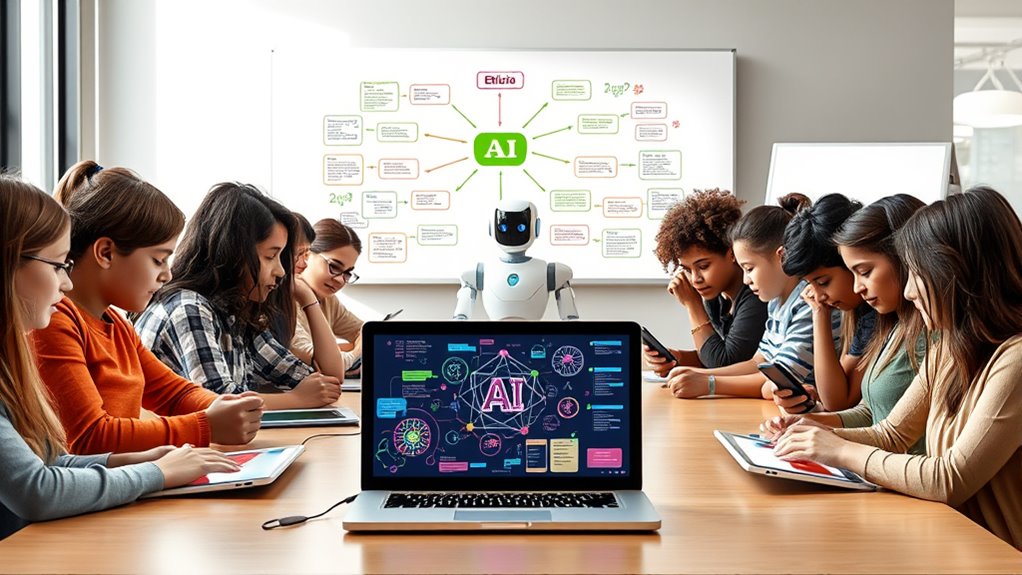
Guiding the ethical and societal dimensions of AI adoption requires a proactive approach to guarantee responsible deployment. You must prioritize transparency, fairness, and accountability to build trust and mitigate risks. Understand that AI systems can unintentionally reinforce biases or invade privacy if not carefully managed. It’s essential to evaluate the societal impact of AI applications, including job displacement and data misuse, and develop strategies to address these issues. Responsible AI use also involves adhering to legal and regulatory frameworks, ensuring ethical decision-making, and designing human-centered systems that enhance human capabilities rather than replace them. By actively engaging with these considerations, you help foster an environment where AI benefits society while minimizing harm, promoting sustainable and equitable technological growth. Additionally, fostering a culture of attention and continuous learning among developers and users is crucial for adapting to evolving ethical challenges.
Building Skills for AI-Driven Decision Making and Automation

Are you ready to leverage AI for smarter decision-making and automation? To build these skills, focus on understanding data-driven strategies and integrating AI tools into workflows. Imagine:
Harness AI to enhance decision-making, automate workflows, and turn data into actionable insights for business success.
- A dashboard displaying real-time insights guiding your business choices.
- Automated alerts triggered by AI analyzing patterns and anomalies.
- Customized AI models predicting customer behavior with high accuracy.
- Seamless human-AI collaboration in decision processes, like chatbots assisting clients.
You’ll learn to interpret AI outputs, design decision frameworks, and deploy automation solutions effectively. Hands-on exercises will sharpen your ability to create and optimize models for specific tasks. Mastering these skills enables you to transform raw data into actionable insights, streamline operations, and make confident, timely decisions that drive success.
Leveraging No-Code and Low-Code Tools for Democratized AI Development

No-code and low-code AI tools are transforming how organizations enable broader participation in AI development by removing technical barriers. These platforms let you build, train, and deploy AI models without deep programming knowledge. You can leverage drag-and-drop interfaces, pre-built modules, and user-friendly dashboards to turn data into actionable insights quickly. This democratization empowers non-technical team members to experiment with AI, fostering innovation across departments. You don’t need to write complex code or understand intricate algorithms, making AI accessible to a wider audience. As a result, organizations can accelerate project timelines, reduce costs, and encourage collaborative problem-solving. By embracing these tools, you become part of a movement that makes AI development more inclusive, practical, and aligned with real-world needs.
Validating Expertise Through Certifications and Career Opportunities

Wondering how to demonstrate your AI skills and stand out in a competitive job market? Certifications are a powerful way to validate your expertise and boost your career prospects. They serve as proof of your knowledge, commitment, and ability to apply AI concepts effectively.
Certifications validate your AI skills and help you stand out in a competitive job market.
Imagine:
- Earning a recognized certificate, like ISACA’s AI Fundamentals, opening doors to new roles.
- Showcasing your skills with a portfolio of projects that impress hiring managers.
- Gaining credibility through vendor-neutral certifications that highlight your versatility.
- Connecting with a network of professionals who value continuous learning and growth.
These certifications not only validate your current skills but also signal your dedication to staying ahead in AI’s fast-changing landscape. They make you more attractive to employers seeking proven AI expertise.
Embracing Continuous Growth in the Evolving AI Landscape

Building on your certification achievements and foundational knowledge, embracing continuous growth becomes essential as the AI landscape rapidly evolves. You need to stay updated on new technologies, emerging tools, and shifting best practices to remain relevant. This means regularly engaging with industry news, participating in advanced courses, and experimenting with the latest AI frameworks. It also involves developing a growth mindset—seeking feedback, learning from failures, and adapting to change. AI’s rapid advancements, like new models and ethical considerations, require you to be proactive in expanding your skills. By continuously learning and evolving, you guarantee your expertise stays current, enabling you to leverage AI effectively and responsibly in your projects and organization. Growth isn’t optional; it’s vital in steering AI’s dynamic future.
Frequently Asked Questions
How Does the Course Adapt to Rapid AI Technological Advancements?
You find that the course adapts quickly by regularly updating its curriculum to include the latest AI breakthroughs and tools. It incorporates current research, emerging technologies like generative AI, and new industry use cases. You also benefit from ongoing expert input, flexible modules, and real-world examples that reflect recent advancements. This guarantees you’re always learning relevant skills, keeping pace with AI’s fast-evolving landscape and maintaining your competitive edge.
What Are the Prerequisites for Enrolling in This Comprehensive AI Course?
You don’t need to be a tech genius or have a PhD to enroll in this incredible AI course. Just a basic understanding of computers, some curiosity about how AI works, and a willingness to learn are enough to get started. No prior coding or math skills are required, so even if you’re new to tech, you’ll find this course accessible and engaging. Prepare to unseal your AI potential today!
How Does the Curriculum Address AI Bias and Fairness Issues?
The curriculum addresses AI bias and fairness by integrating dedicated modules that explore ethical principles, societal impacts, and bias mitigation techniques. You’ll learn how to identify potential biases in data and models, apply fairness frameworks, and implement responsible AI practices. Through real-world examples and hands-on exercises, you’ll develop skills to create equitable AI solutions, ensuring your projects promote transparency, accountability, and ethical standards in AI deployment.
Can Non-Technical Professionals Benefit From the Hands-On Labs?
Absolutely, non-technical professionals can benefit from hands-on labs—they’re like keys opening a treasure chest of AI skills. These interactive exercises make complex concepts tangible, helping you build, train, and deploy models without heavy coding. By actively engaging, you gain practical experience that boosts confidence and understanding, empowering you to collaborate effectively with technical teams and apply AI strategies confidently in your role.
What Post-Certification Support Is Available for AI Career Development?
After certification, you can access ongoing support like professional communities, online forums, and mentorship programs to help advance your AI career. Many courses offer alumni networks, webinars, and refresher modules to keep your skills sharp. You might also find job placement assistance, industry events, and advanced training options that help you stay current and grow professionally. Leverage these resources to build connections, learn new skills, and confidently pursue new AI opportunities.
Conclusion
By mastering AI fundamentals, you’ll open endless opportunities—did you know that 85% of jobs will require AI skills in the next decade? With hands-on learning and ethical insights, you’re well on your way to becoming an AI expert. Embrace continuous growth, leverage accessible tools, and stay ahead in this dynamic field. The future of AI is yours to shape—start today and turn possibilities into realities.






![Huawei’s AI Strategy: Dominating AI As Frontier AI Lab With Noah’s Ark, Pangu Ecosystem [In-Depth Analysis, 2026] - Klover.ai](https://thorstenmeyerai.com/wp-content/uploads/2026/09/huawei-s-ai-strategy-dominating-ai-as-frontier-ai-lab-with-noah-s-ark-pangu-ecos-featured-260x140.jpg)