
If you’ve been watching markets, headlines, and model releases, it’s easy to miss what’s happening one layer lower: the internet is quietly being rebuilt for AI agents, not just humans.
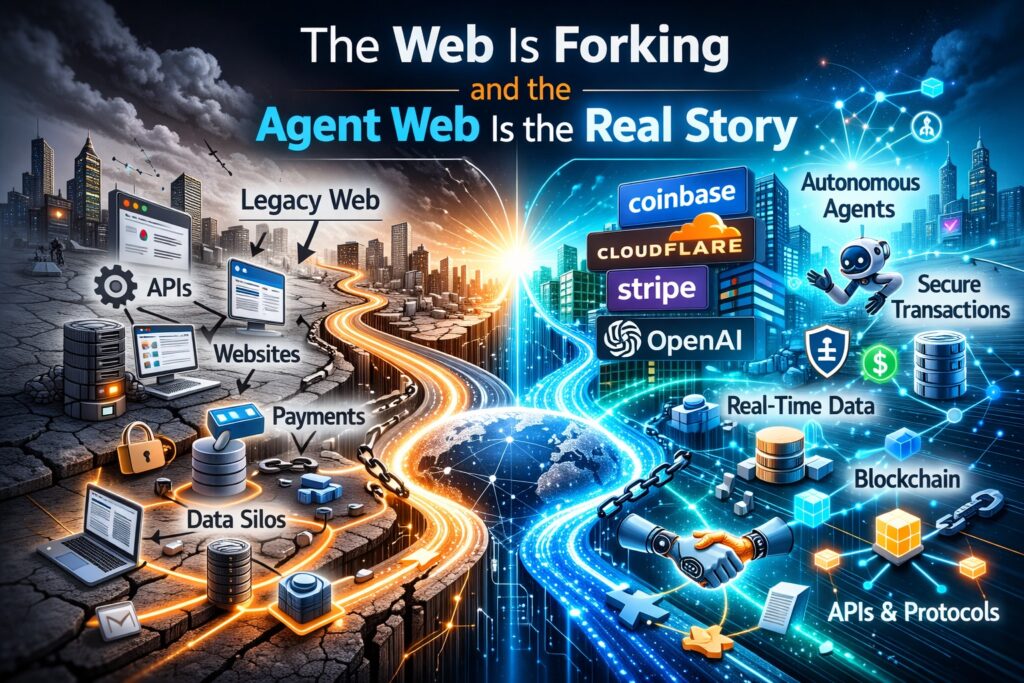
A useful mental model is that the web is splitting into two layers:
- The Human Web: designed for attention—layouts, fonts, UI polish, persuasion, scrolling.
- The Agent Web: designed for execution—APIs, structured data, machine-readable policies, delegated payment credentials, and safe execution environments.
This isn’t speculative. Over the past months, multiple infrastructure giants shipped primitives that turn “assistants” into economic actors—systems that can read, decide, pay, and act without ever opening a browser tab. Cloudflare is explicitly framing this shift as treating agents as “first‑class citizens” by serving machine-friendly markdown when requested.
What’s new is the convergence: payments, content, search, and execution environments are being standardized at the same time.
Key Takeaways
- The web is splitting into a human layer and an agent layer.
- Wallets (x402), delegated payment tokens (SPTs), markdown content negotiation, and hosted shells are the core primitives.
- Search is becoming structured retrieval, not blue links.
- The biggest bottleneck is now trust: agents must be treated as adversarial code.
- Winning products will expose agent-friendly APIs + policies and keep humans in control.
The Four Primitives of the Agent Web
To understand what’s coming, it helps to map the agent web into four foundational layers:
- Money rails (agents can pay)
- Agent-readable content (agents can read efficiently)
- Agent-native search and extraction (agents can find and structure facts)
- Execution environments (agents can run code and complete workflows)
Each layer is being built in public—by different companies—yet the pieces fit together.

AI-DEE RFID Blocking Wallet – Minimalist Leather Business Credit Card Holder – Black2
As an affiliate, we earn on qualifying purchases.
As an affiliate, we earn on qualifying purchases.
1) Money rails: when software can spend
Coinbase: Agentic Wallets + x402 (machine-to-machine payments)
Coinbase’s Agentic Wallets are aimed directly at autonomous agent use cases, built around x402, a payments protocol that revives HTTP 402 “Payment Required” as a native way for machines to pay for resources and services. Coinbase positions x402 as already “battle-tested” with 50M+ transactions and frames it as enabling machine-to-machine payments, paywalled APIs, and programmatic access without human intervention.
This matters because it turns payments into something an agent can do as part of a request—not as a separate “checkout” experience designed for humans.
Stripe: Agentic Commerce Suite + Shared Payment Tokens
Stripe took a different but complementary path: delegated payments for agentic shopping.
Its Agentic Commerce Suite introduced Shared Payment Tokens (SPTs)—a payment primitive that lets an agent initiate purchases using a buyer’s saved method without revealing raw payment credentials. Stripe describes SPTs as scoped (e.g., seller-bound), bounded (time/amount limits), and observable to reduce unauthorized actions and disputes.
OpenAI’s commerce documentation also references Stripe’s Shared Payment Token as a Delegated Payment Spec-compatible implementation, signaling that delegated credentials are becoming a shared pattern rather than a one-off integration.
Visa + PayPal + Google: protocols for safe agent-driven checkout
Once agents can pay, merchants need a way to distinguish:
- a legitimate agent acting for a real customer
vs. - a bot trying to abuse checkout flows
Visa has been pushing its Trusted Agent Protocol, positioning it as an open framework for safer agent-driven checkout and merchant verification.
PayPal announced support for an Agent Payments Protocol (AP2), described as an interoperable extension tied into broader agent interoperability efforts (Agent2Agent and MCP), aiming to standardize agent-driven payments across ecosystems.
Google has also been publicly talking about an open standard for agentic commerce and tooling to help retailers connect with “high-intent shoppers” in an agentic shopping era.
Bottom line: money is being refactored into something agents can execute safely, programmatically, and audibly—without screen scraping and without handing an LLM a credit card number.

As an affiliate, we earn on qualifying purchases.
2) Content: from “HTML for humans” to “markdown for agents”
For most of the web’s history, “web content” meant HTML optimized for browsers. Agents don’t want that. They want clean text, structure, and predictable semantics.
Cloudflare: “Markdown for Agents”
Cloudflare introduced Markdown for Agents, a feature that uses content negotiation: if a client requests text/markdown via the Accept header, Cloudflare can fetch the origin HTML and convert it to markdown on the fly (when possible).
Cloudflare’s own example shows massive token reduction—one Cloudflare blog page dropping from ~16k tokens in HTML to ~3k in markdown (about an 80% reduction), which directly changes the economics of retrieval and summarization.
Why Cloudflare specifically matters: Cloudflare has repeatedly stated it manages/protects traffic for “20% of the web,” which makes any “agent-friendly default” at their layer instantly huge in potential impact.
Translation: the web can remain visually rich for humans, while simultaneously becoming “LLM efficient” for agents—without every site rewriting their stack overnight.

Klein Tools VDV001819 Tool Set, Cable Installation Test Set with Crimpers, Scout Pro 3 Cable Tester, Snips, Punchdown Tool, Case, 6-Piece
- Complete Installation Kit: Includes all essential tools for cable installation
- Scout Pro 3 Tester: Tests coax, data, and telephone cables
- Ratcheting Modular Crimper: Cuts, strips, and crimps various cables
As an affiliate, we earn on qualifying purchases.
As an affiliate, we earn on qualifying purchases.
3) Search and extraction: less “ten blue links,” more “structured outputs”
Agents don’t browse; they retrieve. And “retrieval” is moving from ranking links to producing:
- clean extracted page content
- structured snippets
- citations
- stable schemas
- low-latency APIs
Exa: search APIs built for LLM consumption
Exa positions its Search API as returning webpage results and their contents, optimized for LLM usage and token efficiency—i.e., not just links.
Its Research API goes a step further, offering agentic researcher models that break down instructions, search, extract, reason, and return structured answers with citations.
This is the emerging pattern: the agent web expects structured retrieval, not a UI metaphor.

The No-BS Guide to AI Agents & Automation: Build AI Workflows, Automate Your Business, and 10x Your Productivity — No Coding Required (The No-BS AI Playbooks Book 2)
As an affiliate, we earn on qualifying purchases.
As an affiliate, we earn on qualifying purchases.
4) Execution environments: agents that can actually do the work
When an agent can pay and can retrieve content efficiently, the missing piece is “hands”: a reliable way to run code, install dependencies, and generate artifacts.
OpenAI: Shell tool + Skills
OpenAI’s shell tool gives a model the ability to run commands inside a terminal environment—either in OpenAI-hosted containers or in your own local runtime.
On top of that, Skills are reusable, versioned bundles of files/instructions that can be mounted into these environments—effectively packaging repeatable workflows into something agents can load on demand.
OpenAI also published guidance highlighting why these primitives matter for long-running, real-world agent workflows: hosted containers, controlled execution, and operational patterns for reliability.
Why this changes the game: a shell + skills turns an agent from “advisor” into “operator.” It can execute multi-step workflows end-to-end.
Agents as economic actors: the first real examples are already here
Once you combine:
- payment capability (wallets/tokens/protocols)
- retrieval capability (markdown/structured extraction/search APIs)
- execution capability (shell + skills)
…agents stop being chatbots and start being participants in markets.
Polymarket arbitrage: bots extracting real value
One frequently cited proof point is prediction markets. Academic work analyzing Polymarket order book/on-chain data estimated ~$40M in realized arbitrage profit extracted, and reporting around this research suggested the largest accounts appeared “bot-like.”
That’s important not because everyone should build a trading bot (most shouldn’t), but because it shows a new behavior: software performing economic action continuously and capturing value in a machine-speed environment.
Also worth noting: the “easy money” narrative is often misleading. Real arbitrage in competitive markets tends to collapse into speed and infrastructure advantages (latency, execution quality, fee structure). Treat any viral “risk-free bot” story with caution.
Security & trust: assume the agent is an adversary
The moment an agent can:
- execute code
- access files
- authenticate into systems
- spend money
…it must be treated like an untrusted process, not a loyal employee.
That adversarial stance is showing up in the ecosystem. OpenClaw’s rapid popularity has also triggered security concern and even bans in some organizations, highlighting the fear of unpredictable behavior and misuse.
Meanwhile, security-first re-implementations and sandboxes are emerging. For example, IronClaw is positioned as an OpenClaw-inspired implementation focused on privacy and security.
If you’re building or deploying agents, assume:
- prompt injection will happen
- tool abuse will happen
- data exfiltration attempts will happen
- “helpful” automation can become costly automation very quickly
The trust challenge isn’t theoretical anymore. It’s the product.
What this means for your stack
Here’s the practical translation for builders, marketers, and operators.
If you run a website: design for two audiences
- Humans need great UX.
- Agents need clean structure, explicit policies, and stable endpoints.
Concrete steps:
- Offer (or enable) machine-friendly representations of content (markdown/text, clean article bodies, clear headings). Cloudflare’s “Markdown for Agents” is a strong signal that this is becoming mainstream infra, not niche tooling.
- Double down on structured data (schema where relevant) and clear entity relationships.
- Treat your content policy as a first-class artifact (what can be used for training vs. search vs. AI input); Cloudflare’s framing around agent traffic and content signals is pointing in this direction.
If you sell products: prepare for delegated checkout
Agents won’t “browse your shop” the way humans do. They’ll ask:
- What’s the price?
- What’s in stock?
- What’s the shipping time?
- What’s the return policy?
- Can I pay safely, with consent and limits?
You should expect commerce to move toward:
- delegated credentials (e.g., Stripe SPTs)
- verification protocols (e.g., Visa Trusted Agent Protocol)
- agent payment standards (e.g., PayPal AP2)
If you build SaaS: you now have “two clients”
- The human UI
- The agent interface
The agent interface is often:
- API-first
- idempotent (safe to retry)
- auditable (logs + receipts)
- scoped (least privilege)
- explicit about costs and limits (usage-based + paywalls)
If you don’t provide this, agents will still interact with your product—but through brittle scraping and unreliable automation.
If you deploy agents internally: start with a threat model
If your agent can run tools, the right default is:
- isolate tools (containers, sandboxes, VM boundaries)
- restrict permissions (capabilities and allowlists)
- separate secrets from the model context
- log everything, review often
- implement approval gates for sensitive actions (money movement, production writes, account changes)
OpenAI’s shell + skills approach is powerful—but also makes the “operator” leap very real, so guardrails are non-negotiable.
The next few years are about the trust gap
The infrastructure is racing toward full autonomy:
- agents that can pay
- agents that can execute
- agents that can negotiate for data and services
But humans rarely want full autonomy in practice. They want something closer to “autopilot with supervision”:
- ask me before spending
- show me a receipt
- keep an audit trail
- let me override decisions
- don’t surprise me
That tension—between what infrastructure enables and what humans trust—is likely the defining product and governance challenge of the agent era.
The web is forking. The question isn’t whether agents will become first-class users of the internet. They already are.
The question is whether we can make them safe, legible, and accountable fast enough.