
Research compiled: March 23, 2026
For: Thorsten Meyer / ThorstenmeyerAI.com
Executive Summary
The thesis that companies must become “agent-readable and agent-writable” is no longer speculative. Between January 2025 and March 2026, the infrastructure for agentic commerce has moved from concept to live protocols, real transactions, and early courtroom precedent. Google launched the Universal Commerce Protocol (UCP) with 20+ endorsing partners. Stripe shipped the Agentic Commerce Suite with brands like URBN, Etsy, and Coach already onboarded. OpenAI launched — and then scaled back — Instant Checkout in ChatGPT, proving that the demand side exists but the supply-side data plumbing remains the bottleneck. Amazon sued Perplexity over its Comet shopping agent and won a preliminary injunction, establishing the first legal precedent distinguishing user consent from platform authorization for AI agents.
Why Your Business Must
Become Agent-Readable
AI agents are becoming the new customer. If they can’t read your data, they will skip you entirely. Here’s what every business leader needs to know.
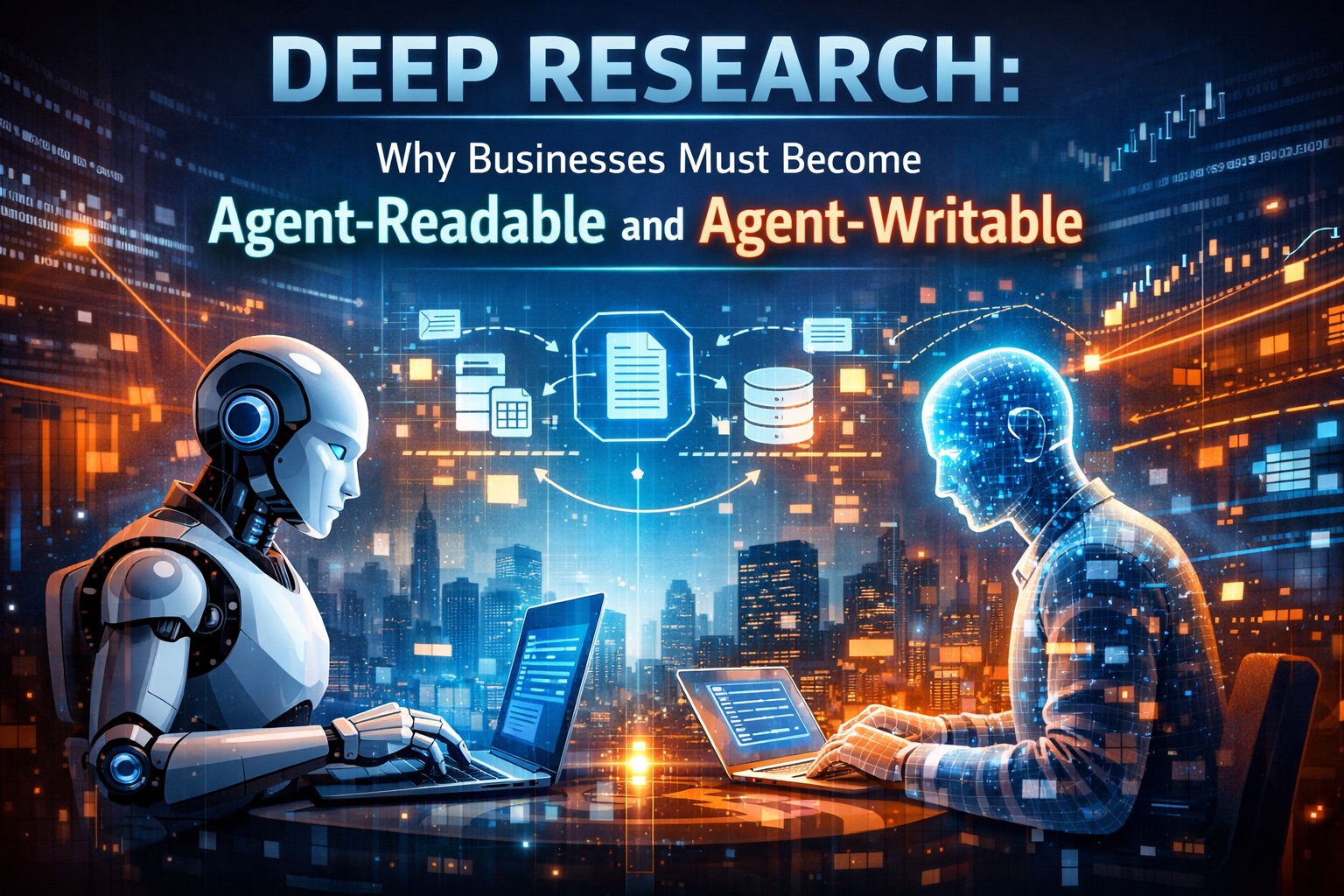
The research confirms your core argument: agent visibility is a data architecture problem, not an SEO problem. And the companies that treat it as cosmetic are already falling behind.
Product Management's Sacred Seven: The Skills Required to Crush Product Manager Interviews and be a World-Class PM (Fast Forward Your Product Career: The Two Books Required to Land Any PM Job)
As an affiliate, we earn on qualifying purchases.
As an affiliate, we earn on qualifying purchases.
Part 1: The Market Is Real and Arriving Faster Than Expected
The Numbers
McKinsey’s most recent projection (January 2026) estimates that AI agents could mediate $3 trillion to $5 trillion in global consumer commerce by 2030 — significantly higher than the $1 trillion figure circulating in 2025. The U.S. B2C retail segment alone could see up to $1 trillion in agent-orchestrated revenue.
Gartner predicts that by end of 2026, 25% of enterprise software purchases will involve some form of AI agent mediation. eMarketer reports that AI-assisted product discovery already influences over 40% of online searches in key retail categories. Traffic from AI sources to e-commerce sites has surged 1,200% year-over-year, while traditional search traffic has declined 10%.
ChatGPT now handles approximately 50 million shopping-related queries daily — roughly 2% of total queries, but at 700 million weekly active users, even that fraction represents enormous volume.
Adoption Is Still Early but Accelerating
McKinsey’s 2025 State of AI survey found that 88% of organizations report using AI in at least one business function, but only 23% have begun scaling agentic AI. 62% are experimenting with AI agents. The gap between experimentation and production is the central tension in the market right now.
IBM’s assessment is blunt: most enterprises are running “model-rich, data-poor” environments. The models are capable, but the underlying data is not ready.

Warehouse Management and Inventory Control System
As an affiliate, we earn on qualifying purchases.
As an affiliate, we earn on qualifying purchases.
Part 2: The Protocol War — Three Competing Standards
The single most important infrastructure development since mid-2025 is the emergence of three competing (and partially overlapping) commerce protocols. This is the TCP/IP moment for agent commerce.
Google’s Universal Commerce Protocol (UCP)
Announced January 11, 2026 at NRF. Co-developed with Shopify, Etsy, Wayfair, Target, and Walmart. Endorsed by 20+ partners including Adyen, American Express, Best Buy, Flipkart, Macy’s, Mastercard, Stripe, The Home Depot, Visa, and Zalando.
UCP is designed as a vendor-neutral, open standard covering the full shopping journey — discovery, checkout, payment, and post-purchase. Its architecture separates capabilities into layers (modeled after TCP/IP): a core shopping service defines transaction primitives, capabilities add functional areas like Checkout and Catalog, and extensions augment with domain-specific schemas (fulfillment options, discounts, loyalty).
Key design decisions: merchants declare their capabilities via profiles that agents can dynamically discover. Payment is handled through a flexible handler model — the merchant advertises accepted handlers, the agent picks one. New payment methods can enter the ecosystem without protocol-level changes.
UCP is already powering checkout in Google’s AI Mode in Search and the Gemini app for eligible U.S. retailers. As of March 19, 2026, Google released updates adding multi-item cart support, real-time product data loading, and identity linking for loyalty programs. Partners like Commerce Inc, Salesforce, and Stripe are implementing UCP on their platforms. Google is simplifying onboarding via Merchant Center.
OpenAI / Stripe’s Agentic Commerce Protocol (ACP)
Live since September 2025. Co-developed by OpenAI and Stripe. Open-sourced. Powers Instant Checkout in ChatGPT (now transitioning to ChatGPT Apps).
ACP requires three components: a product feed (daily gzip files pushed to an OpenAI endpoint), a checkout API, and a payment integration via Stripe. OpenAI charges merchants a 4% transaction fee on completed purchases, in addition to Stripe’s standard processing fees (~2.9% + $0.30).
The critical innovation is the Shared Payment Token (SPT) — a new payment primitive where AI agents can initiate payments using a buyer’s saved payment method without exposing credentials. SPTs are scoped to a specific seller, time-limited, amount-bounded, and observable throughout their lifecycle. Stripe’s Radar provides fraud signals specifically tuned for agent transactions.
Since co-developing ACP with OpenAI in September 2025, Stripe has shipped four protocol releases adding payment handlers, scoped tokens, extensions (starting with discounts), buyer authentication, and native MCP transport.
Critically, Stripe built the Agentic Commerce Suite as a protocol-agnostic commerce layer that works across standards including Google’s UCP. Retailers using Stripe’s suite will automatically support all protocols through a single integration.
The Linux Foundation’s Agentic AI Foundation (AAIF)
Formed December 9, 2025. Founding projects: Anthropic’s Model Context Protocol (MCP), Block’s goose agent framework, and OpenAI’s AGENTS.md. Platinum members include AWS, Anthropic, Block, Bloomberg, Cloudflare, Google, Microsoft, and OpenAI.
MCP provides the connective layer — the universal protocol for connecting AI models to tools, data, and applications. It has been adopted by ChatGPT, Cursor, Gemini, Microsoft Copilot, VS Code, and many others.
AGENTS.md is a lightweight markdown convention giving AI coding agents project-specific guidance. Already adopted by 60,000+ open source projects and agent frameworks including Cursor, Devin, GitHub Copilot, and Gemini CLI.
The AAIF represents the industry’s attempt to prevent vendor lock-in on the foundational infrastructure layer. Its existence signals that agentic AI has matured from experimentation to infrastructure that requires neutral governance.
What This Means for Businesses
Brands now face a three-ecosystem world: Amazon’s proprietary agents (Rufus, Buy For Me), Google’s UCP, and OpenAI’s ACP. Most businesses will need to support at least two. The companies with the most complete, well-structured product data will be the ones AI agents surface first regardless of protocol.

GoPro HERO11 Black – E-Commerce Packaging – Waterproof Action Camera with 5.3K60 Ultra HD Video, 27MP Photos, 1/1.9" Image Sensor, Live Streaming, Webcam, Stabilization
Revolutionary New Image Sensor: expansive field of view ever on a HERO camera out of the box. This…
As an affiliate, we earn on qualifying purchases.
As an affiliate, we earn on qualifying purchases.
Part 3: The Platforms — Who Is Building What
Amazon: The Walled Garden Strategy
Amazon’s Rufus AI shopping assistant has reached 250 million users and is projected to drive $10 billion in additional annual sales. Customers who engage with Rufus are 60% more likely to complete a purchase.
In November 2025, Amazon rolled out agentic auto-buy: customers set target prices and Rufus automatically purchases when prices drop. Combined with 30-day and 90-day price tracking, this makes Rufus a 24/7 deal-hunting agent. Rufus now uses Anthropic’s Claude Sonnet and Amazon Nova for complex reasoning and multi-step tasks.
Amazon’s strategy is explicitly walled-garden. It has blocked dozens of external AI agents including ChatGPT from accessing its shopping sites. It sued Perplexity over the Comet browser and won a preliminary injunction. The message: agents are welcome only if they operate transparently, respect platform rules, and negotiate access.
However, only 22% of products appearing on Amazon’s first results page coincide with those recommended by Rufus. 36% of Rufus suggestions don’t even appear on the first page. This means traditional Amazon SEO and Rufus optimization are diverging — sellers can maintain good keyword rankings and still be invisible to the AI assistant.
Amazon’s Rufus recommendations are also reportedly 83% self-serving (favoring Amazon’s interests) and only 32% accurate in providing genuinely relevant results. This creates an opening for neutral agents that serve the consumer first.
OpenAI / ChatGPT: The Pivot
OpenAI’s Instant Checkout launched with Etsy in September 2025 and was billed as “the next step in agentic commerce.” But by March 2026, the picture has changed significantly.
Onboarding merchants proved arduous. As of February 2026, roughly 30 Shopify merchants were live on Instant Checkout. Product information was often inaccurate — pricing, inventory status, and shipping costs were scraped and frequently out of date. OpenAI had not built a system for collecting and remitting state sales taxes. Conversion rates were low: users researched extensively but didn’t complete purchases inside the chatbot.
OpenAI is now transitioning from Instant Checkout to a ChatGPT Apps model, rerouting users to the retailer’s own website to complete purchases. This gives merchants more control but abandons the “buy without leaving chat” vision.
In February 2026, OpenAI merged Operator into ChatGPT Agent — a unified agentic system that can browse the web, research products, and take actions on behalf of users. Shopping Research, a deep-research feature for product comparison, has seen stronger traction than direct checkout.
The lesson is clear: the discovery and comparison phases of agent commerce are working. The transaction phase is where the data quality and integration problems your video identifies become acute.
Google: The Infrastructure Play
Google’s approach is the most infrastructure-oriented. UCP is positioned as the open plumbing layer, with Google surfaces (AI Mode in Search, Gemini) as reference implementations. Google is also shipping specific merchant tools: a Business Agent that lets shoppers chat with brands directly on Search, a catalog enrichment agent template in Copilot Studio (with Microsoft), and Direct Offers in Google Ads.
Google’s advantage is that it already sits at the intent layer — it sees search queries, Maps activity, Gmail, and Calendar. UCP is designed so agents can act when consumer goals surface (a birthday party conversation, a trip calendar reminder, a low-supplies signal).
Perplexity: The Legal Precedent
Perplexity’s Comet browser attempted the most aggressive approach — an AI shopping agent that could browse any e-commerce site and make purchases on behalf of users without the platform’s explicit consent. It accessed Amazon accounts by disguising itself as a Chrome browser.
Amazon sued in November 2025. On March 10, 2026, Judge Maxine Chesney granted a preliminary injunction, finding that Comet accessed Amazon’s systems “with the Amazon user’s permission, but without authorization by Amazon.” This distinction — user consent vs. platform authorization — is now the first legal precedent for agentic commerce.
A federal appeals court has since temporarily stayed the injunction, so the legal question remains open. But the precedent matters enormously. It means companies can legally require AI agents to identify themselves and negotiate access. The era of scraping-first agent commerce is being constrained.
Microsoft: Brand Agents and Copilot Checkout
Microsoft launched Brand Agents for Shopify merchants and a personalized shopping agent template in Copilot Studio at NRF 2026. It also launched a catalog enrichment agent that extracts product attributes from images, enriches them with social insights, and automates catalog tasks. Copilot Checkout, powered by Stripe, enables users to purchase from Etsy and retailers like Urban Outfitters without leaving the chat.

Writer's Guide to Hollywood Producers, Directors, and Screenwriter's Agents, 2002-2003: Who They Are! What They Want! And How to Win Them Over!
Used Book in Good Condition
As an affiliate, we earn on qualifying purchases.
As an affiliate, we earn on qualifying purchases.
Part 4: The Data Architecture Problem — Your Core Thesis Validated
The Readiness Gap
The research overwhelmingly confirms that data quality and structure are the primary bottlenecks, not model capability.
- MIT Sloan: 82% of executives name “organizational data quality” as the greatest barrier to achieving GenAI goals.
- Gartner: 63% of organizations don’t have — or are unsure if they have — AI-ready data management practices.
- IBM: Up to 90% of enterprise data is locked in unstructured silos.
- BARC 2026 Trend Monitor: “For AI and AI agents, high data quality is more important than ever to avoid hallucinations, bias or faulty recommendations.”
- Forrester: AI has “traded its tiara for a hard hat” — success is now determined by data architecture, not the model.
- McKinsey: Only 39% of companies report real bottom-line impact from AI. Only 6% capture real enterprise value.
- EisnerAmper: Nearly 88% of AI proof-of-concept initiatives fail to reach widescale deployment, with poor data readiness as the primary constraint.
What “Agent-Readable” Actually Requires
Stripe’s 10 lessons from building the first generation of agentic commerce (published March 12, 2026) provide the most concrete operational picture:
- Your product catalog is the entry point to agents, but different AI agents want data in different formats. One needs an SFTP file drop. Another wants a custom API integration.
- Real-time inventory and pricing are non-negotiable. If an agent surfaces a product that is out of stock or at the wrong price, the user experience collapses and the agent learns your data is unreliable.
- Protocol fragmentation is real. Stripe built a protocol-agnostic suite specifically because retailers can’t afford to rebuild their stack every time a protocol changes.
- Fraud signals tuned for human traffic are becoming obsolete. AI agents lack human variability and can be misflagged as fraudulent.
Akeneo’s partnership with Stripe further validates the data layer problem: they describe themselves as “a centralized source of truth for product information, transforming fragmented data into governed, contextualized, and AI-ready product knowledge.” Their CEO stated: “AI agents can only deliver reliable shopping experiences when they have access to centralized, enriched, activated, and well-governed product information.”
The Metadata vs. Meaning Problem
Your video’s distinction between basic metadata and higher-order product meaning is the least-discussed but most important dimension.
Airia’s 2026 report documents that when data is enriched with semantic layers, AI model accuracy improved from 16% to 54% in documented cases. “Metadata and ontologies” — meaning structured understanding of data relationships, not just attributes — is listed as a critical capability for agent-ready retailers.
Flipflow’s analysis of Amazon Rufus confirms this: Rufus doesn’t just read product pages. It incorporates signals from external brand reputation, reviews inside and outside Amazon, purchasing patterns, and category-level expectations. A product can be perfectly optimized at the keyword level and still be displaced by another with superior contextual fit.
This is exactly the “tribal knowledge” problem you identified. The richer context that today lives in marketing copy, brand storytelling, or internal human knowledge needs to be translated into structured attributes that agents can reason over.
Part 5: The Incumbent Dilemma — Fear of Disintermediation
Amazon as Case Study
Amazon’s behavior is the clearest example of the disintermediation fear you describe. It has:
- Built its own AI shopping tools (Rufus, Buy For Me)
- Blocked dozens of external AI agents from accessing its site
- Sued Perplexity for using its Comet browser to shop on Amazon
- Launched “Shop Direct” to surface products from other retailers’ websites on Amazon’s platform — without those retailers’ knowledge or consent
Amazon CEO Andy Jassy has acknowledged that agentic commerce “has a chance to be really good for e-commerce” but insists partnerships happen “on Amazon’s terms.” The advertising revenue stakes are enormous — when an AI agent shops, it bypasses all the sponsored listings, banner ads, and promoted products that drive Amazon’s retail media business.
Perplexity argued in court that AI agents “don’t have eyeballs to see the pervasive advertising Amazon bombards its users with.” Amazon’s response: the concern is not just advertising, but security, customer experience, and maintaining the quality of the platform. The court sided with Amazon on the authorization question.
The SAP Problem
Your observation about enterprise systems like SAP being structured to keep data inside the company’s walls is supported by the broader research. IBM notes that enterprises typically lack “unified access to both structured and unstructured data” and that “data fragmentation prevents teams from accessing and combining information across sources and formats.” The problem is not that the data doesn’t exist — large companies often have extremely rich internal data. The problem is that it was never designed to be externalized to machine consumers.
The “Wait and See” Misconception — Quantified
KPMG’s Q4 2025 AI Pulse Survey (published January 2026) found that 65% of leaders cite agentic system complexity as the top barrier — for two consecutive quarters. The prediction: “2026 will be the year we begin to see orchestrated super-agent ecosystems, governed end-to-end by robust control systems.”
Accenture’s Technology Vision 2025 found that 69% of executives say AI brings new urgency to how their businesses are built and run. Forrester found that 30% of enterprises cite unpredictable outcomes as a key barrier. The combined message: complexity and uncertainty are real, but waiting compounds the problem.
Stripe observed at NRF 2026 that almost every retailer asked the same question: “What does ‘good’ product data look like for AI agents?” The fact that this question is still being asked in Q1 2026 confirms your point about the gap between knowing the shift is coming and actually executing on it.

Part 6: The Four Misconceptions — Evidence
Misconception 1: “We’ll optimize for agents like we did for search”
Flipflow’s analysis of Rufus demonstrates this directly: only 22% of products on Amazon’s first results page coincide with Rufus recommendations. 36% of Rufus suggestions don’t even appear on the first page. Agent visibility and search visibility are diverging.
The OpenAI ACP spec requires completely different data infrastructure from SEO: a gzip-compressed product feed with structured fields (title max 150 chars, description max 5,000 chars, price with ISO 4217 currency code, availability status, images, eligibility flags), pushed daily to a dedicated endpoint. This has nothing to do with keywords, meta tags, or link-building.
Sanbi.ai frames it directly: “AI visibility is the new SEO. Agencies that add agentic commerce readiness to their service offering will win the next wave of clients.”
Misconception 2: “Structured schemas only work for simple products”
McKinsey’s automation curve describes five levels of agent sophistication. At Level 4, agents operate against standing goals: “Keep household essentials under $300/month” or “Maintain my airline loyalty status at the lowest total cost over 2026.” This requires deep structured understanding of loyalty programs, substitution logic, service guarantees, and multi-variable optimization — exactly the complex domains where structured data provides the most value.
Misconception 3: “Customers won’t trust agents to transact”
McKinsey’s research maps a clear delegation curve. Level 0: automated reorder (23% of U.S. Amazon shoppers already had active Subscribe & Save in 2024). Level 1: research and comparison without execution. Level 2: execution with confirmation. Level 3: conditional delegation. Level 4: standing goals with episodic human involvement.
OpenAI’s experience validates this progression. Shopping Research (the comparison phase) has gained stronger traction than Instant Checkout (the transaction phase). Users are comfortable delegating research. Transaction delegation is coming, but gradually.
Misconception 4: “We’ll wait and see”
OpenAI’s retreat from Instant Checkout demonstrates the cost of being unprepared. Onboarding merchants was “arduous.” Product data was often inaccurate. As of February 2026, only ~30 Shopify merchants were live. The merchants who were ready captured early exposure to 50 million daily shopping queries. The ones who weren’t are invisible.
Part 7: What “Good” Looks Like — The Practical Checklist
Based on all the research, businesses pursuing agent readiness need:
Data Layer (Foundation)
- Structured product data with complete schema markup (JSON-LD)
- Real-time pricing and inventory feeds
- Machine-readable delivery windows, shipping costs, and return policies
- Clean taxonomy and consistent attribute naming across SKUs
- Semantic enrichment: why a product is special, use-case fit, comparison context
Protocol Layer (Access)
- Product feed compatible with ACP (OpenAI/Stripe) and/or UCP (Google)
- MCP server or REST API for agent queries
- Google Merchant Center feeds kept current
- Bing Webmaster Tools indexing verified
Transaction Layer (Execution)
- Stripe integration for Agentic Commerce Suite
- Support for Shared Payment Tokens (SPTs)
- Agent-ready checkout (can be embedded in AI interfaces)
- Tax collection and compliance automation
Trust Layer (Governance)
- Third-party validation: reviews on Google, Trustpilot, G2, Amazon
- Consistent brand information across platforms
- Transparent consent flows and agent action logs
- Fraud detection calibrated for agent traffic (not just human patterns)
Measurement Layer (Intelligence)
- Monitor how AI models perceive and recommend your brand
- Track agent-driven vs. human-driven traffic and conversions
- Benchmark against competitors using Claude/ChatGPT as test agents
- Audit schema completeness regularly
Part 8: The Open Questions
1. Who controls the customer relationship when an agent buys?
The Amazon-Perplexity ruling establishes that platforms can require agent authorization. But the appeals court has stayed the injunction. This question will likely reach higher courts.
2. Will there be “advertising for machines”?
Gartner analyst Andrew Frank suggested there could be “some other way that you can influence agents that’s like advertising for machines.” No one has built this yet, but the question is existential for retail media businesses worth hundreds of billions.
3. Which protocol wins?
Likely both UCP and ACP coexist, with Stripe acting as the protocol-agnostic bridge. Amazon remains the wild card — it has not joined either standard and is building proprietary tools.
4. What happens to marketing?
Your sharpest point — that marketing has historically covered for weak data — is confirmed by the OpenAI Instant Checkout failure. Scraped data from marketing-oriented pages (designed for human persuasion) was often inaccurate for machine consumption. The companies that invested in clean, structured data backends were ready. The ones relying on polished frontends were not.
5. How fast does consumer trust in delegated purchasing actually grow?
The honest answer from industry observers: “Everyone thinks everyone else has this figured out. The fact is that no one has this figured out.” 2026 is a step along the way, not the finish line. But the infrastructure is being laid now.
Sources and Key References
- McKinsey: “The automation curve in agentic commerce” (January 28, 2026)
- Google Developers Blog: “Under the Hood: Universal Commerce Protocol” (January 11, 2026)
- Shopify Engineering: “Building the Universal Commerce Protocol” (2026)
- Stripe Blog: “10 things we learned building for the first generation of agentic commerce” (March 12, 2026)
- Stripe Blog: “Introducing the Agentic Commerce Suite” (December 11, 2025)
- OpenAI: “Buy it in ChatGPT” (2025)
- CNBC: “OpenAI’s first try at agentic shopping stumbled” (March 20, 2026)
- Linux Foundation: AAIF formation announcement (December 9, 2025)
- KPMG: Q4 AI Pulse Survey (January 15, 2026)
- IBM Think: “The biggest data trends for 2026” (February 17, 2026)
- Airia: “2026: The State of Agentic AI in Retail” (January 7, 2026)
- GeekWire: “Judge blocks Perplexity’s AI bot from shopping on Amazon” (March 2026)
- WinBuzzer: “Court Lets Perplexity AI Shopping Bots Stay Active on Amazon” (March 18, 2026)
- Flipflow Blog: “From SEO to AI Agents: Amazon Rufus’s Strategic Shift” (January 21, 2026)
- commercetools: “7 AI Trends Shaping Agentic Commerce in 2026” (February 2026)
- PwC: “2026 AI Business Predictions” (2026)
- BARC: “The Data, BI and Analytics Trend Monitor 2026”
- Gartner: 2024 AI-ready data management survey