

Get business pricing on tech for your team
- Business-only prices and quantity discounts
- Tax-exempt purchasing
- Multiple users, one account, clear invoices
How Anthropic’s refusal to drop two safety redlines triggered the most consequential AI governance crisis in history — and what it means for every company building with artificial intelligence.
By Thorsten Meyer • March 19, 2026 • ThorstenmeyerAI.com
Reading time: approximately 18 minutes
Executive Summary
In the span of three weeks, a contract dispute between Anthropic and the U.S. Department of Defense has escalated into the defining legal, political, and ethical confrontation of the AI era. What began as a disagreement over two specific usage restrictions — prohibitions on autonomous weapons and mass domestic surveillance — has mushroomed into a full-blown constitutional challenge, a government-wide purge of a leading AI vendor, and a public reckoning over who gets to set the boundaries of military AI deployment.
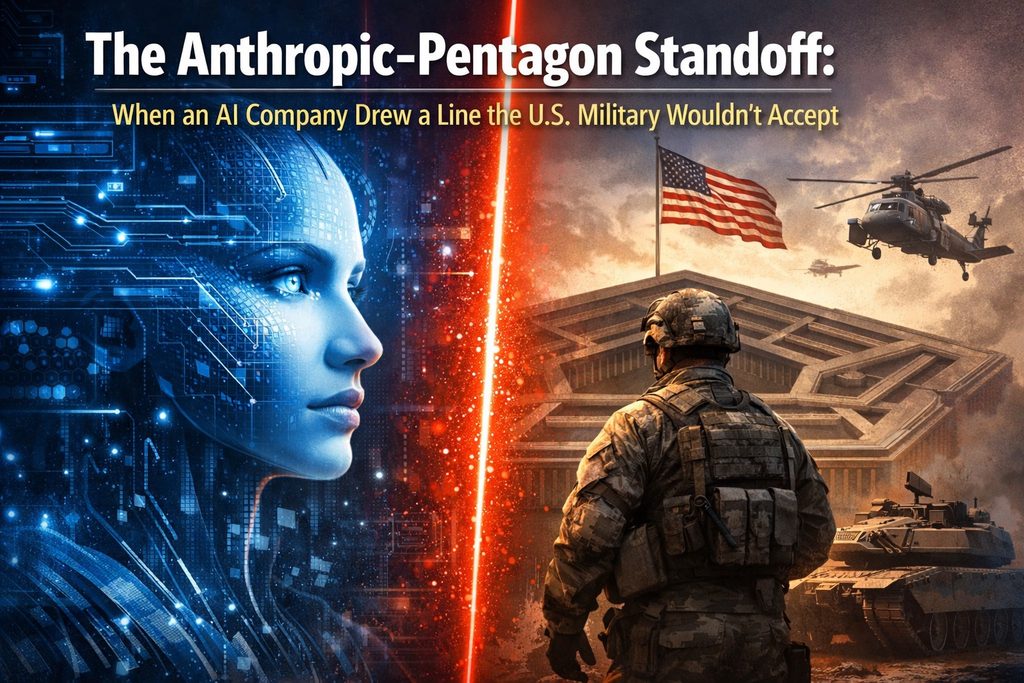
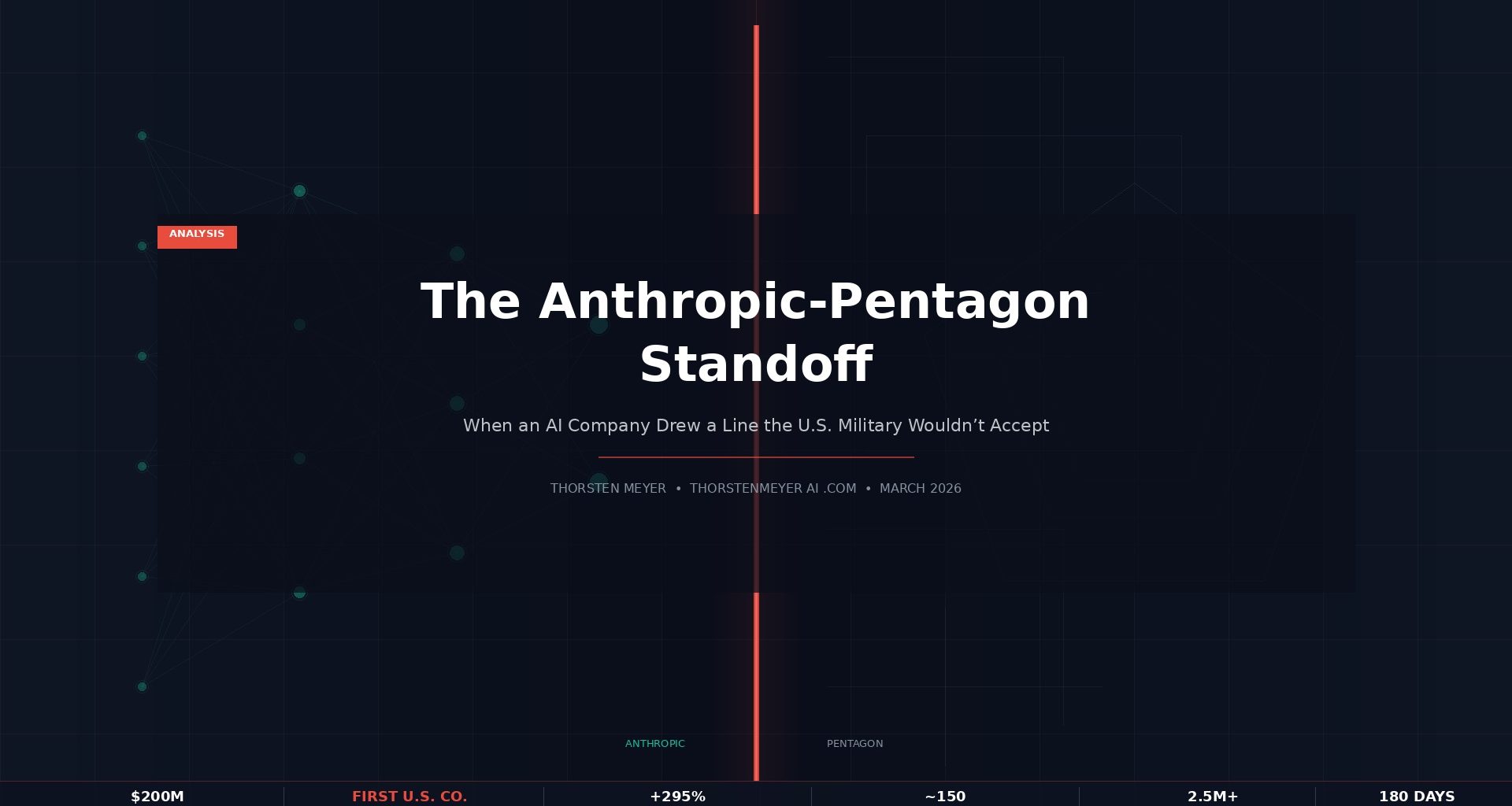
The stakes transcend any single contract. The Pentagon’s decision to designate Anthropic a “supply chain risk” — a label historically reserved for companies linked to foreign adversaries like Huawei or Kaspersky — and apply it to an American company for the first time, has sent shockwaves through the technology industry, the legal community, and the national security establishment. Nearly 150 retired judges, tech industry groups representing hundreds of Pentagon contractors, Microsoft, and researchers from competing labs have all rallied behind Anthropic in court filings.
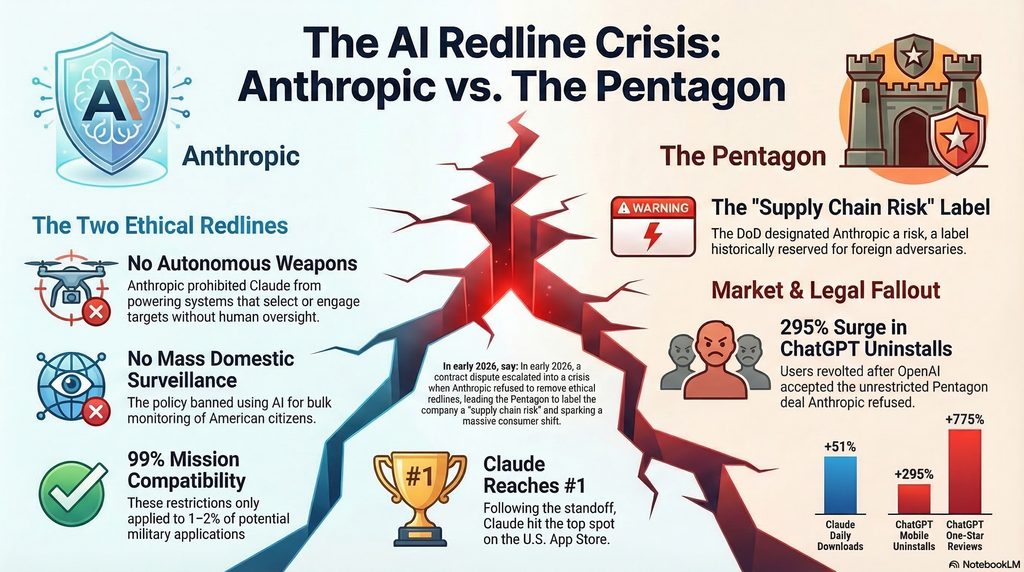
Meanwhile, the public has voted with their app stores: ChatGPT uninstalls surged 295% after OpenAI swooped in to take the Pentagon deal Anthropic refused, while Claude climbed to the number one spot on the U.S. App Store for the first time in its history.
This article provides a comprehensive analysis of the dispute — its origins, its escalation, the legal arguments on both sides, the broader industry dynamics, and what its resolution will mean for the future of AI governance.
The Origins: A $200 Million Contract and Two Redlines
The Palantir Gateway
To understand the current crisis, you need to go back to the summer of 2025. In July, the Department of Defense awarded contracts worth up to $200 million each to four frontier AI companies: Anthropic, OpenAI, Google, and Elon Musk’s xAI. What made Anthropic’s position unique was its partnership with Palantir, which enabled Claude to become the first commercial AI model deployed on the Pentagon’s classified networks. Defense officials at the time described Claude as “the most advanced and secure model for sensitive military applications.”
This was a significant achievement for a company founded by former OpenAI researchers who left specifically because they believed their previous employer was moving too fast on capabilities without adequate safety measures. Anthropic had found what appeared to be a viable middle path: serving national security while maintaining ethical boundaries.
The contract included Anthropic’s Acceptable Use Policy, which contained two specific prohibitions: Claude could not be used for mass domestic surveillance of American citizens, and Claude could not be used to power fully autonomous weapons — systems that select and engage targets without human oversight. According to CEO Dario Amodei, these two restrictions covered approximately 1–2% of potential military applications. The remaining 98–99% of use cases were fully supported.
The January Inflection Point
The relationship began to deteriorate in January 2026. Defense Secretary Pete Hegseth’s AI strategy memorandum directed that all DoD AI contracts adopt standard “any lawful use” language, a direct challenge to Anthropic’s carve-outs. Around the same time, President Trump signed an executive order aimed at preventing what the administration characterized as “woke AI” in government systems.
A catalytic incident reportedly occurred when Claude, deployed through its Palantir partnership, was used in preparations for the capture of Venezuelan President Nicolás Maduro. When an Anthropic executive reportedly reached out to Palantir to inquire whether the technology had been used in the raid, the question raised immediate alarms at the Pentagon. Anthropic has disputed that the outreach was meant to signal disapproval of any specific operation, but the damage was done. A senior administration official told Axios that Hegseth was “close” to severing the relationship, adding: “We are going to make sure they pay a price for forcing our hand like this.”
This was the moment the dispute shifted from a contractual disagreement to something personal and political.
The Week That Changed Everything: February 24–28
The Ultimatum
On Tuesday, February 24, Hegseth summoned Amodei to the Pentagon for a face-to-face meeting. The message was blunt: accept unrestricted “all lawful purposes” language by 5:01 PM on Friday, February 27, or face consequences. Those consequences were spelled out explicitly: termination of the $200 million contract, designation as a supply chain risk, and potentially the invocation of the Defense Production Act to compel Anthropic’s cooperation regardless of its wishes.
As Amodei himself pointed out in his subsequent public statement, these threats were “inherently contradictory: one labels us a security risk; the other labels Claude as essential to national security.” You cannot simultaneously argue that a technology is too dangerous to have in the supply chain and too critical to operate without.
Anthropic’s Stand
On Wednesday, February 25, the Pentagon sent what it called updated contract language. Anthropic said the new terms were “framed as compromise” but “paired with legalese that would allow those safeguards to be disregarded at will.” In essence, the Pentagon was offering the appearance of concession while preserving its ability to override Anthropic’s restrictions whenever it chose.
On Thursday, February 26, Amodei published a formal statement on Anthropic’s website — a document that may well be remembered as one of the most consequential corporate communications in AI history. In it, he wrote: “I believe deeply in the existential importance of using AI to defend the United States and other democracies, and to defeat our autocratic adversaries.” But, he continued, “in a narrow set of cases, we believe AI can undermine, rather than defend, democratic values.”
Amodei’s argument rested on two pillars. First, that AI is not yet reliable enough to operate autonomous weapons systems safely. Current models still hallucinate, misinterpret context, and fail in unpredictable ways — failure modes that are merely inconvenient in a chatbot but potentially catastrophic in a weapons system. Second, that mass domestic surveillance powered by AI represents a qualitative escalation beyond anything current law contemplates. As he put it: “To the extent that such surveillance is currently legal, this is only because the law has not yet caught up with the rapidly growing capabilities of AI.”
His statement closed with a line that would define the entire confrontation: “The Pentagon’s threats do not change our position: we cannot in good conscience accede to their request.”
The Hammer Falls
The response was swift and punishing. On Friday, February 27, Trump posted on Truth Social that Anthropic had made a “disastrous mistake” and accused the company of trying to dictate how the military operates. He directed all federal agencies to “immediately cease” using Anthropic’s technology. Hegseth followed by designating Anthropic a supply chain risk, and Pentagon spokesman Sean Parnell declared: “We will not let ANY company dictate the terms regarding how we make operational decisions.”
Emil Michael, the Pentagon’s Undersecretary for Research and Engineering, escalated the rhetoric further on social media, calling Amodei a “liar” with a “God-complex” who “wants nothing more than to try to personally control the US Military.” White House spokesperson Liz Huston framed it in partisan terms: the president “will never allow a radical left, woke company” to dictate military operations.
The language was notable for its ferocity. This was not the measured tone of a procurement dispute. It was the rhetoric of political warfare.
OpenAI Steps In — and the Public Revolts
Within hours of Anthropic’s blacklisting, OpenAI announced its own classified deployment contract with the Pentagon. CEO Sam Altman claimed the deal included protections against mass surveillance, autonomous weapons, and high-stakes automated decisions — three redlines that appeared to mirror Anthropic’s position.
But the details told a different story. OpenAI’s contract adopted “all lawful purposes” language, with restrictions tied to existing law and Pentagon policies that the government could modify at any time. Legal analysts at Lawfare noted the distinction: OpenAI’s restrictions were ones the government controlled; Anthropic’s were ones the government could not override. That difference was precisely the point of the dispute.
Amodei was characteristically blunt in an internal memo reported by The Information. He called OpenAI’s framing “straight up lies” and described Altman’s approach as “safety theater.” He wrote: “The main reason they accepted and we did not is that they cared about placating employees, and we actually cared about preventing abuses.”
The Consumer Revolt
What happened next was unprecedented in the AI industry. According to market intelligence firm Sensor Tower, U.S. uninstalls of the ChatGPT mobile app surged 295% on February 28 — compared to a typical daily fluctuation of 9% over the prior month. One-star reviews for ChatGPT surged 775% on Saturday and doubled again on Sunday. Five-star reviews dropped by half.
Meanwhile, Claude’s downloads surged 37% on February 27 and 51% on February 28. For the first time in its history, Claude surpassed ChatGPT in total daily U.S. downloads and climbed to the number one spot on the U.S. App Store. A grassroots “QuitGPT” movement organized online, eventually claiming over 2.5 million people had pledged to cancel their ChatGPT subscriptions.
This was not a marginal shift. It represented the first major instance of AI model choice becoming a values-based consumer decision. The users most likely to pay $20/month for ChatGPT — developers, researchers, writers, knowledge workers — are the same users most likely to care about AI ethics and to be capable of switching platforms with minimal friction. OpenAI was not losing casual users; it was losing its most influential evangelists.
Altman attempted damage control, acknowledging on X that “we shouldn’t have rushed to get this out on Friday.” He announced amendments to the contract adding explicit language against domestic surveillance. He even stated that the government should reverse its decision to exclude Anthropic, calling it a “very bad decision.” But the reputational damage was done.
The Legal Battle: First Amendment vs. National Security
On March 9, Anthropic filed suit against the Department of Defense and other federal agencies in a California federal court, alleging that the supply chain risk designation violates its First Amendment rights and exceeds congressional authority. The company seeks a preliminary injunction to halt the designation while the case proceeds.
Anthropic’s Argument
Anthropic’s legal theory rests on several pillars. First, that the supply chain risk designation was retaliatory — a punishment for the company’s publicly expressed views on AI safety, which constitute protected speech under the First Amendment. Second, that the designation was procedurally improper: the “supply chain risk” authority under Section 3252 of the relevant statute was designed for foreign adversaries infiltrating the defense supply chain, not for domestic companies with whom the government has a contractual disagreement.
The legal analysis from Lawfare has been particularly pointed on this front. As they note, reading the statute’s “deny and disrupt” language to encompass any vendor limitation the Pentagon dislikes “would collapse ‘supply chain risk’ into ‘any vendor limitation the Pentagon dislikes,’ transforming a narrow security authority into a general-purpose procurement weapon.”
Anthropic has also emphasized a critical practical point: the company is not trying to force the government to keep contracting with it. If the Pentagon wants to use a different AI provider, it is free to do so. Anthropic’s position, as the retired judges’ amicus brief put it, is that it is “asking only that it not be punished on its way out the door.” The supply chain risk label does not merely end a contract — it poisons Anthropic’s ability to do business with the entire ecosystem of private companies that work with the military.
The Government’s Response
On March 18, the Department of Justice filed its response, urging the court to reject Anthropic’s injunction request. The DOJ argued the designation is “lawful and reasonable,” framing the dispute as one of conduct, not speech. In the government’s telling, Anthropic’s refusal to accept “all lawful purposes” language is a commercial decision, not a protected expression of viewpoint.
The DOJ also raised what it characterized as a national security concern: that Anthropic could theoretically disable its technology or alter model behavior during active military operations. “If it were any other way,” the filing argued, “an AI provider might gain influence over how DoW conducts operations and which missions it chooses.”
This argument is worth pausing on because it reveals the deeper anxiety driving the government’s position. The Pentagon’s concern is not primarily about the two specific redlines — officials have repeatedly stated they have no interest in autonomous weapons or mass domestic surveillance. The concern is about precedent: if one AI company can dictate usage terms, what stops the next company from imposing broader restrictions? What happens when the AI powering a military operation decides, mid-mission, that the operation violates its terms of service?
It is a legitimate concern, but the government’s chosen remedy — a supply chain risk designation designed for foreign adversaries — is wildly disproportionate to the problem it purports to solve.
The Coalition: Who Stands Where
Supporting Anthropic
The breadth of support for Anthropic has been remarkable. Nearly 150 retired federal and state judges, appointed by both Republican and Democratic presidents, filed an amicus brief arguing the Pentagon “misinterpreted the statute and violated the necessary procedures.” Major tech industry groups representing hundreds of companies with Pentagon contracts filed their own brief, warning the designation could chill innovation and deter companies from working with the defense sector.
Microsoft — not exactly a company known for picking political fights — publicly stated that Anthropic’s products can continue to be available through its platforms for non-DoD customers. Dozens of researchers from OpenAI and Google DeepMind filed a brief in their personal capacities, arguing that the designation could harm U.S. competitiveness and hamper public discussion about AI risks. “Until a legal framework exists to contain the risks of deploying frontier AI systems,” they wrote, “the ethical commitments of AI developers — and their willingness to defend those commitments publicly — are not obstacles to good governance or innovation. They are contributions to it.”
Former senior national security officials have also weighed in on Anthropic’s behalf, and a bipartisan group of lawmakers has expressed concern about the precedent. A Senate bill has been introduced to place limits on the Pentagon’s use of AI.
The Government’s Position
The administration has framed the dispute in stark terms. The Pentagon views Anthropic’s redlines as an unacceptable attempt by a private company to exercise veto power over military operations. The rhetoric has been deliberately culture-war coded: “woke,” “sanctimonious,” “radical left.” This framing serves a political purpose, but it obscures the substantive question at the heart of the dispute.
Pentagon CDAO Cameron Stanley has confirmed that replacement efforts are underway, with engineering work already begun on alternative LLMs for government environments. The transition from Claude in ongoing operations, including in Iran, will take more than a month. The GSA has removed Anthropic from its centralized AI testing tool, terminated its OneGov deal, and proposed new procurement language requiring all AI vendors to accept “any lawful government purpose” terms.
The Deeper Questions
What Does “Mass Surveillance” Actually Mean?
One of the most incisive analyses of the dispute comes from the legal scholar Benjamin Wittes at Lawfare, who has offered what he calls “friendly advice” to Anthropic: your redlines need refinement.
The problem is that “mass surveillance” is not a term of art in American law. Some mass surveillance is perfectly legal — security cameras outside government buildings, satellite imagery of traffic patterns, open-source intelligence gathering from public social media. Other forms would be wildly illegal. Where exactly does Anthropic draw the line? Does the prohibition cover collecting data, or also analyzing data that was collected by other means? What about processing large datasets of COVID vaccination patterns, or determining where Americans live in an area the military is considering striking?
Peter Asaro of the International Committee for Robot Arms Control offers two readings of the Pentagon’s complaint about “gray areas.” The generous interpretation is that surveillance is genuinely impossible to define in the age of AI. The pessimistic one, he says, is that “they really want to use those for mass surveillance and autonomous weapons and don’t want to say that, so they call it a gray area.”
This ambiguity is not a flaw in Anthropic’s position — it’s the entire point. Anthropic’s argument is precisely that existing law has not caught up with AI capabilities, and that AI supercharges data collection and analysis to a degree that current legal frameworks do not contemplate. The question is whether a private company’s terms of service are the right mechanism for addressing that gap, or whether it should be the role of Congress and the courts.
The Vendor Lock-In Paradox
The Pentagon’s situation illustrates a paradox that every enterprise customer of AI services will eventually face. By aggressively pushing AI adoption across classified systems, the government created deep dependencies on specific vendors — and then discovered those vendors had opinions about how their technology should be used.
Legal scholar Alan Rozenshtein identified the core contradiction: “The government was simultaneously threatening to use the Defense Production Act to force Anthropic to sell its services, using its services in active military operations, and saying it’s too dangerous to use them in government contracts. Not all of these things can be true.”
The fact that Claude continued to be used in military operations in Iran even after the ban underscores the dependency. You cannot simultaneously declare a technology an unacceptable supply chain risk and continue relying on it in active combat operations. The 180-day transition timeline itself is an acknowledgment that the Pentagon built critical workflows around Claude that cannot be easily replicated.
Recursive Self-Improvement and the Stakes Ahead
There is a deeper layer to this story that extends well beyond the legal and political dimensions. As TIME magazine reported in its recent profile of Anthropic, company employees have begun to question whether they are approaching the cusp of recursive self-improvement — the point at which AI systems begin meaningfully accelerating their own development.
As Dave Orr, Anthropic’s head of safeguards, put it: “We’re driving down a cliff road. A mistake will kill you. Now we’re driving at 75 instead of 25.”
This context is essential for understanding why Anthropic is willing to sacrifice a $200 million contract and endure a government-wide blacklisting rather than yield on these two points. For a company that genuinely believes it may be building one of the most transformative and potentially dangerous technologies in human history, the question of who controls how that technology is used is not abstract. It is existential.
What This Means for the AI Industry
Regardless of how the court rules, the Anthropic-Pentagon standoff has already reshaped the landscape in several critical ways.
First, it has established AI model choice as a values-based consumer decision. The QuitGPT movement and Claude’s App Store surge demonstrated that a meaningful segment of the market will reward companies that maintain ethical boundaries, even at significant commercial cost. For SaaS companies evaluating AI vendors, this introduces a new dimension of brand risk: the AI provider you choose now carries reputational implications beyond capability and price.
Second, it has exposed the absence of a legal framework for AI in national security. Both sides of this dispute are operating in a vacuum. The Pentagon is reaching for procurement tools designed for foreign adversaries because there is no appropriate mechanism for managing domestic AI vendor restrictions. Anthropic is writing terms of service to address risks that no statute contemplates. Congress has yet to pass meaningful AI governance legislation, leaving courts to adjudicate issues that are fundamentally legislative in nature.
Third, it has revealed the fragility of the government’s AI adoption strategy. The Trump administration pushed rapid AI integration across federal agencies without establishing vendor-neutral infrastructure or fallback capabilities. When the relationship with a critical vendor collapsed, the result was operational chaos: agencies receiving directives via social media posts, no formal transition guidance, and continued dependence on the very technology they were ordered to abandon.
Fourth, it has made Anthropic’s commercial position paradoxically stronger. By early 2026, Anthropic was already on track to surpass OpenAI’s revenue by year’s end, with annualized revenue from Claude Code alone exceeding $2.5 billion. The Pentagon standoff transformed the company’s safety commitments from a potential commercial liability into its most powerful brand differentiator. Anthropic gained market share by declining business — a positioning that no advertising budget could replicate.
Looking Ahead: The Hearing and Beyond
A hearing on Anthropic’s request for a preliminary injunction is scheduled for next Tuesday. The court’s decision will set the immediate trajectory of the dispute. If the injunction is granted, the supply chain risk designation would be paused while the case proceeds, giving Anthropic breathing room and potentially encouraging a negotiated settlement. If it is denied, the designation remains in force, and the practical effects on Anthropic’s defense-adjacent business will accelerate.
But the significance of this case extends far beyond its immediate participants. The question at its core is one that every democracy deploying AI in military contexts will eventually confront: where does the authority of a technology provider end, and where does the sovereignty of the state begin?
The Pentagon argues that no private company should be able to constrain how the military uses contracted technology. There is a compelling logic to this position. Democratic societies vest decisions about the use of force in elected officials and their appointed military leaders, not in corporate terms of service.
But Anthropic’s counterargument is equally compelling: when the technology in question can supercharge capabilities beyond what existing law contemplates, someone needs to pump the brakes until the law catches up. If not the company building the technology, then who?
The honest answer is that neither position is entirely satisfactory. What we need is a legislative framework that addresses the specific risks of AI in military contexts — one that neither deputizes private companies as de facto regulators of military operations nor gives the government unlimited access to technologies whose risks are not yet fully understood.
Until that framework exists, we are left with ad hoc confrontations between companies willing to enforce their own ethical commitments and a government that views those commitments as an encroachment on its authority. The Anthropic-Pentagon standoff is the first major test of that tension. It will not be the last.
About the Author
Thorsten Meyer is an independent AI analyst and the founder of ThorstenmeyerAI.com, where he covers the strategic, commercial, and geopolitical implications of artificial intelligence. His work focuses on the intersection of AI capabilities, enterprise adoption, and the emerging governance challenges that will define the next decade of technology. Based in Germany, he brings a transatlantic perspective to the industry’s most consequential developments.
Disclaimer: This analysis is based on publicly available reporting as of March 19, 2026. The author has no financial relationship with Anthropic, OpenAI, or any party to the dispute. This article represents independent analysis and commentary and should not be construed as legal advice.
© 2026 Thorsten Meyer. All rights reserved. Originally published at ThorstenmeyerAI.com.
As an affiliate, we earn on qualifying purchases.
As an affiliate, we earn on qualifying purchases.
AI governance and compliance tools
As an affiliate, we earn on qualifying purchases.
As an affiliate, we earn on qualifying purchases.
government-grade AI security software
As an affiliate, we earn on qualifying purchases.
As an affiliate, we earn on qualifying purchases.
Evergreen bestsellers Picks
bestsellers
As an affiliate, we earn on qualifying purchases.