TL;DR

Get business pricing on tech for your team
- Business-only prices and quantity discounts
- Tax-exempt purchasing
- Multiple users, one account, clear invoices
Mistral emphasizes sovereignty, open weights, and local deployment to stand out in Europe’s AI scene. Whether this strategy is a true advantage or a sign of falling behind US and Chinese giants depends on your view of control, performance, and infrastructure.
When you hear about Mistral, it’s easy to assume a typical AI startup chasing the latest large model. But the company’s real punch isn’t just in its models. It’s in its bold claim: building a sovereign AI ecosystem. That’s a game that’s less about raw power and more about control—over data, infrastructure, and regulatory compliance.
At the recent AI Now Summit in Paris, Mistral’s stance became clear: it’s not just competing in the AI race; it’s trying to reshape the rules. But is this a smart strategy, or a sign that Europe has already fallen behind in the world of frontier AI? We’ll unpack what Mistral said, what critics argue, and whether sovereignty is truly a moat or just a political slogan.
Different game, or already lost?
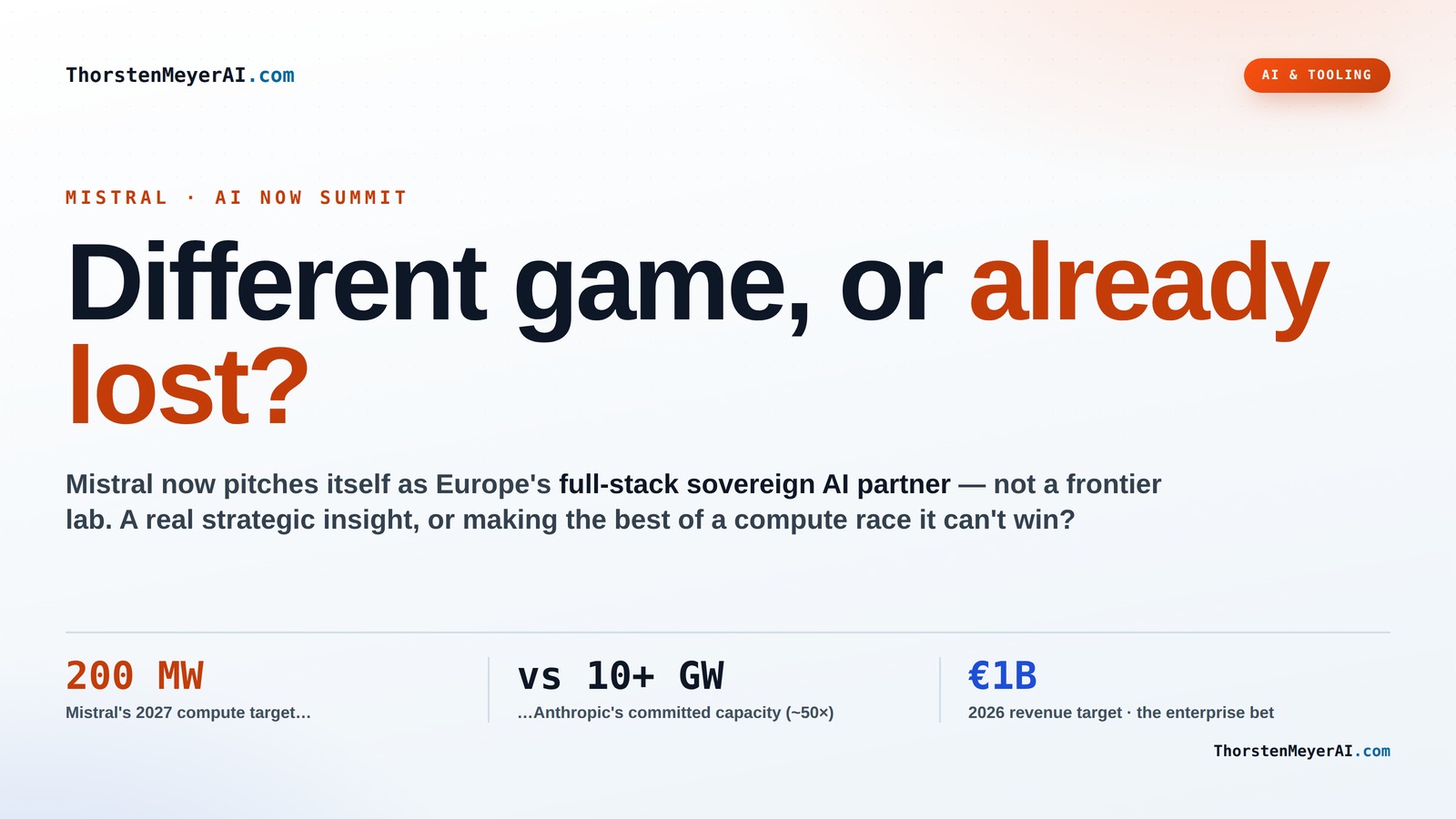
Mistral now pitches itself as Europe’s full-stack AI provider — compute, models, platform, consultancy — not a frontier-model lab. Is that a real strategic insight, or making the best of a race it can’t win? Both readings fit the same facts.
From model lab to full-stack provider
The clearest signal from the summit wasn’t a model — it was a posture. Heavy on enterprise logos and partnerships (ASML, BNP Paribas, Alexa+), light on new-model announcements. That absence is exactly what skeptics seized on.
Compute
40MW Paris DC + Sweden build · 200MW target by 2027
Models
Open & custom · efficient · you own and run them
Platform
Forge for custom models · Vibe for Work agent
Consultancy
Sales teams, integrators, EU provenance & support
Small & focused, or large & general?
Mistral bets on specialized small models. The claim isn’t that they win a reasoning leaderboard — they don’t. It’s that on the metrics that matter in production agent systems, a purpose-built small model wins. Flip the metric to see the case reverse.
Small specialized vs large general — by what you measure
In token-heavy agentic apps making hundreds of calls, speed/energy/cost compound. Toggle the metric.
Narrow models doing real work
Each is one model doing one thing efficiently — the tangible version of the strategy. Strong on their own terms; the open question is whether the bundle beats a free Chinese open-weight download.
On-prem KYC compliance
Mistral models run inside the bank’s walls for know-your-customer checks. Sensitive financial data never leaves. (BNP was Mistral’s first customer, 2023.)
Voxtral multilingual voice
A focused voice model powering Alexa+ across Europe — speed and efficiency over raw size.
Robostral industrial robotics
Plus a “physics AI” push (via the Emmi acquisition) into aerospace, automotive & semiconductor design and simulation.
Document AI / OCR at scale
Large-scale text extraction — the unglamorous, high-volume enterprise work small models excel at.
The strategy is downstream of the compute gap
Once you see the raw numbers, “why is Mistral behind?” answers itself — and the specialized-small-model strategy starts looking partly like a smart adaptation to a binding constraint, not a pure philosophical choice.
Compute & capital · Mistral vs a frontier leader, this same week
Not a knock — it’s the constraint that forces the efficiency-first, sovereignty-wedge strategy. Adapting intelligently to your position is what good strategy is.
“I want them to win, but I’m worried”
That ambivalence is the most accurate read of where Mistral sits. The enterprise pivot gets read two opposite ways — and both deserve airing.
On-prem, real sales teams, the Koyeb deployment acquisition, EU provenance — exactly what regulated enterprises want, and stickier than consumer mindshare. Targeting €1B revenue in 2026 with 1,000 staff, up from 15 people and one customer in 2023. US closed-API labs structurally can’t match the sovereignty axis.
“Software consultancy with a data center,” not a foundation-model moat. Enterprise B2B is where European startups go when they can’t win consumer or world-scale SaaS. Why pay Mistral on-prem when you could run Qwen free? One paying Le Chat Pro user said the quality gap with frontier labs is now hard to ignore.
Key Takeaways
- Mistral’s sovereignty strategy hinges on full control of infrastructure, data, and models, appealing to regulation-heavy industries.
- Open weights give Mistral a competitive edge in customization and compliance, but may not surpass free open models for cost-conscious clients.
- Small, specialized models can outperform large ones in production—speed, cost-efficiency, and control matter more than raw reasoning power in many enterprise contexts. Explore AI infrastructure.
- Europe faces a tight window—about two years—to build sovereign AI infrastructure before becoming reliant on US and Chinese giants. Discover more about AI infrastructure development.
- Ultimately, sovereignty can be a strategic moat, but only if backed by rapid infrastructure development and real control over data and compute.
As an affiliate, we earn on qualifying purchases.
Why Mistral’s Sovereignty Push Is More Than Just a Buzzword
Mistral’s core pitch is simple: European companies and governments want AI they can control—on their own terms. This isn’t just about having a model; it’s about owning the entire stack: data centers, compute, models, and deployment. The company’s CEO, Arthur Mensch, calls it "transforming electrons into tokens and intelligence."
For example, Mistral owns a 40MW data center near Paris, with plans for a €1.2 billion facility in Sweden. This infrastructure lets them promise European clients they can keep sensitive data within national borders, complying with strict regulations. Think of BNP Paribas running Mistral models on-prem for compliance—no data leaves the bank’s firewalls.
But here’s the kicker: sovereignty means more than just local hosting. It’s about legal control, physical infrastructure, and the ability to switch providers or tweak models without relying on US cloud giants. This makes Mistral’s full-stack approach appealing to regulators and enterprises eager for independence.
As an affiliate, we earn on qualifying purchases.
Is Open-Weight the Secret Weapon or Just a Niche Play?
Mistral’s open weights are a big part of its appeal. Learn more about AI solutions. Unlike OpenAI or Anthropic, which lock models behind APIs, Mistral offers models you can download, fine-tune, and run yourself. This means more control, less dependence on external APIs, and the ability to keep data in-house.
For example, BNP Paribas uses Mistral’s models on-prem for sensitive financial tasks, keeping customer data inside the bank. Abanca, a Spanish bank, orchestrates models across its apps, ensuring data never leaves its secure environment.
But here’s the question: why pay Mistral when open weights like Qwen are free? The answer lies in the support, European provenance, and the ability to customize and tune models for specific needs. Still, skeptics argue that if your goal is just local deployment, open weights may already be enough—so Mistral’s premium pricing depends on how much you value sovereignty over raw performance.

As an affiliate, we earn on qualifying purchases.
Small, Fast, Focused Models: Mistral’s Secret Weapon?
Mistral argues that smaller, purpose-built models outperform giant general-purpose models in production environments. They’re faster, cheaper, and more energy-efficient—crucial traits for enterprise and industrial use cases.
Think of Mistral’s Voxtral for multilingual voice used in Europe’s Alexa+ or Robostral for industrial robotics at ASML. Each is a narrow model optimized for a specific task, not a behemoth designed for every conceivable situation.
This focus on specialized models reflects a broader debate: should AI companies build massive reasoning engines, or aim for lean, efficient tools tailored for specific workflows? Mistral’s strategy leans toward the latter, claiming it offers better performance and control in real-world applications.
But can small models scale? That’s the big question. While they excel at specific tasks, they might struggle to match the reasoning power of the giants like GPT-4, which could limit their long-term dominance.

As an affiliate, we earn on qualifying purchases.
Europe’s Time Window: Is Mistral Playing a Strategic or Political Game?
Arthur Mensch warned that Europe has roughly two years to build its AI infrastructure before becoming dependent on US or Chinese firms. This timeframe isn’t just a prediction; it’s a call to action.
European countries are pouring resources into sovereignty initiatives—Groupe Caisse des Dépôts, for example, is investing in GPU infrastructure to support local AI development.
But the challenge is enormous. Building a full-stack, sovereign AI ecosystem requires not just models, but also data centers, energy supply, and a skilled workforce. It’s a political and technical race against giants who already control most of the world's AI infrastructure.
So, is Mistral’s focus on sovereignty a strategic masterstroke or a political posture? The answer hinges on whether Europe can mobilize its resources fast enough and whether sovereignty is a real moat or just a political flag.

Is Mistral Winning or Just Playing a Different Game?
The big question: is Mistral’s focus on sovereignty and small models a sign of strategic insight or a retreat from the AI frontier? Read more on AI sovereignty strategies. The truth is probably a mix of both.
They’re betting that in regulated industries, control over data and infrastructure outweighs raw model performance. That’s a smart move if your goal is to serve governments and financial institutions that prize compliance over cutting-edge reasoning.
But critics argue that if the real AI race is about scaling, reasoning, and platform dominance, then Mistral’s niche might be a fallback—an industry-specific, European-oriented play rather than a global disruptor.
In the end, it’s a question of whether sovereignty becomes a durable advantage or just a political band-aid in the face of relentless global AI scaling.
Frequently Asked Questions
What does “sovereign” mean in Mistral’s context?
In Mistral’s terms, sovereignty means providing AI models and infrastructure that European companies and governments can run locally, without relying on US cloud giants. It’s about control over data, models, and deployment—keeping everything within national or regional borders to meet regulatory and strategic needs.
Is Mistral open source or just open weights?
Mistral offers open weights, meaning clients can download and run models themselves. They’re not fully open-source, but they provide enough transparency for enterprises to customize and deploy models in-house, supporting sovereignty and control.
Why do governments care so much about AI sovereignty?
Governments worry about losing control over the data and infrastructure that underpin critical systems. Sovereign AI ensures that sensitive data stays within legal jurisdictions, and that the country or region isn’t dependent on foreign tech giants for essential services or national security.
Can Mistral compete on model quality with US giants?
It’s unlikely that Mistral’s current models match the reasoning and scale of GPT-4 or PaLM. Their advantage lies in control, customization, and deployment options—especially for regulated industries—rather than pure performance on reasoning benchmarks.
Is Europe really at risk of dependence on US AI infrastructure?
Yes, according to industry insiders and Mistral’s CEO, Europe has about two years to develop its own AI infrastructure before becoming heavily reliant on US or Chinese systems. This urgency drives the push for sovereign, local AI ecosystems.
Conclusion
Is Mistral truly playing a different game, or is it just a side bet while the real race is already lost? Its focus on sovereignty, control, and small models makes sense for Europe’s regulated industries. But whether this approach can outpace giants or just slow the inevitable dependence remains uncertain.
For now, it’s a game of control—over data, infrastructure, and legal boundaries. Europe’s window is closing fast. The question is whether Mistral’s bet on sovereignty will turn into a lasting advantage or just a political shield in a rapidly scaling AI universe.

Halloween Picks
halloween
As an affiliate, we earn on qualifying purchases.