
Most satellite imagery has a weakness it rarely advertises: it needs daylight and a clear sky. Optical satellites take beautiful pictures right up until there’s cloud cover, or it’s night, or there’s smoke — which is, inconveniently, exactly when you most want to see what’s happening. The world doesn’t pause for good weather.
Synthetic-aperture radar doesn’t have that problem. SAR is radar, not a camera: it illuminates the surface with its own microwave signal and reads the return, which means it sees through cloud and works in total darkness. The trade is that a SAR image isn’t a photo — it’s a map of how things scatter radar — so the hard part isn’t capturing it, it’s interpreting it. That interpretation gap is the opening, and it’s where VigilSAR lives.
VigilSAR is a SAR-based intelligence, surveillance, and reconnaissance platform that detects and classifies objects in radar imagery and fuses them with other public signals — vessel and aircraft transponders (AIS and ADS-B) and open-source information — to build wide-area awareness. Its single most legible idea is also its most legitimate one: the object that the radar sees but no transponder is reporting. A ship that shows up on SAR with its AIS switched off is, by definition, interesting — and finding it is the heart of maritime domain awareness.
Two honesty notes belong up front, because this is a defense product and precision matters. First, what’s proven versus what’s positioning. The demonstrable foundation is built on Sentinel-1 / Copernicus — the European Space Agency’s free, public SAR data — which anyone can build on and which makes the core capability real and checkable. The platform’s reach across commercial constellations and its air-gapped deployment are best understood as positioning and roadmap rather than independently demonstrated, contracted capability. Second, there’s no public pricing — VigilSAR goes to market through a “Request Briefing” conversation, not a self-serve plan, which is normal for defense and worth stating plainly. It sits in the Defense / Intel family, and everything here is commentary on a product’s public positioning, not verification of it.
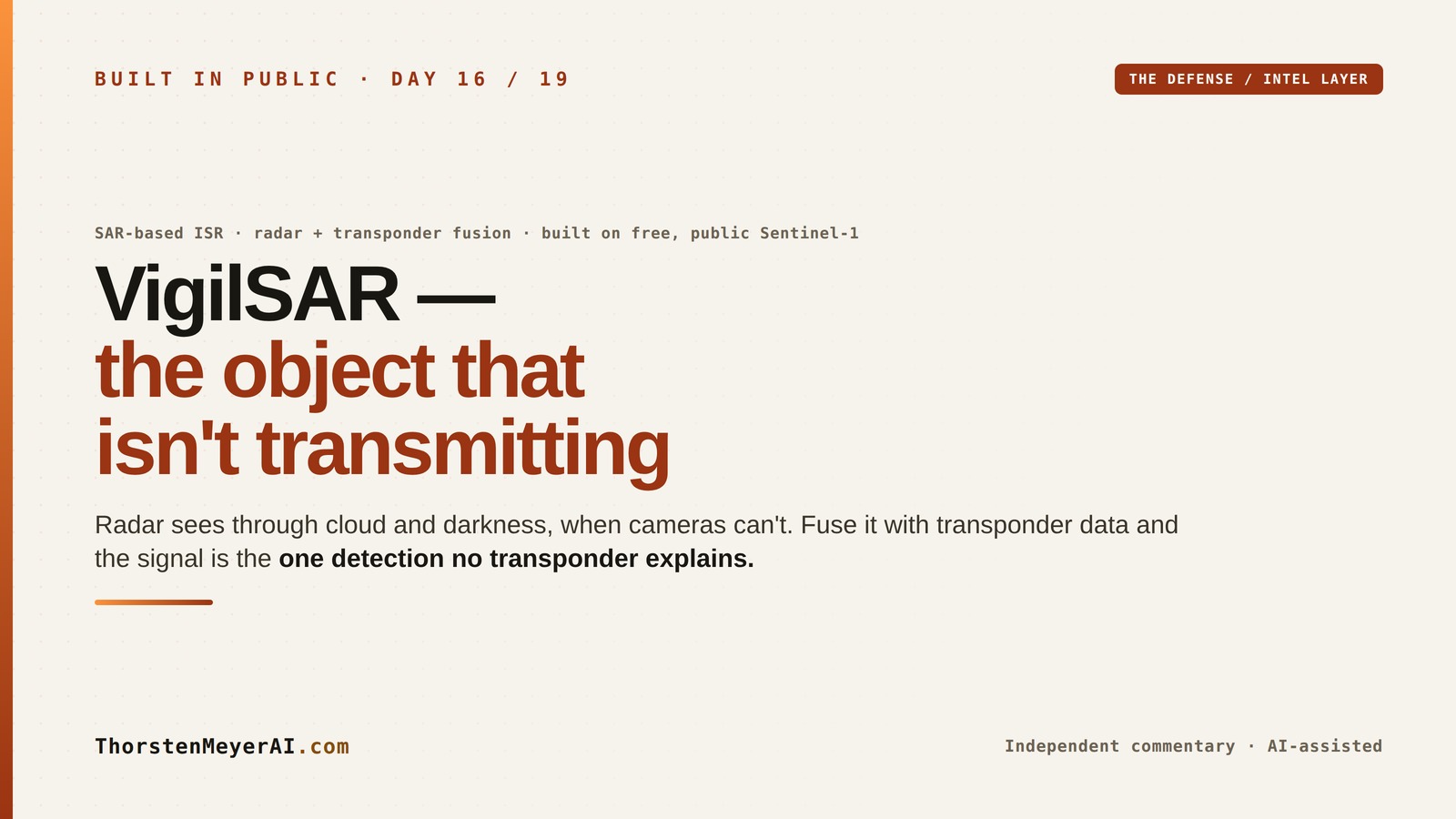
VigilSAR — the object that isn’t transmitting
Radar sees through cloud and darkness, when cameras can’t. Fuse it with transponder data and the signal is the one detection no transponder explains.
Independent commentary on public positioning, produced with AI assistance under human editorial oversight. The views are the author’s own and may change. This does not verify or endorse VigilSAR’s capabilities, contracts, or performance. Capabilities on Sentinel-1 / Copernicus reflect a free, public data foundation; commercial-constellation and air-gapped-deployment references reflect stated positioning, not independently demonstrated fact. ISR and related technologies may be subject to export controls and dual-use regulations — lawful, ethical use is solely the operator’s responsibility. Nothing here is an offer, pricing, or operational/safety/legal advice. AI detection and classification can err and require human verification. Product and company names are trademarks of their respective owners; mention does not imply endorsement.
Radar sees what cameras can’t
Start with why SAR matters, because it’s the whole premise. An optical satellite is a camera in space: it’s wonderful in clear daylight and useless under cloud or at night. For situational awareness — where the entire point is to know what’s happening now, regardless of conditions — that’s a crippling limitation. Weather and darkness aren’t edge cases; they’re half of all the time.
SAR flips that. Because it provides its own illumination and uses wavelengths that pass through cloud, it images the surface all-weather, day and night. For monitoring oceans, borders, infrastructure, or disaster zones, that reliability is the difference between a capability and a fair-weather demo. The cost is interpretability: a SAR return is a technical signal, not a recognizable picture, which is exactly why an AI layer that turns raw radar into “there is an object here, and it’s probably this kind” is the part that creates value.
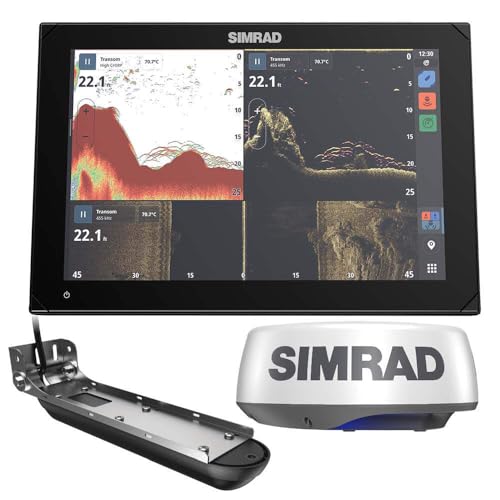
Simrad 000-15377-001, NSX 3009, Chartplotter and Fishfinder with Active Imaging 3-in-1 Transducer, HALO20+ Radar and C-MAP Discover X Charts, 9 Inch, Black
- Display Size: 9-inch high-definition IPS touchscreen
- Viewing Angles: Extreme viewing angles, polarized lens compatible
- Charting System: C-MAP Discover X with updates and support for Reveal X
As an affiliate, we earn on qualifying purchases.
As an affiliate, we earn on qualifying purchases.
The pipeline, at a high level
Conceptually — and this is well-trodden, publicly-documented territory in remote sensing, not a secret recipe — turning SAR into awareness is a two-step move. First, detection: pick out the bright, anomalous returns (a metal ship on water scatters very differently from the water around it) from the background. Second, classification: take each detection and estimate what it is. VigilSAR’s stated approach pairs a classical detection stage with a neural classifier across a set of object classes — a standard, sensible architecture rather than an exotic one.
That’s worth being honest about: the detect-then-classify pipeline is not where the moat is. These are established techniques. The defensible value, if it exists, is in the fusion and the integration — what you do once you have detections.

Sensar Marine Boat Monitor with Bilge Sentry – Smart Boat Monitoring – GPS Tracking, GeoFence & Battery Alerts. Bilge Pump Monitoring, Impact Detection, SMS & App – Know Your Boat is OK!
- Real-time Boat Monitoring: 24/7 updates via mobile app
- Comprehensive Sensor Monitoring: Bilge pump, temperature, battery, water level, impact
- Supports Multiple Systems: Battery banks and bilge pump monitoring
As an affiliate, we earn on qualifying purchases.
As an affiliate, we earn on qualifying purchases.
Fusion, and the gap that matters
This is where it gets genuinely interesting, and where the legitimate use is clearest. On its own, a SAR detection is just “something is here.” The leap is correlating it with everything else that should explain it. Most vessels broadcast AIS; most aircraft broadcast ADS-B. So you take your radar detections and you ask, for each one: is there a transponder that accounts for this?
Most of the time, yes — the radar sees a ship, AIS says it’s a named cargo vessel on a filed route, and the detection is explained and uninteresting. The value is in the residue: the detection with no transponder behind it. A vessel large enough to show on radar, broadcasting nothing, is the signal that matters — and the reasons a ship goes “dark” are exactly the reasons anyone watching the ocean cares about: illegal fishing, sanctions evasion, smuggling, or a vessel in distress that needs finding.
That’s “edit by subtraction” in radar form. Fusion’s job is to subtract everything that’s explained — every detection a transponder accounts for — so that what’s left is the small set of anomalies worth a human’s attention. The product isn’t more detections; it’s the one that doesn’t add up.
It’s worth dwelling on how civilian that core capability is, because it’s easy to assume “defense ISR” means only one thing. The dark-object problem is, at heart, a maritime-safety and rule-of-law problem. Illegal, unreported fishing depletes fisheries that whole economies depend on, and it runs precisely on going dark. Sanctions evasion and smuggling work the same way. And on the humanitarian side, a vessel in distress with a failed or disabled transponder is exactly the object you most want a radar to catch when no one is hearing its radio. The same fusion that serves a defense mission also serves coast guards, fisheries regulators, and search-and-rescue — which is why this slice of the capability is the most broadly legitimate face of the platform.
VigilSAR describes a range of mission profiles built on this foundation, spanning civil and defense uses — maritime domain awareness being the clearest civilian-adjacent one, alongside explicitly military profiles. It’s a defense platform, and it’s honest to name that rather than dress it as purely civilian.
As an affiliate, we earn on qualifying purchases.
The thesis fit
VigilSAR carries the portfolio’s spine, with a couple of principles doing real work. It’s provider-agnostic at the data layer: fusing multiple constellations rather than depending on one source is the same no-lock-in instinct applied to satellites — and the proven base being free, public Sentinel-1 is a genuinely smart, honest foundation to build from. Its local-first / air-gapped positioning — deployable in disconnected, sovereign, or sensitive environments — is the right posture for the buyers it’s aimed at, with the caveat already stated that this is positioning more than demonstrated fact. And it leans on verifiability (a verify step for deployment integrity), which is the same provenance instinct that runs through the open and regulated families.
As an affiliate, we earn on qualifying purchases.
The honest bear case
Several caveats deserve to be stated plainly. First, and most important: the positioning is ahead of the demonstrated capability. Building on free Sentinel-1 makes the core real, but multi-constellation fusion and air-gapped deployment are claims until they’re contracted and shown — and the distance between “architected for” and “delivered in production” is where defense-tech ambitions most often stall.
Second, the proven part rests on free public data. That’s a strength for honesty and a question for moat: if the foundation is data anyone can access and the detection pipeline uses standard techniques, the defensibility has to live in the integration, the fusion quality, and the trust relationships — not the inputs.
Third, defense procurement is brutal. Long cycles, certification and accreditation burdens, and an overwhelming preference for vendors with track records and scale make it one of the hardest markets for a small, independent operation to win, regardless of how good the technology is.
And fourth, the ethical weight is real. ISR is dual-use and frequently subject to export controls and defense regulations; the same fusion that finds a vessel in distress can serve harder ends. Naming that honestly — and that the responsibility for lawful, controlled use is significant — is part of taking the domain seriously rather than waving it off.
The bull case, plainly
With all of that on the table: SAR ISR is a real and growing field, and the core idea here is sound. All-weather, day-night radar awareness is genuinely more useful than fair-weather optical; fusing radar with transponder data to surface the unexplained object is a legitimate, valuable capability with clear civilian uses; building the proven base on free, public Sentinel-1 is an honest and capital-efficient foundation; and multi-source, air-gap-positioned, verifiable architecture is exactly what sovereign and defense buyers say they want.
It’s early, and the gap between its proven core and its positioning is the thing to watch. But “see through the clouds, then subtract everything that’s explained” is a clear and defensible reason for a product to exist — and the most legitimate face of it, finding the ship that’s gone dark, is a capability the world genuinely needs.
VigilSAR is a defense / ISR platform; this article is independent commentary on its public positioning and does not verify, endorse, or confirm its capabilities, contracts, or performance. Capabilities built on Sentinel-1 / Copernicus reflect a free, public data foundation; references to commercial constellations and air-gapped deployment reflect stated positioning and may not be independently demonstrated. ISR and related technologies may be subject to export controls, dual-use regulations, and other legal restrictions — lawful and ethical use is solely the operator’s responsibility. Nothing here is an offer, a statement of pricing, or operational, safety-critical, or legal advice. This article was produced with AI assistance under human editorial oversight; the views are the author’s own and may change. AI detection and classification can produce errors and require human verification. Product and company names are trademarks of their respective owners; mention does not imply affiliation, sponsorship, or endorsement. © 2026 Thorsten Meyer · Powered by Thorsten Meyer AI. See Imprint/Impressum and Privacy Policy.