
Most jurisdictions on this map have a single instinct. Europe reaches for rules, the Nordics catch the worker, America bets on growth, the Gulf owns the capital. Singapore’s instinct is different, and it’s revealing: engineer all of them.
There is no one Singaporean silver bullet. Instead there is a calibrated, well-funded, individually named instrument for nearly every lever — SkillsFuture for skills, Workfare for income, the Central Provident Fund for savings, the Progressive Wage Model for wages, and a National AI Strategy overseen by an AI Council chaired by the Prime Minister himself for governance. It is the response of a state that trusts its own competence more than it trusts any single idea.
The bet it leans on hardest is continuous reskilling: keep every worker perpetually upgrading so they stay ahead of the machine rather than waiting to be caught by it. Where the Nordics catch you after displacement and a basic income would pay you regardless, Singapore’s wager is that displacement can be pre-empted — if the state reskills its people relentlessly enough.
On the Matrix, the result is distinctive in its own quiet way: Singapore has no weak lever and no single dominant one. It is partial everywhere it isn’t strong, and strong on exactly two things — skills, and the capacity of the state itself.
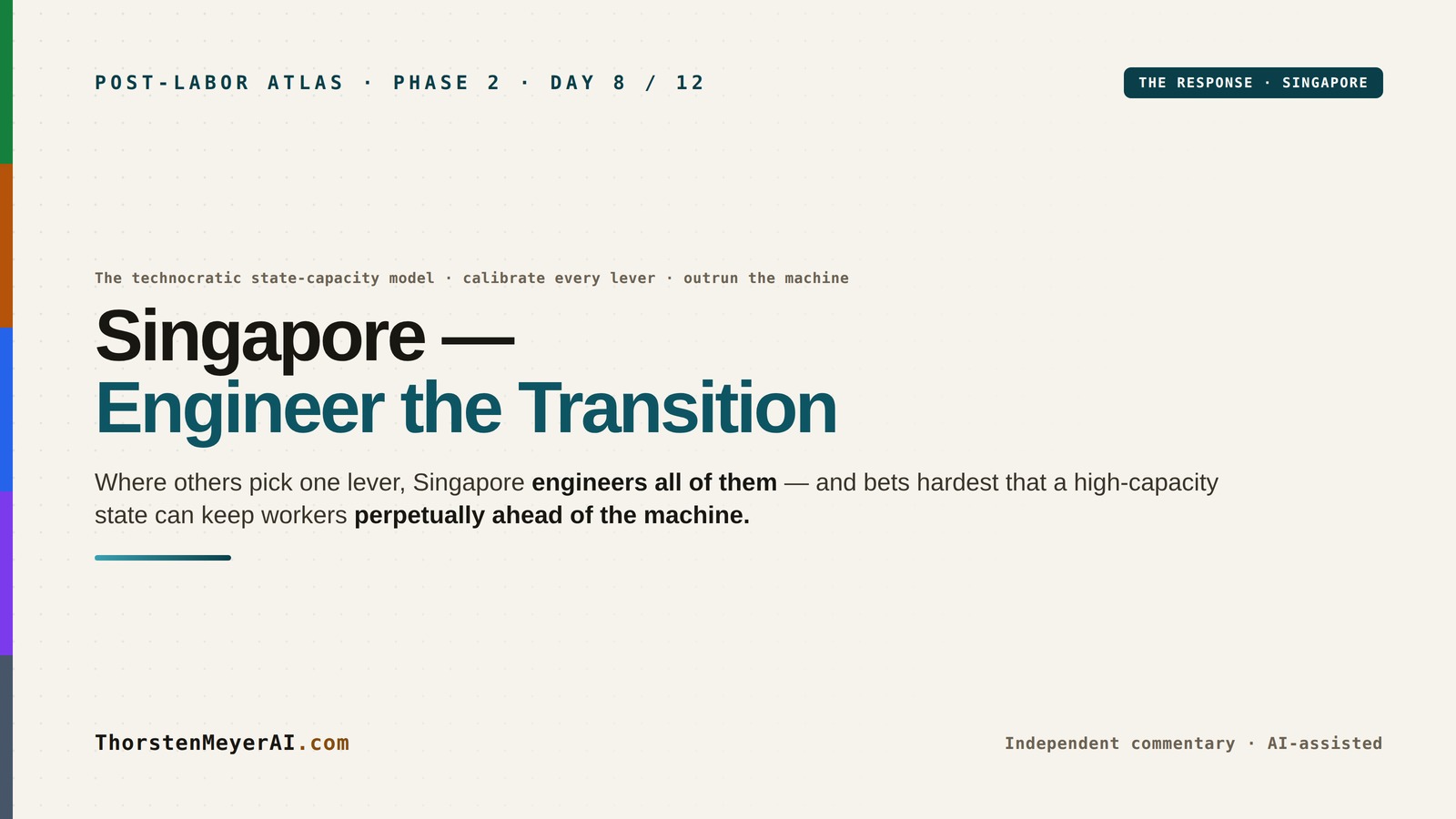
Engineer the Transition
Where others pick one lever, Singapore engineers all of them — a calibrated, well-funded instrument for each — and bets hardest that a high-capacity state can keep workers perpetually ahead of the machine.
Independent commentary, produced with AI assistance under human editorial oversight. The views are the author’s own and may change. This is analysis, not policy, economic, investment, or legal advice. Descriptions of SkillsFuture, Workfare, the CPF, the Progressive Wage Model, Singapore’s National AI Strategy and AI Council, and Temasek/GIC reflect publicly reported information as of mid-2026 and may change; figures are indicative. This phase maps differing approaches and endorses none; characterizations of contested arrangements present competing views, not a verdict. Country, program, and company names are referenced for analysis and imply no affiliation.
The model’s logic
The real Singaporean asset isn’t any one program. It’s an exceptionally capable, meritocratic, well-resourced state that can design, fund, and execute policy at a level of precision few others manage. That capacity is the meta-lever, and the rest follows from it.
Rather than gamble on one big idea, Singapore builds a specific instrument for each part of the problem and tunes it continuously. Income support runs through Workfare — a top-up that supplements the wages and retirement savings of lower-paid citizens and is explicitly designed to reward work rather than substitute for it. Wages are lifted through the Progressive Wage Model, sector-by-sector ladders that tie pay rises to skills and productivity instead of a blunt national minimum. Savings and a measure of asset ownership run through the mandatory CPF accounts every worker holds. And the whole apparatus is governed by an ethos that is anti-dependency and pro-work, pairing heavy investment in people with an insistence that support be conditional and active.
It is, in a sentence, the “govern your way through it” model — and it rests on the conviction that competent, calibrated administration beats any single grand bet.

LEARNING BUGS Phonics Songs Book, 26 Letter Sound Songs, Preschool & Kindergarten Learn to Read for 3 Year olds, Perfect Toy and Gift for Toddlers Ages 2+
- Early Education Focus: Stimulates early childhood development
- Screen-Free Learning: No moving images, focuses on sounds
- Phonics Readiness: Teaches alphabet letters and sounds
As an affiliate, we earn on qualifying purchases.
As an affiliate, we earn on qualifying purchases.
The signature: outrun the machine
The flagship is SkillsFuture, and it’s worth seeing as the staircase it’s designed to be.
Every citizen gets a SkillsFuture Credit account at 25, then years of heavily subsidised courses — up to 70% of fees for many. At 40, the Level-Up Programme adds a further $4,000 credit top-up and, crucially, a Mid-Career Training Allowance that replaces a portion of lost income — up to around $3,000 a month for full-time study, and a flat $300 a month for part-time courses from 2026 — directly attacking the biggest reason people don’t retrain: they can’t afford the time off. Career Transition Programmes run on a “train-and-place” basis, and a new, time-limited jobseeker support payment cushions the involuntarily unemployed while they search. The lower-wage worker gets the most generous version of all of it.
The logic is a staircase you never stop climbing. Don’t protect the old job, and don’t pay people to sit idle — keep moving everyone up the skill ladder faster than automation eats the rungs below. It is the most directly responsive answer on the map to how automation actually works: tasks shift, so the worker shifts with them.
And Singapore engineers the other side of the equation too. Its National AI Strategy, refreshed in 2026 and steered by an AI Council the Prime Minister chairs, pairs over a billion Singapore dollars of public AI research funding with home-grown open-source models (SEA-LION, MERaLiON), a pragmatic “AI for the Public Good” governance posture built on testing frameworks rather than heavy law, and a deliberate push to become a regional AI hub despite tiny land and strict power limits. The same state that is deploying AI across its economy is simultaneously reskilling the workers that AI will displace. It is trying to run both halves of the transition at once.
The constraints are worth dwelling on, because they’re the clearest window into the mindset. Singapore has almost no land and tight electricity limits, which ought to disqualify it as an AI-infrastructure hub — and the response was not to give up but to engineer around the limits: lifting a multi-year data-center moratorium only once efficiency standards were high enough, mandating advanced cooling, and routing much of its AI capital outward through Temasek and GIC into infrastructure it couldn’t build at home. It is the same instinct applied to the labour problem — treat a hard constraint as a design challenge, not a verdict — and it’s why “engineer the transition” is the honest description of the whole approach.

Singapore Math – Level 4A Math Practice Workbook for 5th Grade, Paperback, Ages 10–11 with Answer Key
- Supports Singapore Math curriculum: Supports Singapore Math curriculum
- Includes method introduction: Clear introduction to Singapore Math
- Teacher and parent approved: Reviewed and recommended by educators
As an affiliate, we earn on qualifying purchases.
As an affiliate, we earn on qualifying purchases.
The levers it pulls
The Singaporean row has a shape no one else’s does: nothing minimal, nothing all-consuming. Income floor: partial — Workfare and targeted top-ups, conditional and work-linked, plus the new temporary unemployment cushion; deliberately not a universal floor. Capital and ownership: partial — the CPF gives every worker an individual asset account, and the sovereign funds Temasek and GIC invest globally, with their returns helping to fund the national budget; real capital machinery, framed as reserves rather than a citizen dividend. Work and time: partial — a flexible market shaped by the Progressive Wage Model and tripartite cooperation. Skills and transition: strong — the signature. Institutions: strong — not in the rights-heavy European sense, but in the sense that matters most here: state capacity, coordination, and the ability to actually deliver.
It’s the closest thing on the map to the Nordic profile, with one philosophical difference that defines it: where the Nordics make the income floor generous and unconditional, Singapore makes it conditional and work-tied, and pours the saved conviction into skills and state capacity instead.

Facilitating Mid-Career Faculty Programs
As an affiliate, we earn on qualifying purchases.
As an affiliate, we earn on qualifying purchases.
The honest read
The competence is real and the bear case is equally real, and most of it comes down to one question: can the reskilling actually keep pace?
The deepest worry is that the race might be unwinnable. Continuous reskilling works if humans can re-skill roughly as fast as the machine acquires new capabilities. If AI accelerates faster than people can climb, the staircase turns into a treadmill that keeps speeding up — and no amount of allowance covers the gap between how fast you can learn and how fast the rungs disappear. There are early hints of friction even now: Singapore’s own training participation rate fell to its lowest level in nearly a decade, and officials openly worry about the gap between skills upgraded and jobs actually secured. World-class infrastructure still can’t force the outcome.
The second problem is replicability. This is, after the Gulf’s oil, the least exportable model on the map — because the thing that makes it work is the state itself. You cannot copy Singapore’s civil service, its city-state scale, or its decades of political continuity, and the calibrated instruments that look so impressive are downstream of a capacity most governments simply don’t have.
The third is the familiar post-labor blind spot. A model built on “work plus reskill” has no native answer for the person with no job to reskill into — the conditional, anti-dependency floor is thin for those who genuinely can’t keep up. The new temporary unemployment payment is a quiet admission of exactly this: even Singapore has concluded that pure self-reliance needs a cushion. And the state capacity that makes the model hum is bound up with a managed, dominant-party political system; the competence and the politics don’t separate cleanly, and not everyone would accept the bargain that produces the competence.
AI and automation upskilling courses
As an affiliate, we earn on qualifying purchases.
As an affiliate, we earn on qualifying purchases.
What travels
The instruments travel well. SkillsFuture is the most-studied lifelong-learning system in the world and is widely emulated; the Progressive Wage Model’s skill-linked ladders are portable; Workfare’s reward-for-work design has clear analogues elsewhere. A government can lift any of these blueprints.
What doesn’t travel is the meta-lever. The single most important lesson of the Singaporean model is that execution is a policy variable — the same instrument run by a high-capacity state and a low-capacity one produces entirely different outcomes. Singapore is the standing proof that how well you run it can matter as much as which lever you pull. That’s a profound and slightly deflating insight for everyone else on the map, because it’s the one thing you can’t simply legislate into being.
Row seven
Singapore is the engineer’s answer: not one bet but a calibrated set, executed with a competence almost no one can match, leaning hardest on the wager that relentless reskilling can keep people ahead of the machine. Of every response in this Atlas, it is the most thoroughly executed — the one where the gap between the policy on paper and the policy in practice is smallest.
Its open question is whether even flawless execution of a skills-first strategy is enough if the machine accelerates past the human capacity to re-skill — and whether the one ingredient that makes the whole thing work, state capacity itself, can ever be handed to anyone else. Row seven, and the last of the technocratic models before the map turns to the state-directed giant.
Independent commentary, produced with AI assistance under human editorial oversight; the views are the author’s own and may change. This is analysis, not policy, economic, investment, or legal advice. Descriptions of SkillsFuture and the Level-Up Programme, Workfare, the CPF, the Progressive Wage Model, Singapore’s National AI Strategy and AI Council, and Temasek/GIC reflect publicly reported information as of mid-2026 and may change. Figures are indicative. This phase maps differing approaches and endorses none; characterizations of contested arrangements present competing views rather than a verdict. Country, program, and company names are referenced for analysis and imply no affiliation. © 2026 Thorsten Meyer · Powered by Thorsten Meyer AI. See Imprint/Impressum and Privacy Policy.