For eight days this series has been about two things: making stuff and deciding stuff. The content machine produces; the decision layer chooses what’s worth producing. Both are visible, both are satisfying to build, and both quietly assume something that nobody talks about — that the thing they’re producing for is still standing.
Listen free for 30 days with Audible
Thousands of audiobooks and originals — cancel anytime.
Start your free trialAs an affiliate, we earn on qualifying purchases.
Today is about that load-bearing, invisible layer: keeping the whole operation running.
When you operate a handful of sites, operations isn’t a discipline — it’s a Tuesday. You notice when something breaks. But the math changes brutally with scale. At hundreds of sites, the bottleneck stops being creation and becomes operations: monitoring, coordination, and the thousand small things that rot silently while you’re busy making the next thing. A fleet doesn’t usually die of too little content. It dies of neglect — slowly, invisibly, one unnoticed failure at a time.
Grimfaste is the publisher operations platform built for exactly that problem: one control plane for a fleet. It’s worth being upfront about two things. First, it’s a hosted product — the deliberate exception to the local-first stack that runs through the rest of this portfolio, and the only software-as-a-service in the lineup. Second, it’s a real German business — a standalone trade entity, privacy-by-design, with the legal scaffolding to match. (No pricing here; this is about what it does and why.)
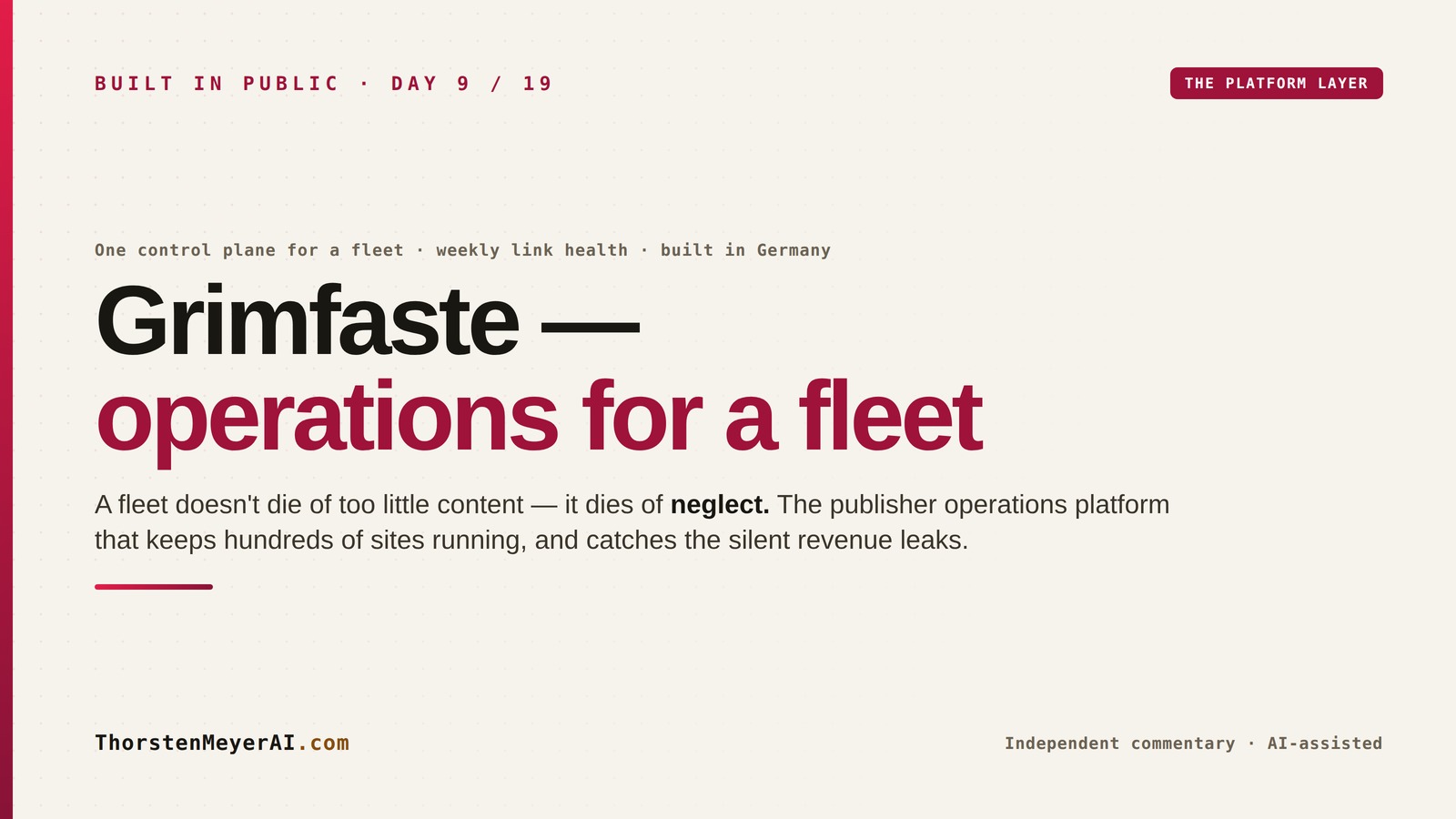
Grimfaste — operations for a fleet
A fleet doesn’t die of too little content. It dies of neglect. One control plane for hundreds of sites — and a weekly link-health sweep that catches the silent revenue leaks.
Independent commentary, produced with AI assistance under human editorial oversight. The views are the author’s own and may change. Grimfaste is a hosted software-as-a-service product; availability, features and terms are governed by its own terms of service and may change. Nothing here is an offer or a statement of pricing; see grimfaste.com for current details. Automated monitoring and link-health checks may produce errors or miss issues — operational aids, not guarantees. Product and company names are trademarks of their respective owners; mention does not imply endorsement.
The operations bottleneck
Here’s the uncomfortable arithmetic of running many sites. Each one is a small, ongoing liability: links that can break, plugins that drift, monitoring that needs doing, health that needs checking. At one site, the per-site overhead is invisible. At a hundred, the sum of all that invisible overhead is a full-time job nobody scheduled.
This is the trap that kills publishing operations long before traffic does. The content keeps flowing — the machine is good at that — but the operational debt compounds underneath it. Sites quietly degrade. Problems that would be obvious on a single property hide in the aggregate, because no human is looking at all hundred at once. By the time something is bad enough to surface on its own, it’s been bleeding for months.
The only fix that scales is to stop treating the fleet as a hundred separate things and start treating it as one thing with a dashboard. That’s what an operations platform is for: collapsing a hundred small surveillance jobs into a single pane of glass, so the fleet’s health is something you see rather than something you discover.
As an affiliate, we earn on qualifying purchases.
Link health: the silent revenue leak
If there’s one concrete, unsexy problem that captures the whole argument, it’s link health.
Affiliate links rot. Products get delisted, URLs get restructured, merchants change programs, redirects pile up, and tags silently stop tracking. Every one of those is a small hole in the bucket — a recommendation that still looks fine to a reader but no longer earns anything, or worse, sends them to a dead page. On a single site, you’d catch it. Across a large fleet, broken links are the definition of a silent revenue leak: money draining from pages you haven’t looked at in months, with nothing to alert you.
Grimfaste runs weekly link health across its paid tiers — automated checks that surface the broken, the redirected, and the quietly-dead before they bleed. That’s the kind of capability that sounds minor and is actually the difference between a fleet that compounds and one that slowly hollows out. At scale, the cheapest revenue you’ll ever find is the revenue you were already earning and didn’t notice you’d stopped.
This is “edit by subtraction” wearing work boots: not pruning ideas, but catching the dead connections in something you’ve already built, on a schedule, so nothing rots in the dark.
As an affiliate, we earn on qualifying purchases.
One control plane
Around that core, Grimfaste is the coordination surface for running the fleet as a single operation rather than a sprawl. It’s structured in tiers — from a solo operator up through a small team — so the platform fits whether you’re running your own sites or coordinating a group, with team-oriented touches like Slack integration available for collaborative setups.
The point isn’t a feature list; it’s a posture. An operations platform earns its place by turning “I hope everything’s fine” into “I can see that everything’s fine” — and by making the things that aren’t fine impossible to miss. For an operator whose competitive edge is running more, more reliably, than anyone reasonably could by hand, the control plane isn’t overhead. It’s the thing that makes the whole model possible.
There’s a second, subtler payoff to seeing the fleet as one thing: patterns become visible that no single site could ever show you. A problem that hits one site looks like bad luck. The same problem hitting forty sites in the same week is a signal — a merchant that changed its program, a plugin update that broke something everywhere, a structural shift you need to respond to now. Looking at properties one at a time, you’d never connect the dots; looking at the fleet at once, the pattern is the first thing you notice. Aggregation isn’t just convenience — at scale, it’s a different and better kind of vision.
IT infrastructure monitoring system
As an affiliate, we earn on qualifying purchases.
As an affiliate, we earn on qualifying purchases.
Built in Germany, for EU operators
Grimfaste is operated as a standalone German trade entity — deliberately separate from the rest of the publishing group — with privacy handled by design rather than as an afterthought: a real data-processing posture, a DPA, and German jurisdiction. For an EU-based publisher, that’s not boilerplate; it’s a genuine differentiator.
A lot of operations tooling is built US-first and treats GDPR as a compliance bolt-on. A platform that’s German by default — built where the rules are strictest, by an operator who has to live under them — starts from a different place. For European publishers who’d rather not route their operational data through a vendor that treats EU law as an edge case, “built in Germany, governed by German law” is a feature you can actually sell.
As an affiliate, we earn on qualifying purchases.
The honest exception
It would be dishonest to skip the obvious tension: Grimfaste is a hosted SaaS sitting inside a portfolio whose entire thesis is local-first. That’s not an oversight — it’s a deliberate line.
The local-first principle is about how the operator builds and runs their own stack: own the compute, hold the data, avoid lock-in. That’s the right call for one operator’s own machine. But Grimfaste isn’t a tool for one operator’s own machine — it’s a product meant to serve many publishers, most of whom can’t and won’t run a service on their own hardware. You can’t ship “just run it on your Mac” to a customer base. A platform that other people rely on has to be hosted, supported, and available — which makes SaaS the honest architecture for what it’s trying to be, even as it sits at odds with the principle the rest of the portfolio follows.
So Grimfaste is best understood as the operator’s hard-won operations knowledge, packaged as a product for others — which is a different job than the local-first tools, and honestly a different kind of bet.
The honest bear case
Several caveats deserve to be stated plainly. First, it’s a SaaS, and SaaS means dependency. A customer relying on Grimfaste is relying on someone else’s hosted service — the same vendor-risk calculus (availability, longevity, terms that can change) that applies to any platform applies here too. The portfolio preaches owning your stack; this is the one piece its customers don’t own.
Second, operations tooling is a crowded, unglamorous market, and “we monitor your fleet” is a claim a lot of products make. Link health is genuinely valuable, but it’s also fairly narrow — the open question for any operations platform is whether the surrounding feature set is deep enough to be a control plane rather than a single useful check.
Third, it’s closed source, which makes it less inspectable than the open products elsewhere in this lineup — a reasonable choice for a commercial SaaS, but worth naming in a portfolio that otherwise leans open.
And finally, the value scales with fleet size. For a single site, a control plane for a hundred is overkill; Grimfaste earns its keep precisely when the number of things you’re running has outgrown your ability to watch them by hand.
The bull case, plainly
With all of that on the table: operations is where fleets quietly live or die, and Grimfaste is aimed squarely at the failure mode that actually kills them — neglect at scale. It’s built by someone who runs a large fleet and therefore feels the problem personally rather than theoretically; it catches real, money-shaped problems like dead affiliate links on a schedule; and it’s built EU-first, under the strictest privacy regime, by default rather than as a patch.
It’s the least glamorous product in the series and, for anyone actually running a fleet, possibly the most necessary. Making things and deciding things are worth nothing if the thing you made falls over in the dark. Grimfaste is the layer that keeps the lights on — which is exactly why it usually only gets noticed when it’s missing.
Grimfaste is a hosted software-as-a-service product; availability, features, integrations, and terms are governed by its own terms of service and privacy policy and may change without notice. Nothing here is an offer, a commitment, or a statement of pricing; see grimfaste.com for current details. This article was produced with AI assistance and reviewed under human editorial oversight — it is independent commentary and analysis, and the views are the author’s own and may change. Automated monitoring and link-health checks may produce errors or miss issues; they are operational aids, not guarantees. Product and company names are trademarks of their respective owners; mention does not imply affiliation, sponsorship, or endorsement. © 2026 Thorsten Meyer · Powered by Thorsten Meyer AI. See Imprint/Impressum and Privacy Policy.
NFL season / tailgating Picks
team gear
As an affiliate, we earn on qualifying purchases.