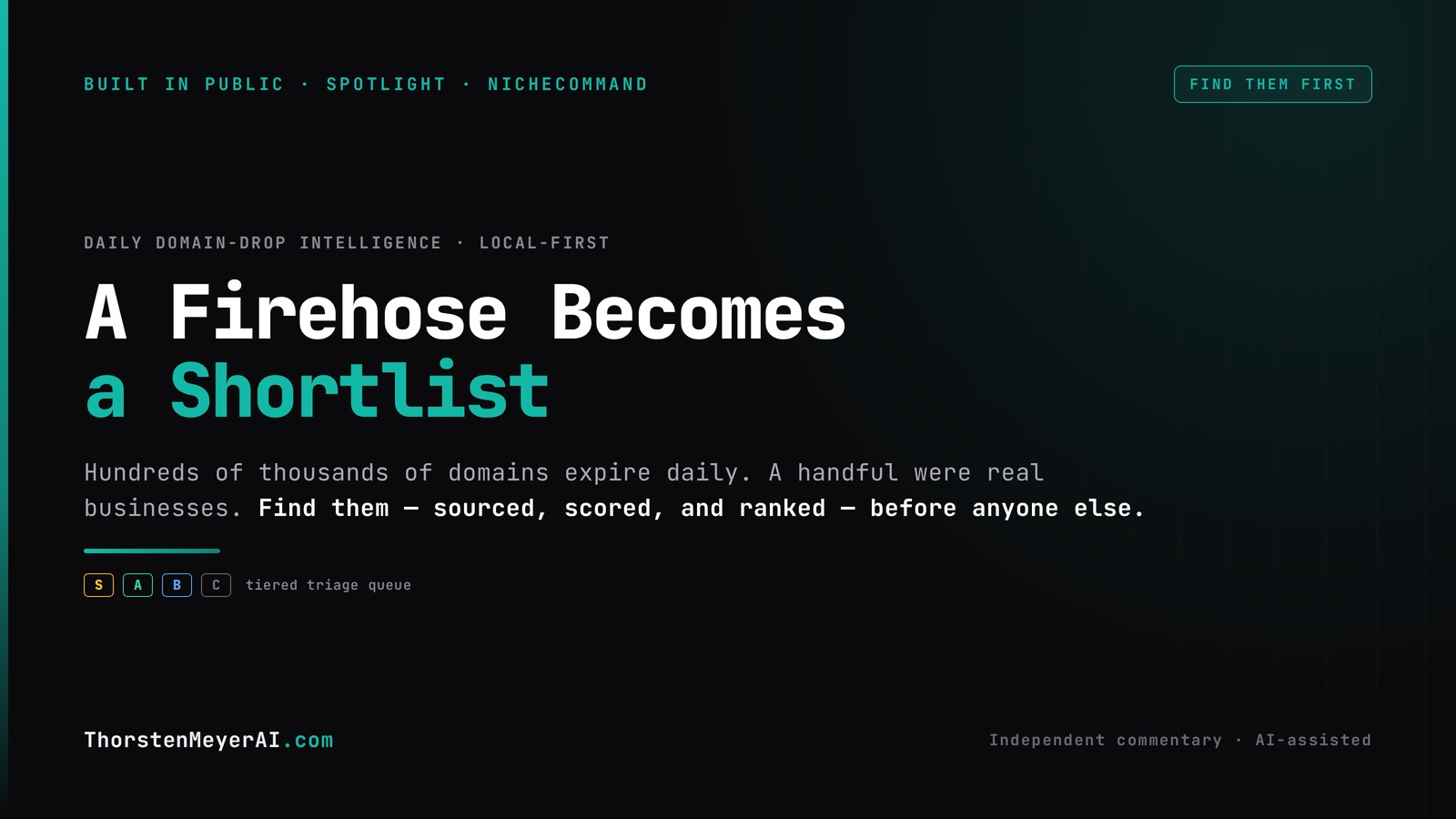

Hundreds of thousands of domains expire every single day. The overwhelming majority are junk — auto-generated names, dead spam sites, typos nobody will ever want again. But buried in that daily flood are a handful that were real businesses: aged publishers with deep history and residual backlinks, abandoned shops, brandable SaaS names quietly worth far more than the registration fee. The people who get those are simply the people who looked first.
The problem, then, was never finding domains. The drop list hands you more than you could ever read. The problem is finding the right ones, fast enough to act before someone else does — and being able to explain, later, why they were right. NicheCommand is a local-first intelligence tool built for exactly that: it ingests the day’s drop list, kills the junk with zero-cost rules, enriches the survivors with real history, classifies each into a business vertical, scores them, and hands you a tiered triage queue — with every signal sourced and every decision recorded.
A firehose becomes a shortlist.
Hundreds of thousands of domains expire every day; a handful were real businesses. NicheCommand ingests the drop list, kills the junk with zero-cost rules, enriches survivors with real history, classifies and scores each, and hands you a tiered triage queue — every signal sourced, every decision recorded.
Every signal carries its source
Each fact — snapshot counts, name analysis, keyword hits — is an append-only ledger row with source, fetch time, and a pointer to the raw evidence.
Scores that show their work
A per-component breakdown sums exactly to the 0–100 score, and every classification stores the model, prompt version, confidence, and a written rationale.
Nothing drops silently
Every run and per-domain outcome — including rejections, with reasons — is an event. If a name isn’t in your queue, the system tells you why.
A few are real businesses. Be the one who finds them first.
Independent commentary, produced with AI assistance under human editorial oversight. The views are the author’s own and may change. This describes a product’s design and stated features — not business, financial, legal, or investment advice. Acquiring expired domains carries legal, trademark, and commercial risk that is the buyer’s own responsibility to assess; filtering and scoring figures are the product’s own framing, not guarantees. The Wayback Machine, RDAP, and other names are trademarks of their respective owners; mention does not imply endorsement.
Why doing this by hand doesn’t work
It’s worth being precise about the grind NicheCommand replaces, because it’s a grind a lot of people actually attempt. You skim endless lists. You paste a few promising names into the Wayback Machine. You guess at a niche from the spelling. You hope you didn’t just scroll past the one that mattered. It doesn’t scale — there are too many names and too few hours. It isn’t repeatable — tomorrow you start from zero. And worst of all, when you do find something good, you often can’t reconstruct why it was good a week later, which means you can’t defend the decision to a partner, a buyer, or your own future self.
NicheCommand turns that brutal, lossy manual process into a disciplined pipeline. That’s the whole pitch, and everything else is a consequence of it.

The Aims Of Local Domain Names: Examples Of GEO Domains And Websites: Internet-Based Income Opportunities
As an affiliate, we earn on qualifying purchases.
As an affiliate, we earn on qualifying purchases.
The pipeline: one disciplined funnel
The flow is a funnel, and each stage exists to spend the next stage’s effort only where it’s earned: ingest the day’s drop list, prefilter with pure rules that kill roughly 95% of names at zero cost, enrich the survivors with Wayback Machine history and a live registration check, classify each into a business vertical, score it against that vertical’s weights, and drop it into a triage queue sorted into four tiers.
The tiers are the output you actually live in: S is aged authority — act today. A is strong — shortlist it. B is decent — review it when things are slow. C is recorded, ranked, and deliberately out of your way. You don’t open a list of two hundred thousand names; you open a ranked queue of the few dozen worth a human’s attention. The needle-in-a-haystack problem becomes a triage problem — and triage is something you can finish before your coffee goes cold.
The ordering of that funnel is the quiet bit of engineering discipline that makes it usable day after day. The expensive work — history lookups, model classification, availability checks — only ever runs on candidates that already cleared the cheap bar. Pure rules eliminate the bulk before a single paid or rate-limited call happens. That’s what makes the daily ritual cost minutes rather than hours and dollars: the system does the overnight sifting, and you can have the result POSTed to a webhook — Slack, Zapier, anything — so the shortlist comes to you, or simply open the command deck each morning to today’s tier counts and best finds.
As an affiliate, we earn on qualifying purchases.
Built like an intelligence platform, not a feed
This is the part that genuinely separates NicheCommand from the pile of “expired domain finder” tools, and it’s worth dwelling on because cheap signals are worthless if you can’t trust them. Nothing here is a black box.
Every signal carries its source. Each fact — snapshot counts, name analysis, keyword hits — is an append-only ledger row with where it came from, when it was fetched, and a pointer to the raw evidence. Open any domain’s dossier and you can see exactly where every number originated. Every score shows its work. A per-component breakdown sums exactly to the 0–100 score — no mystery weighting — and every classification stores the model used, the prompt version, a confidence, and a written rationale. Nothing drops silently. Every run is recorded, and every per-domain outcome, including rejections with their reasons, is an event. If a name isn’t in your queue, the system can tell you precisely why it isn’t.
The payoff is a quieter kind of value than “we found you a domain”: these are decisions you can stand behind — to a partner, to a buyer, or to yourself next month when you’ve forgotten the context. In a field full of opaque scores and vibes, an auditable trail is the actual product.
And because a great domain you can’t acquire is just a tease, every scored opportunity also gets a live RDAP registration check — free, standards-based, no API key. A green available badge means it’s genuinely there for the taking; registered means someone already re-caught it. It’s sourced and timestamped like every other signal, so you spend your energy only on the ones you can still win.

As an affiliate, we earn on qualifying purchases.
Tuned to your thesis, not a vendor’s defaults
A dropped domain is worth different things to different operators, and NicheCommand takes that seriously rather than flattening it. An aged publisher should be judged on history depth; a brandable SaaS name on name quality; a geo-service domain on balanced fundamentals. So the tool ships nine vertical playbooks — content and media, e-commerce, SaaS and tech, local services, health and wellness, finance, education, travel, and hobbies — each with its own keyword hints for classification and its own scoring weights for tiering. A finance domain leans hard on history and trust; an e-commerce name leans on brandability; a local-services domain stays balanced.
Crucially, these live in the database, not in the code. You can retune any playbook’s weights and keywords right on the verticals page — validated before save, applied on the very next run, no deploy and no code change. The rankings sharpen around the niches you actually know. And the niches view clusters your opportunities by classification with counts and average and best scores, so the high-value themes that keep recurring rise to the surface — which is exactly where a portfolio strategy lives. One great find is luck; a repeatable source of great finds is a thesis.
domain classification and scoring software
As an affiliate, we earn on qualifying purchases.
As an affiliate, we earn on qualifying purchases.
Yours: local-first, offline, agent-native
NicheCommand runs entirely on your machine, and this is where it lands squarely inside the rest of this portfolio. The default mode replays a complete recorded run with zero API keys and zero network — the same hermetic mode its thirty-test suite uses — so you can evaluate the entire product, end to end, before committing a cent or a credential. Your candidate list, your decisions, and your acquired inventory stay with you. Nothing leaks your edge to a vendor.
It’s also built to be driven by more than a human clicking a dashboard. Everything the command deck shows, an agent can fetch: a full JSON API exposes opportunities with filters, complete dossiers, and run lineage; you can run any single domain through the whole pipeline on demand with one request, and export the triage table to CSV with the same filters. Under the hood it’s a lean, local stack — a Next.js command deck, a Node and BullMQ worker handling the daily cron with bounded concurrency and rate limits on every external call, and Postgres with a typed schema shared across web, worker, and tests. The whole thing comes up in four commands and runs offline on bundled fixtures; one environment flag swaps in the live drop list, real lookups, and model-powered classification when you’re ready.
Why it belongs in the portfolio
NicheCommand is a fitting one to close on, because it’s the portfolio’s whole stance compressed into a single tool. It’s local-first to the point of running fully offline with no keys and no data leaving your machine. It’s subtraction as a core mechanic — it throws away ninety-five percent of the firehose with cheap rules to surface the few percent worth your attention, because when the input is infinite, the scarce skill is deciding what to discard. It refuses lock-in — your data, your tuning, your edge, with a heuristic fallback so it works even without a model. It’s agent-native, built to be automated as far as you want to take it. And it’s defensible, with the same insistence on provenance and shown work that runs through the decision tools elsewhere in this set.
Hundreds of thousands of domains will expire tomorrow. A few of them are real businesses. NicheCommand is a disciplined, auditable, local-first way to be the one who finds them first — and, just as importantly, the one who can still explain why a week later.
Independent commentary, produced with AI assistance under human editorial oversight; the views are the author’s own and may change. This describes a product’s design and stated features — not business, financial, legal, or investment advice, and acquiring expired domains carries legal, trademark, and commercial risks that are the buyer’s own responsibility to assess. Filtering and scoring figures are the product’s own framing rather than guarantees. Product, model, and company names — including the Wayback Machine, RDAP, and others — are trademarks of their respective owners; mention does not imply affiliation, sponsorship, or endorsement. © 2026 Thorsten Meyer · Powered by Thorsten Meyer AI. See Imprint/Impressum and Privacy Policy.