
By Thorsten Meyer
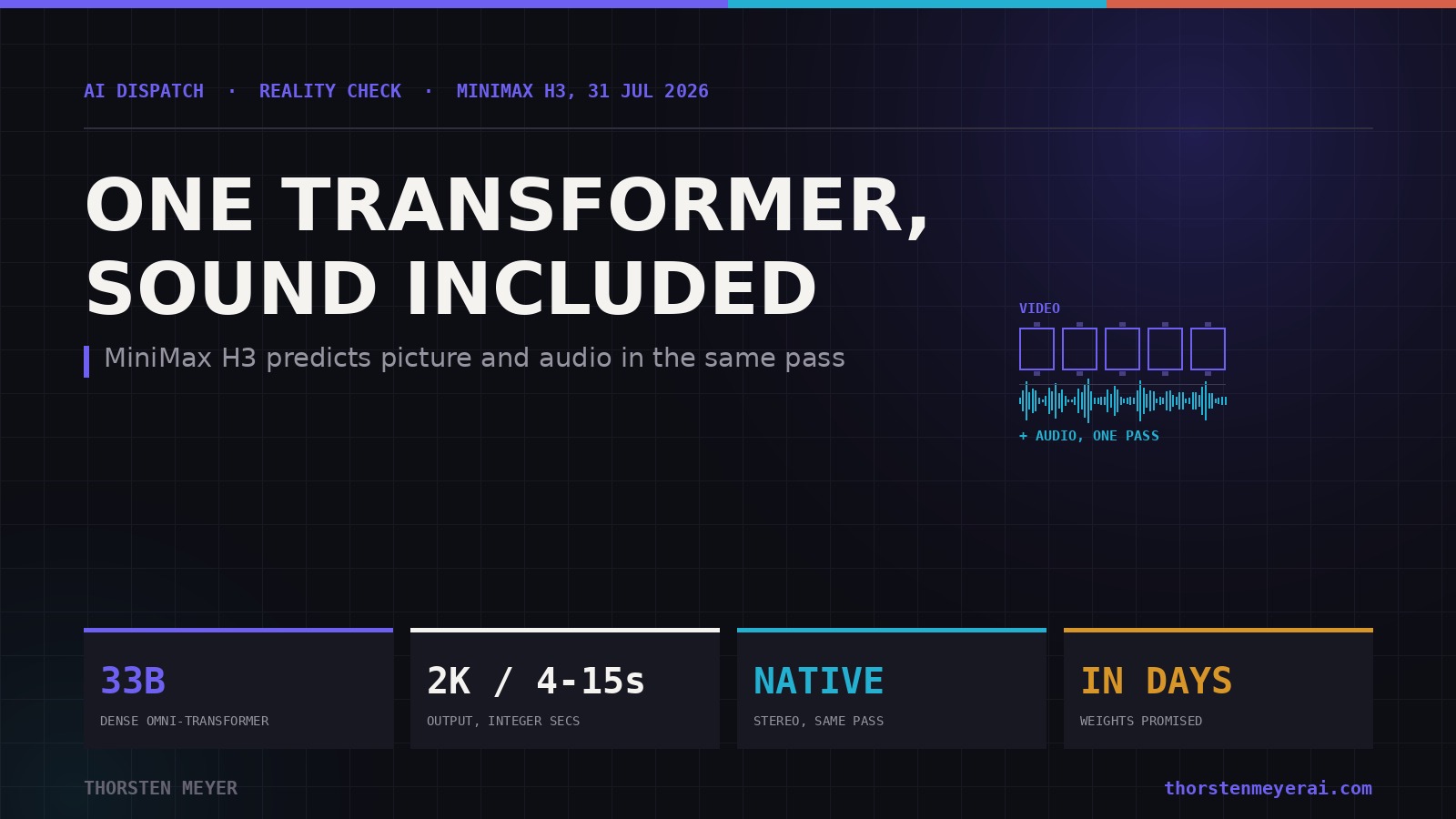
The interesting thing about MiniMax H3 is not that it makes 2K video. Plenty of models make 2K video.
The interesting thing is that the sound comes out of the same pass as the picture — dialogue, ambience, and score predicted jointly with the frames by a single network, rather than bolted on afterward by a separate speech model, a separate Foley generator, and a synchroniser praying they line up. For anyone who has built an audio lane the old way — and I have been specifying exactly that, a multi-stage sonic pipeline, for a game portfolio — this is the architectural change that matters. Everything else is downstream of it.
But the word doing the heaviest lifting in the launch coverage is “open,” and it is carrying more weight than the facts support. Keeping the architecture story and the openness story apart is the whole job here, because one of them is a genuine advance and the other is a promise with an asterisk.
MiniMax H3 predicts picture and stereo audio in the same pass, from one dense network — a cleaner answer to audio-visual coherence than the stitched pipelines it competes with. Its openness is narrower than the headlines suggest.
▲ No independent benchmarks yet · all quality claims trace to MiniMaxThe conventional way to get a scored, talking clip stitches four models and prays they align. Every seam is a place for drift. H3 predicts both latent streams jointly.
Each junction is a seam where a syllable lands a frame late or a footfall misses the step.
one dense sequence →
Jointly predicted. The model isn’t aligning two artifacts after the fact — it produces one that was audio-visual from the start.
The openness is real but heavily qualified — and the qualifications are exactly the ones a sovereignty-minded builder needs to see.
- Generates at a 768-pixel short edge
- A local render can be entirely local
- Community testing: 24GB+ VRAM to run
- Good fit for previs, animatics, draft passes
- Feeds the 768p result back through to upscale
- Stays on MiniMax’s servers
- Any delivery-grade output makes a round-trip
- DSGVO note: consider data routing for EU work
Two more catches: weights were promised “in the coming days,” not shipped — no H3 repo existed on MiniMax’s Hugging Face at launch. And the licence is custom, not OSI open source. “Open-weight base model under a custom licence” is a different thing from “open source.”
Launch coverage is conflating three near-identical labels. Trace any claim to MiniMax’s own H3 docs before trusting it.
Native single-pass audio removes an entire fragile stage from a generative-media pipeline. The catches are real and worth pricing.
- Single-pass audio kills a fragile stage — no separate speech, Foley, and sync sub-models to maintain.
- Sensible pipeline split: local 768p base for iteration, hosted 2K for finals only.
- Unified reference model folds camera, character, and audio references into natural language.
- Among the strongest open-weight video options if the base is previs-grade.
- Weights promised, not shipped. Verify the HF repo exists before planning around it.
- 2K is hosted — delivery-grade output requires a mandatory server round-trip.
- No independent benchmark — “comparable to proprietary” is untested by anyone neutral.
- Custom licence — commercial-use rights unanswered until the file is public.
The word “open” needs the asterisk every time.
What actually shipped, on 31 July
MiniMax launched H3 on 31 July 2026 with the model live in the platform API under the ID MiniMax-H3 and in the consumer Hailuo app. The confirmed envelope: 2K output, clips of 4 to 15 seconds at integer durations only, with native stereo audio generated in the same pass as the video. Third-party write-ups report 24fps; MiniMax's own docs specify resolution, duration and aspect ratio but omit a frame-rate figure, so treat 24fps as reported rather than confirmed. Early testing put the cost around one dollar per 2K generation.
The pitch is that H3 is not a text-to-video model with features stapled on. MiniMax describes it as a general-purpose multimodal generator that reads text, images, video, and audio as one unified context and returns video with sound. The example prompt makes the ambition concrete: reference the camera movement from one video, have the character in an image sing, and match the vocals to a supplied audio clip — expressed in natural language rather than as a chain of separate expert models.
That folding-in is the actual product. The old stack split into text-to-video, image-to-video, first-and-last-frame, subject reference, motion reference, and video editing — each often its own model. H3 expresses reference and editing relationships as language inside one pretraining paradigm.

Mini Body Camera with Audio and Video Recording, POV Camera with 64G Card Body Worn Cam ,Wearable Patrol Video Recording Camcorder With Night Version ,Camcorder for Security Work Records Traveling
- Resolution: FHD 1080P video and photo capture
- Recording Modes: Loop and motion detection recording
- Memory Included: Pre-tested 64GB memory card included
As an affiliate, we earn on qualifying purchases.
As an affiliate, we earn on qualifying purchases.
The architecture, stated plainly
Here is the part worth understanding, because it is where the advance lives.
The core is the H3-Omni-Transformer: 33 billion parameters, dense, single-stream, 50 layers, hidden size 5,376, 56 attention heads, with three-dimensional rotary position embeddings running across time, height, and width. Roughly 13 billion of those parameters sit in AdaLN-related conditioning branches. It packs text, reference media, target-video latents, and target-audio latents into one multimodal sequence, and a single dense transformer processes that sequence and jointly predicts the audio and video latents.
The significance is in the word jointly. The conventional way to get a talking, scored video is to generate a silent clip, generate speech, generate ambient sound, and then run a synchronisation step to align the lip movements and the beats. Every seam in that pipeline is a place for drift — a syllable landing a frame late, a footfall that does not match the step. Predicting both latents in one network means the model is not aligning two artifacts after the fact; it is producing one artifact that was audio-visual from the start. That is a cleaner solution to lip-sync and sound-motion coherence than the industry's default, and it is the reason H3 is being discussed in the same breath as Seedance and Kling despite having no independent benchmark scores at all.
Note that last point and hold onto it: every quality claim so far traces back to MiniMax. There are no arena scores, no third-party evaluations. The architecture is genuinely novel; the performance is, for now, vendor-attested.
AI Smart Glasses with Camera, 4K HD Video & Photo Capture, Real-Time Translation, Recording Glasses with AI Assistant, Open-Ear Audio, Object Recognition, Bluetooth, for Travel (Transparent Lens)
- AI Real-Time Translation: Instant language translation with ChatGPT assistance
- 4K Video & Photo Capture: High-definition recording and photography from first-person view
- Open-Ear Audio & Calls: Bluetooth music and hands-free calls with open-ear design
As an affiliate, we earn on qualifying purchases.
As an affiliate, we earn on qualifying purchases.
"Open weight," with the asterisk made visible
This is where a careful reading pays off, because the openness is real but heavily qualified, and the qualifications are exactly the ones a sovereignty-minded builder needs to see.
First, at launch, the weights were not actually shipped. MiniMax pledged an open-weight release "in the coming days"; as of the 31 July launch, no H3 repository existed on its Hugging Face organisation. The API was, and is, the only path. "Open weight" described an intention, not a download.
Second — and this is the structural catch — the open artifact and the flagship output are not the same thing. The weights MiniMax is releasing are H3-Base, which generates at a 768-pixel short edge. The headline 2K is produced by a second stage, H3-Regenerate-2K, which feeds the 768p result and the original context back through the model to upscale — and that stage remains hosted. A local H3-Base render can be fully local. The official full-2K workflow cannot. So "open" here means you can run the base resolution yourself and you still call MiniMax's servers for the finish.
Third, the licence is custom, not OSI-approved open source. That is not a criticism — plenty of useful models ship custom licences — but "open-weight base model under a custom licence" is a materially different thing from "open source," and the launch shorthand blurs them. Anyone integrating H3 into a commercial product should read the licence file before assuming anything, particularly around commercial output rights.
The honest one-line version: H3 is an open-weight base model with a hosted 2K finishing stage and a bespoke licence. That is more open than a pure API product and considerably less open than the word "open" is doing in the headlines.
As an affiliate, we earn on qualifying purchases.
The naming problem, because it will cost someone money
Three near-identical names are being conflated in the launch coverage, and the confusion is expensive enough to spell out.
H3 is the new video model — released 31 July, API ID MiniMax-H3. M3 is a completely different product: the open-weight, one-million-context language model MiniMax shipped on 1 June. And "Hailuo 3.0" is a community label for H3, since H3 succeeds the Hailuo product line. A team searching for "H3 benchmarks" will surface M3 coding scores; a procurement team pricing "the new MiniMax model" may quote the wrong product entirely. When a vendor ships two flagship releases two months apart with one-character-apart names, the disambiguation burden lands on everyone downstream. Treat any "Hailuo 3.0" claim as secondhand until it traces to MiniMax's own H3 documentation.

ANNKE 8CH 3K Lite H.265+ Security Digital Video Recorder, 1TB Hard Drive
- Hybrid DVR Support: Supports 8 analog and 2 IP cameras
- Future-Proof System: Integrates DVR, NVR, and HVR functions
- Efficient Compression: H.265+ saves up to 80% storage
As an affiliate, we earn on qualifying purchases.
As an affiliate, we earn on qualifying purchases.
What it means if you run your own hardware
For a local-first media operation, the practical question is whether H3-Base is usable on machines you already own, and the answer is a qualified yes with a real ceiling.
Community testing puts local H3-Base inference at 24GB of VRAM and up on a high-end GPU. On the unified-memory Apple silicon a lot of local inference actually runs on, the memory is there; the open question is tooling maturity, since the launch-day path was SGLang and CUDA-oriented rather than Metal. A 33B dense model producing audio-visual latents is heavier per second of output than a text model of the same size, because it is emitting two synchronised latent streams, not one token stream.
The bull case for a builder in this position is specific and strong. Native single-pass audio removes an entire fragile stage from any generative-media pipeline — the exact stage I have been specifying as a separate audio lane with multiple sub-models and a synchronisation pass. If H3-Base at 768p is good enough for previsualisation, animatics, and draft passes, the local render covers the iterative work and the hosted 2K stage handles finals only. That is a sensible division of a media pipeline, and it keeps the high-volume iteration on your own metal.
The bear case is equally concrete. The weights were promised, not shipped, and "coming days" from a company mid-launch is a schedule, not a fact — verify the Hugging Face repository exists before planning around it. The 2K finish is hosted, so any workflow that needs delivery-grade resolution has a mandatory round-trip to MiniMax's servers, with whatever that implies for latency, cost, and — for EU work under DSGVO — data routing. No independent benchmark exists, so the "comparable to proprietary models" claim is untested by anyone without a commercial interest in it. And a custom licence on the base weights means the commercial-use question is unanswered until the file is public and read closely.
The dispatch in one line
MiniMax H3's real news is architectural: one dense transformer predicting sound and picture together, which is a cleaner answer to audio-visual coherence than the stitched pipelines it competes with. Its openness is narrower than advertised — a 768p base model, weights promised rather than shipped, a hosted 2K finish, and a custom licence. The advance is genuine and worth building toward. The word "open" needs the asterisk every time.
Sources: MiniMax H3 model card, H3 API specification, and SGLang H3 guide via MarkTechPost, Kingy.ai, and DigitalApplied, all checked 31 July–3 August 2026; Reuters on the native-stereo and open-weight pledge; community testing for local VRAM figures. Architecture details (33B dense Omni-Transformer, 50 layers, joint audio-video latent prediction, 768p base vs hosted 2K regenerate) are from MiniMax's published specifications. No independent benchmark or arena score existed at time of writing; all quality claims trace to MiniMax. Frame rate (24fps) reported but not vendor-confirmed. Point-in-time as of 3 August 2026. Not purchasing advice.