
By Thorsten Meyer

Get business pricing on tech for your team
- Business-only prices and quantity discounts
- Tax-exempt purchasing
- Multiple users, one account, clear invoices
When I wrote that credit was the risk worth respecting in this cycle, I promised myself I would come back and do the plumbing properly. This is that piece.
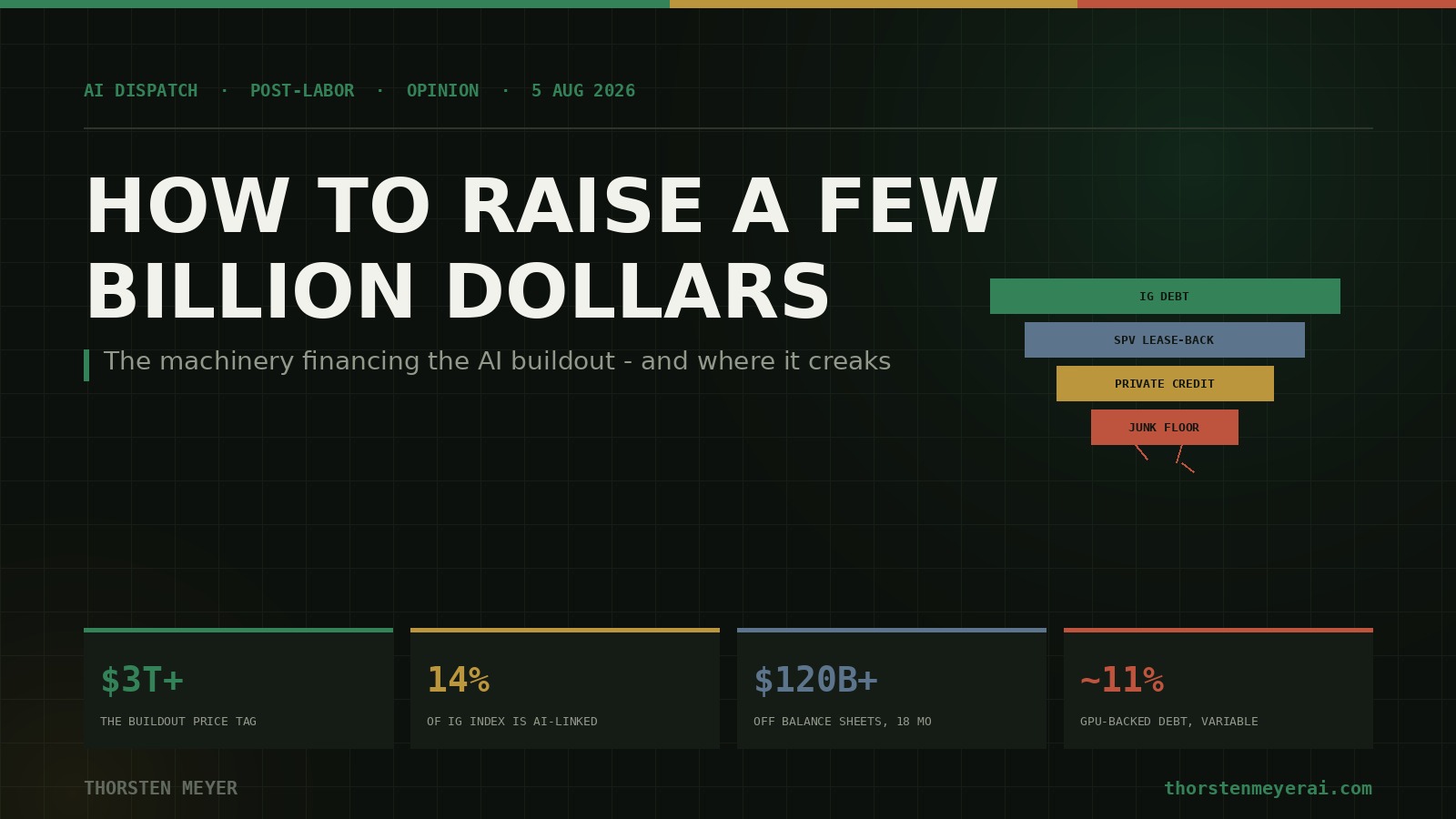
The AI buildout is now routinely described as the largest peacetime investment project in history — a price tag past three trillion dollars for the datacenters alone. And here is the fact that reframes everything: not even the richest companies on Earth can pay for it out of pocket. Amazon, Microsoft, Meta — the deepest cash-flow machines ever constructed — are not prepared to foot this bill from their own balance sheets. The equity mega-rounds into the frontier labs, dazzling as they look, do not come close to covering an Industrial-Revolution-sized cost.
So the money is being raised. All of it, everywhere, through every instrument the capital markets know how to build — and a few they had to dust off from 2007. If you want to understand where this cycle actually breaks or holds, you do not study the models. You study the paper. So let me walk through how one raises a few billion dollars in 2026, layer by layer, and then say plainly where I think the machinery creaks.
The buildout is past $3 trillion, and not even the richest companies on Earth can pay for it out of pocket. So the money is being raised — through every instrument the capital markets know, and a few dusted off from 2007. To see where this cycle breaks or holds, study the paper, not the models.
▲ Opinion & analysis · not investment adviceFour layers, descending in safety and ascending in cleverness. The senior layer is the healthiest; everything below exists because it cannot carry $3 trillion alone.
How more than $120 billion left the balance sheets while everyone reported cleaner numbers.
Where I think the machinery creaks, held alongside the case for it rather than instead of it.
Not the model launches — the covenants.
is a promise about a technology that has never once held still.
Layer one: the investment-grade firehose
The respectable top of the stack is straightforward corporate debt, and the volumes have gone vertical. AI-related companies and projects tapped debt markets for at least $200 billion last year — likely an undercount, since many deals are private — and the street expects $250 to $300 billion of issuance in 2026 from the hyperscalers and their joint ventures alone. AI-linked firms now make up roughly 14 percent of the investment-grade index — more than the US banks. Sit with that for a second: the bond market's biggest single constituency is no longer finance. It is compute.
This layer is the healthiest, because it is recourse debt against the strongest cash flows in corporate history. My view from the token-economics side is that it gets healthier still: as legacy compute contracts roll off and reprice upward, operating cash flow rises, and more of the buildout self-funds. But this layer alone cannot carry three trillion. Hence everything below it.
enterprise GPU server for AI training
As an affiliate, we earn on qualifying purchases.
As an affiliate, we earn on qualifying purchases.
Layer two: the SPV — how $120 billion left the balance sheets
Here is where the financial engineering starts, and where I want readers to slow down, because this is the structure that defines the cycle.
The prevailing move works like this: a technology company partners with a private credit fund to create a special purpose vehicle — a separate, "bankruptcy-remote" legal entity whose assets and liabilities are ring-fenced from the parent. The SPV owns the datacenter; the tech company leases it back; the SPV issues debt against the contractual claim on those future lease payments. The parent gets the compute without the liability on its books. The lender gets long-duration, contract-backed cash flows. Everyone reports cleaner numbers.
The scale is no longer a footnote. Tech companies have moved more than $120 billion of datacenter spending off their balance sheets in roughly eighteen months. The flagship was a $30 billion SPV deal for a single Louisiana campus — the largest private-credit datacenter transaction in history, run through an entity co-owned with a credit fund. Around one hyperscaler-adjacent buildout alone sit an approximately $13 billion SPV for a Texas facility, a $38 billion debt package for two more sites, and an $18 billion loan for a fourth. One of these structures now carries an investment-grade rating and ranks among the largest individual investment-grade corporate debt instruments ever issued.
And notice the tension buried inside the lease itself, because it is the honest tell of the whole arrangement: lenders need long, stable cash flows; tenants in a fast-moving technology want flexibility. The compromise — shorter leases wrapped in residual-value guarantees that simulate long commitments — is clever. It is also a promise that someone absorbs the technology risk, written in a way that makes it hard to see who.
high-capacity data center cooling systems
As an affiliate, we earn on qualifying purchases.
As an affiliate, we earn on qualifying purchases.
Layer three: private credit becomes the load-bearing wall
The counterparty to most of this is not a bank. It is the private credit industry — a handful of giant funds originating most of the datacenter debt, both through SPVs and through direct lending. Outstanding private loans to AI-related companies have surged from near zero to over $200 billion in a few years, and the projection making the rounds is another $800 billion of private-credit datacenter financing over the next two years, with private credit plausibly funding more than half of global datacenter construction by 2028.
Two things about this are genuinely new. First, the banks are — officially — barely exposed: a Federal Reserve study put banks' direct exposure to AI-adjacent industries at just 0.8 percent of assets, while warning in the same breath that they most likely carry additional exposure through their lending to the private credit funds themselves. The risk did not leave the banking system; it went around it, one hop further from the regulator's flashlight. Second, private credit is flexible, fast, and opaque. These loans do not trade daily; they are not marked to a screaming market price; and in a downturn that opacity cuts both ways — it prevents panic selling, and it prevents anyone from knowing where the losses actually sit.
industrial-grade data center power supplies
As an affiliate, we earn on qualifying purchases.
As an affiliate, we earn on qualifying purchases.
Layer four: the junk floor and the GPU as collateral
Below investment grade, the buildout gets properly exotic, and this is the layer I watch most closely — because it is where the neoclouds live, and the neoclouds are the canary.
A converted Bitcoin miner issued $3.2 billion in BB- rated bonds. GPU-cloud operators borrow at around 9 percent in the high-yield market. And the emblematic structure of the whole cycle is GPU-collateralized lending: a multi-billion-dollar facility secured by the chips themselves plus the customer contracts running on them, at variable rates averaging roughly 11 percent — with repayments commencing precisely as the market value of the collateral was falling sharply. Read that sentence twice. The loan is secured by an asset that depreciates like electronics while amortizing like real estate, and the repayment schedule does not care which one it actually is.
Then there is securitization — the 2008 toolkit, repurposed. Datacenter leases pooled and sliced into asset-backed securities; digital-infrastructure ABS has expanded eightfold in five years, datacenters now back nearly two-thirds of the deals, and issuance is projected at $30 to $40 billion a year through 2027. The instruments are standard. The assets underneath them — leases to an industry whose demand curve, technology stack, and unit economics are all being repriced quarterly — are not standard at all.
As an affiliate, we earn on qualifying purchases.
My read: three fault lines, one honest defense
I promised an opinion, so here it is, sorted.
Fault line one: duration mismatch dressed as duration match. The entire structure sells long-duration paper against a technology that reprices in eighteen-month cycles. The residual-value guarantees, the lease laddering, the amortization schedules — all of it exists to make a fast-depreciating, fast-evolving asset look like a toll road to a bond investor. Sometimes engineering like that is genuine risk transfer. Sometimes it is risk disguise. The GPU-collateralized facility repaying into a falling collateral market is the small preview of what the large version looks like.
Fault line two: circularity. Chip vendors invest in the labs that buy their chips; the labs sign compute contracts with clouds financed by credit funds; the credit funds' paper is rated on the strength of contracts with counterparties whose own funding depends on the same ecosystem's continued ascent. Everyone's collateral is, at one remove, everyone else's promise. In good times this reads as a flywheel. Under stress, correlated exposures that looked independent turn out to be one exposure — that is the oldest story in financial history, and the SPV opacity makes the correlation harder to see this time, not easier.
Fault line three: the migration of the risk. The most quietly consequential fact in this whole landscape is where the paper ends up. It ends up in insurance portfolios, pension allocations, retail fixed-income funds — the fixed-income side of ordinary savers' portfolios is becoming AI-heavy at the same time their equity side already is. Both sides of the household balance sheet are now long the same trade. If the buildout disappoints, the diversification people believe they have will turn out not to exist.
And the honest defense, which I hold alongside the worry rather than instead of it: the underlying demand is real and, in my own operation, visibly accelerating. Tokens are not tulips; every gauge I can read — utilization, rental prices, my own consumption — points up. The senior layers of this stack are lending against genuinely bankable counterparties, and the compute-repricing dynamic strengthens exactly the cash flows the paper depends on. A debt-financed buildout of a real thing is not a bubble by definition. The dot-com fiber turned out to be the substrate of the next twenty years — it just bankrupted its financiers first. That is the precise scenario the structure should be judged against: the technology can succeed and the paper can still fail, because paper has schedules and technology has cycles, and the two only align when nothing wobbles.
What I actually watch
Not the model launches — the covenants. Specifically: whether new SPV deals keep finding takers at current spreads, or whether the residual-value guarantees start growing (a sign lenders no longer believe the leases alone); whether GPU-backed facilities get refinanced or quietly restructured as their collateral curves and repayment curves cross; whether the credit-default-swap prices on the most leveraged buildout names keep diverging from their equity prices — bond investors getting nervous while stockholders celebrate is the single most reliable late-cycle signal I know; and whether the banks' indirect exposure through their private-credit lending ever gets forced into the light.
Raising a few billion dollars in 2026 is, it turns out, the easy part — the machinery for it is magnificent, layered, and running at full speed. The hard part is that every layer of that machinery is a promise about the future shape of a technology that has never once held still. I think the demand is real. I think much of the paper is sound. And I think the layer where those two beliefs are furthest apart — the junk floor, with its depreciating collateral and its 2008 toolkit — is where this cycle will tell us what it really is.
Opinion and analysis from a local-first builder and post-labor economist; a companion to "A Token Is a Token." Figures — the $3T+ buildout estimate, $200B+ debt issuance last year, $250–300B projected hyperscaler issuance in 2026, 14% of the investment-grade index, $120B+ moved off balance sheets in ~18 months, the $30B SPV transaction, $200B+ private AI credit and the $800B two-year projection, the 0.8% bank-exposure figure, GPU-collateralized lending at ~11% variable, and $30–40B/yr projected datacenter securitization — are drawn from contemporaneous reporting and analyses (Bloomberg, CNBC, Federal Reserve Bank of Chicago, bank research, and legal-industry client alerts, late 2025–mid 2026) and are point-in-time estimates, several of them projections. Specific firms are referenced structurally, not as recommendations. Not investment advice. Point-in-time as of 5 August 2026.
Fall Picks
fall essentials
As an affiliate, we earn on qualifying purchases.