🔍 Read the full analysis: Thirteen Teams, One Ledger: A Data Center Home For Every Team, With AI That Shows Its Work on Rymvard

Get business pricing on tech for your team
- Business-only prices and quantity discounts
- Tax-exempt purchasing
- Multiple users, one account, clear invoices
TL;DR
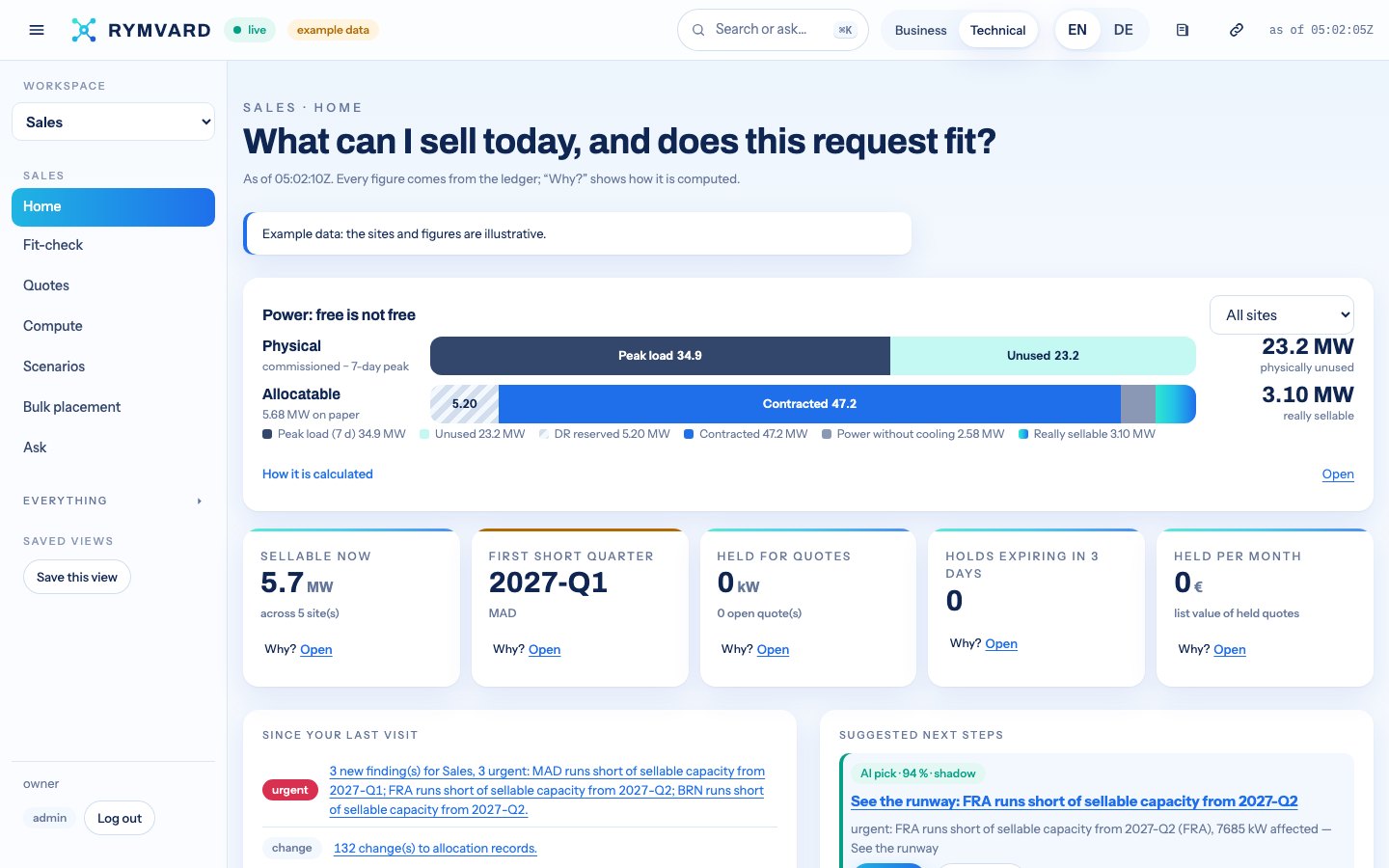
Rymvard says its early-access data center capacity ledger now provides dedicated workspaces for 13 teams, adding SAP Operations on Oct. 4, 2026. Its AI features summarize changes, explain figures and suggest next steps, but proposed actions require human approval and answers are logged. The screens use an illustrative estate, not a customer deployment, and no customer outcomes or prices were provided.
Rymvard says its data center capacity ledger now has a dedicated workspace for SAP Operations, bringing the listed total to 13 team homes as of Oct. 4, 2026. The early-access product pairs team-specific views of shared capacity data with AI helpers, while keeping suggested actions subject to human approval.
The workspaces cover IT infrastructure, Sales, Management, Facility, C-Level, Finance, Capacity planning, Account management, Sustainability and ESG, Compliance and audit, the NOC wall, Procurement and SAP Operations. Rymvard describes each home as a view designed around a team’s questions and figures; other parts of the ledger remain accessible from there. The company says a workspace hides pages rather than granting access, and that money figures require an administrator role.
Rymvard says the AI helpers are available across the workspaces. They can show what changed since a user’s last visit, answer a “Why?” prompt on a figure and suggest next steps. Those suggestions become proposals for a person to approve, rather than actions the system carries out automatically. The company says answers use figures from the ledger, are logged as decisions and remain in shadow mode until people have reviewed enough of them. If the AI engine cannot be reached, the helpers fall back to rules.
The announcement describes a product in early access, not a customer rollout. Rymvard says the screens come from its running product, but use an illustrative example estate; no customer, site or outcome is implied. The company has not published prices and says terms are agreed with early-access partners.
Product update · Early access · Oct. 4, 2026
Thirteen Teams,
One Ledger
Rymvard says SAP Operations is the latest dedicated workspace in its data center capacity ledger. AI helpers explain changes and suggest next steps, with people approving proposed actions.
“SAP Operations” joins a shared capacity ledger with 12 other team homes.
Announced October 4, 202601 / The development
One ledger, 13 team views
Rymvard says each home is designed around a team’s questions while keeping the broader ledger accessible.
02 / How it is described
Views, explanations, proposed steps
The announcement describes workflow features and safeguards; it does not report measured performance in customer estates.
Team-specific homes
Workspaces surface pages suited to a team’s questions. Rymvard says a workspace hides pages rather than granting access; money figures require an administrator role.
Understand what moved
Helpers can summarize changes since a user’s last visit and answer “Why?” prompts about a figure, using data from the ledger, according to Rymvard.
Suggestions stay proposals
Suggested next steps require a person’s approval. Answers are logged, and Rymvard says the system stays in shadow mode until people have reviewed enough answers.
03 / Stated control flow
From ledger figure to human decision
Rymvard says helpers fall back to rules if the AI engine cannot be reached.
Figures provide the stated basis for answers.
Summarize a change or explain a figure.
Record the answer and suggested next step.
A person decides whether a proposed action proceeds.
04 / Evidence check
What the announcement establishes
The product is described as running in early access. The screens use an illustrative example estate.
Described today
13 team homesAI summariesHuman approvalAnswer logsThe dated change is the addition of SAP Operations. Rymvard says the ledger and its helpers are available in early access.
It describes access controls and a rules fallback, but provides no independent testing showing how those controls work in practice.
Still unreported
No customer, site or outcome is implied by the illustrative screens. The announcement includes no customer deployment history, adoption figures, benchmark, or evidence of savings or better planning.
Pricing is not public; Rymvard says terms are agreed with early-access partners. Partner names and a public launch date were not provided.
05 / What to watch
Early access will test the claims
Operational value depends on evidence from real estates and day-to-day use.
How does it fit?
Useful details for evaluation include deployment requirements, data handling and administration of access.
When does shadow mode end?
The announcement does not define review counts, decision criteria, or how logged AI answers can be inspected and corrected.
Do explanations hold up?
Evidence should show whether teams trust the shared figures, explanations match underlying records, and proposed steps help users decide.
06 / Key questions
Quick answers
What changed?
Rymvard says it added a dedicated SAP Operations workspace on Oct. 4, 2026, bringing its listed workspaces to 13.
What does the AI do?
It can show changes, explain figures and suggest next steps. Proposed actions require human approval, according to the company.
Are customer results available?
No. The product is in early access, the screens use an illustrative estate, and no customer outcomes or prices were provided.
One Capacity Ledger, 13 Team Views
The pitch is that separate teams can use views suited to their work without relying on separate figures or systems as their starting point. In a data center, capacity decisions can involve facilities, IT, finance, procurement and sustainability. A shared ledger could make it easier for those teams to discuss the same underlying numbers, while limiting each workspace to relevant pages and restricting financial figures by role.
The AI features could also reduce the effort of spotting changes and understanding why a figure moved. But the announcement does not establish that the product has improved planning, saved staff time or reduced costs for a customer. Since the example estate is illustrative and the product is in early access, the current evidence is about features and controls, not measured results.
The approval and logging model matters because a capacity recommendation can affect operational plans and spending. Rymvard says suggestions need human approval, and that answers are recorded and initially kept in shadow mode. Those are stated safeguards; the announcement does not provide usage data or independent testing showing how they work in practice.
Products Worth Considering

Apple MacBook Air 13-inch with M5 Chip, 16GB Memory, 512GB SSD, Liquid Retina Display, and 12MP Center Stage Camera – Midnight

Samsung 32 Odyssey G5 QHD Gaming Monitor

LG 27GR83Q-B 27-inch Ultragear QHD IPS Gaming Monitor
As an affiliate, we earn on qualifying purchases.
Rymvard describes itself as a capacity ledger for data centers. The product concept combines a shared set of figures with different team-facing workspaces, rather than presenting every user with the same dashboard. The team list spans operational, commercial, financial and oversight functions, as well as a NOC wall view.
SAP Operations is the newly dated addition: Rymvard says it was included on Oct. 4, 2026. The company presents the other workspaces as part of the same product, but has not supplied a customer deployment history, adoption figures or comparisons with other capacity-planning tools. Its material describes how the product is intended to work, not a report of independently verified performance.
““what changed since the last visit””
— Rymvard
Customer Results Remain Unreported
Rymvard has not identified a customer using the product or provided evidence from a live customer estate. It explicitly says the screens are based on an illustrative example and that no customer, site or outcome is implied. That leaves unanswered how the ledger performs with real operational data, how teams use the separate homes and whether the AI suggestions are useful in day-to-day work.
The announcement also does not define how many human reviews are required before shadow mode ends, what criteria determine that threshold, or how logged AI decisions can be inspected and corrected. It does not describe the rules used when the engine is unreachable, beyond saying the helpers fall back to rules. Pricing is not public; Rymvard says it is agreed with early-access partners. These are open details, not evidence that the controls fail.
Early-Access Use Will Test the Claims
The next evidence will come from Rymvard’s early-access use with partners, although the company has not announced partner names, a timetable for broader availability or a public launch date. It also has not said when it will publish pricing. Readers evaluating the product would need details on deployment requirements, access administration, data handling and the review threshold for moving AI answers out of shadow mode.
Any assessment of operational value will depend on results from actual estates: whether teams find the shared figures useful, whether the explanations match underlying records, and whether proposed next steps lead to decisions users approve. Rymvard has not announced a specific benchmark or customer-results report. For now, the dated development is the addition of SAP Operations to a running early-access product, not a demonstrated customer outcome.
Where I land
I see this as a product announcement with a clear feature set, not proof that AI has improved data center planning. The strongest part of the design, as described, is the combination of a shared ledger with role-specific views and human approval for proposed next steps. Logging answers and using a rules fallback are sensible controls to disclose, but the announcement alone cannot show how reliably they operate.
The strongest counterargument is that these controls and team-specific screens may be useful even before public customer results exist: early access is where a vendor can test whether the workflow fits real operations. I would revise my assessment upward if Rymvard publishes independently checkable customer evidence, including the review criteria for shadow mode and results from real estates. Evidence of errors, weak explanations or little day-to-day use would push it the other way. For now, the confirmed development is the addition of SAP Operations; the product’s practical impact remains unreported.
Source: Rymvard
Key Questions
What changed on Oct. 4, 2026?
Rymvard says it added a dedicated SAP Operations workspace to its data center capacity ledger. Its listed workspaces now cover 13 teams or functions.
What does the AI do?
Rymvard says its AI helpers show changes since a user’s last visit, answer “Why?” prompts on figures and suggest next steps. Suggested actions become proposals that require human approval.
Is the product being used by customers?
Rymvard says the product is in early access and runs today. The screens described use an illustrative example estate; the company does not identify a customer or claim a customer outcome.
How does Rymvard describe access controls?
The company says workspaces hide pages but do not grant access, and that money figures require an administrator role. It also says AI answers are logged and the helpers use rules if the AI engine cannot be reached.
How much does Rymvard cost?
Rymvard has not published prices. It says pricing is agreed with early-access partners.
Source: Rymvard