By Thorsten Meyer | November 19, 2026 | ThorstenMeyerAI.com

Get business pricing on tech for your team
- Business-only prices and quantity discounts
- Tax-exempt purchasing
- Multiple users, one account, clear invoices
Reality check. Conflict of interest: OpenAI and AMD are central to this story. This article was researched and drafted with AI assistance, including Anthropic’s Claude, a competitor of OpenAI. Neither OpenAI, AMD nor Anthropic reviewed or sponsored it.
AI is starting to work on the hardware that runs AI, OpenAI says. On November 18, 2026, the company said its models had rewritten parts of the circuit designs for AMD’s flagship graphics processor and found “up to 14 per cent improvements” in power, performance and area, the three numbers every chip team trades against each other. OpenAI called it “roughly a year of progress achieved in less than 5 months”. Some of the changes, it said, are already in a design AMD has sent for manufacturing.
If that holds, it is a new link in a loop we have been tracking: AI that speeds up the research behind AI, now reaching into the chips that the next models will run on. But almost every figure in this story comes from one company, OpenAI, which also has a large commercial stake in AMD. Here is what was actually measured, by whom, against what, and what nobody outside the two companies has been able to check.
Key takeaways
- The headline number is a best case. OpenAI reported “up to” 14% improvement in power, performance and area (PPA) on AMD’s flagship GPU design, measured against “heavily optimised baselines”. It did not say which blocks, or what the average was.
- The method is narrow and concrete. The models rewrote SystemVerilog RTL, the code that describes a chip’s circuits, and Synopsys design tools checked that each rewrite behaved like the original and measured the trade-offs, according to OpenAI as reported by ANI.
- AMD’s own words are short. AMD verified “single-digit” PPA gains in key blocks of its next flagship CPU, OpenAI says. AMD’s chief executive, Lisa Su, praised the results on X. AMD has published no figures of its own.
- OpenAI’s own chip got smaller. On Jalapeño, its first custom inference chip, model-proposed changes cut standard-cell area by about 13% in one unit and 10% in another, validated when the first chips came back, the company says.
- The two companies are financially tied. Since October 2025, OpenAI holds a warrant for up to 160 million AMD shares that vests as AMD chips are deployed. No independent audit of the chip-design results has been published.
How the AMD work was done · as OpenAI describes it
AI rewrote the circuit code. Trusted tools checked every change.
One step of chip design, the register-transfer level (RTL), where engineers describe in code what each block of the chip does.
- Step 1Set the goalEngineers define the target: better power, performance and area, same behaviour.
- Step 2Rewrite the codeThe model rewrites the SystemVerilog RTL that describes the circuits.
- Step 3Check with Synopsys toolsDoes it behave like the original? Is power, performance or area better?
- Step 4Keep what passesChanges go into AMD’s design files; some are in a design sent for manufacturing.
Best case reported by OpenAI. No block names, no average and no independent check have been published.
Source: OpenAI, November 18, 2026, as reported by ANI and The Decoder. Animation: Thorsten Meyer AI.
Products Worth Considering

Apple MacBook Air 13-inch with M5 Chip, 16GB Memory, 512GB SSD, Liquid Retina Display, and 12MP Center Stage Camera – Midnight

DJI Mini 5 Pro Fly More Combo with DJI RC 2, 1-Inch CMOS

Samsung 32 Odyssey G5 QHD Gaming Monitor
As an affiliate, we earn on qualifying purchases.
What OpenAI announced
OpenAI published the results in a post titled “Advancing chip design with OpenAI models” on November 18. Our automated request to the post was refused, so the details below are as reported by the news agency ANI, The Decoder and Inside AI, which agree on the key figures. OpenAI president Greg Brockman summarised it on X as “roughly an additional year of progress on @AMD’s chip achieved in less than 5 months using our models”, quoted by Stocktwits.
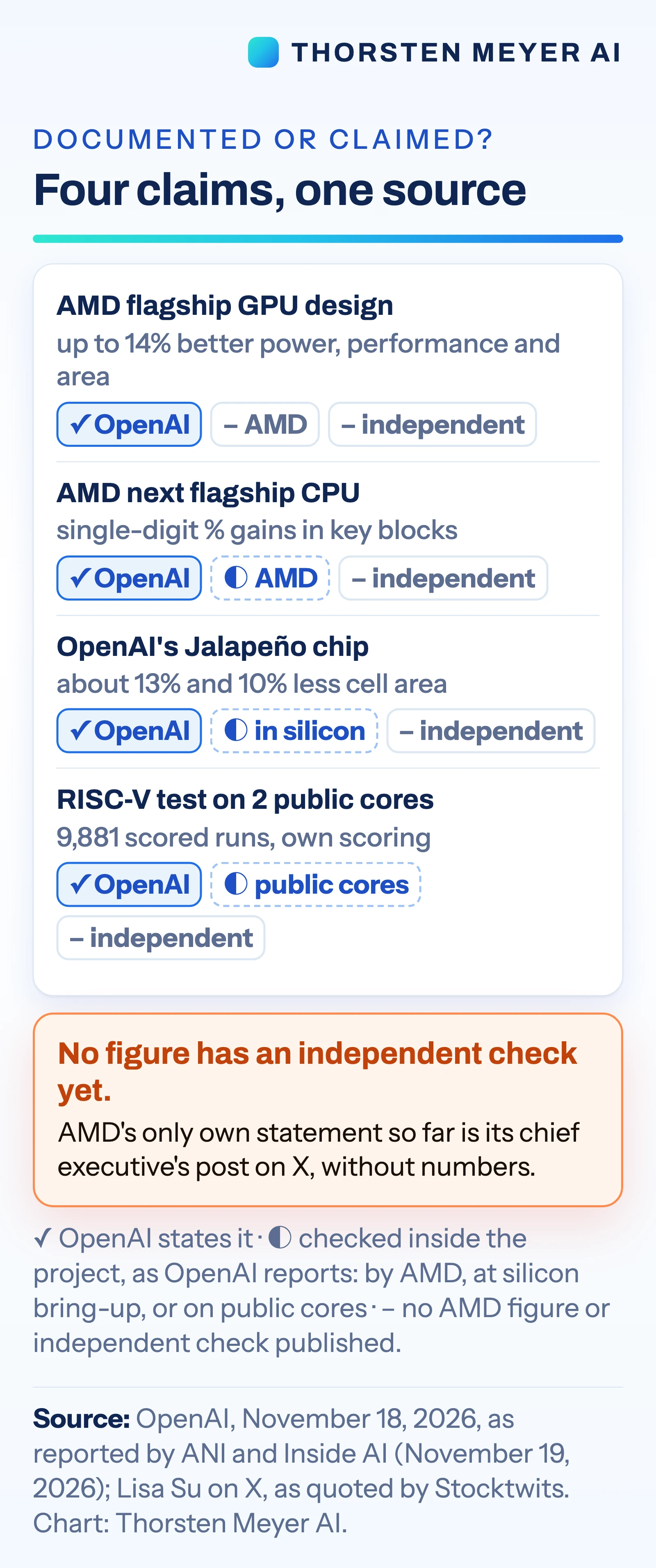
There are four separate claims, and they rest on different kinds of evidence:
- AMD’s flagship GPU design: up to 14% better PPA than heavily optimised baselines. AMD “has already included some of the model-generated changes in a recent design sent for manufacturing”, while others went into its production design files for future versions, OpenAI said, according to ANI.
- AMD’s next flagship CPU: “AMD had verified single-digit percentage gains in performance, power and area” in key blocks, per OpenAI.
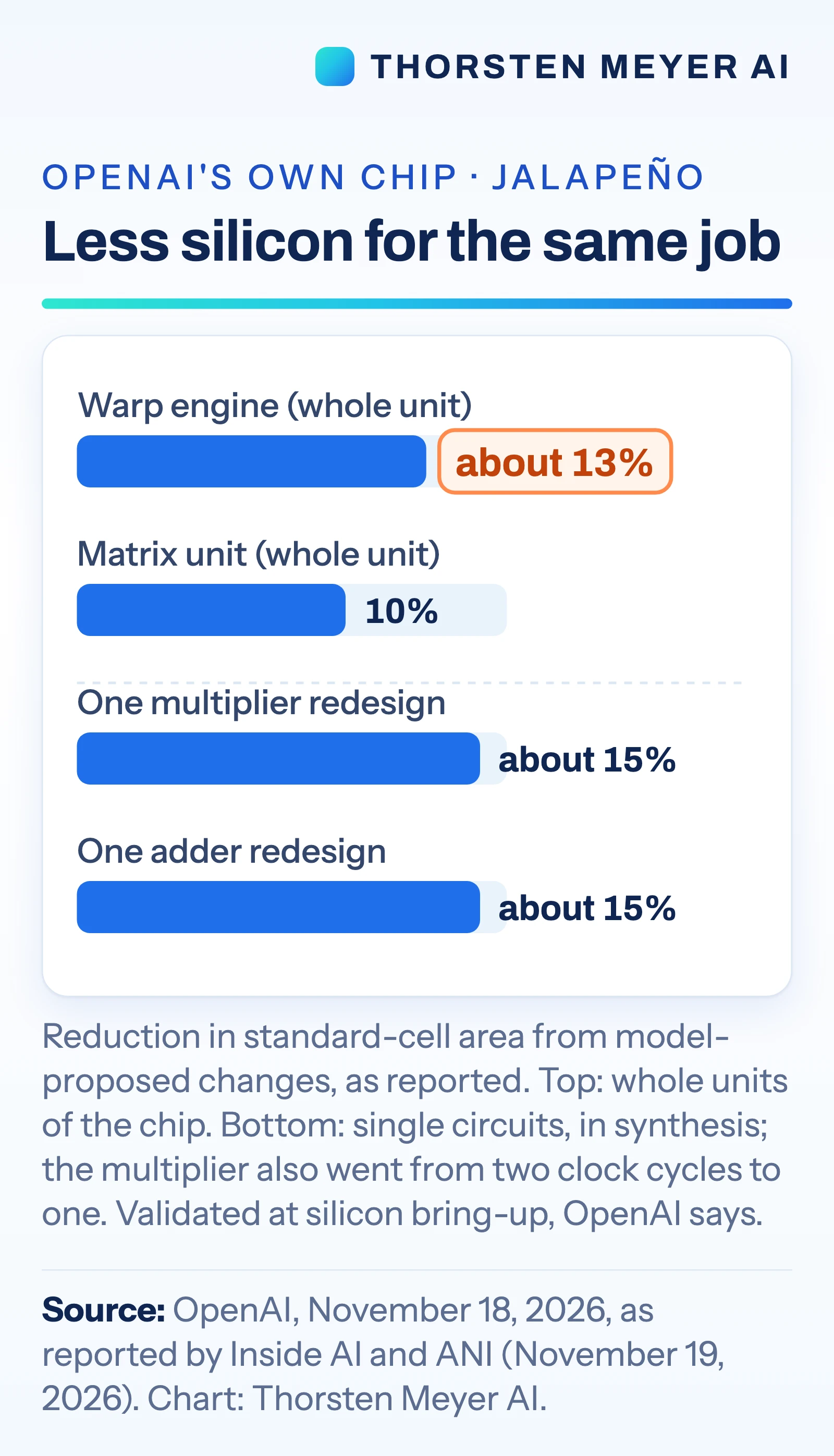
- OpenAI’s own Jalapeño chip: standard-cell area down about 13% in the warp engine and 10% in the matrix unit. (ANI calls the first unit the vector unit; Inside AI calls it the warp engine.) OpenAI started using GPT-4o on Jalapeño in early 2025.
- A benchmark on two open-source processor cores: OpenAI tested five of its models on PicoRV32 and Ibex, two small RISC-V cores, with 9,881 scored runs in total. GPT-6.2 Astra, released the day before, scored highest.
What exactly was accelerated
The work happened at one step of chip design: the register-transfer level, or RTL. At this stage engineers describe in code what every block of the chip does, cycle by cycle. Synthesis tools then turn that code into logic gates, and later steps place and wire them on silicon.
According to the reports, the models proposed alternative ways to build the same function: different logic, a different split of a calculation across pipeline stages, shared hardware, less intermediate storage. Inside AI describes two examples from Jalapeño. One multiplier redesign “used about 15% less cell area in synthesis while reducing latency from two clock cycles to one”. An adder redesign cut cell area by about 15% at the same two-cycle latency.
The checking was done by conventional engineering tools, not by the model itself. Synopsys tools verified “that the changes preserved the original design’s behaviour” and assessed their impact on power, performance and area, OpenAI said. That matters: a rewrite that is faster but subtly wrong is worthless in hardware, where a bug can cost a new manufacturing run.
How it was measured, and against what
For AMD, the comparison point is AMD’s own design, which according to The Decoder’s summary of OpenAI’s post AMD engineers “had already optimized for years”. That is a demanding baseline. It also means the 14% is not a comparison with a naive design, which would make big gains easy.
What the reports do not say is just as important. They do not name the blocks, the share of the chip they make up, or the design stage at which the gain was measured: after synthesis, or after the much harder step of placing and wiring the chip. “Up to” marks the best result, not the typical one.
The benchmark part is more transparent, because the cores are public. According to Inside AI, each model received the original design and had to raise throughput. A design scored zero if it failed the simulation checks or used more than 16 times the original core’s area. At a comparable budget of about 112,000 tokens per run, GPT-6.2 Astra had the highest average score on both cores.
OpenAI also named a limit of its own test. When models designed a core from written requirements instead of improving an existing one, all five scored higher, but they could leave out features such as performance counters that did not help the score. Requiring those features, a tighter area limit and checking timing after physical synthesis “would make the test more representative of production chip design”, Inside AI reports.
Documented, claimed, or unchecked
| Claim | Who says so | Checked by | Public detail |
|---|---|---|---|
| Up to 14% PPA on AMD’s flagship GPU design | OpenAI | Synopsys tools, inside the project | No block names, no average, no design files |
| Single-digit PPA gains in key CPU blocks | OpenAI, citing AMD | AMD, per OpenAI | No figures from AMD |
| Some changes in a design sent to manufacturing | OpenAI; Brockman on X | Not stated | No product named |
| About 13% and 10% less cell area on Jalapeño | OpenAI (own chip) | Validated at silicon bring-up, per OpenAI | Unit-level percentages only |
| GPT-6.2 Astra leads 9,881 runs on PicoRV32 and Ibex | OpenAI | OpenAI’s own scoring | Public cores; method described |
The only first-hand statement from AMD is a short post by Lisa Su on X: “Proud of these fantastic results – @OpenAI + @AMD engineers pushing the frontiers of chip design together!”, as quoted by Stocktwits. That confirms the collaboration and AMD’s approval. It does not confirm a number.
The commercial background belongs in the picture. In October 2025, AMD and OpenAI announced a 6 gigawatt agreement for AMD’s Instinct GPUs, starting with 1 gigawatt of MI450 GPUs in the second half of 2026. AMD issued OpenAI a warrant for up to 160 million AMD shares, vesting as deployments grow and tied to AMD share-price targets, according to AMD’s press release. AMD’s finance chief said the deal was expected to deliver “tens of billions of dollars in revenue for AMD”. Both companies therefore gain from a story in which their joint chips get better faster. That does not make the results wrong. It makes independent verification more important.
Why this matters: the loop reaches the hardware
We have been following a simple question: is AI now speeding up the development of AI? On November 5, METR, an independent evaluator, estimated after a high-access review that Anthropic is likely improving its models on well-specified tasks “at around twice the rate” of March 2024 to October 2025, and would not be surprised by anything between 1.3x and 3x. On November 17, OpenAI’s system card said GPT-6.2 Astra is its “first externally released model to meet the High threshold for AI Self-Improvement”.
Both of those concern software: models helping to build models. Chip design is the other half of the loop. If models make chips more efficient, the same power and the same factories deliver more computing, which trains the next models. Taken at face value, roughly a year of progress in less than five months means about 2.4 times the usual pace in this narrow task. That is our arithmetic on OpenAI’s own figures, not a measured rate.
OpenAI’s system card names the risk this kind of speed creates in its own field: “as the time between significant capability advancements shrinks, researchers may have less time to understand newly emerging capabilities”. Hardware has a natural brake that software lacks. Every design still has to be manufactured, tested and deployed, and that runs at factory speed, not model speed.
What it means for businesses
- Chip timelines: faster RTL optimisation shortens one step of a long chain. Verification, physical design, manufacturing, packaging and deployment still take their time. Expect better chips per generation before you expect faster generations.
- Compute supply: PPA gains mean more computing per watt and per wafer, if they survive all later design steps. For buyers of AI computing, nothing changes this quarter. The chips that carry these changes are still on their way through manufacturing.
- Chip and design-tool companies: OpenAI is working with Synopsys on GPT-Synopsys, a model meant to use electronic design automation tools “in the way expert chip designers do”, ANI reports. The pressure on chip firms to test such tools on their own designs will grow. Ask for results on your own blocks, at the final design stage, not a vendor’s best case.
What it means for engineers and workers
The work described here does not replace a chip team. Engineers set the goals and limits, Synopsys tools did the checking, and AMD engineers decided what went into the design. What changes is where the human effort goes: less hand-tuning of circuit code, more defining what “better” means, writing the checks, and judging trade-offs. Neither company has said anything about staffing. For people in hardware design, verification skills and the ability to specify a problem precisely look like the safer bets. Those are the steps the models still depend on.
What is not known
- The average gain. “Up to 14%” is the best case. How much of the chip improved, and by how much on average, has not been published.
- The design stage. Whether the gains were measured after synthesis or after placing and wiring the chip is not stated in the reports.
- The human share. How many engineer hours, how many model runs and how much computing went into the five months is not public.
- AMD’s own numbers. AMD has not published figures, and no independent party has checked the GPU and CPU results.
- Which products. No AMD product has been named as carrying the changes, and no date.
- Whether it generalises. One partner, one company’s models, a small set of blocks. Whether other chip teams see similar gains is open.
Bottom line
OpenAI has shown a plausible, well-defined use of AI in chip design: rewriting circuit code and letting trusted tools check every change. The Jalapeño examples are specific, and AMD’s chief executive publicly backs the work. But the 14% is a best case reported by a company with a financial stake in its partner, without the details needed to judge it. Treat it as a strong signal that AI is moving into hardware design, and as an unverified number until AMD or an independent party publishes more.
I’m Thorsten Meyer. More reality checks are at thorstenmeyerai.com.
Sources
- ANI: AI models deliver up to 14% chip design gains in AMD collaboration, OpenAI says, November 19, 2026 (reporting OpenAI’s post “Advancing chip design with OpenAI models”, November 18, 2026, which refused our request and is therefore not quoted directly)
- Inside AI: OpenAI Models Cut Chip Area by 13%, Boost AMD GPU PPA by 14%, November 19, 2026
- The Decoder: OpenAI says its models delivered a year’s worth of chip optimization on top of AMD’s own engineering, November 18, 2026
- Stocktwits via Yahoo Finance: Why Is AMD Stock Rising Overnight?, for the X posts by Lisa Su and Greg Brockman only
- AMD: AMD and OpenAI Announce Strategic Partnership to Deploy 6 Gigawatts of AMD GPUs, October 6, 2025
- METR: Independent Assessment of AI R&D Acceleration at Anthropic in October 2026, November 5, 2026
- OpenAI: GPT-6.2 System Card, Deployment Safety Hub, November 17, 2026
Further reading on ThorstenMeyerAI.com
- Is AI now speeding up its own development? What METR found inside Anthropic
- GPT-6.2 Astra and Sol: what OpenAI’s new models cost, score and change for work
- Has recursive self-improvement started?
- When AI starts improving AI
- Scenario 2027: a year of AI progress in two months, until compute runs out?
This is a reality check; it is not investment, legal or career advice, and it does not discuss share prices. Researched and drafted with AI assistance, including Anthropic’s Claude. Conflict of interest: OpenAI and AMD are central to this article, Anthropic makes the AI we used and competes with OpenAI, and METR’s assessment cited for context concerns Anthropic; we report the companies’ claims as claims and their own caveats as the sources state them. No company or organisation named here reviewed or sponsored this article. Our own text and graphics contain no affiliate links; offer and product boxes added by the site may contain Amazon affiliate links. Sources checked on November 19, 2026. Images: AI-generated illustration (Runware), animation and charts by Thorsten Meyer AI from the reported numbers; our own images show no real people or logos. Boxes added by the site may show product photos or people.