
Get business pricing on tech for your team
- Business-only prices and quantity discounts
- Tax-exempt purchasing
- Multiple users, one account, clear invoices
A room where waiting leaves a trace
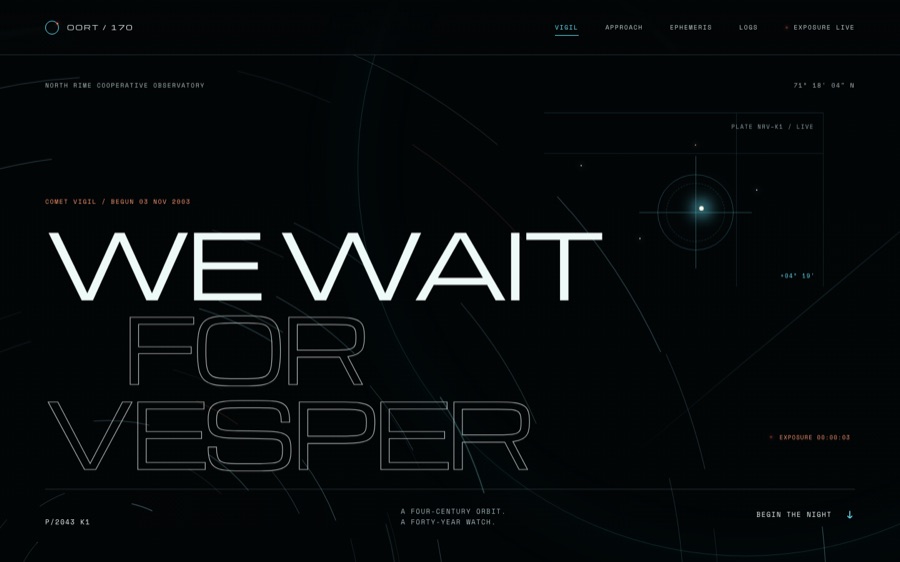
OORT is an AI-built exhibition piece: a fictional observatory devoted to a fictional comet, P/2043 K1 Vesper. Its imagined community keeps a decades-long watch, and the site turns that premise into an interface you can affect simply by staying.
The signature technique is held light. A seeded field of stars forms curved trails on canvas, and those trails lengthen with elapsed time. Return later and the same local sky resumes. The page makes duration part of the artwork instead of treating it as time spent before the content.
astronomy star trail photography kit
As an affiliate, we earn on qualifying purchases.
As an affiliate, we earn on qualifying purchases.
Inside the instrument
The room adopts the restraint of a dark-adapted observatory. Deep black gives the eye room to adjust; cyan marks the ion tail and live readings; warm red-orange signals instructions and actions. Pale dust-toned text keeps the longer passages readable. Glow is saved for emitted light, while borders and labels remain sharp.
Display type gives headings and measurements an engineered presence. Monospaced text handles coordinates and field notes, keeping the reading experience closer to a logbook than a conventional marketing page.
Time as an interface input
The canvas draws stars around a point below the visible frame. As seconds pass, each star’s arc grows, with a logarithmic curve that makes early changes visible while leaving room for a longer visit. A repeatable seed keeps the sky consistent on that device, and local storage preserves its elapsed time. When the page is hidden, the animation loop stops; reduced-motion settings receive a still version.
A second instrument uses scrolling to move the comet through an inline SVG. Its ion tail stays directed away from the sun, while the dust tail bends along the imagined orbit. Both paths respond to the same progress value, so the changing geometry, distance, and year stay in step. A range control also adjusts the defocus view and its related brightness estimate.
A small act of witness
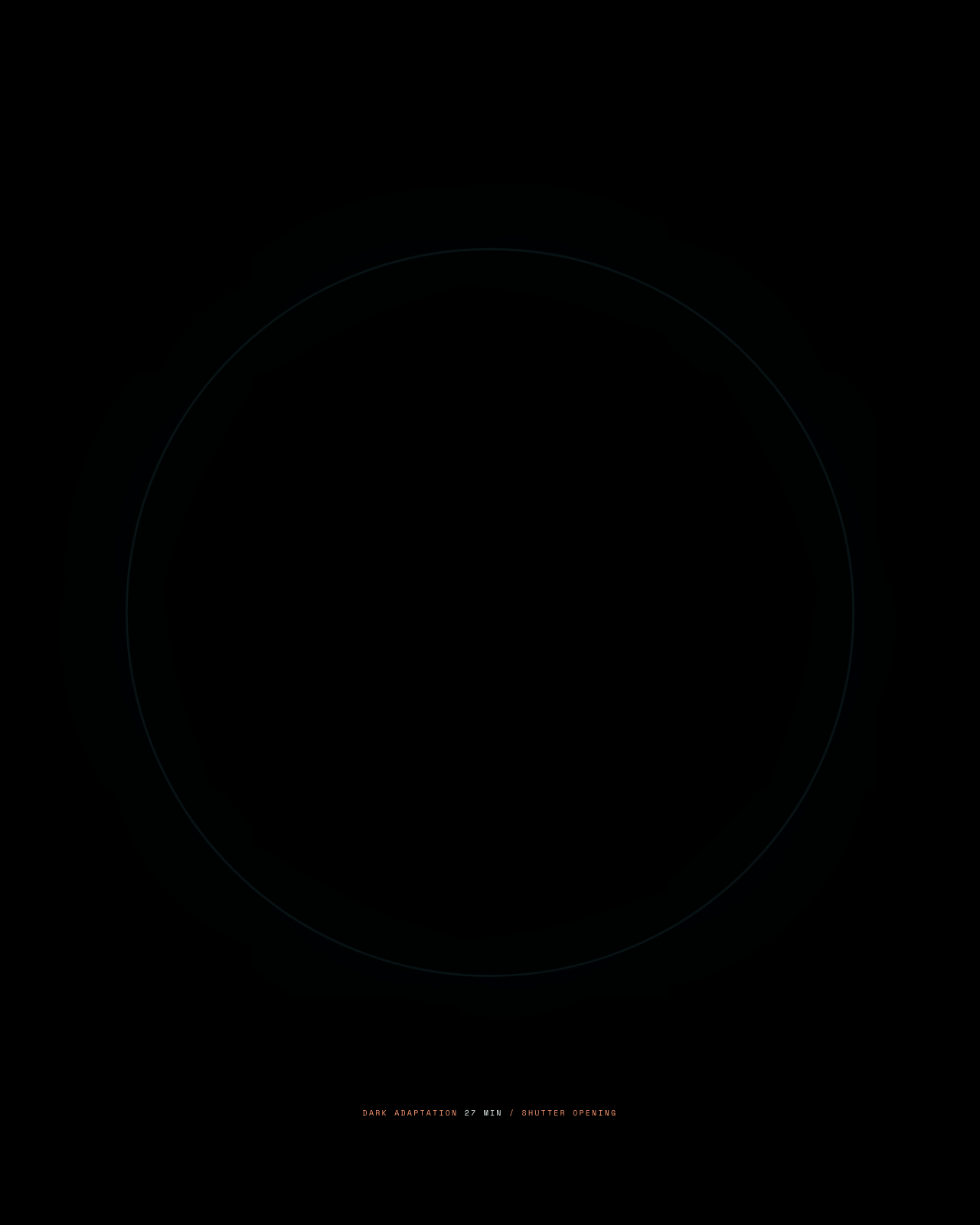
Visitors can hold a control briefly to open a simulated shutter. The site records a timestamp, but frames the moment as a record of attention: the comet remains unseen and in transit. That choice keeps the interaction faithful to the fiction of waiting instead of rewarding visitors with a fabricated discovery.
Want this? Paste this into your AI coding agent
Build a single-page showcase website from this art-direction brief. Work like an elite creative frontend engineer; commit totally to the direction.
BRIEF (room 170 of 175, “oort”):
OORT — COMET VIGIL: waiting for P/2043 K1 “Vesper” (fictional comet, real orbital patience). Aesthetic: observatory red-light and long exposure; astronomy as devotion. Palette: deep-space black, ion-tail cyan, dust-tail white, red-light amber. Fonts: michroma (display), space-mono (ephemeris). SIGNATURE: LONG EXPOSURE — the page ACCUMULATES light: star trails slowly arc across the background the longer you stay (a persistent canvas — your visit is the exposure; leave for the guide and return, your trails remain). The comet grows down the page as it approaches perihelion: TWO tails diverging correctly (ion tail straight anti-sunward, dust tail curving along the orbit — the geometry animates as the sun angle shifts). Vigil logs from invented amateurs (the 40-year wait, the frost on the eyepiece), ephemeris table set like a psalter, magnitude-estimation technique, the “last seen 1608” provenance. Unforgettable: your visit recorded in star trails.STACK: pure HTML/CSS/JS, no build step, no frameworks, no CDNs or external requests of any kind; self-hosted fonts only; every visual is code (CSS/SVG/canvas/WebGL) — no image assets required.
QUALITY BAR: flawless at 390px, 834px and 1440px with zero horizontal overflow; tap targets >= 44px; semantic landmarks, focus-visible styles, body-text contrast >= 4.5:1; prefers-reduced-motion pauses or simplifies heavy animation; rAF loops pause when the tab is hidden; hold 60fps (cap particle counts, avoid layout thrash); rich invented content everywhere — real-sounding names, numbers and program notes, never lorem ipsum; orchestrate one beautiful staggered load moment plus scroll and hover surprises. FORBIDDEN: Inter/Roboto/Arial/system-ui, purple-gradient-on-white, and cookie-cutter hero+cards+footer layouts.
PROCESS: iterate in three documented passes — (1) build plus builder self-critique, (2) merciless external critique finding and fixing at least ten real problems, (3) art-director elevation from good to unforgettable. Screenshot at all three widths every pass and fix everything you can see.
— Original brief by Claude Fable 5 (art director), executed by the FABLE/175 pipeline.
— This room lives at https://fable-25-830.netlify.app/sites/oort/
This is the verbatim art-direction brief that produced the room — exposed by the exhibition itself via the “Prompt” link in the room’s footer.
deep space black telescope filter
As an affiliate, we earn on qualifying purchases.
As an affiliate, we earn on qualifying purchases.
Three passes, one coherent vigil
The three-pass pipeline moves from build to merciless critique to art-director certification: first, code creates the observatory and its instruments; next, the work is challenged for legibility, rhythm, and behavior; finally, a visual review certifies the room’s direction. The accompanying field guide explains how the seeded exposure, SVG orbit, palette, and type work together, so the finished site can be read as both an exhibition and a reproducible technical study.
The full build notes live in the room’s design guide.
As an affiliate, we earn on qualifying purchases.
Enter the room
Visit OORT: Comet Vigil for P/2043 K1 Vesper and spend a moment with its changing sky. Then browse all 175 rooms at the hub for more AI-built exhibition pieces.
OORT is fictional, and its site was built by AI. The invented observatory is the frame; the real subject is how code can make waiting visible.
Visit the live room → · Browse all 175 rooms
Previously in Wing VII
- Room 161: Station Chiroptera — Read the Dark by Echo
- Room 169: Hibernaculum — Where Winter Sleeps
- Room 163: MARU-K — Aisle Census, 03:12
FABLE / 175 is a finished exhibition of 175 fundamentally different websites, each built end-to-end by an AI. This article is part of our series walking through it room by room.
astronomy observatory red light flashlight
As an affiliate, we earn on qualifying purchases.
As an affiliate, we earn on qualifying purchases.
Fall Picks
fall essentials
As an affiliate, we earn on qualifying purchases.