

To thrive alongside AI’s unstoppable evolution, focus on continuous learning and developing new skills such as data analysis, AI oversight, and ethical understanding. Embrace digital literacy and stay adaptable to quickly master emerging tools. Upskilling early in your career can protect you from disruption and open new opportunities. By proactively preparing now, you position yourself to stay relevant in a changing workforce, and if you continue exploring, you’ll discover essential strategies to succeed in this evolving landscape.
Key Takeaways
- Promote continuous learning and digital literacy to help workers adapt to evolving AI technologies.
- Focus on developing AI-related skills like data analysis, oversight, and ethical understanding.
- Encourage sector-specific training to address unique employment shifts and resilience needs.
- Support early-career workers with targeted upskilling programs for future-ready roles.
- Foster a mindset of adaptability and proactive skill development to stay competitive in an AI-driven economy.
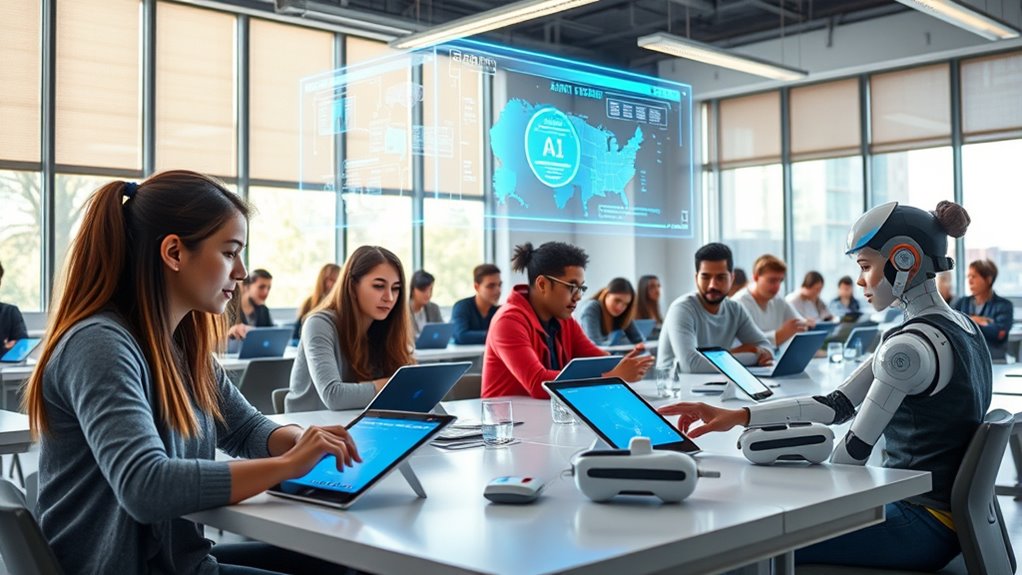
Are you ready for the AI-driven changes shaping tomorrow’s workforce? As AI continues to evolve, it’s clear that its impact on employment isn’t about sudden disruptions but gradual shifts that require your attention. Since ChatGPT’s debut, the U.S. labor market hasn’t experienced large-scale job losses directly tied to AI, but the pace of employment changes has quickened slightly compared to past technological leaps like computers and the internet. You’ll notice occupational mixes shifting, with some roles shrinking—especially those easily automated, like medical transcriptionists and customer service reps, which are projected to decline by about 4.7% to 5% through 2033. Meanwhile, professions that leverage AI for augmentation, such as lawyers and financial advisors, might actually see demand grow because their work complements AI rather than competes with it.
AI is also fueling impressive productivity gains across industries. Since 2022, sectors that adopted AI have experienced nearly quadrupled revenue growth, showing how AI boosts efficiency through automation and decision support. This trend isn’t limited to tech; mining and agriculture are now integrating AI tools, signaling broad economic transformation. As AI skills become more valuable, wages for those with AI expertise have risen by 25% in just a year, creating strong incentives for workforce upskilling. However, these gains come with uneven employment shifts, often favoring AI-exposed jobs, which means you’ll need to adapt quickly to stay relevant. The rapid pace of AI development has prompted a 20% increase in the adoption of AI-related skills across the workforce in the past year. Developing a solid foundation in digital literacy will be essential for navigating these changes effectively.
The rapid pace of change demands continuous learning. Workers in AI-affected roles are already experiencing faster skill upgrades, emphasizing the importance of acquiring new competencies. Skills like data analysis, AI oversight, and ethical understanding are increasingly essential. Early-career workers are particularly vulnerable and require targeted support to navigate this evolving landscape. Combining domain knowledge with AI proficiency will become a key advantage. Different sectors will experience varying effects: legal and financial fields see mixed impacts, with some roles shrinking and others remaining steady or growing, while sectors like customer service face employment reductions due to automation. Industries like mining and agriculture are adopting AI more rapidly, but their employment effects are still unfolding. Staying adaptable, continuously developing your skills, and embracing AI as a tool for growth will position you to thrive in this unstoppable evolution.
Frequently Asked Questions
How Can Educators Adapt Curricula for AI Integration Effectively?
You can adapt curricula for AI integration by embedding AI literacy as a core skill, emphasizing ethical use, and using adaptive learning tools to personalize lessons. Incorporate interdisciplinary approaches that connect computer science, ethics, and society. Provide ongoing professional development to keep up with AI advancements, and design assignments that promote AI-assisted creativity and critical thinking. Foster a classroom environment that encourages responsible AI use, trust, and collaboration to prepare students for AI’s evolving landscape.
What Specific Skills Will Be Most Valuable in Ai-Driven Workplaces?
In AI-driven workplaces, you’ll find data literacy, critical thinking, and AI proficiency most valuable. You’ll need to interpret data accurately, evaluate AI outputs critically, and seamlessly integrate AI tools into your workflow. Emotional intelligence and strong communication are essential for leading and collaborating effectively. Developing skills in machine learning, cybersecurity, and ethical decision-making guarantees you stay adaptable, innovative, and prepared to thrive alongside AI advancements.
How Will AI Impact Job Availability Across Different Industries?
AI will impact job availability differently across industries. In sectors like manufacturing and retail, automation may reduce roles, but in tech and data-driven fields, you’ll find new opportunities. As AI advances, some jobs will disappear, but others will emerge, especially for those with adaptable skills. To stay relevant, you need to continually upgrade your skills, focusing on AI literacy, problem-solving, and strategic thinking, ensuring you can thrive alongside AI’s evolution.
What Ethical Considerations Arise With AI in the Workplace?
You need to consider ethical issues like algorithmic bias, privacy, transparency, and accountability. When deploying AI, ensure it’s fair by regularly auditing for biases and involving diverse teams. Protect employee data with clear privacy policies, and be transparent about how AI decisions are made. Human oversight is vital to prevent harmful outcomes, while ongoing monitoring helps you address unintended consequences and keep your workplace fair and trustworthy.
How Can Workers Retrain Efficiently for Ai-Augmented Roles?
Think of yourself as a modern Leonardo, sharpening your skills for the AI era. You can retrain efficiently by focusing on AI literacy, like prompt engineering and tool proficiency, which are in high demand. Embrace continuous learning through real-time platforms, and develop soft skills like creativity and ethical judgment. Identify the roles most affected, leverage industry data, and pursue targeted upskilling to stay ahead in AI-augmented workplaces.
Conclusion
As you prepare for a future shaped by AI, remember that adaptability is your greatest asset. Embrace continuous learning and stay open to change, because “the only constant in life is change.” By developing new skills and staying curious, you’ll not only survive but thrive alongside AI’s unstoppable evolution. Keep evolving with it, and you’ll find opportunities where others see challenges. Your proactive mindset will be your best tool in steering this brave new world.