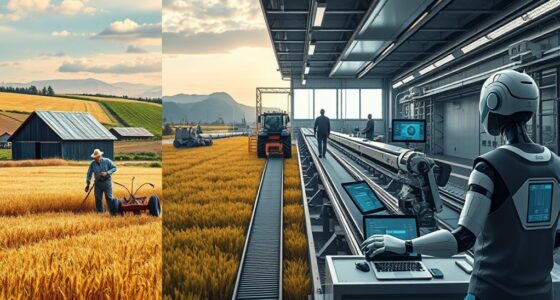

By 2026, automation and AI are set to reshape your job landscape, with nearly half of workers at risk of displacement. Many routine and entry-level roles will be replaced, especially in sectors like manufacturing and administrative support. To stay ahead, you’ll need to develop new skills such as AI oversight, data ethics, and human-AI collaboration. Preparing now can help you adapt and thrive—continue exploring how to navigate this transformative shift effectively.
Key Takeaways
- Nearly 47% of US workers face potential job loss to automation by 2026, requiring proactive reskilling efforts.
- High-risk roles include routine, repetitive jobs across sectors like manufacturing, clerical, and customer support.
- Emphasize developing skills in AI oversight, data ethics, human-AI collaboration, and critical thinking for future resilience.
- Organizations should implement tailored workforce transition strategies, including internal mobility and continuous learning programs.
- Creating a supportive, innovative workplace environment enhances employee well-being and adaptability amid automation changes.
The Current Landscape of AI-Driven Job Displacement

AI-driven job displacement is accelerating rapidly, transforming the workforce across multiple sectors. Nearly half of US workers, about 47%, face the risk of losing their jobs to automation within the next decade. From January to June 2025, AI directly caused almost 78,000 tech job losses, highlighting its growing impact. You might notice that 13.7% of workers report losing jobs to robots, though the actual affected rate could be higher. By 2026, around 37% of companies plan to replace jobs with AI, up from 29%. Many businesses have slowed hiring or conducted layoffs—39% in 2025. This rapid shift means you must stay adaptable, as automation reshapes roles, pressures wages, and demands new skills to remain relevant in this evolving job market. Maximizing your ability to adapt involves understanding the emerging trends in automation and AI and developing skills that complement these technologies.
Sectors and Roles Most Vulnerable to Automation in 2026

As automation accelerates in 2026, certain sectors and roles face a higher risk of significant disruption. You’re most vulnerable in jobs involving routine, repetitive tasks that AI and robots can perform efficiently. Entry-level white-collar roles are especially at risk, with potentially half eliminated in five years. Manufacturing remains heavily affected, with over 1.7 million jobs lost since 2000. Administrative support roles continue declining, while healthcare, education, and AI maintenance grow but still face automation threats. High-salary employees and those lacking AI skills also face layoffs. You should watch for these vulnerable areas to better prepare for the shifts ahead. Staying adaptable and developing new skills can help you navigate these changes more confidently. Additionally, understanding Well-Being Tips can support your mental resilience during periods of transition.
Skills and Roles Gaining Priority in an Automated Economy

With certain roles facing automation threats, the focus shifts toward developing skills that complement and oversee AI systems. You’ll need expertise in AI oversight, data ethics, and prompt engineering to stay relevant. Human-AI collaboration skills will become essential across industries, especially in healthcare, education, and technical fields. Strong analytical, technical, and problem-solving abilities will command higher wages and better job security. As routine tasks become automated, your value will depend on your ability to manage, interpret, and improve AI-driven processes. Adaptability and continuous learning will be critical. Developing these skills now positions you to leverage new opportunities and avoid displacement. Employers increasingly prioritize those who can bridge the gap between technology and human insight, making these roles and skills indispensable for future success. Additionally, understanding AI in Education can provide insights into how automation influences learning environments and workforce demands.
Workforce Transition Strategies and Reskilling Initiatives

To navigate the rapid changes brought by automation, organizations must implement all-encompassing workforce shift strategies and reskilling initiatives. You need proactive plans that help employees transition smoothly into new roles, minimizing disruption. Focus on identifying at-risk positions and developing tailored training programs. Collaborate with educational institutions and online platforms to expand reskilling options. Encourage internal mobility by creating clear pathways for career growth within your organization. Invest in tools that assess skills gaps and track progress. Prioritize communication to keep your workforce engaged and informed. Recognizing the importance of creative practice can also foster innovation and adaptability among staff during transitions.
Economic Impacts: Wage Dynamics and Job Market Shifts

The economic landscape is shifting rapidly as automation reshapes job markets and influences wage structures. You’ll notice wages rising twice as fast in industries exposed to AI compared to less-affected sectors. AI-skilled workers, especially those in oversight, data ethics, or prompt engineering, command higher pay. However, automation also fuels competition, which can lead to wage suppression in some roles. Displaced workers often face wage stagnation or reduction if they lack new skills. The table below highlights key differences:
| Sector | Wage Impact |
|---|---|
| AI-exposed industries | Wages increase faster |
| Routine, low-skill jobs | Wage growth slows or declines |
| High-skill AI roles | Significant wage premiums |
Adapting your skills is essential to benefit from these shifts and avoid falling behind. Staying informed about job market shifts and developing relevant expertise will position you better for the evolving economic landscape.
Timeline of Automation Adoption and Future Projections

Automation adoption is accelerating rapidly, with significant changes expected in the next 18 to 24 months. You’ll see job displacement estimates rising, as millions of roles are replaced or transformed across sectors. Looking ahead, workforce shifts will demand swift reskilling to adapt to the evolving job landscape by 2026 and beyond. Proper maintenance and troubleshooting of technological systems will be critical to ensuring continued productivity and minimizing downtime during this transition.
Adoption Timeline Acceleration
As AI adoption accelerates, the timeline for widespread automation is shifting dramatically, with significant impacts expected in the next 18 to 24 months. You’ll see companies prioritizing automation faster than initially projected, leading to rapid job restructuring. This acceleration is driven by technological advancements, cost efficiencies, and competitive pressures. Increased active listening and empathy in workplace communications can help mitigate some of the social disruptions caused by rapid automation.
- Companies are planning to replace nearly 37% of jobs with AI by 2026, up from 29%.
- Automation projects are moving from pilot phases into full implementation more quickly.
- The rate of job displacement could double compared to earlier estimates.
- Sectors like customer support, clerical work, and manufacturing are adopting automation at unprecedented speeds.
- Investment in AI skills and infrastructure is increasing, fueling faster deployment across industries.
Job Displacement Estimates
With rapid advancements in AI technology, job displacement is expected to accelerate considerably over the next few years. Currently, around 47% of US workers face potential job loss due to automation within a decade. From January to June 2025, nearly 78,000 tech jobs linked to AI were lost, highlighting the immediate impact. Studies estimate that 13.7% of US workers have already lost jobs to robots, though actual affected workers may be higher. By 2026, nearly 37% of companies plan to replace more jobs with AI, up from 29%. While some sectors, like manufacturing and administrative support, experience significant layoffs, new roles in healthcare, education, and AI maintenance will emerge. Overall, automation could displace up to 300 million jobs worldwide by 2030, but new opportunities will also create millions of jobs. Incorporating organization-wide strategies can help businesses adapt more effectively to this transformation.
Future Workforce Shifts
Over the next 18 to 24 months, AI adoption is set to reshape the job market more dramatically than it has in decades. You’ll see rapid shifts in workforce composition, with many roles evolving or disappearing. Companies will increasingly replace routine jobs, especially in clerical, customer support, and entry-level white-collar positions. Expect high-salary workers and those lacking AI skills to face greater layoffs. Some critical trends include:
- Nearly 37% of companies planning to replace jobs with AI by 2026.
- A projected 12–14% of workers needing to switch occupations by 2030.
- Wage premiums for workers with AI and data skills rising across industries.
- Automation affecting up to 300 million jobs worldwide by 2030.
- Greater emphasis on reskilling, especially in AI oversight and human-AI collaboration.
Preparing now is essential for steering through these rapid changes.
Strategies for Employers and Workers to Thrive Amid Transformation

To succeed amid the rapid automation transformation, both employers and workers must proactively adapt their strategies. As an employer, invest in reskilling programs that focus on AI oversight, data ethics, and human-AI collaboration. Emphasize creating roles that augment human skills rather than replace them, fostering a culture of continuous learning. Workers should seek upskilling opportunities, especially in emerging fields like AI maintenance, cybersecurity, and data analysis. Develop adaptable skill sets that are hard to automate, such as critical thinking and emotional intelligence. Stay informed about industry trends and be willing to pivot into new roles. Collaboration between employers and workers—through transparent communication, shared training initiatives, and flexible career pathways—will be essential to thrive in this evolving landscape. Incorporating rustic decor elements and fostering a farmhouse-inspired environment can also enhance workplace well-being and creativity, supporting a more resilient workforce.
Frequently Asked Questions
How Will Small Businesses Be Affected by Automation Trends?
As a small business owner, automation trends will likely increase efficiency and reduce costs, but also pose challenges. You might need to invest in new skills or technology to stay competitive. Some roles, especially routine tasks like data entry or customer support, could be automated, leading to layoffs or restructuring. To thrive, you’ll want to focus on strategic automation, upskilling employees, and adapting your business model to the evolving tech landscape.
What Ethical Considerations Arise With Increased AI Workforce Integration?
You face a dilemma: as AI becomes more integrated into your workforce, ethical concerns loom large. Will you guarantee transparency in AI decisions, protect employee privacy, and prevent biases from skewing opportunities? The choices you make now shape trust and fairness. Delaying action risks undermining morale and reputation. Embrace responsible AI use, set clear standards, and prioritize human values—because the future depends on your ethical resolve today.
How Can Displaced Workers Effectively Transition to New Careers?
You can shift effectively by reskilling in high-demand areas like AI oversight, data ethics, and human-AI collaboration. Take advantage of training programs, online courses, and employer-sponsored initiatives to build new skills. Network within industries, seek mentorship, and stay adaptable to changing job requirements. Focus on developing technical and analytical abilities, which will increase your employability and wage potential in emerging sectors driven by AI and automation.
What Role Will Government Policy Play in Managing Automation Impacts?
They say, “A chain is only as strong as its weakest link,” and government policy will be vital in managing automation’s impact. You can expect policies that promote reskilling, provide safety nets, and encourage ethical AI use. These measures help protect workers, support economic stability, and guarantee that technological progress benefits everyone. Active government involvement can ease the shift, making sure no one is left behind in the automation era.
How Might Automation Influence Income Inequality Across Different Regions?
Automation will likely widen income inequality across regions by replacing low- and middle-skill jobs more rapidly in some areas, leaving workers with fewer opportunities. You might notice higher-income regions benefiting from AI-driven productivity and higher wages, while lower-income areas face job losses and reduced economic growth. To stay ahead, you should focus on developing skills in AI, data, and tech-related fields, which can help bridge the inequality gap.
Conclusion
As automation accelerates toward 2026, the changes aren’t just on the horizon—they’re already shaping your future. Will you adapt quickly enough to stay ahead, or be left behind? The next wave of technological transformation promises both challenges and opportunities. Now’s the time to prepare, reskill, and stay flexible. Because in this fast-evolving landscape, those who act now will determine whether they thrive or fall behind—your move could make all the difference.