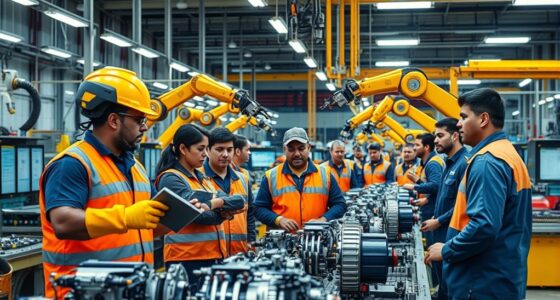
Entrepreneurship notably helps absorb automation’s impact by creating new jobs and fostering innovation across industries. Startups adapt quickly to market shifts, develop niche solutions, and leverage digital tools to grow. They also promote inclusive growth, bridge skills gaps, and build resilient ecosystems with policy support. While challenges exist, startups’ agility and focus on sustainability can turn automation into opportunity. Exploring this balance further uncovers how startups can shape a dynamic, future-ready workforce for all.
Key Takeaways
- Startups can create new jobs by leveraging automation for innovative products and services, offsetting routine job losses.
- Entrepreneurship fosters agility, enabling startups to quickly adapt and fill niche markets created by automation.
- Startups promote sustainable and inclusive growth, closing resource and gender gaps while expanding employment opportunities.
- Through upskilling and reskilling initiatives, startups help workers transition into emerging roles driven by automation.
- Ecosystem support and policy incentives enhance startup scalability, maximizing their potential to absorb automation’s workforce impact.

Dynamite Startup Tool Set Metric DYN2834 Hand Tools Misc
Contains most every tool needed in order to maintain a vehicle
As an affiliate, we earn on qualifying purchases.
As an affiliate, we earn on qualifying purchases.
The Growing Role of Startups in a Disrupted Workforce

Startups are increasingly essential in shaping the disrupted workforce driven by automation. You play a crucial role in creating new job opportunities that offset routine job losses. By introducing innovative services and products, startups adapt quickly to changing market demands, often leveraging digital tools and automation to boost efficiency and reach. Your agility allows you to access niche markets, providing employment that’s more resilient to automation’s effects. With a focus on sustainability and inclusivity, startups can also lead in closing gender and resource gaps, expanding job creation globally. As automation continues to transform industries, your entrepreneurial efforts drive economic growth and help absorb displaced workers, ensuring a more dynamic and adaptable workforce that evolves alongside technological advancements. Additionally, understanding the impact of automation on employment enables startups to better anticipate market needs and develop strategies that foster resilience and growth.

AI-Displaced Workers: Corporate AI Training & Upskilling Programs
As an affiliate, we earn on qualifying purchases.
As an affiliate, we earn on qualifying purchases.
Automation’s Dual Impact on Employment Opportunities

Automation is reshaping employment by displacing some jobs while creating new ones, especially through startups. However, many workers face skills gaps, making it hard to shift into emerging roles. This dual impact presents both challenges and opportunities for entrepreneurs to innovate and fill workforce needs. Emphasizing training programs can help bridge the skills gap and enable a smoother transition for workers into the evolving job market.
Job Displacement vs. Creation
While automation transforms industries rapidly, it brings both job displacement and creation in its wake. You might see routine jobs, especially in manufacturing and administrative roles, vanish as machines take over repetitive tasks. Yet, automation also opens new opportunities—roles in AI development, data analysis, and maintenance emerge, requiring different skills. By 2030, automation is expected to displace 92 million jobs but create 170 million new ones, leading to a net gain. Startups can play a pivotal role here, adapting quickly and innovating new products or services. They can absorb some displaced workers by providing new roles that leverage human creativity, problem-solving, and emotional intelligence—areas machines still struggle with. Honda Tuning knowledge highlights that customization and innovative upgrades often require human expertise, which startups can utilize to create new niches. So, while displacement is a genuine concern, the potential for new job creation offers hope for a balanced transition.
Skills Gap Challenges
As automation transforms industries, it creates a dual challenge by widening the skills gap in the workforce. You may find that many jobs now demand advanced technical skills, yet a significant portion of workers lack proper training. This mismatch hampers your ability to fill roles that automation generates, especially in tech-driven sectors. Upskilling and reskilling become essential for workers to stay relevant, but access to quality education remains limited for some. Startups can help bridge this gap by fostering training programs and offering real-world learning opportunities. However, the pace of technological change often outstrips workforce adaptation, leaving many underprepared. Addressing the skills gap requires concerted effort from entrepreneurs, governments, and educational institutions to ensure workers can seize emerging opportunities. Recognizing regional heritage sites and their preservation can also inspire innovative approaches to workforce development in various communities.
Startup Opportunities Growth
Despite the challenges automation poses to traditional employment, it also opens up significant opportunities for startups to thrive and create new jobs. As automation transforms industries, startups can leverage digital tools and AI to innovate rapidly, meet emerging market needs, and expand their reach. Service-based startups especially benefit, as they often double their survival chances and generate resilient employment. Investing in marketing and automation helps these businesses grow faster, attracting more customers and opening new roles. The increasing adoption of AI and automation also creates specialized jobs in tech, data analysis, and AI development. By focusing on innovative solutions and niche markets, startups can capitalize on automation’s dual impact—displacing routine jobs while simultaneously generating new employment opportunities and fostering economic growth. Additionally, understanding Paint Sprayer Reviews & Buying Guides can inspire innovative product development and niche market targeting within the startup ecosystem.

dot. Card – Digital Business Card – Tap Compatible with iPhone & Android (Black)
No app or device requirement: Share your dot.Profile with anyone, as others don't need an app or a…
As an affiliate, we earn on qualifying purchases.
As an affiliate, we earn on qualifying purchases.
How Entrepreneurs Are Shaping Sustainable Business Models

Entrepreneurs are actively shaping sustainable business models by prioritizing environmental and social responsibility alongside profitability. You’re integrating eco-friendly practices, like reducing waste and conserving resources, into your core operations. Many startups are adopting circular economy principles, designing products for reuse and recyclability, which minimizes environmental impact. Social responsibility is also front and center; you’re empowering local communities, promoting fair labor, and supporting diversity. These efforts not only meet consumer demand for ethical brands but also differentiate your business in competitive markets. By embedding sustainability into your value proposition, you create long-term resilience and appeal to conscious consumers. This approach fosters innovation, attracts talent, and opens new markets, proving that profitability and sustainability can go hand in hand. Additionally, fostering active listening and empathy within your team and with stakeholders enhances collaboration and drives sustainable growth.

The Inclusive Organization: Real Solutions, Impactful Change, and Meaningful Diversity
As an affiliate, we earn on qualifying purchases.
As an affiliate, we earn on qualifying purchases.
Industry Sectors Leading the Automation and Startup Synergy

You’ll notice that healthcare, finance, and retail are leading industries in combining automation with startup innovation. These sectors are leveraging AI and automation tools to improve diagnostics, streamline risk management, and personalize customer experiences. Exploring how each industry adapts can reveal key opportunities for startups aiming to capitalize on automation trends. For example, the financial sector is increasingly adopting wealth management strategies to optimize investment portfolios and enhance client services.
Healthcare Innovation Drives Growth
Healthcare innovation is rapidly advancing through the integration of automation and startup-driven solutions, transforming diagnostics, treatment personalization, and patient management. You’ll see AI-powered tools diagnosing diseases faster and more accurately, reducing human error. Personalized treatment plans are now created using machine learning algorithms that analyze individual data, improving outcomes. Startups are developing remote monitoring devices and telehealth platforms, expanding access and efficiency in patient care. Automation streamlines administrative tasks like scheduling, billing, and data management, freeing healthcare professionals to focus on patient interaction. These innovations lead to faster diagnoses, tailored therapies, and better resource allocation. The use of bee pollination data and insights can further optimize crop yields and agricultural productivity, showcasing the diverse applications of automation-driven solutions. As startups continue to push boundaries, healthcare becomes more effective, cost-efficient, and accessible—driving growth while creating new employment opportunities within the industry.
Finance Streamlines Risk Management
Automation is revolutionizing risk management across the finance industry by enabling faster, more accurate analysis and decision-making. You can now detect fraud, assess credit risks, and monitor market volatility in real-time, reducing errors and response times. Startups are leveraging AI-driven tools to streamline compliance, automate audits, and improve predictive analytics. This synergy accelerates financial processes, minimizes losses, and enhances security.
| Industry Role | Impact |
|---|---|
| Fraud Detection | Rapid, precise identification of threats |
| Credit Risk Assessment | Real-time, data-driven evaluations |
| Compliance & Audits | Automated, error-free reporting |
| Market Monitoring | Instant insights for decision-making |
| Customer Verification | Faster, secure onboarding |
Retail Enhances Personalization
Retailers harness automation to deliver highly personalized shopping experiences that cater to individual preferences and behaviors. By leveraging AI-driven tools, you can analyze customer data in real-time, tailoring product recommendations, promotions, and content to each shopper. This level of personalization boosts engagement, increases conversion rates, and fosters loyalty. Automated chatbots provide instant support, guiding customers through their journey seamlessly. Inventory management systems predict demand patterns, ensuring the right products are available at the right time. Startups specializing in retail automation innovate rapidly, creating more efficient, customer-centric solutions. As a result, retail businesses can differentiate themselves in competitive markets, generate more revenue, and create new jobs focused on data analysis, customer experience design, and technology implementation. This synergy amplifies both startup growth and employment opportunities in the retail sector.
Overcoming Challenges: Failures and Risks in Automation-Driven Entrepreneurship

Despite the promising growth of automation in entrepreneurship, many startups face significant risks and challenges that can lead to failure. One major hurdle is the high rate of automation projects that don’t meet their goals—around 70% fail, often due to poor implementation, data issues, or lack of skilled talent. You might also encounter resistance from employees wary of automation replacing their jobs, which can hinder progress. Limited resources and infrastructure pose additional risks, especially for small startups trying to scale automation tools. Fear of failure can discourage you from even starting, while misaligned expectations can lead to costly setbacks. To succeed, you need careful planning, continuous learning, and a willingness to adapt to technological complexities and organizational changes. Regular updates on cookie policies and understanding user preferences can also help build trust and transparency with your team and customers.
Strategies for Startups to Leverage Digital Tools and Automation

To leverage digital tools and automation effectively, start by automating routine tasks to free up your team’s time for strategic work. Invest in digital marketing to expand your reach and attract customers more efficiently. Additionally, enhance data analytics capabilities to make smarter decisions and stay ahead of industry trends.
Automate Routine Tasks
Leveraging digital tools and automation is essential for startups aiming to streamline their operations and stay competitive. To effectively automate routine tasks, start by identifying repetitive processes like invoicing, data entry, and customer follow-ups. Use tools such as Robotic Process Automation (RPA) and workflow management software to handle these tasks, freeing your team to focus on strategic initiatives. Integrate these tools into your existing systems for seamless operation. Keep training your staff to adapt to new technologies and monitor automation performance regularly. Automating routine tasks reduces errors, speeds up processes, and lowers costs. Incorporating wall organization systems can also help in maintaining a well-structured workspace that supports your automation efforts. By leveraging these strategies, you not only improve operational efficiency but also create room for innovation and growth, positioning your startup to better absorb the impacts of automation and foster job creation.
Invest in Digital Marketing
Investing in digital marketing enables startups to expand their reach and accelerate growth by utilizing powerful automation tools. These tools streamline customer outreach, optimize ad spend, and personalize messaging at scale. To leverage digital marketing effectively, consider these strategies:
- Automate email campaigns to nurture leads and boost conversions with targeted content.
- Use social media automation to maintain consistent posting and engage audiences across platforms.
- Implement chatbots for instant customer support, enhancing user experience and reducing response times.
- Analyze digital data regularly to refine campaigns, identify trends, and improve ROI.
Enhance Data Analytics
Enhancing data analytics is essential for startups aiming to stay competitive in a rapidly evolving digital landscape. You can leverage digital tools and automation to gather, analyze, and act on data more efficiently. Implement advanced analytics platforms that integrate AI and machine learning to identify patterns, forecast trends, and optimize decision-making. Automating data collection reduces errors and accelerates insights, freeing your team for strategic tasks. Use visualization tools to communicate findings clearly and drive informed actions.
| Strategy | Benefit |
|---|---|
| Automate data collection | Faster insights, fewer errors |
| Integrate AI/ML tools | Predictive analytics and trend forecasting |
| Data visualization software | Clearer communication, better decision-making |
| Continuous monitoring | Real-time adjustments and improved responsiveness |
Gender Gaps and Inclusive Growth in Startup Ecosystems

Despite significant progress in entrepreneurship, gender gaps persist within startup ecosystems, limiting inclusive growth. These disparities hinder talent utilization and economic potential. To address this, you should consider that:
- Women-led startups are 20% less likely to secure funding, restricting scalability.
- Female entrepreneurs face higher failure rates, often due to limited access to resources and networks.
- Only about 30% of startup founders globally are women, indicating underrepresentation.
- Closing gender gaps could boost global GDP by up to 20%, emphasizing untapped market potential.
Fostering gender-inclusive environments enhances innovation, resilience, and job creation. Your efforts to access these gaps can unlock diverse perspectives and expand entrepreneurial impact across economies.
The Resilience of Service-Based Startups Amid Automation Trends

Service-based startups demonstrate remarkable resilience amid automation trends because they often rely on human-centered interactions and specialized expertise that technology can’t easily replace. Your success depends on personalized service, emotional intelligence, and nuanced understanding—areas where automation struggles. As routine tasks become automated, your focus shifts to building relationships, offering tailored solutions, and providing exceptional customer experiences. This differentiation makes service startups less vulnerable to displacement and more adaptable to technological changes. Additionally, digital tools and automation streamline operations, freeing your team to concentrate on core competencies. By leveraging technology for efficiency while maintaining a human touch, your startup can thrive despite automation’s rise. This resilience not only sustains jobs but creates new opportunities for growth and innovation within your sector.
Investing in Skills and Resources for Future-Ready Entrepreneurs

To succeed in an increasingly automated world, you must invest in developing the right skills and gathering essential resources. First, focus on digital literacy to navigate AI tools, data analytics, and automation platforms efficiently. Second, enhance your entrepreneurial mindset by learning agility, resilience, and innovation strategies. Third, acquire technical skills like coding, cybersecurity, or machine learning to stay competitive. Fourth, build a robust network and access to mentorship, funding, and industry insights that keep you adaptable. These investments enable you to leverage automation for growth, reduce failure risks, and seize emerging opportunities. By prioritizing skill-building and resource acquisition, you position yourself as a future-ready entrepreneur capable of thriving amidst rapid technological change.
Policy and Ecosystem Support for Startup-Driven Job Creation

Effective policy and a supportive ecosystem are essential for startups to drive job creation in an era of rapid automation. Clear regulations, accessible funding, and innovation hubs empower entrepreneurs to grow and hire. Governments can facilitate this by offering tax incentives, simplifying business registration, and investing in digital infrastructure. A vibrant startup ecosystem includes mentorship programs, networking events, and talent pipelines that attract skilled workers. These elements help startups scale quickly, creating more jobs despite automation’s displacement effects. Consider the table below, which highlights key support areas:
| Support Area | Example Initiatives |
|---|---|
| Financial Incentives | Tax breaks, grants, seed funding |
| Infrastructure | Digital hubs, coworking spaces |
| Education & Training | Skills programs, startup accelerators |
| Regulatory Environment | Streamlined registration, IP laws |
| Networking & Mentorship | Industry events, mentorship programs |
Together, these policies build resilient ecosystems that enable startups to generate employment opportunities.
Frequently Asked Questions
How Can Startups Effectively Balance Automation Adoption With Job Creation?
You can effectively balance automation adoption with job creation by focusing on integrating technology to boost efficiency while maintaining a strong emphasis on hiring and training. Invest in upskilling your team to handle new roles, especially in customer service and strategic areas where humans excel. Use automation to eliminate repetitive tasks, freeing employees to innovate and grow your business, creating more jobs and fostering sustainable growth.
What Strategies Do Successful Startups Use to Attract Talent in Automated Industries?
You attract talent in automated industries by emphasizing growth opportunities and innovation. Offer training programs to upskill employees, making them valuable assets in your tech-driven environment. Foster a culture of adaptability and continuous learning, which appeals to ambitious professionals. Highlight your startup’s mission to drive change and create impact. Use competitive compensation and flexible work arrangements to stand out. Engaging storytelling about your vision also draws passionate, tech-savvy talent enthusiastic to shape the future.
How Does Automation Influence the Innovation Capacity of New Entrepreneurial Ventures?
Automation acts like a catalyst, igniting your startup’s innovation fire. It frees you from routine tasks, allowing your creative ideas to soar like sparks from a forge. With AI and automation handling repetitive work, you can focus on disruptive solutions and unique market niches. This boost in efficiency fuels your entrepreneurial spirit, turning your venture into a dynamic innovator, capable of shaping new industries and carving out fresh opportunities.
What Policies Best Support Startups in Leveraging Automation for Sustainable Growth?
You should support policies that provide startups with access to affordable automation tools and training programs, enabling them to innovate and scale sustainably. Encourage tax incentives for investments in AI and automation, and foster collaborations between startups and tech providers. Simplify regulatory processes to reduce barriers, and promote inclusive policies that empower underrepresented entrepreneurs. These measures help startups leverage automation effectively, drive economic growth, and create resilient, sustainable jobs.
How Can Entrepreneurs Mitigate Risks Associated With Automation Failures?
Remember, “fail to plan, plan to fail.” To mitigate automation risks, you should thoroughly test new systems on small scales before full deployment, ensuring they meet your goals. Diversify your tech investments to avoid over-reliance, and keep staff trained to adapt to changes. Regularly review automation outcomes, making adjustments as needed. Building a resilient, flexible strategy helps you navigate failures and seize automation’s full potential.
Conclusion
As you navigate this evolving landscape, remember that startups, like the mythical phoenix, can rise from automation’s ashes. By embracing innovation, honing skills, and advocating for inclusive policies, you can turn disruption into opportunity. Don’t forget, even in a world racing toward the future, the human touch remains irreplaceable. With resilience and adaptability, you’re not just surviving—you’re shaping a sustainable, thriving workforce for tomorrow.