
Managed service providers and enterprise IT teams share the same problem from opposite sides of the table: the infrastructure is healthy, but nobody can see it. Static monthly PDF reports, screenshots pasted into slide decks, and “trust us, it’s fine” status calls don’t scale — and they don’t build confidence with the executives, auditors, and customers who keep asking the same question in different words: how do I know?

Get business pricing on tech for your team
- Business-only prices and quantity discounts
- Tax-exempt purchasing
- Multiple users, one account, clear invoices
Glasspane is an answer to that question, and the interesting thing about it isn’t the dashboard. Plenty of tools draw charts. The interesting thing is the thesis underneath: that transparency compounds — that trust in your infrastructure, trust in the AI interpreting it, and the ability to hand that trust to the people who need it are not four separate features but one idea building on itself. This piece is about what Glasspane is, the design decision that makes it more than another monitoring panel, and what its three newest capabilities actually deliver.
When transparency itself becomes the product
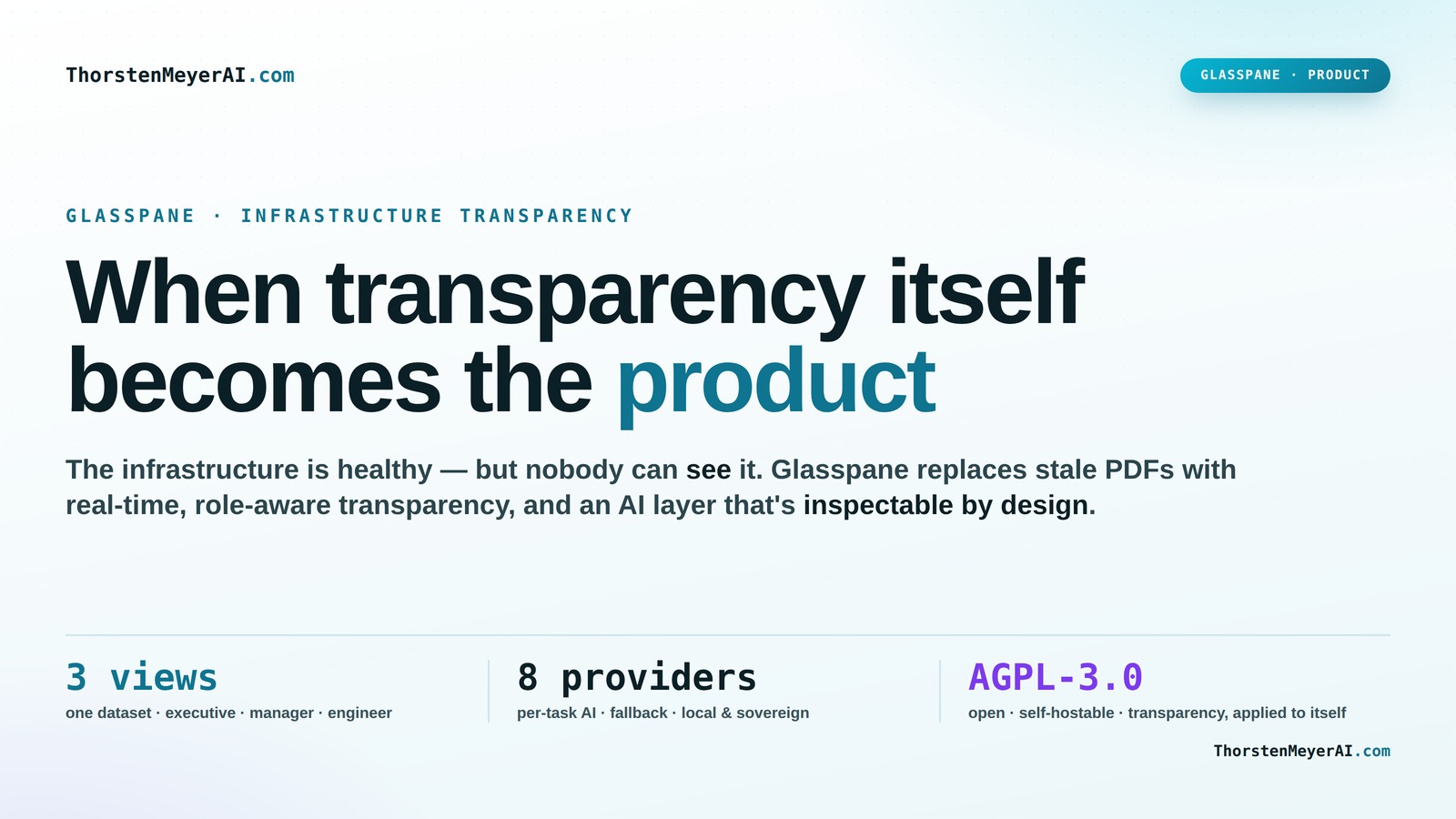
The infrastructure is healthy — but nobody can see it. Static PDFs and “trust us” status calls don’t scale. Glasspane replaces them with real-time, role-aware transparency, and an AI layer that explains what’s happening, why it matters, and what to do next.
“It’s healthy — trust us” doesn’t scale
MSPs and enterprise IT share the same problem from opposite sides of the table: the same question, asked over and over in different words — how do I know?
- Monthly PDF reports, already out of date
- Screenshots pasted into slide decks
- “Trust us, it’s fine” status calls
- Real-time status, not last month’s
- The right view for each audience
- AI that says what to do next
One dataset, three audiences
The CFO, the account manager, and the on-call engineer look at the same infrastructure — but need completely different things from it. A dashboard that forces a CFO to read latency histograms is a dashboard the CFO closes. Switch the role and watch the same data re-present itself.
Role-aware presentation
The data underneath is identical. Only the framing changes — fitted to whoever’s asking.
Model-agnostic — and inspectable by design
The AI turns what is happening into why it matters and what to do next. Two architectural choices keep that layer from becoming a liability.
Eight providers · assign per task · automatic fallback
If a primary provider fails, the next takes over transparently. Run a local model and sensitive infrastructure data never leaves your network.
Per-task + fallback chains
A different provider per task with one env var each; define a chain so a failure fails over, not down.
AGPL-3.0 · self-hostable
A transparency tool that can’t be audited would be a contradiction. Every line is inspectable.
Each feature extends the same thesis
None is really standalone. Each pushes transparency onto a new surface — the people, the AI itself, and the outsiders who need to see in.
Transparency for the people who run it
Career-ladder progression, growth signals, skills & goals — with AI generating evidence-backed development recommendations grounded in the next rung. Turns reviews from anecdote into evidence.
The tool that watches itself
Telemetry on every AI call — latency, errors, fallback events, version drift — across 1h / 24h / 7d. Alerts on degradation or version drift; every result footnotes the exact provider, model, version & latency.
Trust, delivered safely
Time-limited, role-based public links. Choose an audience, curate widgets from a public-safe whitelist, set an expiry. A read-only “Transparency Center” — no login, nothing you didn’t share.
Transparency compounds
Each layer is only as valuable as the one beneath it is credible — which is exactly why one coherent system beats bolting any single piece onto a tool that hasn’t earned the layers below.
The compounding stack
Infrastructure data
earns a customer’s trust — SLAs, security, cost, operations
Model Transparency
earns trust in the AI interpreting that data — no unaccountable black box
Public Sharing
delivers that trust directly & safely to the people who need it
Workforce Growth
extends the same evidence-based philosophy to the team behind it
The core move: one dataset, three audiences
Start with the problem most dashboards never solve. The CFO, the account manager, and the on-call engineer are all looking at the same infrastructure — but they need completely different things from it, and a single chart-wall serves none of them well. The executive wants “are we meeting our commitments and what’s it costing.” The business manager wants “which accounts are at risk and what do I tell the client.” The engineer wants “what’s actually broken and where.”
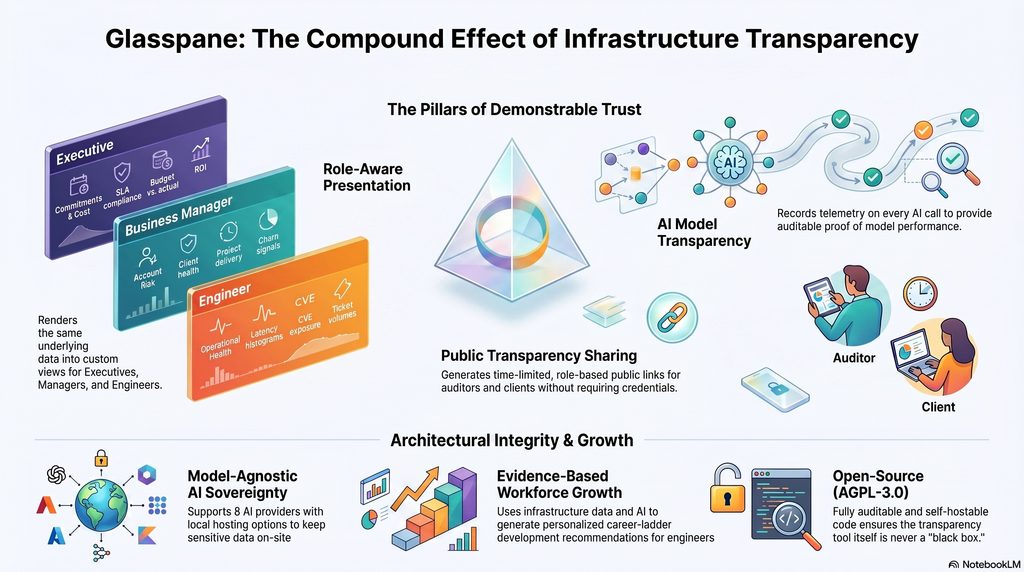
Glasspane’s central design decision is role-aware presentation: the same underlying data, rendered three different ways for three different audiences, rather than one generic view everyone has to squint at and translate. That sounds simple. It’s the thing that determines whether a transparency tool is actually used or quietly ignored, because a dashboard that forces a CFO to read latency histograms is a dashboard the CFO closes. The data is identical underneath; the framing is fitted to who’s asking.
What that data covers is exactly the set of things stakeholders actually ask about. Availability and SLAs — live service status, latency, and a 99.999% availability target tracked against real-time compliance gauges. Security and compliance — posture scoring, CVE exposure, patch compliance, certificate expiry, backup health. Cost — budget versus actual, month-over-month trends, per-service breakdowns. And operations — ticket volumes, project delivery status, change success rates. The four questions every status call circles, in one portal, framed for whoever’s looking.
real-time infrastructure monitoring dashboard
As an affiliate, we earn on qualifying purchases.
As an affiliate, we earn on qualifying purchases.
The AI layer, stated honestly
On top of that data sits an AI layer, and it’s worth being precise about what it does rather than waving at “AI-powered.” Instead of leaving humans to interpret charts, Glasspane generates natural-language summaries of what the data shows, flags anomalies, forecasts risk, and answers plain-English questions through a streaming chat assistant. The useful framing is that it turns what is happening into why it matters and what to do next — the translation layer between a metric moving and a human deciding.
Two architectural choices keep that layer from becoming a liability. The first is that Glasspane is model-agnostic to an unusual degree — it supports eight AI providers (OpenAI, Anthropic, Google Gemini, IBM watsonx, OpenRouter, AWS Bedrock, Ollama, and LM Studio), lets you assign a different provider per task, and lets you define automatic fallback chains so that if a primary provider fails, the next takes over transparently. Crucially, you can run Ollama or LM Studio locally, which means sensitive infrastructure data never has to leave your network to be interpreted — a genuine data-sovereignty position rather than a checkbox. The second choice is that the whole thing is open source under AGPL-3.0. For a tool whose entire premise is transparency, being itself inspectable, auditable, and self-hostable isn’t a footnote — it’s the premise applied to itself. A transparency tool you can’t audit would be a contradiction in terms.
As an affiliate, we earn on qualifying purchases.
What’s new — three faces of one idea
The latest release adds three capabilities, and the reason they’re worth covering together is that none of them is really a standalone feature. Each extends the same compounding-transparency thesis to a new surface.
Workforce Growth extends transparency from the infrastructure to the people who run it. A manager selects an engineer and sees their career-ladder progression, growth signals (engagement and opportunity-readiness scores), skills, and goals — and the AI generates personalized, evidence-backed development recommendations, each grounded in that person’s role, their stated goals, and the expectations of the next rung on their ladder. The point isn’t to automate management; it’s to turn performance conversations from anecdote into evidence. For an enterprise, retention and capability are board-level concerns, and this gives engineering leaders a defensible, data-driven way to plan promotions, close skill gaps, and document development conversations. For an MSP, whose product genuinely is its people, demonstrating a structured, AI-assisted growth path helps win talent, reduces churn on critical accounts, and signals operational maturity to prospective clients. (A fair caveat worth stating: people aren’t infrastructure, and any system that scores engineers should be used to inform human judgment, not replace it — the evidence is an input to a conversation, not a verdict.)
AI Model Transparency is the feature I find most telling, because it’s the tool watching itself. Since Glasspane runs AI across many providers, it now records telemetry on every AI call — latency, success and error rates, fallback events, and version drift — across configurable windows of one hour, 24 hours, or seven days. It raises alerts when a model’s quality degrades or when multiple model versions show up in the same window, and every AI-generated result carries a footnote naming the exact provider, model, version, and latency behind it. This matters because “the AI said so” is not an acceptable basis for an operational decision. Model Transparency provides auditable provenance — proof of which model produced which insight and how reliably it performed — which is exactly what risk, compliance, and governance teams increasingly require. For a service provider whose sold insights are underpinned by AI, its reliability is your reliability; real-time model health lets you catch a degrading or drifting provider before it produces a bad recommendation in front of a customer. It’s a rare and welcome thing: an AI feature whose job is to keep the other AI features honest.
Public Transparency Sharing is where the trust gets delivered. Glasspane can now generate time-limited, role-based public links: from settings you choose an audience (Executive, Operations, or Service), curate which widgets are exposed from a whitelist of pre-approved, public-safe panels, and optionally set an expiry. The link encodes that selection into a secure token and opens a read-only “Transparency Center” — no login, no access to anything you didn’t explicitly share. For enterprises, auditors and regulators and executives often need a live view without an account or a standing seat in your tooling, and expiring, scoped links provide exactly that: controlled visibility with a built-in end date and zero credential management. For service providers, this is transparency as a differentiator — instead of emailing a monthly PDF, you hand each client a live, branded, read-only window into the metrics that matter to their role. It is the single fastest way to convert “trust us” into “see for yourself,” and it scales to every account without giving anyone more access than intended.
AI-powered network monitoring software
As an affiliate, we earn on qualifying purchases.
As an affiliate, we earn on qualifying purchases.
Why the pieces reinforce each other
Lay the three out and the compounding becomes visible. Infrastructure data earns a customer’s trust. Model Transparency earns trust in the AI that’s interpreting that data — closing the obvious loop where you’d otherwise be asked to trust an unaccountable black box. Public Sharing delivers that trust directly and safely to the people who need it. And Workforce Growth extends the same evidence-based philosophy to the team behind the whole operation. Each layer is only as valuable as the one beneath it is credible — which is precisely why doing them as one coherent system beats bolting any one of them onto a tool that hasn’t earned the layers below.
All four rest on the same foundations that define Glasspane: role-aware presentation, provider-agnostic AI with automatic fallback, recorded telemetry, and graceful handling when something fails. That last one matters more than it sounds — a transparency tool that hides its own failures would undermine the entire premise, so the honest move is to surface them.
self-hosted infrastructure visibility platform
As an affiliate, we earn on qualifying purchases.
As an affiliate, we earn on qualifying purchases.
Who it’s actually for
The shape of who benefits follows directly from the design. An enterprise IT leader gets real-time SLA, cost, and security posture with AI summaries — plus auditable AI provenance and people-development insight for governance and planning. A managed service provider gets a live, brandable transparency portal shareable per-client through scoped, expiring links, backed by reliable, observable multi-provider AI. A compliance or risk team gets open-source, self-hostable tooling with model-level telemetry and read-only external views that satisfy “show, don’t tell” requirements. And an engineering manager gets AI-assisted, evidence-backed growth recommendations grounded in each engineer’s actual career ladder rather than a generic template.
The honest read
Most observability tools answer “is it up?” Glasspane is making a larger bet: that in a world where infrastructure is increasingly reliable and increasingly interpreted by AI, the scarce thing isn’t uptime — it’s demonstrable trust, the kind you can hand to an auditor, a client, or a board without a credential or a caveat. The three new features are each a piece of that: trust in the data, trust in the AI reading it, and trust delivered safely to whoever’s asking.
Whether transparency-as-a-product is the right frame for your operation depends on who you have to convince and how often. If your honest answer to “how do I know it’s healthy?” is still a monthly PDF and a status call, the gap Glasspane closes is a real one. And because it’s AGPL-3.0 and self-hostable down to a locally-run model, you can evaluate that claim the same way the tool asks you to evaluate everything else: by seeing for yourself, with the sensitive data never leaving your network.
Glasspane is open source under AGPL-3.0 — self-hostable, with 16 AI-powered features, 8 provider options, and three role-based views. Repository: github.com/MeyerThorsten/Glasspane.
© 2026 · Glasspane is powered by Thorsten Meyer AI.
Fall Picks
fall essentials
As an affiliate, we earn on qualifying purchases.