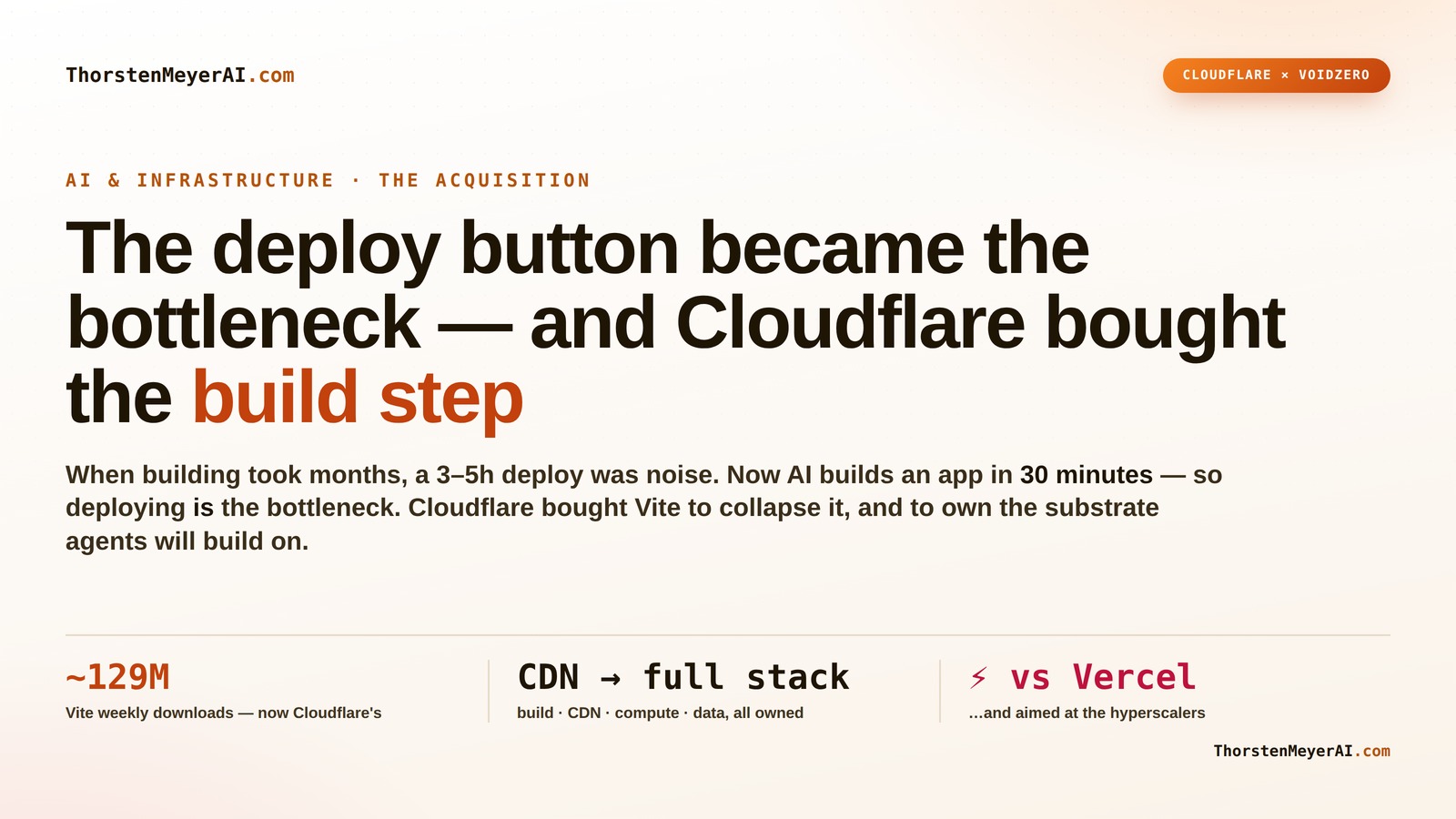

Something has quietly inverted in how software gets made, and the VoidZero acquisition is the clearest sign yet that the industry has noticed.
Open a free Amazon Business account
Business pricing, bulk buying and tax-exempt orders.
Create a free accountAs an affiliate, we earn on qualifying purchases.
For most of the history of web development, the ratio was lopsided in a comfortable direction. Building an application took weeks or months. Deploying it took a few hours. When the build is measured in months, a three-to-five-hour deployment is a rounding error — nobody optimizes the thing that costs 1% of the timeline. You wrote the code, you wrestled the pipeline into shape once, and you moved on.
That ratio has flipped. In 2026, with AI coding assistants doing the bulk of the typing, a working application — a real one, with a frontend, an API, and a database — can come together in thirty minutes to a few hours. Matthew Prince put the shift plainly: the best engineers he knows are shipping more code than ever, and writing less of it by hand. And the moment building collapses from months to minutes, the math changes completely. The three-to-five-hour deployment that used to be a rounding error is now the single largest line item in your timeline. The bottleneck moved. It moved from writing the thing to shipping the thing — and the worst offenders are exactly the applications worth building: complex dashboards, multi-service SaaS, anything with more than one moving part, where wiring up the build toolchain, the bundler, the edge config, and the deploy target is its own little project.
This is the problem VoidZero joining Cloudflare is built to attack, and it’s worth understanding why these two companies in particular fit together.
The deploy button became the bottleneck — and Cloudflare just bought the build step
When building an app took months, a 3–5 hour deploy was a rounding error. Now that AI builds an app in 30 minutes, deployment is the bottleneck — worst for complex dashboards & multi-tool SaaS. Cloudflare bought the web’s most-used build toolchain to collapse it.
The bottleneck moved — from writing to shipping
“The best engineers I know are shipping more code than ever, and writing less of it by hand.” — Matthew Prince. When build collapses from months to minutes, the deploy you never optimized becomes the largest line item.
As an affiliate, we earn on qualifying purchases.
Cloudflare just expanded into the full stack
My old mental model put Cloudflare in three boxes — CDN, compute, database. VoidZero adds the layer it only sat downstream of: the build step. Toggle the platform and watch the coverage.
Stack coverage — who owns which layer
The same layers from the napkin sketch. Vercel sits high but narrow; Cloudflare now spans the stack.
build pipeline management software
As an affiliate, we earn on qualifying purchases.
As an affiliate, we earn on qualifying purchases.
The toolchain under a huge slice of the web
An acqui-hire — the whole VoidZero team joins Cloudflare’s Emerging Technology & Incubation org, with Evan You (creator of Vue.js) still leading the open-source roadmap.
VoidZero’s portfolio
A unified, high-performance JavaScript toolchain — the foundation under Vue, Nuxt, SvelteKit & Astro.
As an affiliate, we earn on qualifying purchases.
Owning the substrate agents will build on
The deployment story is the surface. Underneath is a year-long bet on the agentic world — and the company most exposed to it is Vercel.
Build agents in minutes, not months
- Workers AI — inference on its own edge GPUs
- Workflows — durable multi-step runs (GA)
- Remote MCP server — industry-first, agents reach tools
- Durable Objects — stateful memory at the edge
Vercel’s two structural problems
- Dependency: much of what it deploys is built with Vite — now governed by its rival
- Architecture: Vercel runs on AWS — you pay AWS infra + Vercel’s margin on top
- Cloudflare owns its hardware → AI features 3–5× cheaper at scale
- Fair point: Vercel’s Next.js depth & DX remain real advantages
cloud infrastructure deployment solutions
As an affiliate, we earn on qualifying purchases.
As an affiliate, we earn on qualifying purchases.
Watch the database tier — and the hyperscalers
If the strategy is “own every layer,” one tier still lacks the crown jewel: the reactive backend. And the real campaign isn’t Vercel — it’s AWS, Azure & Google.
Convex — the reactive-backend gap
Cloudflare has the primitives (D1 + Durable Objects + Workers) but not the developer experience. Convex lets you treat backend state like React state — reactive by default, the genuinely hard part. Developers are already asking who’ll build “Convex on Cloudflare,” because the primitives are all there.
The primitives
Edge SQLite (D1), stateful objects, Workers — but D1 lacks reactive-by-default.
The experience
Reactive data, ~$53.5M raised (a16z) — the delightful layer on top of those primitives.
The bigger war: Cloudflare vs. the hyperscalers
Vercel is a skirmish. The real campaign is positioning as the neutral, edge-native alternative to AWS / Azure / GCP — winning at the moment of creation, not procurement.
Neutrality
The “neutral” layer, no lock-in — R2 has no egress fees vs. the big clouds.
Architecture
Integrated global fabric — code within 50ms of 95% online, not a distant region.
Agentic wedge
Edge-native inference suits an internet where agents are a huge share of traffic.
Q1 2026 revenue $639.8M, +34% YoY. You don’t out-AWS AWS on breadth — you make the build-and-ship loop so fast & cheap that the next generation of apps is born on your network and never leaves.
A fraction of any hyperscaler’s size. If AWS/Azure slash egress fees, the storage wedge blunts. Bigger rivals can compete at zero margin & bundle — and the stock is “priced for perfection.”
What Cloudflare actually bought
On June 3–4, 2026, Cloudflare announced it had acquired VoidZero — the company founded by Evan You, creator of Vue.js, to build a unified, high-performance JavaScript toolchain. The portfolio is the part that matters: VoidZero is the company behind Vite, Vitest, Rolldown, Oxc, and Vite+. This is not a niche tool. Vite now sees roughly 129 million weekly downloads, and it is the foundation underneath an enormous swath of the modern web — the project forms the basis for a variety of frameworks, including Vue, Nuxt, SvelteKit, and Astro.
It’s an acqui-hire: all team members of VoidZero are joining Cloudflare, landing in the company’s Emerging Technology and Incubation organization with Evan You continuing to lead the open-source roadmap. The framing in Cloudflare’s own announcement is the giveaway about intent — the goal is a frictionless, one-click deployment stack from local code straight to Cloudflare’s global network. That sentence is the whole thesis. The build toolchain and the deploy target, fused into one path.
There’s a number buried in the coverage that explains the timing better than any strategy memo. The official Cloudflare Vite plugin had already climbed to nearly 14 million weekly downloads — more than 10% of Vite’s own total — a ratio that surprised even Cloudflare engineers. A year ago they wouldn’t have predicted a Cloudflare-specific plugin reaching more than 10% of Vite’s own downloads. AI changed the math. Developers were already wiring Vite builds straight to Cloudflare’s edge in large numbers. The acquisition just removes the seams from a path people were beating anyway.
For my own read: the picture in my head used to put Cloudflare in three boxes — CDN, compute, and database. With VoidZero, it has expanded into the full stack. It now owns a layer of the developer workflow it previously only sat downstream of: the build step itself.
The open-source question, handled — for now
Any time a single vendor acquires infrastructure this widely used, the community flinches, and reasonably so. Cloudflare moved to get ahead of it. The pledge is explicit: Vite, Vitest, Rolldown, Oxc, and Vite+ will stay open source, vendor-agnostic, and community-driven. Nothing about that changes. To put weight behind the words, the company is committing $1 million to an independent Vite ecosystem fund to support maintainers and contributors unaffiliated with either VoidZero or Cloudflare, and it has committed that no Cloudflare-specific features will land in core Vite.
The honest assessment is that this is the right posture and the precedent is encouraging, but the question isn’t settled by a blog post. Cloudflare has done this before — Astro joined Cloudflare earlier this year, and by the company’s account it’s still open source, still deploys anywhere, still shipping the roadmap it was already shipping. Two clean precedents is genuinely reassuring. But the structural reality remains: competing platforms whose deployment products depend on Vite are now relying on tooling governed by a direct rival, and whether that dependency ever becomes a liability depends on decisions Cloudflare hasn’t had to make yet. The governance record over the next few years is the only thing that will actually answer it. For today, the licenses hold and the fund is real. That’s the most a skeptic can ask for at announcement time, and Cloudflare delivered it.
Why this is really about the agentic world
The deployment-friction story is the surface. Underneath it is a bet on where software is going, and Cloudflare has been making that bet loudly for over a year.
Prince’s positioning is not subtle: “Cloudflare is the best place to build and scale AI agents. Period.” The argument behind the bravado is structural. Building agents requires access to three core components: AI models for reasoning, workflows for execution, and APIs for access to tools and services. Cloudflare has spent the last several release cycles assembling exactly those pieces: Workers AI for inference on its own GPU-equipped edge, Workflows (now generally available) for multi-step applications that can automatically retry, persist, and run for minutes, hours, days, or weeks, and — tellingly — the industry’s first remote Model Context Protocol (MCP) server, the open standard that lets AI agents interact directly with external services. It even built Durable Objects, which provide the ideal foundation for AI agents that need to maintain context across interactions — stateful memory for agents, at the edge.
VoidZero slots into this with a logic that becomes obvious once you see it. If an AI agent is going to write an application and ship it autonomously, the agent needs a build-and-deploy path with no human-shaped friction in it — no “now configure your bundler, now set up your edge target.” The thing that makes deployment a thirty-second afterthought for a human makes it possible at all for an agent. Cloudflare said as much: the VoidZero integration is meant to simplify how developers and AI coding agents build and deploy applications to its global network. Owning the build toolchain isn’t only about courting today’s developers. It’s about owning the substrate that tomorrow’s agents will build on.
This is the same company-level re-platforming Prince has been describing in earnings calls — that AI is driving a fundamental re-platforming of the Internet and a paradigm shift in how software is created and consumed, which he frames as the biggest tailwind in Cloudflare’s history. The VoidZero deal is that thesis made concrete.
The company in the crosshairs: Vercel
If you want to know who this keeps awake, it’s Vercel.
Vercel built its business on being the smoothest place to deploy a frontend — Next.js, the AI SDK, the v0 generator — and “git push, we handle the rest” was a genuinely great pitch when deployment was the friction it smoothed. But the competitive ground has shifted hard. By 2026, the consensus among people who compare these platforms is that Cloudflare has built a credible full-stack deployment platform with a global edge network, a growing Workers ecosystem, and pricing that makes Vercel’s enterprise tier look expensive. The habit of defaulting to Vercel out of habit rather than evaluation is exactly what’s eroding.
There are two structural problems for Vercel that the VoidZero deal sharpens. The first is architectural dependency: a large share of the web Vercel deploys is built with Vite, and Vite is now governed by Cloudflare. Vercel is, in a real sense, building its product on a foundation its direct competitor controls. The second is deeper and predates this acquisition: Vercel runs on AWS. Every serverless function, every ISR revalidation, every image optimization — it all runs on AWS Lambda, S3, and CloudFront under the hood. Vercel’s value is the abstraction layer on top, which means you’re paying for AWS infrastructure with Vercel’s margin on top. Cloudflare owns its hardware end to end, and in the AI era that ownership shows up directly in the bill — running inference on its own network means AI features can be 3-5x cheaper at scale, because a RAG query that round-trips out to external providers on Vercel can stay entirely inside Cloudflare’s edge.
None of this means Vercel loses. Its Next.js depth and developer experience remain real advantages, and the fair-minded read is that Vercel’s Next.js depth and developer experience remain advantages that matter for teams building on the latest framework features. But the asymmetry is unmistakable: Vercel competes on a layer it rents, against a rival that owns the layers beneath it and now the build step above it too.
What Cloudflare might buy next: watch the database tier
If the strategy is “own every layer of the stack from build to edge to data,” there’s one tier where Cloudflare has the raw materials but not yet the developer-experience crown jewel: the reactive backend and database layer. And the most interesting name to watch there is Convex.
Convex is a reactive database and backend runtime that lets frontend developers treat backend state like React component state — when underlying data changes, every subscribed client automatically invalidates and re-renders without manual cache management or polling. It’s reactive-by-default, the thing that’s genuinely hard to build well, and it has raised around $53.5 million to date with a16z leading. Here’s the tell: developers have already noticed that Cloudflare D1 with Workers offers serverless SQLite that runs at the edge with compelling pricing and global distribution but lacks the reactive-by-default behavior that makes Convex distinctive. The community has been openly asking who’s going to build “Convex on Cloudflare,” because Workers, D1, and Durable Objects look like all the primitives you’d need — and nobody has nailed the developer experience on top of them.
That’s the shape of an acquisition thesis. Cloudflare owns the primitives; Convex owns the experience that makes those primitives delightful; the gap between them is precisely the reactive-data layer that a one-click, agent-ready full stack is still missing. I’d treat a Convex-style acquisition — whether Convex itself or a competitor in that reactive-backend space — as the logical next move if Cloudflare wants to finish the stack it just extended into the build step. To be clear, this is my speculation, not a reported deal; but the strategic logic is hard to miss, and analysts already note that with its high-flying stock as currency, Cloudflare could look to acquire specialized AI or cybersecurity firms to further bolster its “Connectivity Cloud” portfolio. The data tier is the obvious adjacent target.
The bigger war: Cloudflare versus the hyperscalers
Zoom out far enough and Vercel is a skirmish. The real campaign is Cloudflare positioning itself against AWS, Azure, and Google Cloud — and the VoidZero deal is one more brick in a wall it’s been building for a decade.
Cloudflare’s pitch against the hyperscalers is essentially three claims. First, neutrality: it positions itself as the “neutral” layer, preventing vendor lock-in and offering lower data “egress” fees through its R2 storage service — the no-egress-fee model being a direct shot at the way the big clouds make leaving expensive. Second, architecture: unlike centralized providers like Amazon Web Services or Microsoft Azure, which operate out of massive, centralized data centers, Cloudflare’s model is built on an integrated fabric of hardware globally, designed to run code within 50 milliseconds of 95% of everyone online. Third, the agentic wedge: with autonomous agents now generating a large and growing share of internet traffic, Cloudflare is betting the edge-native, low-latency, owns-its-own-silicon model is structurally better suited to inference-at-the-edge than a hyperscaler region thousands of miles away.
The honest counterweight matters here, because this is where the bull case meets reality. Cloudflare is far smaller than any of the three hyperscalers — first-quarter 2026 revenue was $639.8 million, representing an increase of 34% year-over-year, an excellent growth rate but a fraction of what AWS books in a week. The company itself warns in its filings that larger competitors can sell products and services with which we compete at zero or negative margins, offer fee waivers and reductions or other economic and non-economic concessions, bundle products and solutions, maintain closed technology platforms. And the single sharpest bear point: if AWS or Azure were to drastically slash their egress fees — under regulatory pressure like the EU Data Act, say — Cloudflare’s primary wedge into the storage market could be blunted. Add a valuation that analysts describe as “priced for perfection”, where any deceleration below 25% growth could trigger a re-rating, and the risk side of the ledger is real.
But the strategic logic of buying VoidZero fits the hyperscaler campaign perfectly. The hyperscalers win enterprises through breadth and inertia. Cloudflare’s counter is to win developers — and increasingly agents — at the point where software is actually created, by making the path from idea to deployed-on-our-network shorter than anyone else’s. You don’t out-AWS AWS on raw breadth. You make the build-and-ship loop so fast and so cheap that the next generation of applications is born on your network and never has a reason to leave. Owning Vite is owning the front door.
The honest read
Strip it back and the VoidZero acquisition is a single coherent move dressed in a lot of context. Building software got fast; deploying it didn’t; that gap is now the bottleneck, and it’s worst for exactly the complex, multi-tool applications people most want to build. Cloudflare bought the most widely used build toolchain on the web to collapse that gap into a one-click, local-to-edge path — and, not incidentally, to own the substrate that AI agents will use to build and ship autonomously.
It completes a march up the stack from CDN to compute to database to, now, the build step itself. It puts Vercel in the uncomfortable position of competing on a layer it rents while depending on a toolchain its rival governs. It points, logically, toward a reactive-data acquisition next — Convex is the name I’d watch. And it’s all in service of the larger ambition: to be the neutral, edge-native, agent-ready alternative to the hyperscalers, winning at the moment of creation rather than the moment of procurement.
Whether it works depends on things not yet decided — whether the open-source trust holds, whether the hyperscalers blunt the egress wedge, whether a valuation priced for perfection survives contact with normal growth. But as a reading of where software is heading, the logic is hard to argue with. When the bottleneck moves, you buy the bottleneck. Cloudflare just did.
Sources: Cloudflare and VoidZero announcements (blog.cloudflare.com, voidzero.dev), BusinessWire, SiliconANGLE, The New Stack, ITPro, Techzine; platform comparisons from Morph, 13Labs, Contra Collective, and DigitalKoncept; Convex analysis from Sacra; Cloudflare Q1 2026 results and 10-Q (SEC). Figures current as of early June 2026. This is independent commentary; the Convex acquisition discussion is speculation, not a reported deal.
Flea & tick season Picks
flea and tick prevention
As an affiliate, we earn on qualifying purchases.