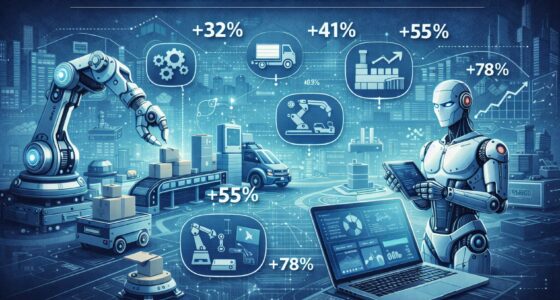
After tech, automation is set to transform industries like healthcare, manufacturing, agriculture, and customer service. In healthcare, AI and robotics will make diagnoses faster and more accurate, while in manufacturing, smart factories and robotics will boost efficiency and safety. Agriculture will benefit from automation and IoT sensors, improving sustainability and productivity. As these sectors evolve, understanding how automation reshapes them will give you a clearer picture of the future—stay tuned for more insights.
Key Takeaways
- Healthcare will continue to see transformative automation in diagnostics, patient monitoring, and personalized treatment planning.
- Manufacturing will advance with smarter robotics, real-time data integration, and Industry 4.0 technologies.
- Agriculture will be revolutionized through precision farming, autonomous machinery, and IoT-enabled resource management.
- Customer experience will be enhanced by AI-driven personalization, chatbots, and seamless automation across service channels.
- Education and workforce development will benefit from AI-powered personalized learning, reskilling platforms, and digital literacy tools.
Better Health with AI: Your Roadmap to Results
As an affiliate, we earn on qualifying purchases.
As an affiliate, we earn on qualifying purchases.
Healthcare Revolution: Automating Diagnostics and Patient Care

The healthcare industry is undergoing a transformation as automation streamlines diagnostics and patient care. You’ll notice AI-powered tools now assist in analyzing medical images, lab results, and patient histories, leading to faster and more accurate diagnoses. Automated systems help monitor essential signs continuously, alerting healthcare providers to critical changes instantly. These innovations reduce human error and free up medical staff to focus on personalized patient interactions. With smart algorithms, treatment plans are becoming more tailored, improving outcomes. You’ll also see automation in administrative tasks like scheduling, billing, and patient data management, increasing efficiency. Overall, automation enhances the quality of care, accelerates decision-making, and reduces costs, shaping a more responsive, precise healthcare system for everyone. Essential Resources and Tips for Caregivers and Seniors

Robotic Factory Design: Volume II Smart Factory Applications: AI, IIoT, Safety, Cybersecurity, Commissioning and Case Studies (Factory Intelligence: The Smart Manufacturing Systems Series)
As an affiliate, we earn on qualifying purchases.
As an affiliate, we earn on qualifying purchases.
Manufacturing 4.0: From Robotics to Smart Factories
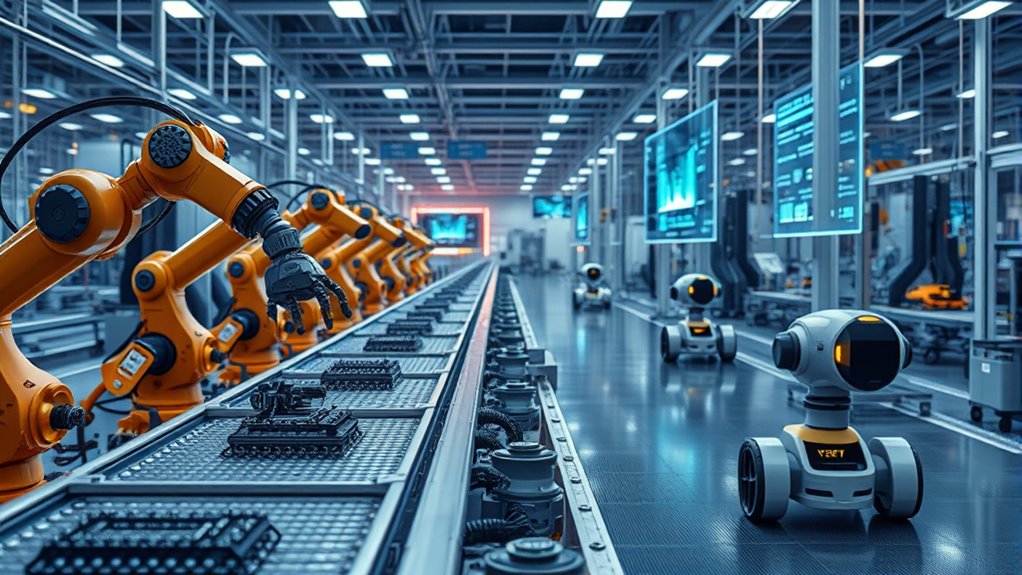
Manufacturing 4.0 marks a new era where automation and digital technologies transform traditional factories into intelligent, interconnected ecosystems. You’ll see advanced robotics and cobots working side-by-side with humans, increasing precision and safety. Autonomous mobile robots (AMRs) streamline material handling, boosting efficiency in warehouses and production lines. The integration of Industry 4.0 technologies like Industrial Internet of Things (IIoT) and AI enables real-time data collection and analysis, optimizing processes and reducing downtime. With 5G connectivity, communication becomes faster and more reliable, supporting seamless coordination across factory operations. You’ll notice that these innovations make factories more flexible, scalable, and responsive to market demands. As a result, manufacturing becomes smarter, more efficient, and better equipped to adapt to rapid technological changes. Additionally, cybersecurity measures are increasingly essential to protect these interconnected systems from cyber threats and ensure operational integrity.
PRECISION AGRICULTURE TECHNOLOGY SYSTEMS : Iot sensors automated farming and yield optimization
As an affiliate, we earn on qualifying purchases.
As an affiliate, we earn on qualifying purchases.
Precision Agriculture: The Role of Connectivity and Automation

Advancements in Industry 4.0 technologies are reshaping agriculture by integrating connectivity and automation to boost productivity. You now benefit from precision farming tools that optimize resource use, improve yields, and minimize waste. With high-speed connectivity like 5G, data from sensors, drones, and autonomous machinery flows seamlessly, enabling real-time decision-making. This integration reduces manual effort and enhances crop management. Here’s a quick overview:
| Technology | Benefit | Impact |
|---|---|---|
| IoT Sensors | Monitor soil, weather, and crop health | Better resource allocation |
| Drones | Aerial crop surveillance | Faster field assessments |
| Autonomous Tractors | Efficient planting, harvesting | Reduced labor, increased yields |
Additionally, self-reflection techniques are increasingly used to assess and improve farm management strategies, contributing to more sustainable practices.

NOMO Smart Care Medical Alert System, Fall Detection for Seniors, WiFi in Home Monitoring Safety System, Emergency Call Button, Custom Fall Alert, Virtual Caregiver, 60-Day Trial, Monthly Subscription
NOMO SMART CARE ESSENTIAL KIT – A complete in-home monitoring safety system featuring a Smart Hub, two motion…
As an affiliate, we earn on qualifying purchases.
As an affiliate, we earn on qualifying purchases.
Customer Experience Transformation Through AI and Automation

As businesses harness AI and automation, they’re transforming customer experiences by delivering faster, more personalized service. You can expect:
- AI chatbots that handle inquiries 24/7, reducing wait times and providing instant support.
- Personalized recommendations based on customer data, increasing satisfaction and loyalty.
- Automated follow-ups and feedback collection, ensuring continuous engagement and improvement.
- A variety of tuning options are now available for automotive enthusiasts, allowing for even more tailored and high-performance vehicle modifications.
These technologies enable you to address customer needs more efficiently while making interactions feel tailored and human-like. Automation also frees up your team to focus on complex issues and strategic tasks. By integrating AI-driven tools, you create seamless experiences that boost retention and brand reputation. The result is a customer journey that’s faster, smarter, and more satisfying for everyone involved.
Education and Workforce Development in the Age of Automation

The rise of automation is reshaping not just customer experiences but also the skills and knowledge required in today’s workforce. You need to adapt quickly, embracing continuous learning to stay relevant. Traditional education models are evolving, incorporating AI-driven tools and personalized learning platforms that tailor lessons to your needs. Reskilling and upskilling become essential as automation automates routine tasks, shifting focus to strategic, creative, and technical roles. Employers increasingly emphasize digital literacy, data analysis, and problem-solving skills. You’ll also find new opportunities in tech-focused training programs and online courses, making workforce development more accessible. Staying proactive about acquiring these new competencies will be your key to thriving in an automated economy, ensuring you remain valuable and competitive in the evolving job market. Additionally, understanding the importance of adaptability can help individuals better navigate ongoing changes in workforce demands.
Frequently Asked Questions
How Will Automation Impact Healthcare Costs and Patient Affordability?
Automation will lower healthcare costs and improve patient affordability by streamlining diagnoses, treatments, and administrative tasks, making care more efficient. You’ll notice faster service, fewer errors, and reduced operational expenses, which can translate into lower prices. As AI-assisted tools and automation become more widespread, healthcare providers can allocate resources better, ultimately making healthcare more accessible. This shift benefits you by providing quality care at a more affordable price point.
What New Jobs Will Emerge From Increased Manufacturing Automation?
By 2026, 90% of enterprises will prioritize hyperautomation, creating new roles. As manufacturing automation advances, you’ll see jobs in automation management, robot maintenance, and data analysis emerge. You might find yourself overseeing AI systems or optimizing robotic workflows. Additionally, roles in cybersecurity, system integration, and technical training will grow, demanding specialized skills. Embracing these changes positions you at the forefront of a transforming industry, shaping efficient, innovative manufacturing futures.
How Does Automation Influence Data Privacy in Agriculture and Healthcare?
Automation in agriculture and healthcare raises concerns about data privacy because it collects sensitive information, including personal health records and crop data. You need to guarantee robust security measures like encryption and access controls to protect this data from breaches. Regular audits and compliance with regulations help you maintain trust. Staying proactive about privacy safeguards is essential as automation advances, so you prevent misuse and safeguard your data integrity.
Will Automation Replace Human Roles in Customer Service Entirely?
Automation isn’t likely to replace human roles in customer service entirely; instead, it acts like a skilled assistant, handling routine tasks while humans focus on empathy and complex problems. You’ll find chatbots and AI tools working alongside you, freeing you from repetitive work. This partnership enhances your ability to deliver personalized, genuine experiences, making customer service more human-centered rather than replacing it altogether.
How Can Educational Institutions Adapt Curricula for Automation-Driven Careers?
You should adapt curricula by integrating AI, data analysis, and automation tools, preparing students for tech-driven roles. Focus on developing skills in programming, robotics, and digital literacy, emphasizing critical thinking and creativity. Include real-world projects and hands-on experience with automation technologies to enhance understanding. Collaborate with industry partners to stay current with emerging trends, ensuring students are ready for evolving careers in automated, technology-rich environments.
Conclusion
As you step into this new automated era, remember that no industry is immune to transformation—it’s like a seismic shift reshaping everything you know. Embrace the change, because those who adapt will lead the future, while others risk becoming relics. Automation’s power is unstoppable, promising a revolution that’s bigger than anything you’ve seen before. Get ready to innovate, or be left behind in history’s dust—because this wave will redefine your world.