
AI is automating more jobs than you might think, from analyzing medical images to detecting wildlife and pollution. It’s now helping radiologists identify tumors, monitoring habitats for conservation, and even managing traffic and logistics behind the scenes. AI’s reach extends far beyond traditional roles, making processes faster, safer, and more efficient. Keep exploring how unexpected industries are being transformed by AI’s innovative applications—you’ll find surprising ways it’s changing the world around you.
Key Takeaways
- AI automates wildlife monitoring and anti-poaching patrols using autonomous vehicles and sensors in conservation efforts.
- It conducts real-time pollution detection and environmental quality assessments for air and water safety.
- AI manages crop health, pest control, and autonomous farming equipment to boost agricultural productivity.
- It analyzes and optimizes inventory and demand forecasting in retail and food supply chains.
- AI enhances entertainment experiences by calibrating device settings like projectors for optimal visual quality.

Medical Insurance Card and ID Card Scanner (w/Scan-ID LITE, for Windows)
BCR901 Simplex (single side) USB Optical Card Scanner. Ultra-compact footprint saves desk space. Mount and use scanner horizontally…
As an affiliate, we earn on qualifying purchases.
As an affiliate, we earn on qualifying purchases.
Transforming Medical Imaging and Diagnostics
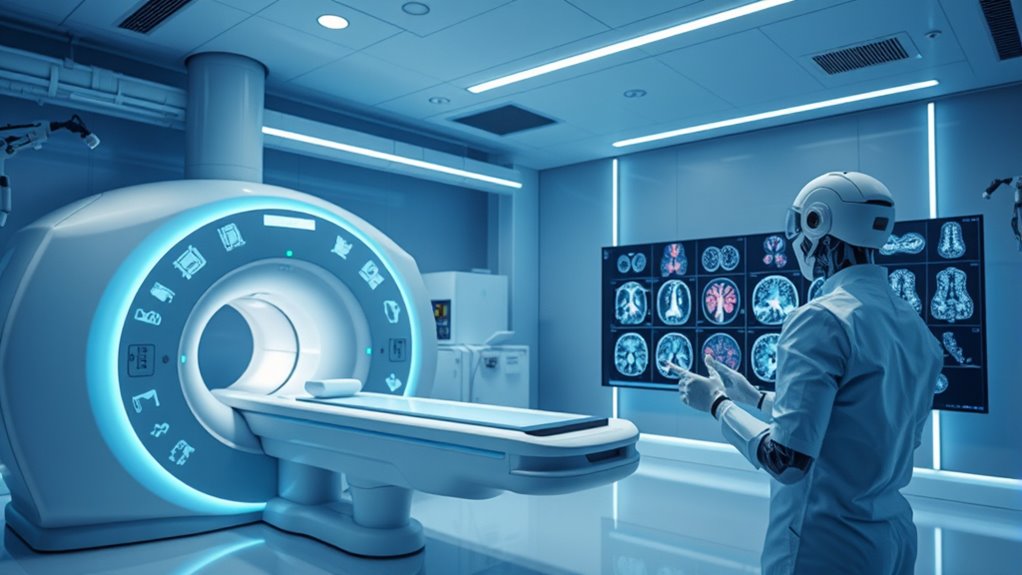
Transforming medical imaging and diagnostics, AI plays a crucial role in detecting diseases earlier and more accurately than ever before. You benefit from AI’s ability to analyze X-rays, MRIs, and CT scans quickly, spotting tumors and cancers that might be missed by the human eye. This technology reduces diagnostic errors and speeds up treatment decisions, saving lives. AI algorithms learn from vast datasets, improving their precision with each scan, ensuring you get timely and reliable diagnoses. Hospitals now use AI tools to assist radiologists, allowing them to focus on complex cases. As a result, patient outcomes improve, and healthcare providers can manage resources more efficiently. AI’s contribution in medical imaging marks a significant leap toward earlier, more accurate disease detection. Advancements in AI technology continue to enhance diagnostic capabilities, making early detection more accessible and reliable.

KJK Trail Camera 36MP 2.7K, Mini Game Camera with Night Vision 0.1s Trigger Time Motion Activated 130°Wide-Angle, Waterproof Trail Cam with 2.0” HD TFT Screen, Hunting Camera for Wildlife Monitoring
【Ultra-clear Photos and Videos】36MP Still Images & 2.7K Videos. Thanks to premium optical lens and an advanced image…
As an affiliate, we earn on qualifying purchases.
As an affiliate, we earn on qualifying purchases.
Revolutionizing Financial Security and Compliance

AI is reshaping financial security and compliance by enabling real-time monitoring and rapid detection of suspicious activities. You can rely on AI-driven systems to analyze transaction patterns continuously, catching fraud attempts as they happen. These tools flag anomalies instantly, helping you prevent financial crimes before they escalate. Risk assessment models leverage vast data to evaluate creditworthiness and investment opportunities with greater accuracy. Automated compliance tools monitor transactions and generate reports, ensuring adherence to regulations effortlessly. You won’t need to sift through endless data manually; AI does it faster and more precisely. This automation reduces penalties, safeguards your reputation, and streamlines regulatory reporting. Additionally, vetted product reviews provide valuable insights into the best tools for your needs. Ultimately, AI enhances your ability to protect assets, maintain trust, and stay ahead of evolving financial threats with minimal effort.

Nanotechnology-based Sensors for Detection of Environmental Pollution
As an affiliate, we earn on qualifying purchases.
As an affiliate, we earn on qualifying purchases.
Enhancing Retail Experience and Supply Chain Efficiency
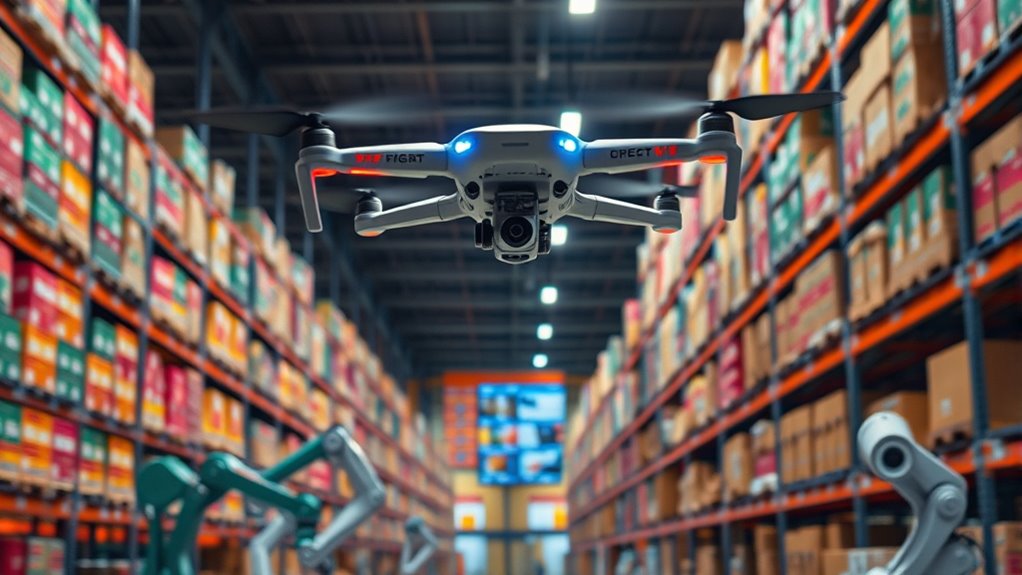
You can see how AI personal recommendations make shopping more tailored and engaging, helping you find products quickly. Seamless checkout technology lets you complete transactions without long lines or manual scans. Inventory optimization strategies make sure stores stay stocked with the right items, making your shopping experience smoother and more reliable. Additionally, AI can assist in supply chain management, ensuring timely restocking and reducing shortages.
AI-Driven Personal Recommendations
Personalized recommendations powered by AI are revolutionizing the retail experience and streamlining supply chains by analyzing customer behavior and preferences in real time. You’re shown products tailored to your browsing history, purchase patterns, and even current trends, making shopping more intuitive and efficient. Retailers use AI to optimize pricing, ensuring you see relevant discounts without overpaying. Supply chains benefit too, as AI forecasts demand, helping stores stock the right products at the right time, reducing waste and shortages. This dynamic system adapts to your evolving tastes, providing a seamless shopping experience. By continuously learning from your interactions, AI-driven recommendations create more personalized, satisfying journeys, ultimately increasing customer loyalty and operational efficiency while reducing excess inventory and logistical costs. Additionally, AI content clustering enables retailers to organize and optimize their product offerings more effectively, leading to even better-targeted marketing strategies.
Seamless Checkout Technology
Seamless checkout technology transforms the retail experience by enabling you to complete purchases quickly and effortlessly. Using AI-powered computer vision and sensors, stores recognize products as you pick them up, eliminating the need for scanning or manually entering information. You simply walk out, and the system automatically charges your account. This not only speeds up your shopping trip but also reduces long lines and wait times. For retailers, it streamlines operations, cuts labor costs, and minimizes errors. Plus, AI collects data on your shopping habits, allowing stores to personalize promotions and optimize store layouts. As a result, your shopping becomes more convenient, while supply chain efficiency improves through better demand forecasting and inventory management. Additionally, understanding the role of contrast ratio and color accuracy in projectors can enhance your home entertainment experience, making your time at home even more enjoyable. Overall, seamless checkout technology creates a smoother, more responsive retail environment.
Inventory Optimization Strategies
Inventory optimization strategies leverage AI to forecast demand accurately, automate reordering, and manage stock levels in real time. You can rely on AI algorithms to analyze sales data, seasonal trends, and customer behavior, ensuring stock levels match actual needs. This minimizes stockouts and overstock situations, improving customer satisfaction and reducing waste. AI-driven systems automatically reorder products when inventory dips below set thresholds, freeing you from manual tracking. You gain visibility into your supply chain, allowing you to respond swiftly to demand shifts or disruptions. Additionally, integrating real-time data analysis helps anticipate future inventory needs more precisely. By optimizing inventory, you enhance operational efficiency and cut costs while maintaining an excellent retail experience. As a result, your business becomes more agile, responsive, and better equipped to meet customer expectations in a competitive market.

Warehouse Management and Inventory Control System
As an affiliate, we earn on qualifying purchases.
As an affiliate, we earn on qualifying purchases.
Redefining Transportation and Logistics Operations
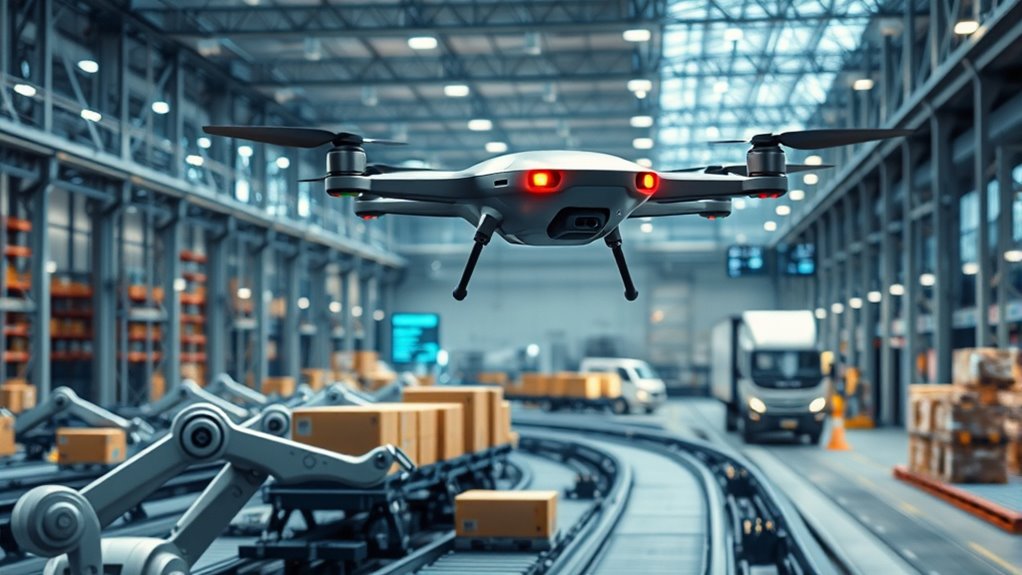
Smart routing solutions use AI to analyze traffic, weather, and delivery data, helping you plan the most efficient routes. Autonomous warehouse robots handle picking and packing tasks with minimal human oversight, speeding up operations. Together, these innovations are transforming transportation and logistics, making them faster, cheaper, and more reliable. Incorporating safety features like regular inspections for equipment ensures continued efficiency and safety in these high-tech environments.
Smart Routing Solutions
Transportation and logistics companies are increasingly turning to AI-driven routing solutions to optimize delivery paths, reduce fuel consumption, and improve overall efficiency. You benefit from real-time traffic data, weather updates, and vehicle performance metrics that AI analyzes to select the fastest, most cost-effective routes. These systems adapt instantly to changing conditions, avoiding delays and congestion. By calculating ideal routes, AI minimizes miles traveled, saving fuel and lowering emissions. Dynamic rerouting helps your fleet respond swiftly to unexpected events, ensuring timely deliveries. Additionally, AI considers variables like delivery windows and vehicle capacity to streamline scheduling. Incorporating tableware sales and promotions insights can also help companies plan for seasonal demand fluctuations and stock management. As a result, your operations become more reliable, eco-friendly, and cost-efficient, giving you a competitive edge in today’s fast-paced logistics landscape.
Autonomous Warehouse Robots
Autonomous warehouse robots are transforming logistics operations by handling tasks like picking, sorting, and packing with minimal human oversight. They navigate warehouse floors using advanced sensors and AI, efficiently locating and retrieving items. These robots work around the clock, reducing delays and increasing throughput. Their precise movements minimize errors, ensuring accurate order fulfillment. Automation also improves safety by reducing human exposure to heavy lifting and hazardous environments. As they coordinate seamlessly with inventory management systems, operations become more streamlined and scalable. You’ll notice faster deliveries and lower labor costs. By taking over routine tasks, these robots free up staff for more complex, value-added roles. Incorporating skincare patches into maintenance routines can also enhance equipment longevity and performance. Their deployment marks a significant shift in warehouse management, making logistics faster, safer, and more reliable.
Innovating Agriculture and Food Production Methods
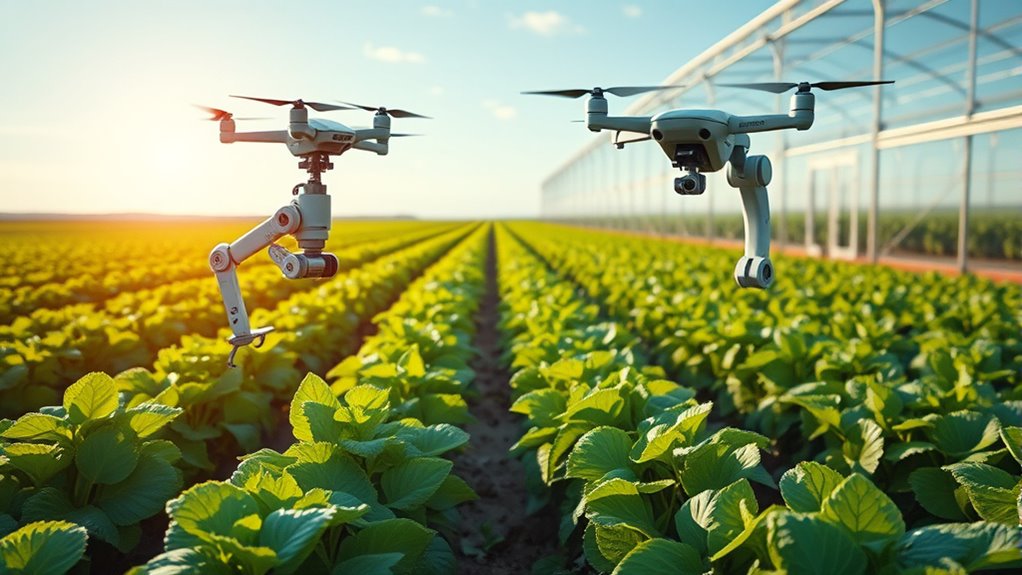
Advancements in AI are transforming agriculture and food production by enabling farmers and producers to optimize every step of the process. You now use sensors, drones, and autonomous equipment to monitor crop health, adjust irrigation, and manage pests precisely. AI-driven tools analyze data to determine the best planting times and fertilization strategies, increasing yields and reducing waste. Autonomous tractors and harvesters perform tasks efficiently, freeing you from manual labor. To illustrate, here’s how AI impacts agriculture:
| Technology | Function | Benefit |
|---|---|---|
| Sensors & Drones | Monitor crop health | Early disease detection |
| Autonomous Equipment | Planting, harvesting | Lower labor costs |
| Data Analytics | Optimize resource use | Increased efficiency |
| Inventory Systems | Track produce from farm to table | Reduce food waste |
| Pest Control | Targeted pest management | Minimized chemical use |
AI-powered automation is also enabling real-time decision-making, which further enhances productivity and sustainability in the industry.
Supporting Conservation and Environmental Monitoring
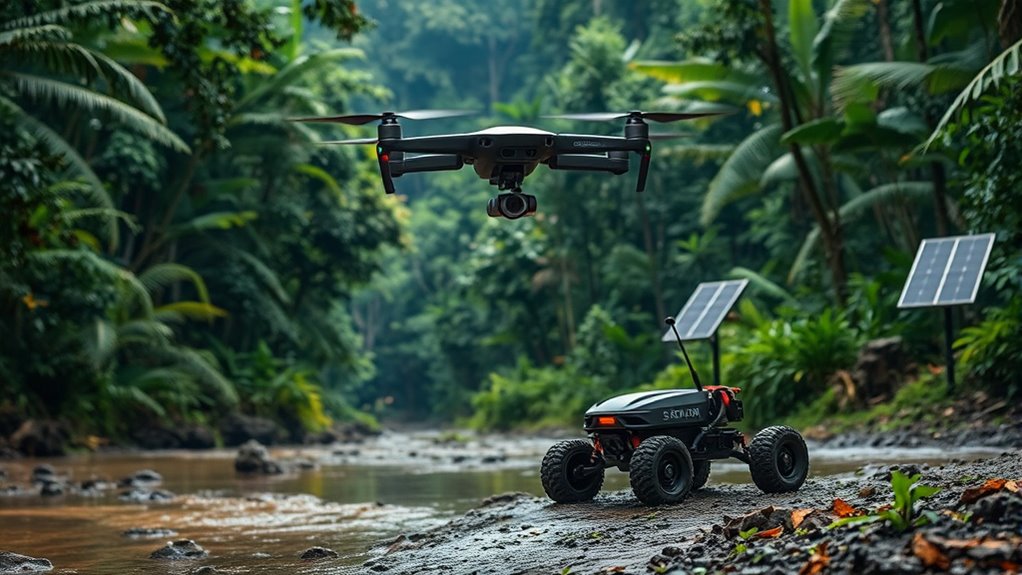
Supporting conservation and environmental monitoring, AI plays a crucial role in gathering and analyzing data to protect ecosystems. You can rely on AI-powered camera traps, satellites, and sensors to track wildlife movements, detect illegal poaching, and monitor habitat changes. Machine learning algorithms analyze this data rapidly, identifying patterns and predicting environmental impacts before they become critical. Autonomous vehicles patrol protected areas, collecting essential information and acting as deterrents against illegal activities. Pollution detection systems analyze air and water quality continuously, providing real-time alerts for hazardous conditions. Additionally, AI models forecast species population trends and habitat shifts, enabling proactive conservation strategies. This automation helps preserve biodiversity, assess environmental health, and respond swiftly to threats, making conservation efforts more effective and sustainable.
Frequently Asked Questions
How Is AI Used in Legal Document Review and Analysis?
You use AI to review and analyze legal documents quickly and accurately. It scans contracts, briefs, and other paperwork to identify relevant information, inconsistencies, or potential risks. AI also helps in predicting case outcomes based on previous data, streamlining the review process. By automating tedious tasks, you save time and reduce errors, allowing you to focus on more complex legal strategies and client needs.
Can AI Assist in Creative Fields Like Art and Music Production?
AI in art and music is like a creative partner, helping you explore new ideas and styles. You can use AI to generate original artwork, compose melodies, or even craft lyrics, all while sparking your own inspiration. It’s not about replacing your creativity but enhancing it. With AI, you can experiment freely, refine your projects faster, and push the boundaries of your artistic expression in ways you might never have imagined.
What Role Does AI Play in Emergency Response and Disaster Management?
AI plays a vital role in emergency response and disaster management by analyzing real-time data from sensors, satellites, and social media to detect incidents early. You can rely on AI-powered systems to predict disaster patterns, coordinate rescue efforts, and allocate resources efficiently. It also helps in mapping affected areas, providing timely alerts, and supporting decision-making, ultimately saving lives and minimizing damage during emergencies.
Is AI Involved in Personalized Education and E-Learning Platforms?
Yes, AI is actively involved in personalized education and e-learning platforms. You benefit from tailored lessons that adapt to your learning style, pace, and strengths, making studying more effective. AI analyzes your progress, provides instant feedback, and suggests resources to help you improve. It also automates administrative tasks for educators, allowing them to focus more on supporting your individual needs, creating a more engaging and customized learning experience.
How Does AI Contribute to Cybersecurity Beyond Fraud Detection?
AI revolutionizes cybersecurity beyond fraud detection by acting as an unstoppable digital guardian. It instantly identifies even the tiniest vulnerabilities, predicts cyberattacks before they happen, and adapts to new threats faster than you can blink. You’ll find it tirelessly monitoring networks, blocking malicious activity in real time, and learning from every encounter. It’s like having an invincible security force that never sleeps, tirelessly defending your digital world from every angle.
Conclusion
As you walk through a world quietly shaped by AI, imagine a future where medical scans glow with clarity, financial systems detect threats instantly, and farms thrive with precision. Picture bustling stores seamlessly stocked, roads smoothly guided by smart vehicles, and forests monitored by invisible eyes. This isn’t distant sci-fi; it’s the reality AI is creating in unexpected places. Embrace the change, because the world you know is transforming right before your eyes.