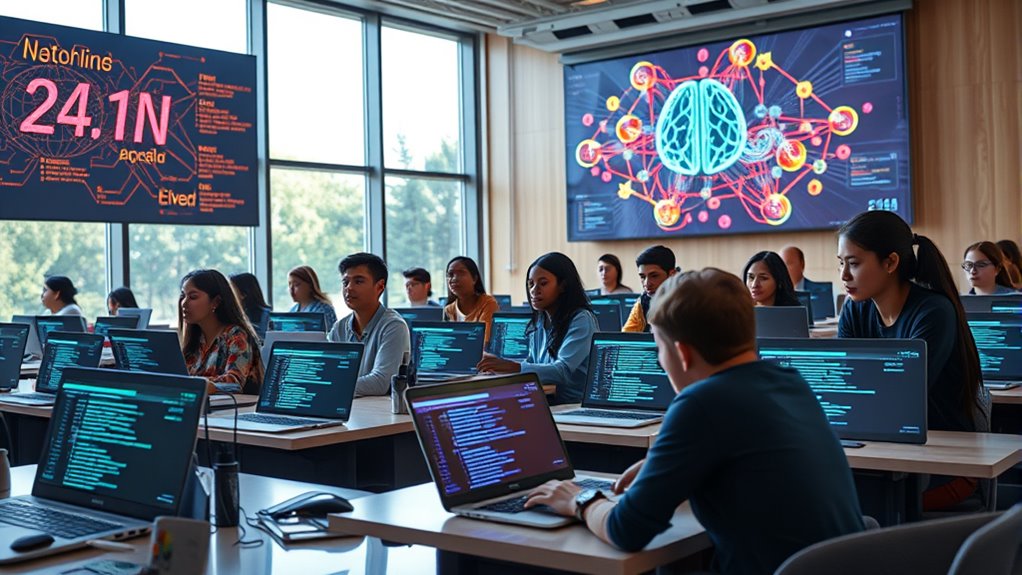
The boom in online AI courses via MOOCs is making AI education more accessible, affordable, and flexible worldwide. You can now learn from top universities like MIT, Stanford, and Helsinki without geographical or financial barriers. Courses cover beginner to advanced topics, including programming, ethics, and social impacts. They’re designed to fit your schedule and skill level. If you want to discover how this movement is shaping the future of AI learning, keep exploring.
Key Takeaways
- MOOCs offer free or affordable AI courses from top universities, removing financial barriers for learners worldwide.
- They provide flexible, no-prerequisite learning options accessible to diverse populations and skill levels.
- Content diversity includes specialized topics like generative AI, ethics, and societal impacts, broadening knowledge scope.
- Hands-on programming exercises using Python and tools like Jupyter notebooks develop practical AI skills.
- Collaboration with industry and academia ensures up-to-date curricula, promoting democratized access to cutting-edge AI education.
The Rapid Growth of AI MOOCs Worldwide
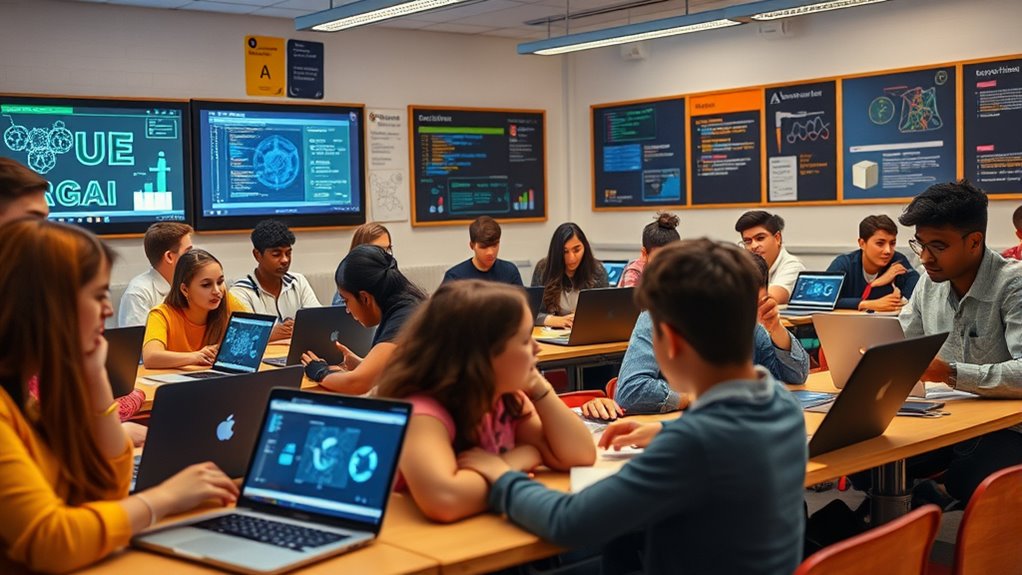
The rapid growth of AI MOOCs worldwide reflects a surge in global demand for accessible and flexible AI education. You can see this in the over 3.3 million enrollments across platforms like Coursera and edX, which host courses from top universities such as MIT, Stanford, and Helsinki. These courses are free or affordable, removing geographical and financial barriers for learners everywhere. They cover a range of levels, from beginner to advanced, with many requiring no prerequisites. As a result, more people than ever are diving into AI topics, enthusiastic to upskill or explore new career paths. This expansion demonstrates how online platforms are democratizing AI knowledge, making it reachable for learners regardless of location or background. Additionally, the availability of home-based learning tools like online courses has further accelerated this democratization process.
Diverse Content and Curriculum Offerings

As AI MOOCs continue to grow in popularity, course providers are expanding their offerings to cover a broader range of topics and skill levels. You’ll find courses that go beyond basic concepts, exploring specialized areas like generative AI, responsible AI, and AI ethics. Whether you’re a beginner or an advanced learner, there are options tailored to your needs, often with no prerequisites. Programming exercises using Python and tools like Jupyter notebooks help you gain practical skills. Many courses incorporate relevant mathematics, deepening your understanding of AI methods. You’ll also encounter content on societal impacts, governance, and responsible use, reflecting the field’s evolving landscape. This variety ensures you can customize your learning journey and stay current with industry trends. Additionally, understanding modern AI tools can enhance your ability to implement these concepts effectively.
Accessibility and Benefits for Learners Everywhere

Online AI courses break down geographical and financial barriers, making high-quality education accessible to learners worldwide. You can study from top universities like MIT, Stanford, or Helsinki without leaving your home, often for free or at a low cost. These courses are designed to fit various schedules, so you can learn at your own pace while balancing work or personal commitments. No matter your background, open enrollment means you don’t need prior degrees or experience to start. Interactive projects, quizzes, and certificates help you build practical skills and showcase your knowledge to employers. With access to expert instructors and cutting-edge content, you gain valuable insights into AI without the traditional barriers of cost, location, or formal prerequisites. The availability of vetted top-rated course content ensures learners receive quality education that meets industry standards.
Practical Skills and Programming in AI Education

Focusing on practical skills and programming, AI education heavily emphasizes hands-on experience with coding and data manipulation. You’ll work with languages like Python, using tools such as Jupyter notebooks, to develop real-world skills. Assignments often involve datasets, helping you apply algorithms and understand data processing. Courses incorporate libraries like TensorFlow and scikit-learn, blending theory with practice. This approach guarantees you’re prepared for AI tasks beyond the classroom. Additionally, understanding the cultural heritage and background of AI development can provide valuable context for responsible and ethical AI application.
Emerging Trends and Future Challenges in AI Learning

Emerging trends in AI learning are shaping how courses evolve to meet industry and societal demands. You’ll see a focus on cutting-edge topics like generative AI and responsible AI, reflecting current innovations and ethical concerns. The growth of modular pathways, such as MicroMasters, allows for targeted specialization, helping you advance your career efficiently. Increased collaboration between academia and industry ensures curricula stay relevant to real-world applications. Additionally, incorporating emotional support considerations into AI education can help address learner motivation and well-being. However, future challenges remain:
- Some courses still require strong math or coding skills, creating barriers for beginners.
- Low completion rates highlight the difficulty of sustaining motivation remotely.
- Rapid technological advances demand frequent content updates.
- Integrating AI education into formal systems and corporate training varies globally.
Staying adaptable and embracing interdisciplinary approaches will be key to overcoming these hurdles.
Frequently Asked Questions
How Do AI MOOCS Accommodate Learners With No Prior Technical Background?
You can start with beginner-friendly AI MOOCs that require no prior technical background. These courses often introduce fundamental concepts using simple language, visual aids, and hands-on projects. They focus on practical skills with programming tools like Python in an accessible way. Many also provide foundational math and coding tutorials, gradually building your confidence. Open enrollment and flexible pacing make it easier for you to learn at your own speed without feeling overwhelmed.
What Are the Typical Costs Associated With Earning an AI Certification?
You see, earning an AI certification is like planting a seed. Many courses let you start free, offering audit options that require no cost. If you want a certificate, expect to pay between $30 and $100, with some premium options reaching $200 or more. These fees act as watering your seed, helping it grow into a tangible badge of your skills, ready to flourish in your career.
How Do MOOCS Ensure Content Stays Current With Rapidly Evolving AI Tech?
You can stay updated with rapidly evolving AI tech through MOOCs by regularly updating course content and collaborating with industry experts. Platforms like Coursera and edX incorporate the latest research, tools, and industry trends into their curricula. Many courses include recent case studies and projects, ensuring you’re learning current practices. Additionally, ongoing feedback and community discussions help you grasp new developments, keeping your skills relevant in this fast-changing field.
What Methods Do MOOCS Use to Assess and Track Learner Progress Effectively?
They say a journey of a thousand miles begins with a single step, and MOOCs track your progress through quizzes, assignments, and project submissions. You actively engage with interactive exercises, receive instant feedback, and earn certificates to showcase your skills. Progress dashboards help you monitor your learning curve, while peer reviews and instructor assessments keep you motivated and on track, ensuring you master AI concepts effectively.
How Accessible Are AI MOOCS for Learners in Low-Resource or Developing Regions?
You can access AI MOOCs easily even in low-resource or developing regions because many universities offer free or low-cost courses online. Platforms like Coursera and edX provide flexible schedules and self-paced learning, so you can study at your own pace. These courses often require minimal prerequisites, making them accessible to a wide range of learners regardless of location or financial situation, helping bridge educational gaps worldwide.
Conclusion
As you explore the booming world of AI MOOCs, you’ll realize they’re transforming your future in ways you never imagined. This revolution isn’t just about learning—it’s about opening unimaginable opportunities, breaking down every barrier, and empowering you to lead in an AI-driven world. Don’t just watch from the sidelines—seize this incredible wave and become the innovator, creator, and pioneer you were born to be. The future of AI education is now, and it’s yours to conquer!