TL;DR

Get business pricing on tech for your team
- Business-only prices and quantity discounts
- Tax-exempt purchasing
- Multiple users, one account, clear invoices
Hugging Face introduced HiRO-ACEv2, an AI climate emulator that produces global rain, wind and pressure data at 3 km resolution. The team reports that its full system costs about 1/300th as much as the X-SHiELD atmospheric model, while reproducing statistics for rare extremes; tests so far are tied to X-SHiELD’s climate.
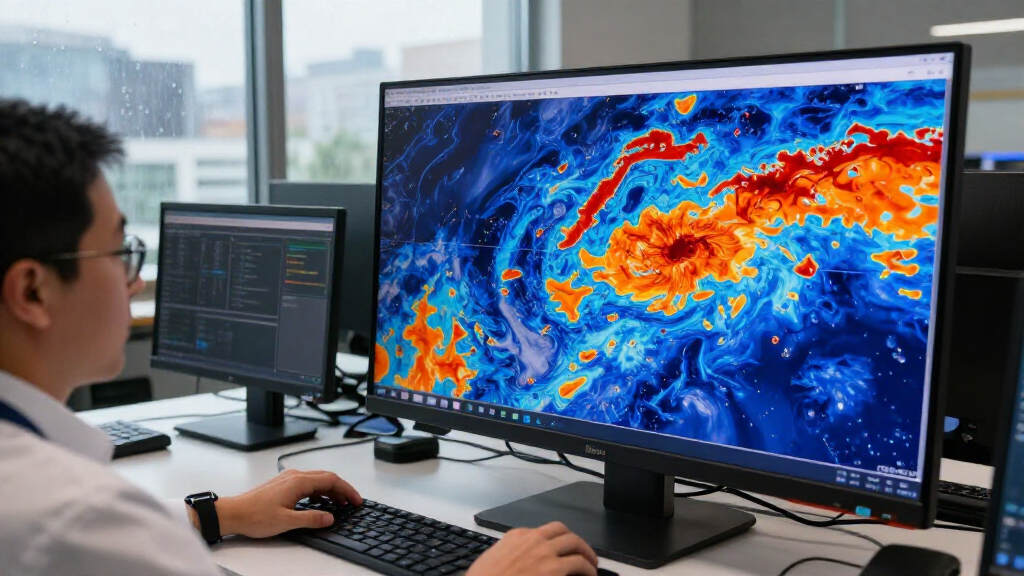
Hugging Face has introduced HiRO-ACEv2, an AI system that generates global climate data at 3 km resolution and is designed to reproduce rare rain, wind and pressure extremes. The team says the system costs about 1/300th as much as X-SHiELD, a high-resolution atmospheric model, potentially making long simulations and multiple climate-data realizations more accessible to researchers.
The system combines two models. ACE produces climate simulations at a coarse 100 km resolution; HiROv2 then downscales those results into finer 3 km fields. The main update is HiROv2, which can produce several high-resolution variables at once, including rain, wind and pressure, whereas the earlier version focused on rainfall.
Hugging Face reports that when HiROv2 is given coarsened X-SHiELD data, its high-resolution statistics come within 3% of the target simulation, including for events occurring once per million data points. The team also says the model estimates tropical cyclone energy accurately, including for storms absent from its training data, and produces recognizable hurricane eyes and rain bands. Wind and pressure around hurricane eyes can remain more asymmetric than in X-SHiELD.
In a 10-year ACE simulation, the team says hurricane activity, average climate patterns and overall rain, wind and pressure distributions aligned well with X-SHiELD. When ACE and HiROv2 were combined, they generated a year of global 3 km data from ACE’s own simulation. Across a 10-year run, the reported hurricane energy was comparable to X-SHiELD’s. These are comparisons reported by the developers; the announcement does not provide independent validation.
Climate computing · Model update · 2026
Extreme weather,
at 3 km resolution.
HiRO-ACEv2 combines a coarse global climate simulation with AI downscaling to generate fine-scale rain, wind and pressure fields. Its developers report output costs around 1/300th of X-SHiELD, with important limits on what the results demonstrate.
The cost of X-SHiELD output, according to Hugging Face.
Reported against coarsened X-SHiELD data, including one-in-a-million events.
Performance claims are tied to the climate represented by the training and evaluation setup.
01 / How the system works
From broad patterns to local detail
HiRO-ACEv2 links two models. ACE generates the large-scale atmospheric patterns; HiROv2 translates those fields into finer detail and produces several variables together.
Climate simulation
ACE
Produces global atmospheric fields at about 100 km resolution.
AI downscaling
HiROv2
Converts coarse patterns into high-resolution rain, wind and pressure.
Fine-scale output
3 km fields
Generates detailed weather patterns, including simulated storm structure.
02 / What developers report
Lower cost, broader exploration
Lower reported generation costs could make it easier to explore more years, regions or possible storm sequences within a research budget.
About 300 times less
Hugging Face estimates global HiRO-ACEv2 output costs about 1/300th as much as X-SHiELD. Regional savings vary with area and may exceed 100 times.
Rare values in scope
When given coarsened X-SHiELD data, HiROv2 reportedly reproduces high-resolution statistics within 3%, including events occurring once per million data points.
Recognizable cyclones
The team reports accurate tropical cyclone energy, including for storms absent from training, and recognizable hurricane eyes and rain bands.
03 / Reported comparison
Cost claim at a glance
The chart summarizes the developers’ stated global output cost comparison. It does not include a complete accounting of data preparation, storage or analysis.
Illustrative index based on the reported ~300× cost difference, not a universal benchmark. Actual costs depend on hardware, region size and workflow.
04 / Evidence and scope
Promising results, bounded claims
The announced evaluations compare the system with X-SHiELD, the model it was trained to emulate. They do not establish performance across all climates or uses.
Evaluation follows its source
Reported comparisons are against X-SHiELD, not independent validation against observations or a range of climate models. Matching its statistics does not prove every generated event is physically accurate.
Climate coverage is limited
The current system works with an ACE version tuned to match X-SHiELD. The team says it cannot yet produce high-resolution output for other climates, including warmer futures or historical ERA5 conditions.
Some storm details differ
Wind and pressure around hurricane eyes can remain more asymmetric than in X-SHiELD. Suitability for specific research or operational decisions is still an open question.
Speedup remains a target
A streamlined HiROv2 that could run more than 10 times faster is in development. That projected gain has not been demonstrated in the reported release.
05 / What comes next
More climates and weather fields
Hugging Face outlines several extensions that could broaden the system’s research uses. These are plans, not results already shown.
A warmer simulation
The team plans to train on additional X-SHiELD data, including a simulation of a world 4°C warmer.
Temperature, snow and ice
Near-surface temperature, snow and ice outputs are on the roadmap, with possible applications such as snowpack prediction.
Inspect and explore
Pre-generated outputs can be viewed in a web demo. Model downloads and tutorial notebooks are available for researchers who want to run the models.
06 / Developer perspective
The case—and the caveat
“HiRO-ACEv2 offers researchers a flexible and inexpensive way to generate many versions of high-resolution rain, wind, and pressure data for extreme events over 10 years or more.” Hugging Face · Developer statement
The appeal is clear if lower costs allow researchers to study more years or storm sequences. The key evidence to watch is independent evaluation against observations and other models, broader climate coverage, and real-world cost accounting.
07 / Trace the pipeline
What feeds what
08 / Key questions
Quick answers
What does HiRO-ACEv2 generate?
Global 3 km climate data for fields including precipitation, wind and pressure. ACE simulates at 100 km resolution first; HiROv2 downscales those results.
How much cheaper is it?
Hugging Face reports that global output costs about 1/300th of X-SHiELD. Regional savings vary by area, and the figure is a developer comparison rather than an independent cost audit.
Lower-Cost Global Storm Simulations
High-resolution atmospheric simulations can be expensive to run, which can limit how many years, regions or alternative realizations researchers can study. Hugging Face estimates that global HiRO-ACEv2 output costs about 300 times less than X-SHiELD. For a single region, the savings can exceed a factor of 100, depending on its size. If those estimates hold in practical research workflows, teams could produce more detailed datasets or explore more possible weather sequences with the same computing budget.
The system’s focus on rare extremes matters for work that depends on intense rainfall, strong winds and tropical cyclones, events that may be poorly represented by averages alone. The developers say the model can generate examples such as realistic hurricane structure and strong downslope winds. That makes it a potential tool for climate and impact research, but the reported results do not establish that its output can replace observations or a physics-based model for every scientific or planning use.
Hugging Face also says it is developing a streamlined HiROv2 that could run more than 10 times faster. That is a future performance target, not a capability demonstrated in the reported release.
As an affiliate, we earn on qualifying purchases.
From 100 km Fields to 3 km
HiRO-ACE was introduced earlier in 2026 as a two-stage approach to high-resolution climate emulation. ACE supplies the broad atmospheric patterns at 100 km resolution, and HiRO converts them into finer detail. In HiRO-ACEv2, the downscaling model is updated to handle multiple fields and improve its representation of extreme values.
The developers trained and evaluated the system against X-SHiELD, which explicitly simulates storms and other small-scale weather. The Hugging Face announcement links to a technical report, model downloads, tutorial notebooks and a web demo. The demo displays pre-generated precipitation, wind and sea-level pressure from HiRO versions alongside X-SHiELD, allowing users to inspect regions without running model inference.
The team says the model’s low cost applies to generating high-resolution output: global data is reported at about 1/300th of X-SHiELD’s cost, while regional savings vary with area. Those figures describe the developers’ comparison and do not by themselves establish total costs for data preparation, storage or analysis.
““HiRO-ACEv2 offers researchers a flexible and inexpensive way to generate many versions of high-resolution rain, wind, and pressure data for extreme events over 10 years or more.””
— Hugging Face
As an affiliate, we earn on qualifying purchases.
Climate Coverage Still Limited
HiROv2 has learned from X-SHiELD, so the current system works only with an ACE version tuned to match that model. Hugging Face says it cannot yet generate high-resolution output for other climates, including a warmer future or historical conditions represented in datasets such as ERA5. The developers plan to train on additional X-SHiELD datasets, including a simulation of a world 4°C warmer, but have not reported those results yet.
The announcement reports comparisons with X-SHiELD, not independent evaluation against observations or across other climate models. It remains unclear how well the system’s generated extremes would perform for specific research or operational decisions, and how its reported cost comparison changes with different hardware and workflows. The developers also identify lingering differences in wind and pressure around hurricane eyes.
As an affiliate, we earn on qualifying purchases.
More Climates and Weather Fields
Hugging Face says it plans to train HiRO on new X-SHiELD datasets, including the 4°C-warmer simulation, to extend the system to different climate conditions. The team also plans to add near-surface temperature, snow and ice outputs, which could support uses such as snowpack prediction.
Researchers can inspect the existing pre-generated outputs in the web demo or download the models and use tutorial notebooks to run them. The next evidence to watch for is whether expanded training improves performance across climate states, whether additional variables are released, and whether the proposed streamlined model achieves its projected speedup.
As an affiliate, we earn on qualifying purchases.
Where I land
I see HiRO-ACEv2 as a promising way to lower the computing cost of exploring high-resolution weather scenarios. The reported results address a meaningful technical challenge: generating fine-scale extremes from a coarser simulation, while producing several weather fields together. The potential value is especially clear if researchers can run more years or compare more possible storm sequences at a fraction of the current cost.
The strongest counterargument is that the system is evaluated against the model it learned from, and the developers acknowledge both climate coverage limits and residual differences around hurricane eyes. Matching X-SHiELD statistics does not by itself show that every generated event is physically accurate or useful for a particular decision. I would raise my assessment if independent studies compared its output with observations and other models across present, historical and warmer climates, and documented how the cost advantage holds in real research workflows.
Source: Hugging Face
Key Questions
What does HiRO-ACEv2 generate?
It generates global 3 km climate data for fields including precipitation, wind and pressure. ACE first simulates at 100 km resolution; HiROv2 downscales those results.
How much cheaper is it than X-SHiELD?
Hugging Face reports that global output costs about 1/300th of X-SHiELD. For a single region, it reports savings of more than 100 times, depending on the region’s size.
Can it reproduce rare weather extremes?
The developers report that HiROv2 matches high-resolution statistics within 3% for events as rare as one per million data points when it is given coarsened X-SHiELD data. That is a reported model comparison, not an independent finding.
Does it work for future or historical climates?
Not yet, according to Hugging Face. The current system is tied to ACE tuned to match X-SHiELD. Training on additional climate simulations, including a world 4°C warmer, is planned.
Source: Hugging Face
Halloween Picks
halloween
As an affiliate, we earn on qualifying purchases.