By Thorsten Meyer | November 26, 2026 | ThorstenMeyerAI.com

Get business pricing on tech for your team
- Business-only prices and quantity discounts
- Tax-exempt purchasing
- Multiple users, one account, clear invoices
An AI hallucination is a false answer that an AI tool gives with full confidence. It happens because language models are built to produce the most likely next words, and because the tests they are trained for reward a guess more than an honest “I don’t know”. This guide explains where these errors come from, why they are so hard to remove, and what you can do to catch them.
This is the written companion to our explainer video. It follows one question from start to finish: why does a machine that knows so much say false things so confidently?
Key takeaways
- What it is: a plausible but false statement from a language model, stated as calmly as a true one.
- Why it happens: the model predicts likely words. Rare facts, like a birthday, follow no pattern it can learn.
- Why it persists: most tests give “I don’t know” the same score as a wrong answer, so guessing pays.
- Where it hurts: invented court rulings, invented code packages, and chatbots that invent company rules.
- What helps: let the AI look things up, reward honesty, and check the answer. Each fix has a limit.
Why a model guesses
The exam picture from OpenAI’s research, in three steps.
The question: “What is her birthday?” The model does not know.
- 1 · Two ways to answerGuess a date, or say “I don’t know”.
Guess: 1 in 365 chance of a point“I don’t know”: 0 points
- 2 · Most tests count right answers onlyOver thousands of questions, the guesser climbs the leaderboard. The honest model looks worse. In OpenAI’s own quiz, its older, guessing model got 75% of answers wrong.
- 3 · The proposed fixMake a wrong answer cost more than “I don’t know”. Then guessing stops paying.
right: +1“I don’t know”: 0wrong: −1
Products Worth Considering

Samsung Odyssey G55C 32-Inch QHD 1000R Curved Gaming Monitor

Apple Watch SE 3 GPS 44mm Smartwatch

Bose TV Speaker (2nd Gen) Compact Soundbar with Bluetooth, HDMI-ARC, and Remote
As an affiliate, we earn on qualifying purchases.
What this means for you
If you use AI for work, treat every name, number, quote, date and source as a claim until you have checked it. Those are exactly the details a model invents. The answer will not warn you. A wrong answer looks and sounds like a right one.
If you can, give the AI the material it should use. Paste the document and ask it to answer only from that. Then ask it how sure it is. Ask the same question a second time, too. If the story changes, treat both answers as unchecked.
If your business puts a chatbot in front of customers, you own its answers. A tribunal in Canada made an airline pay for what its website chatbot told a customer. Test your bot on questions where the right answer is “I don’t know”.
If you are a developer, check every package an AI suggests before you install it. Attackers can register names that AI tools invent.
What exactly is an AI hallucination?
OpenAI’s researchers define it in one line: “Hallucinations are plausible but false statements generated by language models” (OpenAI). The US standards agency NIST prefers the word confabulation. It defines it as “confidently stated but erroneous or false content” (NIST AI 600-1, p. 4).
Here is a real example. Researchers asked a popular open model for the birthday of one of their own authors. They told it to answer only if it knew. On three tries it gave three dates: “03-07”, “15-06” and “01-01”. All three were wrong (Kalai et al.).
How does a language model write an answer?
A language model is the engine behind chatbots like ChatGPT. It writes by predicting the next word, again and again.
Think of the autocomplete on your phone. You type “see you”, and it suggests “tomorrow”. A language model does the same thing with whole answers. The picture is too small, of course: a model has learned from vast amounts of text, not just your messages. But the core move is the same. What fits next?
Here is the catch. During training, nobody marks which sentences are true. OpenAI puts it plainly: there are “no ‘true/false’ labels attached to each statement. The model sees only positive examples of fluent language” (OpenAI). So the model learns what sounds right.
Most of the time, what sounds right is also true. “The capital of France is …” has one clear winner. But some facts follow no pattern. You cannot work out a birthday from grammar. OpenAI writes that “arbitrary low-frequency facts, like a pet’s birthday, cannot be predicted from patterns alone and hence lead to hallucinations.”
For more on the mechanics, see our guides How Large Language Models Work and How LLMs Learn From Sliding Windows.
Why doesn’t the model just say “I don’t know”?
The answer starts with a school memory. Picture a multiple-choice exam. You don’t know an answer. Leave it blank, and you get no points. Guess, and you might get lucky. So you guess.
OpenAI’s researchers argue that AI models learned the same trick. Models are graded on standard tests, called benchmarks. Most of them only count right answers. Under that scoring, “I don’t know” earns the same as a wrong answer: nothing. The paper calls this binary grading, which “awards 1 point for a correct answer and none for blanks or IDKs” (Kalai et al.).
The researchers checked ten widely used benchmarks. Nine of them give no credit at all for admitting uncertainty. Only one, WildBench, offers some partial credit.
Back to the birthday. A guessed date has “a 1-in-365 chance of being right”, while “I don’t know” scores zero (OpenAI). Over thousands of questions, the guesser climbs the leaderboard and the honest model looks worse.

OpenAI showed this with an older and a newer model of its own, on a quiz of short fact questions called SimpleQA. The older model, o4-mini, almost never held back. It got 24% right and 75% wrong. The newer model said “I don’t know” in 52% of cases. It got slightly fewer right, 22%, but only 26% wrong. On a scoreboard that counts right answers only, the guesser wins. In your daily work, the guesser is the one that hurts you.
Do smarter models hallucinate less?
Not necessarily. Knowing more and knowing your limits are two different skills.
The independent testing firm Artificial Analysis measures both in a test called AA-Omniscience. Its “hallucination rate” asks: of all the questions a model did not get right, how often did it give a wrong answer instead of holding back (Artificial Analysis)?
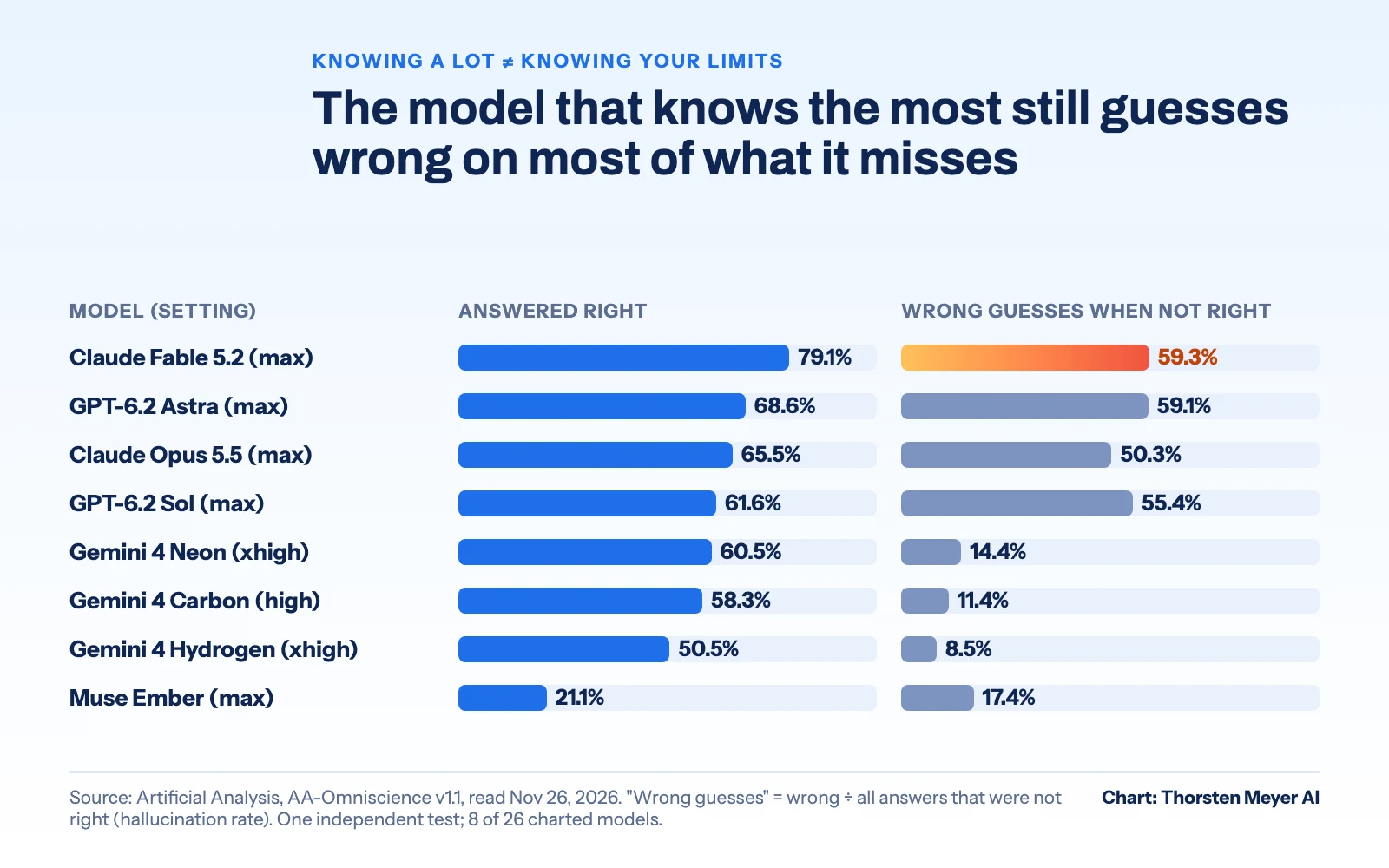
In the results we read on November 26, 2026, the model with the highest accuracy, Claude Fable 5.2 at its highest setting, got 79.1% right. Yet on the questions it missed, it gave a wrong answer 59.3% of the time. Gemini 4 Hydrogen got 50.5% right, but answered wrong on only 8.5% of the rest. It said “I don’t know” much more often.
This is one tester, and the numbers change with each model and each version of the test. But the pattern is the point: a model can know a lot and still guess a lot. Disclosure: Anthropic makes Claude, which helped us research and draft this article.
Where do hallucinations cause real damage?
They come in a few typical shapes. The first is a made-up fact: a wrong date, a wrong number, a quote nobody said. Three more shapes have left a paper trail.
Made-up sources: fake rulings in court
In New York in 2023, a lawyer used ChatGPT to find earlier rulings for a case against the airline Avianca. The rulings had names, numbers and quotes. But the court and the other side could not find them. When the court asked for the texts, the lawyer “had simply asked ChatGPT to summarise the cases it had cited”. The judge called the legal analysis in one of them “gibberish” and sanctioned the lawyers and their firm. We read this account in a later judgment of the High Court in London, which summarises the case (Ayinde v Haringey, pp. 24–25). The US court’s own file pages refused our request, so we did not use them.
That case was only the start. The legal researcher Damien Charlotin keeps a public database of court decisions that deal with hallucinated material. On November 26, 2026, it listed 2,338 cases, last updated November 25 (AI Hallucination Cases).
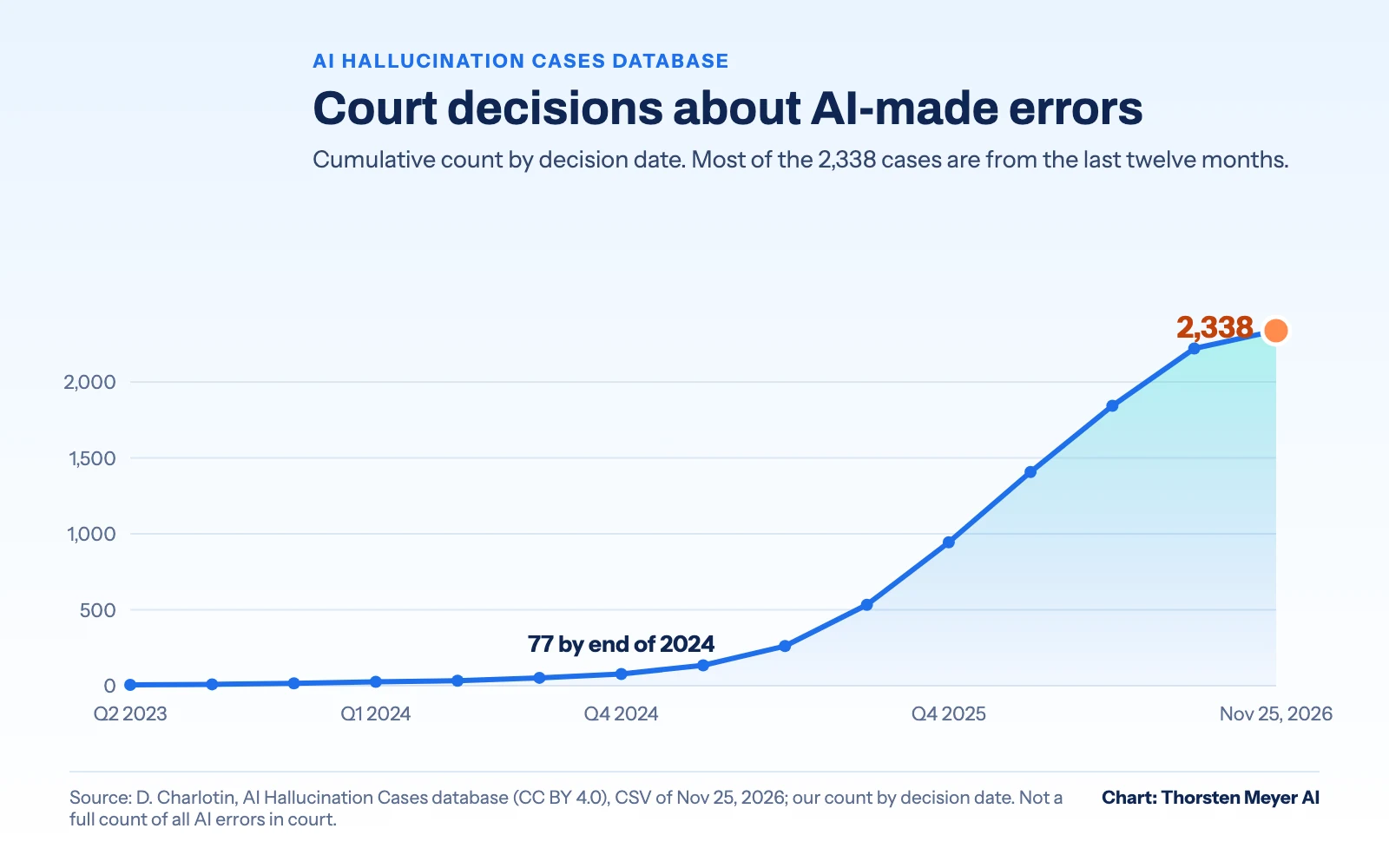
The growth is steep. We counted the database by decision date. Only 77 of its cases date from 2024 or earlier. Most of them, 1,563, are from the last twelve months. This year alone, that is about four new decisions every day. More than half of the cases involve people who went to court without a lawyer. In 922 cases, the material came from a lawyer.
The High Court in London put the risk in one line. Such tools, it wrote, “may cite sources that do not exist” (Ayinde v Haringey, p. 3). It added that lawyers “have a professional duty therefore to check the accuracy of such research”. For a closer look at one country, see our report on fake precedents in Korean courts.
Made-up code: packages that don’t exist
Programmers ask AI for code, and that code often loads ready-made building blocks called packages. Sometimes the AI names a package that does not exist.
Researchers tested 16 models on 576,000 generated code samples. Of 2.23 million package names, 440,445 were invented. That is 19.7%, or about one in five (Spracklen et al.). Commercial models did better than open models, but none was at zero.
Why does that matter? An attacker can register an invented name and fill it with harmful code. The next person who trusts the AI installs it. The study also found that the inventions repeat. When the researchers asked the same question ten times, 43% of the invented names came back every time.
Made-up rules: a chatbot that promised a refund
A customer asked Air Canada’s website chatbot about a cheaper fare after a death in the family. The chatbot said the reduced fare could be claimed after the trip, “within 90 days of the date your ticket was issued”. The airline’s own web page said the policy does not apply “after travel has been completed” (Moffatt v. Air Canada, 2024 BCCRT 149).
The airline argued it was not liable for its chatbot. The tribunal called that “a remarkable submission”. It wrote: “It should be obvious to Air Canada that it is responsible for all the information on its website.” The airline had to pay CA$812.02. The ruling does not say what technology the chatbot used. The lesson holds anyway: a company answers for what its chatbot says.
Why is it so hard to fix?
There are two reasons, and you have met both.
The first is rare facts. If a fact shows up only once in the training text, the model has almost nothing to learn from. OpenAI’s researchers give a rule of thumb: “if 20% of birthday facts appear exactly once in the pretraining data, then one expects base models to hallucinate on at least 20% of birthday facts” (Kalai et al.).
The second is the exam. As long as the scoreboards reward guessing, models keep learning to guess.
What actually reduces hallucinations?
Three things help. Each one has a limit.
Let the model look things up. This is called grounding, or retrieval: the AI searches documents first and answers from them. In our exam picture, it turns a closed-book exam into an open-book exam. That is a real improvement. But open books do not guarantee right answers. Legal research vendors had promised “hallucination-free” citations. Stanford researchers tested such tools and found that they “each hallucinate between 17% and 33% of the time” (Magesh et al.). That is still fewer errors than a general chatbot, the authors note.
Reward honesty. OpenAI’s proposal is simple: “Penalize confident errors more than you penalize uncertainty, and give partial credit for appropriate expressions of uncertainty.” Some school exams already do this. They take points off for wrong answers, so blind guessing stops paying. The catch: the big leaderboards have to change, and most have not yet.
Check the answer. Researchers at the University of Oxford published one clever check in the journal Nature. Ask the same question several times and group the answers by meaning. If the meanings keep changing, the model is probably making it up (Farquhar et al., Nature). That is what happened with the birthday: every try, a different date. The limit: this catches arbitrary guesses, not errors that repeat. Remember the invented package names that came back every time.
No single fix makes AI safe to trust blindly. You need a habit, not a hope.
How can you catch hallucinations yourself?
Five habits, straight from the research above:
- Give the AI the material. Paste the document and ask it to answer only from that. That is your open-book exam.
- Ask how sure it is, and what it would need to check. An answer that admits gaps is worth more than a smooth one.
- Ask twice. If the second answer tells a different story, treat both as unchecked.
- Open every source. A citation is only a claim until you have seen the page.
- Be strictest with details: names, numbers, quotes, dates and package names.
My own view: a hallucination is not a lie, and not a ghost in the machine. It is a guess that sounds like knowledge.
What do we know, and what don’t we know?
What is documented: the definitions come from OpenAI’s research and from NIST. The court cases come from the judgments themselves and from Charlotin’s database. The code study and the legal tools study are published research. The model comparison is one independent test, read on November 26, 2026.
What we don’t know yet:
- Whether the big scoreboards will change. One independent test already punishes bad guesses. Most widely used benchmarks still don’t. What would tell us: new model cards that report wrong answers and “I don’t know” side by side.
- How often this happens in everyday use. The court database counts only cases a court addressed. By its own description, it does not track the much wider world of all fake citations.
- How close to zero it can go. OpenAI’s researchers write that accuracy “will never reach 100%”, because some questions cannot be answered. But they also find that hallucinations are not inevitable, “because language models can abstain when uncertain.”
So why does AI make things up?
Remember the exam. When a blank scores zero, a student who doesn’t know will guess. AI models learned the same lesson.
The picture has a limit. A student usually feels unsure while guessing. A model’s guess reads just as smoothly as its knowledge, so you cannot see the difference.
In one sentence: an AI hallucination is a confident guess, and the fix is to make guessing the wrong move.
Three things to remember:
- The model predicts words. It doesn’t check the truth unless you give it sources.
- It guesses because guessing has been rewarded.
- You catch many errors by opening the source, asking twice, and checking names, numbers and quotes.
Further reading on ThorstenMeyerAI.com
- How Large Language Models Work: From Your Prompt to the Answer, and When to Trust It
- How LLMs Learn From Sliding Windows: Context Windows, Attention and the Cost of Long Prompts
- How AI Actually Works: Data In, Probabilities Out, and Why That Explains the Errors
- Fake Precedents in Korean Courts: What a Survey of 360 Judges Found
- Meta’s Muse Ember: It Often Says “I Don’t Know”
Sources
- OpenAI, “Why language models hallucinate,” Sep 5, 2025
- A. T. Kalai, O. Nachum, S. S. Vempala, E. Zhang, “Why Language Models Hallucinate,” arXiv:2509.04664, Sep 4, 2025
- NIST AI 600-1, Generative Artificial Intelligence Profile, July 2024
- [R (Ayinde) v London Borough of Haringey; Al-Haroun v Qatar National Bank [2025] EWHC 1383 (Admin), Jun 6, 2025](https://www.judiciary.uk/wp-content/uploads/2025/06/Ayinde-v-London-Borough-of-Haringey-and-Al-Haroun-v-Qatar-National-Bank.pdf)
- D. Charlotin, AI Hallucination Cases database (CC BY 4.0), read Nov 26, 2026
- Moffatt v. Air Canada, 2024 BCCRT 149, Civil Resolution Tribunal, Feb 14, 2024
- J. Spracklen et al., “We Have a Package for You! A Comprehensive Analysis of Package Hallucinations by Code Generating LLMs,” USENIX Security 2025, arXiv:2406.10279
- V. Magesh et al., “Hallucination-Free? Assessing the Reliability of Leading AI Legal Research Tools,” arXiv:2405.20362, 2024
- S. Farquhar, J. Kossen, L. Kuhn, Y. Gal, “Detecting hallucinations in large language models using semantic entropy,” Nature, Jun 19, 2024
- Artificial Analysis, AA-Omniscience v1.1, read Nov 26, 2026
Disclosure: Researched and drafted with AI assistance, including Anthropic’s Claude. Anthropic’s and OpenAI’s models appear in this article; we report their figures neutrally. The narration in the video is an AI voice clone of Thorsten Meyer. Our own text and graphics contain no affiliate links; offer and product boxes added by the site may contain Amazon affiliate links. Our graphics are our own and schematic where marked; they show no real people and no logos. Boxes added by the site may show product photos or people. Not investment, legal or tax advice.