
TL;DR
Listen free for 30 days with Audible
Thousands of audiobooks and originals — cancel anytime.
Start your free trialAs an affiliate, we earn on qualifying purchases.
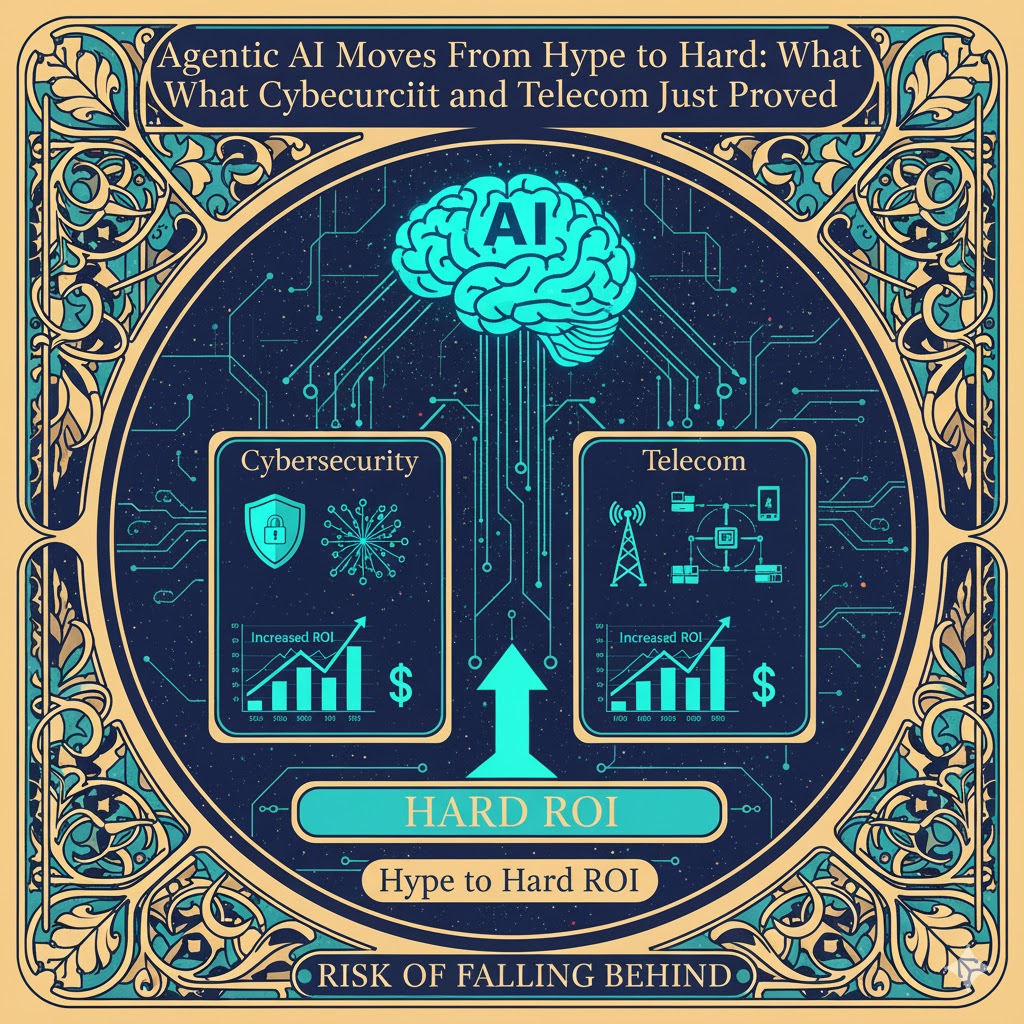
- Cybersecurity: eSentire integrated Anthropic’s Claude into its Atlas XDR and cut end-to-end SOC investigations from ~5 hours to ~7 minutes with ~95% Tier-3-level decision alignment. Venturebeat+1
- Telecom: Google Cloud’s Autonomous Network Operations framework is yielding ~25% lower MTTR at early adopters (e.g., Vodafone, Deutsche Telekom), with DT’s RAN Guardian agent monitoring and acting on RAN anomalies in real time. Google Cloud+1
- Pattern: Agentic systems that orchestrate tools over unified telemetry deliver measurable time-to-value—provided you handle data governance, intervention controls, and post-incident auditability.
The new playbook: agentic systems over unified telemetry
The breakthrough in both sectors isn’t just “adding GenAI.” It’s agentic systems that reason over normalized, end-to-end telemetry (XDR in security; network state, inventory, performance, and coverage in telecom) and then act—either by drafting an analyst-grade investigation (SOC) or by prioritizing and triggering remediation (NOC/RAN). This is why the gains look discontinuous rather than incremental. eSentire+1
endpoint detection and response (EDR) software
As an affiliate, we earn on qualifying purchases.
As an affiliate, we earn on qualifying purchases.
Case study 1 — Cybersecurity: Atlas XDR + Claude
What happened: eSentire deployed Anthropic’s Claude across Atlas XDR. The result: investigations compressed from ~5 hours to ~7 minutes (~43× faster) while matching senior (Tier-3) analyst decisions ~95% of the time. Practically, this shifts containment windows from “hours” to “minutes,” reducing dwell time and analyst fatigue. Venturebeat
How it works (abridged):
- Data foundation: Atlas XDR aggregates endpoint, network, identity, log, and cloud telemetry to cut noise before reasoning begins. eSentire
- Reasoning + tooling: The agent composes multi-step investigations (enrichment, correlation, hypothesis testing) and packages them into analyst-ready outputs. Humans still approve containment or escalations. Venturebeat
Why it matters: For MSSPs and in-house SOCs, this is a concrete cost-to-serve and MTTA/MTTR reset without ripping out existing tools—because the agent sits atop them and coordinates. Venturebeat
AI-powered network monitoring tools
As an affiliate, we earn on qualifying purchases.
As an affiliate, we earn on qualifying purchases.
Case study 2 — Telecom: Google Cloud’s Autonomous Network Operations
What happened: On June 12, 2025, Google Cloud unveiled an AI-first framework for Autonomous Network Operations. Early deployments at operators like Vodafone and Deutsche Telekom show ~25% average reduction in mean time to repair (MTTR). Google Cloud+1
DT’s RAN Guardian: A multi-agent system built on Google Cloud capabilities continuously analyzes RAN behavior, predicts/detects anomalies, and prioritizes fixes using cross-domain data (monitoring, inventory, performance, coverage)—a concrete step toward intent-driven, zero-touch operations. Google Cloud
What’s under the hood: Real-time graph/state models (e.g., Cloud Spanner as a network “digital twin”), BigQuery analytics, and GAI/agentic layers for decisioning and closed-loop control. The strategic goal: predictable, self-healing networks with standardized playbooks and partners aligned via TM Forum workstreams. Google Cloud+1
Critical nuance: Analysts note open questions around data sovereignty and control planes when hyperscalers mediate autonomy. Telcos will balance vendor frameworks with in-house autonomy roadmaps. TelecomTV
telecom network automation solutions
As an affiliate, we earn on qualifying purchases.
As an affiliate, we earn on qualifying purchases.
The common pattern (and why it scales)
- Normalize and correlate first. Both wins rely on a clean telemetry substrate (XDR for security; unified network state for telco). Without it, the agent can’t reason reliably. eSentire+1
- Constrain the loop. High-impact but bounded actions—containment recommendations (SOC) or RAN anomaly handling (NOC)—are ideal starter lanes for autonomy. Venturebeat+1
- Human-on-the-loop. Expert review remains essential for safety, drift control, and learning. This is augmentation with selective automation, not full replacement—yet. Venturebeat
cybersecurity investigation automation tools
As an affiliate, we earn on qualifying purchases.
As an affiliate, we earn on qualifying purchases.
Implementation checklist (CIO/CTO quick start)
- Map a “golden path” use case with measurable latency or MTTR pain (e.g., phishing-led lateral movement; RAN congestion & handover issues).
- Unify the data plane (schemas, lineage, PII handling, residency). Agents are only as good as the substrate. Google Cloud
- Design guardrails: approval thresholds, rollback plans, immutable audit trails of agent actions.
- Measure relentlessly: choose 3–5 metrics (investigation cycle time, MTTA/MTTR, false-positive rate, analyst workload hours, customer impact minutes).
- Prepare the org: redefine runbooks as agent-executable workflows; train analysts/engineers to supervise and tune agents.
Risks & mitigations
- Model or tool drift: lock versions; scheduled evaluations; shadow-mode before changes go live.
- Vendor concentration & sovereignty: prefer modular architectures; keep a portable data model; clarify residency and shared-responsibility in MSAs. TelecomTV
- Outage compounding: autonomy must enhance, not weaken, resilience; design for graceful degradation and local failover paths. Medium
Bottom line
Across two very different operating theaters—SOC and NOC/RAN—agentic AI has crossed from promise to provable ROI. If you can give an agent the right data, tools, and guardrails, you can take multi-hour workflows down to minutes and turn reactive ops into predictive, closed-loop systems. The next competitive edge won’t be who has the model; it’ll be who has the clean substrate, the right action space, and the courage to automate.
Sources: VentureBeat report on eSentire/Claude; Google Cloud Autonomous Network Operations announcement and documentation; Telecom trade coverage on MTTR impacts; DT’s RAN Guardian details; Atlas XDR overview; TM Forum collaboration updates; analyst caution on data sovereignty; context on resilience and outages. Medium+6Venturebeat+6Google Cloud+6
Flea & tick season Picks
flea and tick prevention
As an affiliate, we earn on qualifying purchases.