
By Thorsten Meyer — May 2026
Play games included with Prime
Start a Prime free trial and play with Amazon Luna on your devices.
Start playingAs an affiliate, we earn on qualifying purchases.
April 2026 was the most consequential month for Chinese frontier AI since the DeepSeek R1 launch in January 2025 that triggered the trillion-dollar selloff. Five Chinese labs shipped frontier-tier models within a four-week window. Kimi K2.6 launched April 20. Qwen 3.6 series went GA from Alibaba. DeepSeek V4 Pro and V4 Flash launched April 24-27. Z.ai released GLM-5.1 on April 8 — 754 billion parameters, mixture-of-experts, MIT license, trained entirely on Huawei Ascend domestic silicon. MiniMax M2.7 and Xiaomi’s MiMo V2.5 Pro filled out the cohort. The aggregate effect is structural: the Chinese frontier is no longer “DeepSeek plus Qwen plus a long tail” — it is a five-lab ecosystem with differentiated strategies, each hitting frontier-tier capability at substantially below US frontier-lab pricing.
This dispatch is the Q2 2026 update on the capability gap. Where US frontier still leads. Where the gap is at parity. Where Chinese labs are now defining the pace. The honest picture is more nuanced than either the “China has caught up” narrative or the “Western frontier still ahead” narrative captures alone. Both are partially right, on different dimensions, and the dimensions where China leads are the ones that matter most for downstream production deployment.
The dispatch on the agentic loop failure modes covered the production reality of running 20-100 step agent runs. The dispatch on the skills marketplace six months later covered the standardization that lets developers route between models. This piece sits between them: the frontier-model landscape is now multi-vendor by structural necessity, and the choice of which model to route which workload to is the central production decision of 2026.
Five labs. One narrowing frontier.
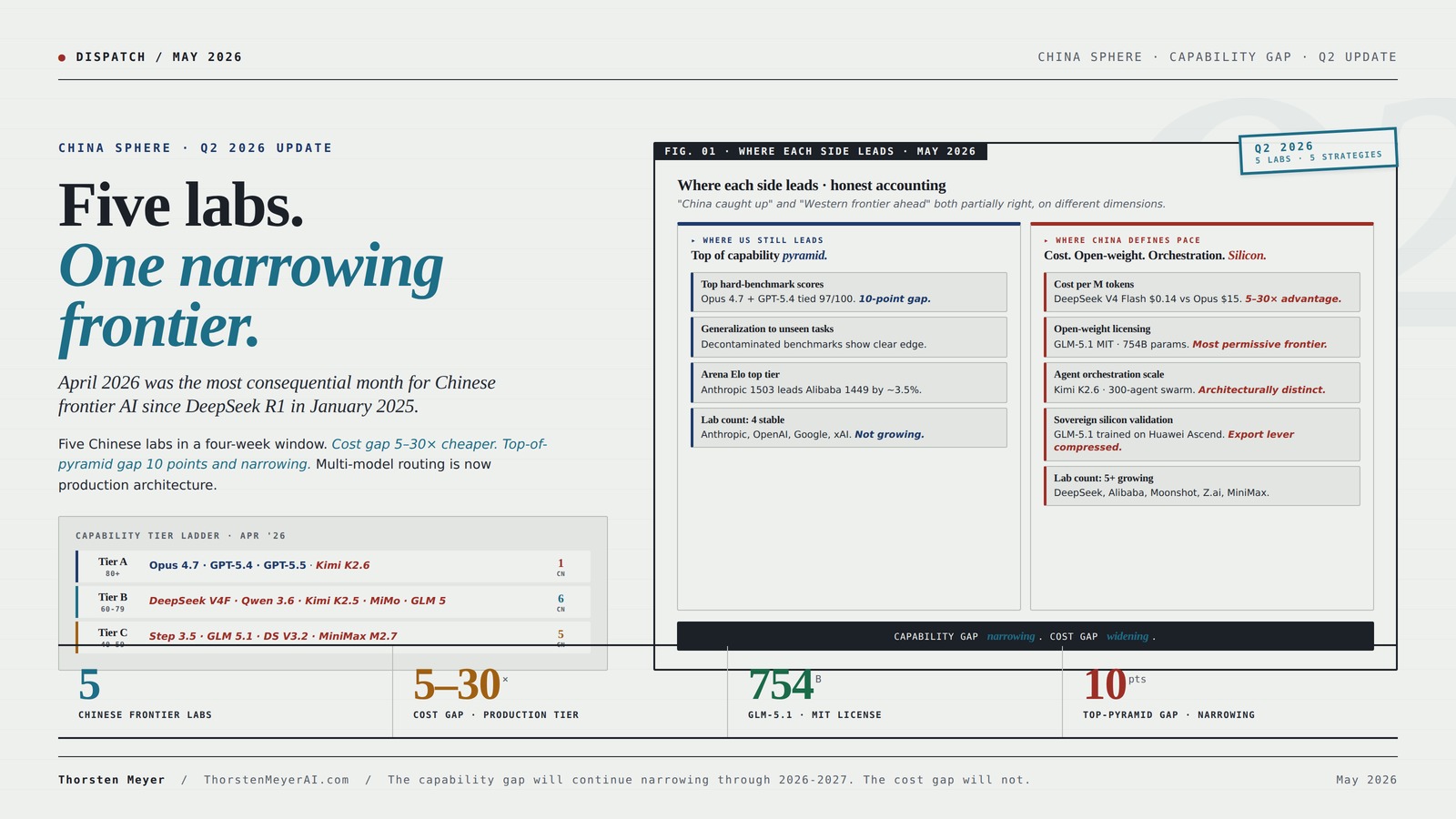
April 2026 was the most consequential month for Chinese frontier AI since DeepSeek R1 in January 2025.
Five Chinese labs shipped frontier-tier models in a four-week window. Kimi K2.6, Qwen 3.6, DeepSeek V4 Pro/Flash, GLM-5.1 (MIT, 754B params on Huawei Ascend), MiniMax M2.7. Cost gap 5–30× cheaper. Top-of-pyramid gap 10 points and narrowing. Multi-model routing is now production architecture.
Top of pyramid still Western. Mid-frontier is now Chinese.
AkitaOnRails benchmark · Rails + RubyLLM + Hotwire + Docker app from fixed prompt · 23 models scored against actual gem source. Tier A: only Kimi K2.6 (87) from China alongside Western trio (Opus 4.7, GPT-5.4 xHigh, GPT-5.5 at 96-97). Tier B is Chinese-dominated.
As an affiliate, we earn on qualifying purchases.
Different dimensions. Different leaders.
“China has caught up” and “Western frontier still ahead” are both partially right, on different dimensions. The dimensions where China leads are the ones that matter most for production deployment economics.
- Top hard-benchmark scoresOpus 4.7 + GPT-5.4 xHigh tied 97/100. 10-point gap to Chinese top.
- Generalization to unseen tasksDecontaminated benchmarks show clear edge. Where Chinese labs lag most.
- Arena Elo top tierAnthropic 1503 leads Alibaba 1449 by ~3.5%. Narrowing but real.
- Lab count: 4 frontier (Anthropic, OpenAI, Google, xAI)Stable; not growing.
- Cost per M tokensDeepSeek V4 Flash $0.14 vs Opus $15. 5–30× advantage at scale.
- Open-weight licensingGLM-5.1 under MIT. 754B params, no restrictions. Most permissive frontier model.
- Agent orchestration scaleKimi K2.6 · 300-agent swarm. Architecturally distinct, not incremental.
- Sovereign silicon validationGLM-5.1 trained entirely on Huawei Ascend. Export-restriction lever compressed.
- Lab count: 5+ frontierPlus Xiaomi, StepFun in second tier. Growing.
As an affiliate, we earn on qualifying purchases.
Five labs, five strategies, one narrowing frontier.
Different positioning, different competitive moats, different routing destinations. The Chinese frontier is no longer DeepSeek-plus-Qwen-plus-tail. It’s a five-lab ecosystem with differentiated strategies.
frontier
lineup
orchestration
+ sovereign
mid-tier
The capability gap will continue narrowing through 2026-2027. The cost gap will not.
As an affiliate, we earn on qualifying purchases.
Four assignments. By role.
Implement multi-model routing as default architecture.
Route top-of-pyramid hard workloads to Anthropic Opus 4.7 / GPT-5.5 / Gemini 3.1 Pro. Production-tier to DeepSeek V4 Flash for cost or Qwen 3.6 for breadth. Self-hosting requirements to GLM-5.1 (MIT). Single-vendor commitment that was rational 18 months ago is now structurally suboptimal.
Articulate the open-weight strategy.
Status quo (closed frontier, API-only) is ceding enterprise self-hosting market share to Chinese labs at structural rate. Either release open-weight variants below flagship tier or explicitly accept the strategic position. Either is coherent. Current ambiguity is not.
Update production-cost models.
5–30× cost gap on Chinese vs. Western pricing is structural and will compress Western lab gross margins on production-tier workloads through 2027. Anthropic’s S-1 disclosure and OpenAI’s eventual S-1 will need to address this as forward-looking risk. 2024 margin levels are not durable.
Decontaminated benchmarks remain cleanest signal.
“China has caught up” narrative is supported by some benchmarks and contradicted by others. Genuine generalization gap remains where Chinese labs lag most. Future benchmarks should explicitly target generalization to genuinely unseen tasks, where the Western frontier advantage is most durable.
As an affiliate, we earn on qualifying purchases.
Executive Summary · The Gap in One Table
| Dimension | US frontier (May 2026) | Chinese frontier (May 2026) | Gap |
|---|---|---|---|
| Arena Elo top tier | Anthropic 1503, OpenAI 1481, Google 1494 | Alibaba 1449, DeepSeek 1424 | ~3.5% top-tier gap |
| Top hard-benchmark score | Opus 4.7 + GPT-5.4 xHigh tied 97/100 | Kimi K2.6 at 87/100 | ~10 points gap |
| Closed-vs-open gap (per Stanford Index) | 3.3% (up from 0.5% Aug 2024) | — | Narrowing |
| Cost per M tokens (flagship) | Anthropic Opus ~$15, OpenAI GPT-5 ~$10-12 | DeepSeek V4 Flash $0.14, Qwen 3.6 $0.38 | 5-30× cheaper |
| Context window | 200K-1M depending on model | DeepSeek V4 at 1M tokens | At parity |
| Open-weight licensing | OpenAI/Anthropic closed; Llama Apache | GLM-5.1 MIT license, 754B params | China leads |
| Agent orchestration | Claude Code, Codex CLI | Kimi K2.6 300-agent swarm orchestration | China leads on scale |
| Sovereign silicon | Nvidia H100/B100, Google TPU | GLM-5.1 trained entirely on Huawei Ascend | China leads on independence |
| Generalization to unseen tasks | Strong — frontier closed advantage | Weaker — decontaminated benchmark gap visible | US leads |
| Lab count at frontier tier | 4 (Anthropic, OpenAI, Google, xAI) | 5+ (DeepSeek, Alibaba, Moonshot, Z.ai, MiniMax) | China has more labs |
The pattern is clean. US labs lead at the top of the capability pyramid — the hardest tasks, the most novel generalization, the closed-frontier benchmarks. Chinese labs lead on cost, open-weight licensing, agent orchestration scale, sovereign silicon validation, and breadth of frontier-tier participants. The gap on top-tier capability is narrowing (3.3% closed-vs-open per Stanford Index) but real. The gap on cost economics is structural and opening, not closing.
1. The April 2026 launch wave · what shipped
The compressed launch timeline is the structural fact. Five frontier-tier Chinese models within four weeks indicates coordinated capability across the ecosystem, not isolated breakthroughs.
Z.ai · GLM-5.1 · April 8. 754 billion parameters, mixture-of-experts architecture, MIT license. Trained entirely on Huawei Ascend domestic silicon — the most-cited engineering achievement of the wave because it validates that frontier-tier training can occur without Nvidia hardware. Z.ai (formerly Zhipu, the Tsinghua spin-out) claims GLM-5.1 outperforms GPT-5.4 and Claude Opus 4.6 on SWE-Bench Pro; independent reproduction is partial. Available on Vercel AI Gateway and OpenRouter with OpenAI-compatible endpoints. The MIT licensing makes GLM-5.1 the most permissive frontier-tier model any lab has shipped — fine-tune, self-host, redistribute, no questions asked.
Moonshot · Kimi K2.6 · April 20. 300-agent swarm orchestration is the headline capability, with autonomous coding rivaling GPT-5.4. On SWE-Bench Pro the model hits 58.6 percent. On the AkitaOnRails Rails-app coding benchmark, Kimi K2.6 is the only Chinese model in Tier A at 87/100 — the rest of the Chinese cohort sits in Tier B (60-79). Moonshot’s strategy is depth on agentic capability rather than breadth of model family.
DeepSeek · V4 Pro and V4 Flash · April 24-27. V4 Pro is the 1.6 trillion parameter flagship with hybrid attention architecture and 1 million token context. V4 Flash is the production tier — $0.14 per million input tokens, $0.28 output, cache hits at $0.014. The price floor collapse is the most consequential economic fact in the wave: DeepSeek V4 Flash is 5-30× cheaper than Anthropic Opus or OpenAI GPT-5 flagship pricing per million tokens, and at scale (50M+ calls per month) the cost difference is the entire production budget conversation. DeepSeek V4 Pro Max leads the BenchLM Chinese leaderboard at 87.
Alibaba · Qwen 3.6 series. The full lineup: Qwen 3.6 Max-Preview as the agentic-coding flagship, Qwen 3.6 Plus as the production tier, Qwen3.6-35B-A3B as the open-weight variant (35 billion total parameters with only 3 billion activated per token via mixture-of-experts). The Qwen3.6-35B-A3B variant is independently observed to draw better SVG pelicans than Claude Opus 4.7 — a proxy benchmark for structured-output discipline. Pricing on Qwen 3.6 is $0.38 per million tokens, which is between the DeepSeek price floor and the Western flagship tier.
MiniMax M2.7 and Xiaomi MiMo V2.5 Pro. Round out the cohort. MiMo V2.5 Pro at 67/100 on the Rails benchmark, MiniMax M2.7 at 41/100. Neither is at the absolute frontier but both ship into the same multi-vendor ecosystem and add diversity to the routing options. StepFun’s Step 3.5 Flash at 56/100 is in the same tier.
The cumulative picture: five labs with frontier-tier or frontier-adjacent capability, four-week launch window, full ecosystem availability via Vercel AI Gateway and OpenRouter, OpenAI-compatible endpoints, open-weight variants where applicable, and pricing at 5-30× below Western flagship tier.
2. Where the gap remains · top of the capability pyramid
The “China has caught up” narrative is more optimistic than the rigorous benchmarks sustain. The AkitaOnRails benchmark — building a Rails + RubyLLM + Hotwire + Docker app from a fixed prompt, scored against the actual ruby_llm gem source rather than memory — produces the cleanest tier-by-tier picture available in May 2026.
Tier A (80+). Three Western models tied at the top: Opus 4.7 (97/100), GPT-5.4 xHigh (97/100), GPT-5.5 (96/100). Gemini 3.1 Pro recently moved into Tier A as well. Only one Chinese model: Kimi K2.6 at 87. The 10-point gap between Kimi K2.6 and the Western top represents the actual top-of-pyramid capability gap as of April 24, 2026.
Tier B (60-79). This is where the Chinese cohort concentrates. DeepSeek V4 Flash 78, Qwen 3.6 Plus 71, Kimi K2.5 69, MiMo V2.5 Pro 67, GLM-5 64, DeepSeek V4 Pro 69 (with mixed-authorship caveats). Five-plus Chinese models in the 60-79 range, indicating broad mid-frontier capability.
Tier C (40-59). Step 3.5 Flash 56, GLM 4.7 Flash local 52, GLM 5.1 46, DeepSeek V3.2 43, MiniMax M2.7 41. The drop of GLM-5.1 to Tier C is notable — Z.ai’s own marketing claims position GLM-5.1 as frontier-competitive, but the rigorous benchmark places it in the third tier on this specific Rails-app workload. The marketing-vs-benchmark gap is consistent with broader scrutiny of Chinese model claims.
Tier D (<40). Older Qwen variants and local-only smaller models. Not relevant for production frontier deployment.
The pattern: top-of-pyramid capability concentrates in Western closed-frontier models. The Chinese labs cluster in Tier B with one Tier A representative (Kimi K2.6). The 10-point gap is real but smaller than it was 12 months ago, and the trajectory is convergence rather than divergence.
The MindStudio analysis frames the trajectory in terms that match the data: “Open models lag frontier by 6-12 months, then catch up on the specific capabilities that were hardest last year.” This is the structural pattern that produced the Stanford AI Index measurement of the closed-vs-open gap moving from 0.5 percent in August 2024 to 3.3 percent in March 2026 — a temporary widening that reflects the recent Western frontier advances (Opus 4.7, GPT-5.4 xHigh, GPT-5.5) before the next round of Chinese catch-up. The gap will likely close to 1-2 percent again by Q4 2026 as the Chinese labs ship their next-generation models.
The capability dimension where Chinese models still genuinely lag: generalization to tasks the model has not seen anything similar to in training. Decontaminated benchmarks consistently show this gap. It is the dimension that matters most for production agentic deployments where the agent encounters genuinely novel customer problems, and it is the dimension that justifies routing the hardest problems to Western frontier models.
3. Where China leads · cost, openness, orchestration, sovereignty
The dimensions where Chinese labs are now defining the pace are not minor. Each is structurally important and each is moving away from the Western frontier rather than converging.
Lead 1 · Cost economics. DeepSeek V4 Flash at $0.14 input, $0.28 output, $0.014 on cache hits. Qwen 3.6 at $0.38. Compare to Anthropic Opus at approximately $15 input and OpenAI GPT-5 flagship at $10-12 input. At small scale the cost difference is irrelevant. At production scale — 50 million or more calls per month — the cost difference becomes the entire budget conversation. A workload that costs $750,000 per month on Opus costs $7,000-21,000 per month on DeepSeek V4 Flash for comparable production tasks. The implication: production workloads that do not require top-of-pyramid capability route to Chinese models for cost efficiency, with Western frontier reserved for the genuine hard cases. This is the multi-model routing architecture that MindStudio and others now describe as standard production practice.
Lead 2 · Open-weight licensing. GLM-5.1’s MIT license is the structural fact. Other frontier labs offer open weights with restrictions: Llama under a custom permissive-but-not-MIT license, DeepSeek under specific terms that prohibit certain commercial uses, Qwen under variable terms across model variants. GLM-5.1 under MIT means no restrictions whatsoever — fine-tune, self-host, redistribute, embed in commercial products, no notification or revenue share required. For enterprise customers that prohibit API egress for sensitive data, GLM-5.1 is the new default starting point for frontier-adjacent capability. This is a moat against Western labs that will not relinquish proprietary control over their best models.
Lead 3 · Agent orchestration scale. Kimi K2.6’s 300-agent swarm orchestration is the headline capability. Western frontier models (Claude Code, Codex CLI) are designed for individual or small-multi-agent workflows. Kimi K2.6 is designed from the architecture level to coordinate hundreds of agents simultaneously on complex tasks. This is the agent-orchestration analog of the cost-economics gap: the architecture is structurally different, not incrementally better. For workloads that require massive-parallel agent deployment, Kimi K2.6 is the only frontier-tier option.
Lead 4 · Sovereign silicon validation. GLM-5.1’s training on Huawei Ascend domestic silicon is the geopolitical proof point. The widespread Western analysis of Chinese AI capability has implicitly assumed Nvidia hardware dependency — that China’s frontier capability is constrained by export restrictions on H100 and B100 GPUs. GLM-5.1 demonstrates that frontier-tier training can occur on Chinese domestic silicon at competitive performance. This does not mean export restrictions are toothless; it means the chip-supply lever is less constraining than it was assumed to be 12 months ago. The strategic implication for Western enterprises: Chinese model availability is structurally more durable than the export-restriction narrative suggested.
Lead 5 · Lab count diversity. Five Chinese labs at frontier or frontier-adjacent tier — DeepSeek, Alibaba, Moonshot, Z.ai, MiniMax — plus Xiaomi and StepFun in the second tier. The Western frontier has four labs (Anthropic, OpenAI, Google, xAI). The Chinese ecosystem is more diverse, which produces more capability variety and more strategic experimentation. Different labs pursue different strategies (DeepSeek on cost, Moonshot on agent orchestration, Z.ai on open-weight, Alibaba on breadth, MiniMax on reasoning) rather than converging on a single approach.
The cumulative implication: the dimensions where Chinese labs lead are the ones that matter most for production deployment scaling. Cost efficiency at scale, open-weight customization for sensitive data, large-scale agent orchestration, and silicon-supply independence all directly affect what enterprises can actually deploy. The 10-point gap on the Rails benchmark matters at the top of the capability pyramid; the 5-30× cost gap matters across the entire production landscape.
4. The lab-by-lab capability picture
Each of the five Chinese frontier-tier labs has a distinct strategy and competitive position.
DeepSeek. Position: cost-efficient frontier. Strategy: ship 1.6T parameter MoE flagship plus production-tier Flash variant at the lowest cost-per-token in the industry. The hybrid attention architecture and 1M token context window are technical differentiators. The January 2025 R1 launch that triggered the trillion-dollar US tech selloff established DeepSeek’s brand globally. V4 (April 2026) consolidates the position. The lab is small relative to Alibaba or Z.ai — quant-fund-affiliated rather than enterprise-backed — which constrains scale but enables faster iteration.
Alibaba (Qwen). Position: broadest lineup. Strategy: ship multiple model variants targeting different deployment contexts. The Qwen 3.6 family includes flagship (Max-Preview), production (Plus), open-weight (35B-A3B), and specialized variants. Alibaba’s hyperscaler infrastructure (Aliyun cloud) provides distribution. The Qwen3.6-35B-A3B mixture-of-experts variant with 3 billion active parameters per token is a notable architectural choice — the smallest active-param footprint in the frontier-tier cohort, which translates to inference cost advantages.
Moonshot (Kimi). Position: agent orchestration depth. Strategy: focus on the agentic-deployment use case rather than competing on broad capability. K2.6’s 300-agent swarm orchestration is the technical signature. The lab is the most-funded Chinese AI lab outside the BAT (Baidu/Alibaba/Tencent) cohort, with backing from Alibaba and Hillhouse. Strategic position: the dedicated agentic infrastructure provider for the Chinese market and increasingly the global market.
Z.ai (formerly Zhipu). Position: open-weight and sovereign silicon. Strategy: ship the most permissive license among frontier-tier models (MIT) and validate domestic silicon training (Huawei Ascend). The Tsinghua spin-out has the strongest academic credentials in the cohort. The combination of MIT licensing and sovereign silicon training positions Z.ai as the natural partner for Chinese state-linked enterprise deployments and for global enterprises that want frontier-tier capability without dependency on either Western APIs or Nvidia hardware.
MiniMax. Position: reasoning-focused mid-tier frontier. Strategy: target the reasoning-heavy workloads where deeper inference time produces better results. M2.7 is mid-tier on the Rails benchmark but stronger on reasoning-specific evaluations. The lab is consumer-facing more than enterprise-facing — different positioning than the other four.
The lab landscape produces a clean strategic map: DeepSeek for cost-efficient production, Alibaba for breadth, Moonshot for agent orchestration, Z.ai for open-weight enterprise, MiniMax for reasoning-heavy workloads. Multi-model routing through Vercel AI Gateway or OpenRouter lets a single application access all five with appropriate workload targeting.
5. The cost economics in detail
The 5-30× cost gap is the most-cited Chinese-vs-Western fact and the most consequential for production strategy. The detail matters.
Tier 1 · Western flagship pricing. Anthropic Opus 4.6/4.7 approximately $15 input, $75 output per million tokens. OpenAI GPT-5.4/5.5 approximately $10-12 input, $30-40 output. Google Gemini 3.1 Pro in similar range. These prices are stable across early 2026; Western labs are not racing each other to the bottom on cost.
Tier 2 · Western production-tier. Anthropic Sonnet 4.6 at lower rates, OpenAI GPT-5 mini at lower rates, Google Gemini 2.5 Flash at lower rates. Approximately $1-3 input per million tokens. This tier competes with Chinese production-tier pricing more closely.
Tier 3 · Chinese flagship pricing. Qwen 3.6 at $0.38 per million tokens. GLM-5.1 in similar range. DeepSeek V4 Pro at slightly higher rates than V4 Flash but still substantially below Western flagship.
Tier 4 · Chinese production-tier (the floor). DeepSeek V4 Flash at $0.14 input, $0.28 output, with cache hits at $0.014 — effectively free for repeated retrievals. This is the production cost floor in May 2026.
The implication for production strategy: workloads that require top-of-pyramid capability (genuinely novel agentic problems, hard coding tasks, complex reasoning on edge cases) route to Western frontier and absorb the 5-30× premium. Workloads that require frontier-adjacent capability (the majority of production deployments) route to Chinese flagship or production-tier models for cost efficiency. The multi-model routing architecture that MindStudio and Vercel describe as production-standard is structurally driven by this cost gap, not by capability preferences.
The downstream implication for Western frontier-lab economics: the production-revenue floor is being established by Chinese pricing, not by US pricing. As the Chinese frontier capability narrows the gap (likely 1-2 percent again by Q4 2026), the cost-pricing advantage will compress Western lab margin on workloads that don’t require top-of-pyramid capability. This is the structural pressure on Anthropic and OpenAI gross margin that the Anthropic IPO disclosure dispatch flagged as the central S-1 risk-factor disclosure.
6. The open-weight licensing comparison
GLM-5.1 under MIT is the structural leader. The full licensing landscape across major frontier-tier and frontier-adjacent open-weight models:
| Model | Parameters | License | Restrictions |
|---|---|---|---|
| GLM-5.1 (Z.ai) | 754B MoE | MIT | None |
| Qwen3.6-35B-A3B (Alibaba) | 35B (3B active) | Variable (per variant) | Some commercial use restrictions |
| DeepSeek V4 Pro / Flash | Closed flagship; open variants below | DeepSeek License | Specific commercial-use terms |
| Llama 4 (Meta) | Up to 405B | Llama Community License | Acceptable use policy applies |
| Mistral Large (open-weight tier) | 123B | Mistral Research License (research only at top tier) | Non-commercial top tier |
| Kimi (Moonshot, open variants) | Various | Apache 2.0 / variable | Apache permissive but not MIT |
| GPT-5 / Opus 4.7 / Gemini 3.1 Pro | — | Closed (API only) | Full closure |
The strategic implication: Z.ai’s MIT licensing on GLM-5.1 is the most permissive frontier-tier offering by a meaningful margin. For enterprise customers in regulated industries (healthcare, financial services, government) that prohibit API egress for sensitive data, GLM-5.1 is the new default starting point because the MIT licensing permits self-hosting without legal review of restrictive terms. The open-weight competitive position that Meta established with Llama is now being matched and exceeded by Z.ai with GLM-5.1.
The Western response is partial. Anthropic has maintained closed-frontier positioning. OpenAI has not released frontier weights since GPT-2 in 2019. Google releases some Gemma models but keeps Gemini 3.1 Pro closed. The closed-frontier position from the major US labs cedes the open-weight enterprise market to Chinese labs by default. This is a strategic choice with downstream consequences for Chinese-vs-Western enterprise share over 2026-2028.
7. The geopolitical structural shift
The April 2026 launch wave is the second consequential moment in the China-vs-US AI capability narrative, after January 2025’s DeepSeek R1.
Shift 1 · The “China is constrained by export restrictions” framing is partially false. GLM-5.1 trained entirely on Huawei Ascend silicon validates that frontier-tier training can occur without Nvidia hardware. Export restrictions still constrain — Chinese labs cannot scale to the largest model sizes as quickly as Western labs with H100/B100 access — but the constraint is ceiling rather than floor. The Stanford AI Index audit’s noting that Apollo Go completed 11 million driverless rides (+175% YoY) is a parallel data point: Chinese AI deployment is structurally more capable than Western coverage typically conveys.
Shift 2 · The lab-count gap reversed. Through 2024, the US had more frontier-tier labs than China (Anthropic, OpenAI, Google, plus xAI emerging). By Q2 2026, China has more frontier-tier labs than the US (DeepSeek, Alibaba, Moonshot, Z.ai, MiniMax). The Western count is stable at four; the Chinese count is growing.
Shift 3 · The cost gap is structural, not transitional. Through 2024-2025, Western analysts assumed Chinese cost advantages were temporary — driven by training-cost disclosures that omitted GPU costs, by promotional pricing, by below-cost market-share strategies. Through Q2 2026, the cost gap is sustained and the underlying structural drivers (mixture-of-experts architectures with low active parameters, hybrid attention, aggressive cache pricing) are technical rather than promotional. The cost gap will persist through 2027 at minimum.
Shift 4 · The open-weight gap is widening, not closing. Western frontier labs have not moved toward open-weight releases at the top tier. Chinese frontier labs are increasingly competing on licensing permissiveness. The gap on this dimension is opening through 2026, with no visible Western counter-strategy.
Shift 5 · Multi-model routing becomes production standard. Enterprises that 12 months ago would have committed to single-vendor deployments (Anthropic OR OpenAI) are now deploying multi-model routing as the default architecture, with Chinese models routed for cost-efficient production workloads and Western frontier reserved for genuine hard cases. The routing architecture is the operational manifestation of the multi-vendor frontier landscape.
8. Strategic implications for Western frontier labs
The Q2 2026 capability picture has direct consequences for Anthropic, OpenAI, Google, and xAI strategy.
Implication 1 · Margin compression on production-tier workloads. Chinese pricing establishes the floor for production workloads that don’t require top-of-pyramid capability. Anthropic Sonnet, OpenAI GPT-5 mini, Gemini 2.5 Flash all face direct pricing pressure from Qwen 3.6 and DeepSeek V4 Flash. The implication for the Anthropic IPO disclosure is that margin guidance for the 12-24 month forward will need to acknowledge this pressure explicitly.
Implication 2 · Top-of-pyramid concentration is a temporary moat. The 10-point benchmark gap between Kimi K2.6 (87) and Opus 4.7 (97) on the Rails workload is real but compressible. Western frontier labs need to ship next-generation capability at faster cadence to maintain the gap, or accept that Chinese labs will close it within 6-12 months as the historical pattern suggests.
Implication 3 · Open-weight strategy is unaddressed. Western frontier labs have not articulated a response to the open-weight competitive position that Z.ai’s MIT licensing on GLM-5.1 establishes. The status-quo strategy (closed frontier, sell access via API) cedes the enterprise self-hosting market to Chinese labs by default. The strategic question for Anthropic and OpenAI is whether to release open-weight variants (with reduced capability vs. flagship) to compete in the self-hosting tier, or to accept the loss of that market.
Implication 4 · Sovereign-silicon validation reduces export-restriction leverage. US export restrictions on H100/B100 to China remain meaningful — they slow the rate of Chinese frontier model scaling. But they are no longer absolute constraints. The strategic question for US policy: whether to extend restrictions further (which produces second-order consequences for Nvidia revenue and US semiconductor industry) or to accept that the chip-supply lever has compressed in effectiveness.
Implication 5 · Multi-vendor routing is the production reality. Western frontier labs need to operate as if customers will route across multiple vendors rather than commit to single-vendor deployment. The competitive question is which workloads route where, and the answer differs by workload type. Anthropic’s Applied AI Engineer (FDE) strategy — embedded with strategic customers — is well-positioned for this reality because the FDE work focuses on the workloads where the customer actually needs Anthropic’s specific capability, with other workloads routing elsewhere.
What to Do This Quarter
1. Enterprises deploying frontier AI. Implement multi-model routing as the default architecture. Route top-of-pyramid hard workloads to Anthropic Opus 4.7 / GPT-5.5 / Gemini 3.1 Pro. Route production-tier workloads to DeepSeek V4 Flash for cost or Qwen 3.6 for breadth. Route enterprise self-hosting requirements to GLM-5.1. The single-vendor commitment that was rational 18 months ago is now structurally suboptimal.
2. Western frontier labs. Articulate the open-weight strategy. The status quo (closed frontier, API-only) is ceding enterprise self-hosting market share to Chinese labs at structural rate. Either release open-weight variants below the flagship tier or explicitly accept the strategic position. Either is a coherent choice; the current ambiguity is not.
3. Investors and analysts. Update production-cost models. The 5-30× cost gap on Chinese vs. Western pricing is structural and will compress Western lab gross margins on production-tier workloads through 2027. Anthropic’s S-1 disclosure and OpenAI’s eventual S-1 will need to address this as a forward-looking risk factor; investors should not treat 2024 margin levels as durable.
4. Researchers and benchmarks. Decontaminated benchmarks remain the cleanest signal. The “China has caught up” narrative is supported by some benchmarks and contradicted by others; the genuine generalization gap remains where Chinese labs lag most. Future benchmarks should explicitly target generalization to genuinely unseen tasks, where the Western frontier advantage is most durable.
The Strategic Read
Q2 2026 is the inflection where the Chinese frontier became unambiguously multi-lab. Five frontier-tier or frontier-adjacent labs (DeepSeek, Alibaba, Moonshot, Z.ai, MiniMax) shipped within four weeks. The cumulative capability is structurally different from the “DeepSeek plus Qwen plus a long tail” framing of 12 months ago.
The capability gap on top-of-pyramid hard benchmarks is real but narrowing — 10 points on the AkitaOnRails Rails benchmark, 3.3 percent closed-vs-open per Stanford AI Index. The historical pattern suggests the gap will close to 1-2 percent again by Q4 2026 as Chinese labs ship next-generation models. Western frontier labs maintain the lead on generalization to genuinely novel tasks; the lead is durable but smaller than 12 months ago.
The dimensions where China defines the pace are cost economics (5-30× advantage), open-weight licensing (GLM-5.1 MIT), agent orchestration (Kimi K2.6 300-agent swarm), and sovereign silicon validation (Huawei Ascend training). Each is structurally important for production deployment scaling. The cost-pricing floor is being established by Chinese models; production economics for Western labs need to absorb this.
Multi-model routing is the production architecture that this landscape requires. Single-vendor commitment is no longer the rational default. Workloads requiring top-of-pyramid capability route to Western frontier; workloads requiring frontier-adjacent capability at production cost route to Chinese flagship; workloads requiring enterprise self-hosting route to GLM-5.1. The routing architecture is the operational reality that the labs, customers, and infrastructure providers (Vercel AI Gateway, OpenRouter) are converging on.
The geopolitical narrative simplifies poorly. Neither “China has caught up” nor “Western frontier still ahead” captures the picture alone. Both are partially right, on different dimensions, and the dimensions where China leads are the ones that determine downstream production deployment economics. The capability gap will continue narrowing through 2026-2027. The cost gap will not.
Q2 2026 is the inflection where the Chinese frontier became multi-lab. Five labs, five strategies, narrowing top-of-pyramid gap, structurally widening cost and open-weight leads. Multi-model routing is the production architecture. The capability narrative simplifies poorly; the structural picture is clean.
About the Author
Thorsten Meyer is a Munich-based futurist, post-labor economist, and recipient of OpenAI’s 10 Billion Token Award. He spent two decades managing €1B+ portfolios in enterprise ICT before deciding that writing about the transition was more useful than managing quarterly slides through it. More at ThorstenMeyerAI.com.
Related Dispatches
- The Skills Marketplace Six Months Later — predicted vs actual
- Forward-Deployed Engineer Economics 2.0 — the unit economics math
- The Stanford AI Index 2026 Audit — reading the report card with a critic’s pen
- Agentic Loop Failure Modes — production taxonomy at year one
- The Anthropic IPO Disclosure Document — what the S-1 has to say
- Single Digits — the April that closed the open-weight gap
Sources
- DEV Community · The Late-April 2026 Chinese LLM Stack: Qwen 3.6, DeepSeek V4PLUS, Kimi K2.6, MiniMax M2.7, GLM-5.1 Compared
- BenchLM.ai · Best Chinese LLMs in 2026: DeepSeek V4, Kimi K2.6, GLM-5, Qwen, and Every Model Ranked
- Medium / Barnacle Goose · DeepSeek V4 Review — architectural analysis
- AkitaOnRails · LLM Coding Benchmark April 2026: GPT 5.5, DeepSeek v4, Kimi v2.6, MiMo, and the State of the Art — Rails-app fixed-prompt benchmark, 23 models
- MindStudio · Kimi K2.6 and Qwen 3.6: The Open-Source Models Closing the Frontier Gap
- Renovate QR · Chinese AI Models in April 2026 — comprehensive ecosystem overview
- Stanford HAI 2026 AI Index — Arena Elo top tier ratings, closed-vs-open gap measurement
- Z.ai · GLM-5.1 announcement and MIT license confirmation
- DeepSeek · V4 Pro and V4 Flash pricing disclosure
- Moonshot · Kimi K2.6 launch specifications
NFL season / tailgating Picks
team gear
As an affiliate, we earn on qualifying purchases.